 Learn Quran

Surah Al-Ikhlas is only four short verses. Most people learn to say it in a day. But many say it wrong for years without knowing. That happens when you copy the sound before you learn the letters.
Thus, we are here to learn Surah Ikhlas the right way, in four clear steps. If you are an adult starting from zero, a new Muslim learning their first surah, or a parent teaching a child, you will find your answer here.
Step 1: Train Your Ears First by Listening to the Verses of Surah Al-Ikhlas
You train your ear by listening to a slow reciter before you try to say anything yourself. This is the old method used in Quran schools. Children there could recite beautifully before they could read a single word. They listened first, then copied.
It works because Arabic has sounds English does not have. Your mouth has never made them. If you start guessing from the spelling, your brain swaps in the closest English sound it knows, and that guess becomes a habit. Habits are much harder to fix than gaps.
Start with the right reciter. Shaykh Mahmoud Khalil Al-Husary‘s teaching mus’haf, Al-Mus’haf Al-Mu’allim, was recorded for learners. He reads slowly and gives every letter its full weight. Faster recitations are lovely, but they blend the letters together, and the details you need are the first ones to disappear at speed.
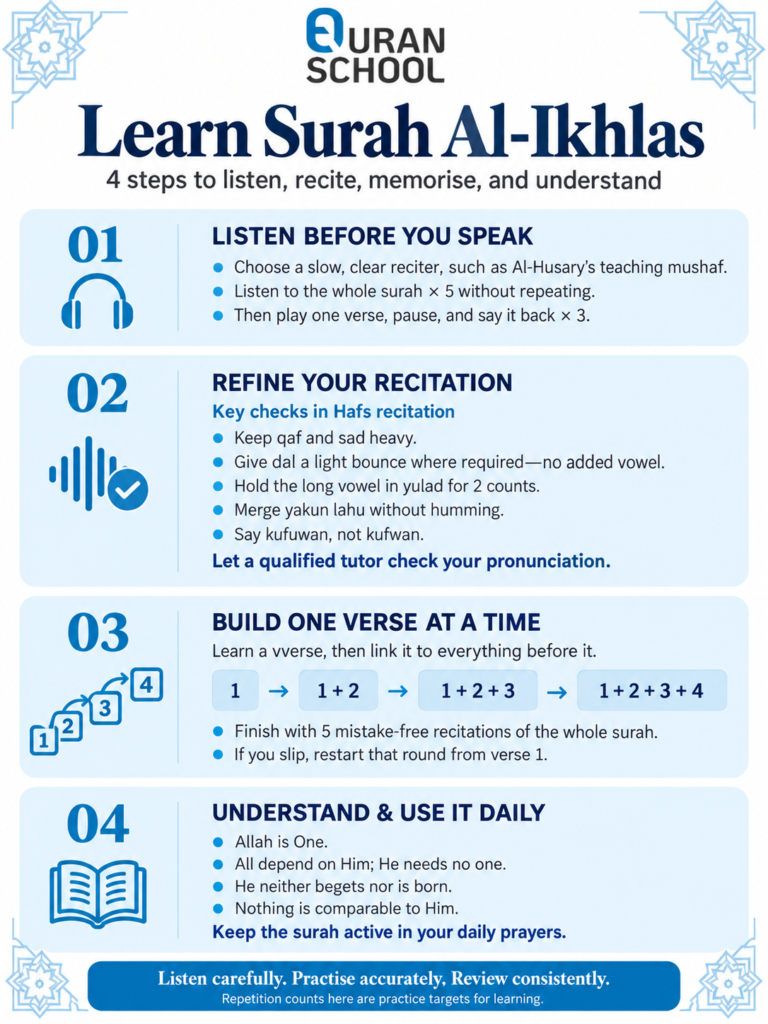
Now play the whole surah five times without repeating after it. Most people skip this part. Your only job is to let your ear settle into the sound: how long each word is held, where the reciter stops, the small bounce at the end of aḥad, the thick ṣād in aṣ-ṣamad.
You are building a picture of what correct sounds like, so you have something real to compare yourself against later.
Then go back and work verse by verse. Play verse one, pause, say it back three times. Then verse two. Keep going to the end. Short pieces with full stops are what make this work. Copy a long stretch at once and you will catch the melody but lose the letters.
Step 2: Learn the Five Sounds That Make Surah Al-Ikhlas Correct
To say Surah Al-Ikhlas correctly, you only need to get five things right: the heavy letters, the small bounce on the letter dāl, one letter you do not say at all, one long vowel, and the u sound in kufuwan.
That is the whole list. Learn these five, and your recitation is correct. Everything below follows the recitation of Hafs, which is the one most people learn.
Sound 1: The Heavy Letters
Arabic has heavy letters and light letters. A heavy letter is said with the back of your tongue lifted, so it comes out thick and full.
A light letter is said with the tongue flat, so it sounds thin. English has no heavy letters at all, which is why this part feels strange at first. Three heavy letters matter in Surah Al-Ikhlas.
The qāf (ق) in qul (قُلْ). This letter comes from the back of your throat. Most English speakers replace it with a kāf (ك), which is made much further forward in the mouth.
That small change turns qul (قُلْ) into kul (كُلْ), and kul is a completely different Arabic word. To find the right spot, try to make a k sound as deep in your throat as you can. It should feel low and heavy, almost like a small click.
The ṣād (ص) in aṣ-ṣamad (الصَّمَدُ). This is the hardest letter in the surah for English speakers. The problem is that a plain English s sounds close enough, so most people never notice they are saying the wrong letter.
To say ṣād (ص), press the front of your tongue down and lift the back of it toward the roof of your mouth. The sound becomes deep and rounded instead of thin and sharp. Samad (سَمَد) and ṣamad (صَمَد) are not the same word, so this one is worth practising on its own.
The lām (ل) in Allāh (اللَّهُ). This letter appears twice in the surah, in verse 1 and verse 2. In both places it is heavy. Say it full and thick, with the back of your tongue raised. Do not say it thin, like the l in the English word “little”.
A thin lām (ل) here is one of the quickest ways to tell that someone learned the surah by copying rather than by being taught.
One warning before you move on. The mīm (م) in aṣ-ṣamad (الصَّمَدُ) is a light letter. Only the ṣād (ص) beside it is heavy. Many learners hear the thick ṣād (ص) and push the mīm (م) as well, which makes the whole word sound wrong. Keep the ṣād (ص) heavy and let the mīm (م) stay soft and normal.
Sound 2: The Bounce On The Letter Dāl
Four words in this surah end in a dāl (د) with no vowel: aḥad (أَحَدْ), aṣ-ṣamad (الصَّمَدْ), yalid (يَلِدْ), and yūlad (يُولَدْ). When you reach one, the dāl (د) gets a small kick of sound. This is called qalqalah.
It sounds like aḥadْ — a light bounce, not a silent letter, and not an added vowel like aḥadu.
The bounce is stronger when you stop at the end of a verse. It is lighter when the word sits in the middle, as yalid (يَلِدْ) does in verse 3.
Here is why the bounce exists. The dāl (د) is made by pressing your tongue against the roof of your mouth and then releasing it.
With no vowel after it, the sound has nowhere to go, so it would die in silence. The bounce is what lets you hear the letter clearly. Think of it like tapping a drum: the tap is short, but you still hear it ring.
Two errors are common here. The first is stopping the tongue and saying nothing, which hides the letter completely.
The second is adding a small vowel, so aḥad (أَحَدْ) turns into aḥadu, which changes the word. The bounce sits between those two, and you find it by releasing the tongue quickly without letting any vowel follow.
Sound 3: The Letter You Do Not Pronounce
In verse 4, do not say the nūn (ن) in yakun lahu (يَكُن لَّهُ). Move straight from the kāf (ك) into a doubled lām (ل). It comes out as ya-kul-lahu. There is no humming sound here at all. This one letter catches almost everyone.
Here is the rule behind it. When a nūn (ن) with no vowel is followed by a lām (ل), the nūn (ن) disappears completely into the lām (ل). This is called idghām, which simply means merging. The lām (ل) then becomes doubled, so you hold it a little longer than a normal lām (ل).
Look at the written verse and you will see the sign for yourself. The lām (ل) in lahu (لَّهُ) carries a small mark called a shaddah, which looks like a tiny w above the letter. That mark is telling you the letter is doubled, because it has swallowed the nūn (ن) before it.
Two mistakes are common here. Some learners say the nūn (ن) clearly, out of habit, because they can see it written on the page. Others merge it but add a nasal hum, copying the rule they learned for other letters.
Neither is right in this word. The merging here happens without any humming at all, so the sound goes cleanly from k into a long l and straight on to hu.
Say the word slowly five times: ya-kul-la-hu. Once your tongue learns the path, you will never say it the other way again.
Sound 4: The Long Vowel In Yūlad (يُولَدْ)
In verse 3, hold the ū in yūlad (يُولَدْ) for two counts. Not one, and not four. It is the only long vowel in the surah, so there is just this one length to remember.
A “count” is simply a beat. The easiest way to measure it is to tap your finger twice at a steady, calm speed while you hold the sound. Whatever speed you choose, keep it the same every time you recite, because tajweed is about being consistent, not fast or slow.
This long sound comes from the wāw (و) in the middle of the word. When a wāw (و) with no vowel follows a letter carrying a ḍammah (the small u mark), the u sound stretches. That is what turns yulad into yūlad (يُولَدْ).
Two mistakes show up here. Some learners cut the sound short and say yulad, which drops the stretch completely. Others pull it long, four or five beats, because they are copying a slow, melodic reciter. Both sound wrong to a trained ear.
Compare it with the word right before it. In yalid (يَلِدْ) there is no stretch at all, and in yūlad (يُولَدْ) there is. Reciting the two words back to back is the fastest way to feel the difference and fix it.
See Us in Action
Watch a quick snippet from our live, interactive classes below and see how our teachers make learning engaging for all ages!
Start Your Quranic Journey Today
Experience our interactive online classes with a dedicated tutor.
Get Your Free TrialSound 5: The U Sound In Kufuwan (كُفْوًا)
In verse 4, the fā’ (ف) carries a u sound. So you say kufuwan (كُفُوًا), not kufwan (كُفْوًا). Skipping it is probably the most common mistake in the whole surah. Kufwan (كُفْوًا) is not the Hafs recitation.
Look closely at the word and you will see two ḍammah marks, one on the kāf (ك) and one on the fā’ (ف). Both letters carry a short u, so the word has three clear beats: ku, fu, wan.
Many learners drop the middle beat and squeeze the word into two, which is where kufwan comes from. Say the three beats slowly and evenly a few times, and the correct shape settles quickly.
Two things cause this error. The first is copying a fast reciter, because at speed the middle u is easy to miss.
The second is that other recitations of the Quran do read this word with a silent fā’ (ف), and those readings are correct in their own chains. If you are learning Hafs, which is what most schools and most apps teach, then kufuwan (كُفُوًا) is your version.
One more detail sits at the end of the word. The tanwīn on kufuwan (كُفُوًا) is a clear n sound, and you say it fully because a hamzah (أ) follows in aḥad (أَحَدٌ). Do not soften it, and do not hum it
Quick Check To Know If You Master The Five Sounds or Not
This table puts every rule from the five sounds back into its verse. Read one verse out loud, then check your reading against its row. It is easier to fix your recitation one verse at a time than to hold all five rules in your head at once
.
Keep the table open beside you while you practise. Most learners get two or three points right on the first try and miss the rest, which is completely normal.
| Verse | What to watch |
| قُلْ هُوَ اللَّهُ أَحَدٌ | Heavy qāf. Clear lām in qul. Heavy lām in Allāh. Bounce on aḥad. |
| اللَّهُ الصَّمَدُ | Heavy ṣād. Light mīm. Heavy lām in Allāh. Bounce on aṣ-ṣamad. |
| لَمْ يَلِدْ وَلَمْ يُولَدْ | Clear mīm in lam. Bounce on yalid. Two-count ū in yūlad. Bounce on yūlad. |
| وَلَمْ يَكُن لَّهُ كُفُوًا أَحَدٌ | No nūn in yakun lahu. Say kufuwan. Clear n before aḥad. Bounce on aḥad. |
Use this table as a checklist, not as reading material. Recite one verse out loud, then read its row and see how many points you actually applied. Most learners get two or three right and miss the rest on the first try, which is normal. Work on one verse a day rather than trying to fix all four at once.
One note on verse 3: say the mīm (م) in lam (لَمْ) and wa lam (وَلَمْ) clearly. Do not merge it, and do not hum it.
Some online guides tell you to merge it here. That is wrong. A sākin mīm (م) only merges when another mīm (م) follows it, and a sākin mīm (م) only hums when a bā’ (ب) follows it. Here the next letter is a yā’ (ي) both times, so the mīm (م) stays plain and clear.
Getting these letters right is not only about accuracy — there are real benefits to reading the Quran with tajweed that go beyond a single surah.
The 8 Mistakes To Check Yourself Against After You Understand the Five Sounds
These eight errors cover almost every problem learners have with Surah Al-Ikhlas. Read the list slowly while you recite the surah out loud to yourself.
Mark the ones you catch in your own reading, because that short list is your practice plan for the week. Fix them one at a time rather than all together, since trying to correct everything at once usually makes the recitation worse before it gets better.
Come back to this table after a few days and check yourself again.
| # | The mistake | What it should be |
| 1 | Saying kul instead of qul | Heavy qāf from the throat |
| 2 | Saying a flat s in as-samad | Heavy ṣād |
| 3 | Pushing the mīm in aṣ-ṣamad | Mīm stays light |
| 4 | Thin lām in Allāh | Heavy, full lām |
| 5 | No bounce on yalid, yūlad, aḥad | Clear bounce on the dāl |
| 6 | Saying the nūn in yakun lahu | Merge it into a doubled l |
| 7 | Saying kufwan | Say kufuwan |
| 8 | Adding a vowel at the end (aḥadu) | Stop on aḥadْ with a bounce |
Read the list out loud against your own recitation. Most learners find two or three of these in their reading straight away.
There is a limit to what you can fix on your own, and that is not a failing on your part. You can hear that something sounds a little off without being able to name the letter causing it.
There is a limit to what you can fix on your own, and that is not a failing on your part. You can hear that something sounds a little off without being able to name the letter causing it.
A trained teacher hears it in seconds, shows you where to place your tongue, and the problem is gone in one sitting.
If you would like someone to listen to you read, the teachers at EQuran School Online do this every day — read the four verses aloud to one of them, and you will know in twenty minutes exactly what to adjust.
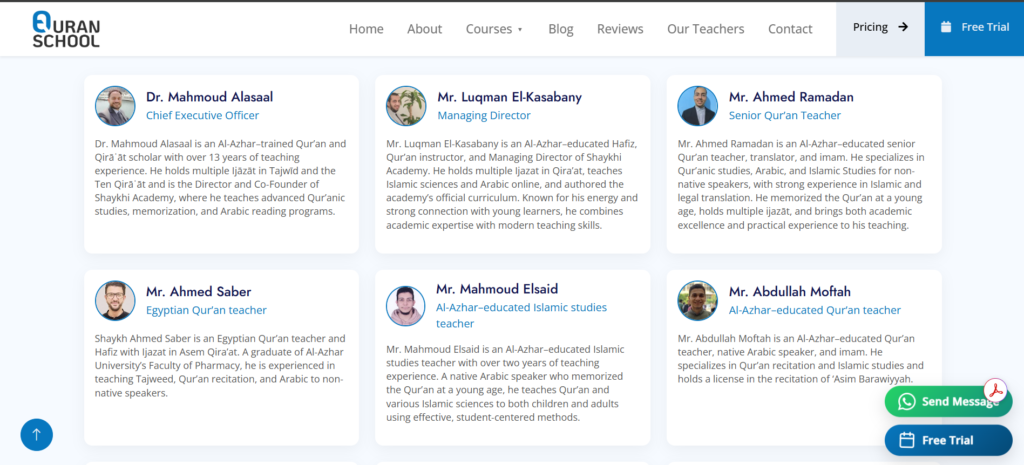
Have a look at our teachers, pick the one you like, then book your free trial.
Step 3: Memorise Surah Al-Ikhlas One Verse At A Time So It Stays With You
You memorise Surah Al-Ikhlas by adding one verse at a time. After each new verse, you say everything before it again from memory. This is called cumulative linking.
Follow this order:
- Verse 1 on its own. Repeat Qul huwa Allāhu aḥad (قُلْ هُوَ اللَّهُ أَحَدٌ) until you can say it without stopping to think.
- Verse 2, then 1 and 2 together. Learn Allāhu ṣ-ṣamad (اللَّهُ الصَّمَدُ). Then say both verses from memory, three times in a row.
- Verse 3, then 1, 2 and 3 together. Add Lam yalid wa lam yūlad (لَمْ يَلِدْ وَلَمْ يُولَدْ). Then say all three in one flow.
- Verse 4, then the whole surah. Add Wa lam yakun lahu kufuwan aḥad (وَلَمْ يَكُن لَّهُ كُفُوًا أَحَدٌ). Then say the full surah from start to end, five times, with no mistakes.
Those five clean repeats at the end are not extra. They are the part that makes it stay. Most people stop the moment they get it right once. That is why the surah is gone by the next morning.
If you slip in the middle, go back to verse 1 and start that round again. Do not pick up where you stopped. The link between the verses is its own memory, and it needs practice too.
Here is why this method works so well. Your mind does not store four separate verses; it stores one chain, where each verse pulls the next one out. Every time you go back to the start, you make that chain stronger.
Skipping ahead leaves you with four verses you know alone but cannot join, which is exactly the problem people hit in prayer. Ten extra minutes of linking now saves you from freezing in the middle of your ṣalāh later.
Read also: How to Learn Surah Kausar: A Simple Guide
Step 4: Learn What the Words Mean and Read the Surah Every Day
Two things make the surah stay with you: knowing what you are saying, and using it every day. Steps 1 to 3 put the words in your memory, but memory alone fades without use.
This step is what turns the surah from something you learned once into something you carry. It also costs you the least effort of the four, because it fits inside prayers you already pray.
What Does Each Verse of Surah Al-Ikhlas Mean?
Each verse of Surah Al-Ikhlas answers one question about Allah, and together they build a complete picture. You do not need deep study to benefit from this.
Read the table slowly once, then read the surah again, and the words will already feel different in your mouth.
| Word or verse | Meaning | What it tells you |
| أَحَدٌ (aḥad) | The One | Allah is one. He has no partner and no equal. No one shares anything with Him. |
| الصَّمَدُ (aṣ-ṣamad) | The One everyone turns to | Every created thing needs Him for what it wants. He needs nothing and no one. |
| لَمْ يَلِدْ وَلَمْ يُولَدْ (lam yalid wa lam yūlad) | No son, no father | He was not born, and He has no children. Those are things created beings need. Allah does not. |
| كُفُوًا أَحَدٌ (kufuwan aḥad) | No one like Him | Nothing matches Him. Not in who He is, not in what He does. |
Read together, the four verses give you the full answer about Allah in four lines. Who He is. What everything depends on. What He is not. And that nothing is like Him. That is a big part of why this small surah carries so much weight.
Meaning also helps your memory in a way that repeating does not. Words you understand are stored as ideas, and ideas are much harder to lose than sounds.
When you know that verse 3 removes the idea of a son and a father, you will never mix it up with verse 4. You are no longer holding four strings of sound; you are holding four clear thoughts in order. Spend five minutes on the meaning and you save yourself hours of repeating.
Read It In Your Prayers
The best way to keep the surah is to read it in ṣalāh. Use it in your daily prayers. Use it in the two rak’ahs before Fajr, and in witr.
When you do this, the surah stops being something you revise. It becomes something you simply know. A surah kept alive in prayer lasts for life. A surah kept alive by revision sessions only lasts as long as the sessions do.
The reason is simple: you already pray every day, so the practice costs you no extra time. Five prayers a day means many chances to recite without ever sitting down to study. Start by using Surah Al-Ikhlas in the second rak’ah of one prayer, then add more as it becomes easy.
You can also read it three times before you sleep, together with Surah Al-Falaq and Surah An-Nas, as the Prophet ﷺ taught. Within a few weeks, the words will come out on their own, and you will not have to think about them at all.
The two rak’ahs before Fajr are an ideal home for this surah, and there are further benefits to reading Quran at Fajr worth knowing.
Read also: How to Master Surah Al-Zalzalah: Correct Recitation and Memorization Tips
What Is Surah Al-Ikhlas?
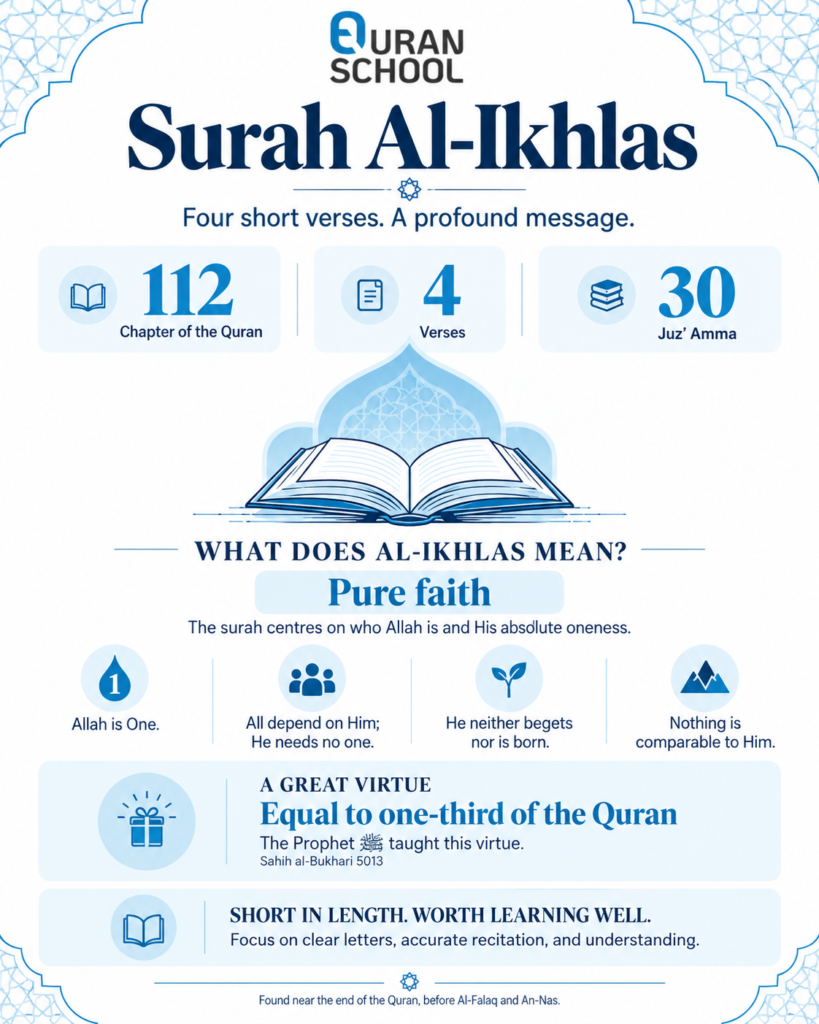
Surah Al-Ikhlas is the 112th chapter of the Quran. It has four verses, which makes it one of the shortest chapters in the whole book. It sits near the end of the Quran, in the section known as Juz’ Amma, next to Surah Al-Falaq and Surah An-Nas.
Its name means “pure faith,” and the name fits the content exactly. The whole surah is about one thing: who Allah is, and what He is not. There are no stories in it, no rules, and no history — only a clear description of Allah.
That is why it carries so much weight for such a small surah. The Prophet ﷺ told his companions that it is equal to a third of the Quran in reward (Sahih al-Bukhari 5013).
It is also one of the first surahs most Muslims ever learn, and one of the most repeated, because it is read in daily prayers and before sleep.
For a learner, this is good news. Four short verses mean the whole surah fits in your memory in a single sitting. The real work is not the length — it is saying the letters correctly, which is what the steps below are for.
How Long Does It Take To Learn Surah Al-Ikhlas?
Most adults can memorise all four verses in one to three days. Saying it with correct tajweed usually takes one to two weeks of short daily practice with someone correcting you.
These are two different skills. Memorising is about your mind. Pronouncing is about your mouth making new sounds it has never made before.
Keep them separate in your plan. If you memorise the surah with the wrong sounds, you memorise the mistakes too. Fixing a habit later takes far longer than learning it right now.
Your own timeline depends on a few simple things. Learners who already read Arabic letters move faster, because they are not decoding and reciting at the same time. Learners starting from zero need a few extra days, and that is completely normal.
Children often memorise quicker than adults but need longer to fix their pronunciation, since they copy sounds before they think about them.
One more point worth knowing. Twenty minutes a day for five days will always beat two hours in one sitting. Your memory needs sleep between sessions to hold what you learned, so short and regular wins every time.
Read also: 5 Simple Steps to Learn Surah An-Nas with Proper Tajweed
What Does A 5-Day Plan Look Like?
Everything in this guide fits into five short sessions. The plan below puts the four steps in order, so you are never learning a new verse and a new sound rule on the same day.
Each session is around twenty minutes, which is short enough to do before work or after Fajr. Follow it as it is, or slide a day if life gets busy — the order matters more than the dates.
| Day | What to do | Time |
| 1 | Listen to the full surah 5×. Then verse by verse. Memorise verse 1. | 20 min |
| 2 | Verse 2. Say 1–2 from memory. Practise the heavy ṣād and heavy lām. | 20 min |
| 3 | Verse 3. Say 1–3 from memory. Practise the bounce on yalid and yūlad. | 20 min |
| 4 | Verse 4. Say the full surah 5× with no mistakes. Practise yakun lahu and kufuwan. | 25 min |
| 5 | Check yourself against the 8 mistakes. Read to a teacher, or record yourself. | 25 min |
| After | Read it in the Fajr sunnah and witr. Review the meaning once a week. | — |
Five short sessions work better than one long one. Spreading practice out is what builds strong memory. One long push on a single day feels good and fades fast.
Notice that day 5 is not about learning anything new. It is a checking day, and it is the one most people skip. Reading to a teacher or recording yourself is what turns “I think I have it” into “I know I have it.” Give that last session the same twenty-five minutes as the rest, and the surah is genuinely yours.
Read also: Surah Falaq Guide: How to Learn and Recite
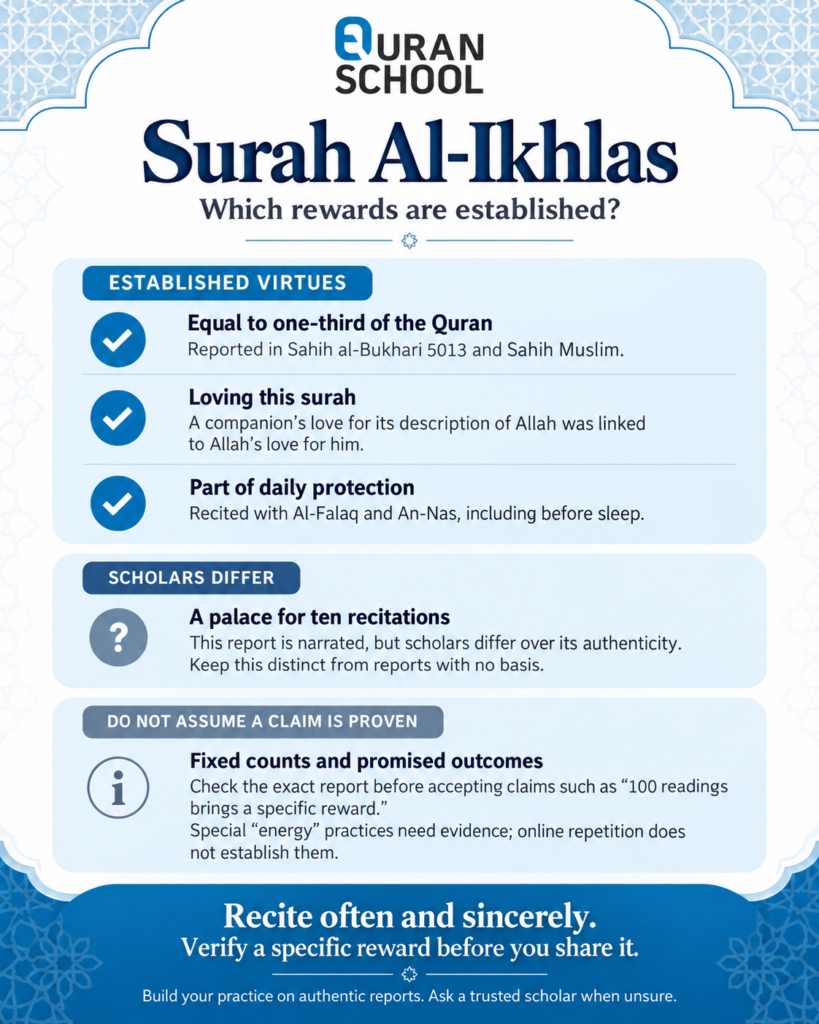
Which Rewards For Surah Al-Ikhlas Are Proven?
Search for this surah online and you will find big promises attached to exact numbers. Some of them come from authentic narrations. Many do not. Here is the difference, side by side, so you can tell them apart yourself.
| The claim | Is it proven? |
| It equals a third of the Quran in reward | Proven. Found in Sahih al-Bukhari (5013) and Sahih Muslim. |
| Loving this surah is linked to the love of Allah | Proven. Reported about a companion who read it in every rak’ah. |
| It is part of daily protection before sleep | Proven. Read with Surah Al-Falaq and Surah An-Nas. |
| A palace in Paradise for ten readings | Debated. Narrated, but scholars grade it differently. |
| A set reward for reading it exactly 100 times | Not proven. Weak, or with no basis at all. |
| Special number counts or “energy” practices | Not proven. No basis in the authentic sunnah. |
What is proven, and why it matters
The strongest narration is the simplest one. The Prophet ﷺ told his companions he would read them a third of the Quran, then read Qul huwa Allāhu aḥad. That is your anchor, and it is already remarkable: four short verses, equal to a third of the Book.
The surah is also part of daily protection. It is read with Surah Al-Falaq and Surah An-Nas before sleep, and loving it is linked in the authentic reports to the love of Allah.
Read also: Is Tajweed Necessary for Quran Recitation?
What is not proven
The reports that promise a fixed reward for exactly one hundred readings are weak, or have no basis at all. Islamweb and a fatwa of Shaykh Ibn Baz both advise against relying on them.
The report about a palace in Paradise for ten readings is narrated, but hadith scholars grade it differently. Build your practice on the “third of the Quran” narration instead, because that one is solid.
Number counting and “spiritual energy” practices belong in the same group. They are not part of the authentic sunnah, however widely they are shared.
Reading the surah often is a good thing, and nobody is telling you to read it less. Attaching a guaranteed reward to a fixed number is a different matter. Knowing the difference from day one saves you from building a habit on something that was never authentic.
Once you know what is proven for this surah, it is worth seeing the bigger picture of the reward for reading Quran and the blessings that come with it.
Experience Our Classes
Don’t just take our word for it-watch real-time recordings of our online classes below to experience our teaching style firsthand.
Start Your Quranic Journey Today
Experience our interactive online classes with a dedicated tutor.
Get Your Free TrialHow Do You Teach Surah Al-Ikhlas To A Child?
You teach a child Surah Al-Ikhlas by starting with the meaning, not the words. The surah talks about things a child cannot see. If they only learn the sounds, they are not really learning the surah.
Try this order:
- Start with something they can see. Point to animals, plants, the sun, their food. Ask where it came from. Keep going back a step: where does food come from? Plants. Who makes plants grow? Allah. Now they understand aṣ-ṣamad before they hear the word.
- Give them four simple lines, one per verse. Allah is One. Everyone needs Him. He has no son and no father. Nothing is like Him.
- Read together in short bursts. Three to five minutes a day. Stop while they are still interested, not after.
- Ask them to explain it to someone else. A brother, a sister, a parent. Explaining is the strongest memory test a young child has.
- Tie it to bedtime. Read it three times with Al-Falaq and An-Nas.
Be ready for hard questions. Children ask very sharp ones about this surah — why Allah has no children, what “nothing is like Him” really means — and a vague answer can leave a child confused for years.
There is no shame in not having the words ready; most parents do not. If you would rather your child hear these answers from someone trained in both the tajweed and the belief side, our Online Quran Classes for Kids at EQuran Online School pair each child with one teacher who knows how to explain it at their level.

Learn It Once, And Learn It Right
You have the method. What you do not have yet is someone listening — and that is the part no article, app or video can replace.
At EQuran School Online, you learn with one teacher, live, one-to-one. Here is what that gives you:
- Certified teachers with ijazah, trained in tajweed and used to teaching people whose first language is English.
- Your own teacher, not a rotating one, so they know exactly which letters you struggle with and track your progress week by week.
- Real-time correction, the moment a letter comes out wrong — not weeks later, after the habit has set.
- Male and female teachers, so you or your child can learn in the setting you are comfortable with.
- Classes that fit your week, at times you choose, from anywhere in the world.
- A clear path forward, from Surah Al-Ikhlas through the rest of Juz’ Amma, for adults and children alike.
Start with a free trial class. Read these four verses aloud to a qualified teacher, hear exactly what you are doing well and what needs adjusting, and decide from there. No payment, no commitment — just twenty minutes that could fix your recitation for life.
Our Quran Courses
- Quran Recitation Classes
- Weekend Quran Classes
- Quran Reading Classes
- Online Quran Classes for Kids
- Learn Quran Online with Tajweed for Kids and Adults
- Online Quran Learning with Tajweed Course
- Quran Classes for Adults
- Female Quran Classes
- Female Quran Teacher for Ladies
- Learn Quran for Beginners
- Quran Qirat Learning Course
👉 Book your free trial class today

Conclusion
Surah Al-Ikhlas is short, and that is exactly why people rush it. Four verses feel like nothing. So learners repeat them a few times, feel confident, and move on.
Then years later someone corrects them, and they find out they have been saying kul instead of qul, or kufwan instead of kufuwan, in every prayer since.
That does not have to happen to you. The fix is simply doing the steps in the right order.
Listen first. Give your ear five clean rounds of a slow reciter before your mouth tries anything. This one habit prevents most pronunciation problems before they start.
Then fix the letters. There are only a handful to get right: the heavy qāf in qul, the heavy ṣād in aṣ-ṣamad, the heavy lām in Allāh, the bounce on the three dāl endings, the silent nūn in yakun lahu, and the u sound in kufuwan. Six details. That is the whole difference between correct and almost correct.
Then memorise by adding, not by repeating. One verse, then link it back. Another verse, then link it back again. Finish with five clean runs of the full surah. This is slower on day one and far faster over a month, because you will not be relearning it every week.
Then learn what you are saying. When you know that aṣ-ṣamad means everything needs Him and He needs nothing, the words stop being sounds. They become something you mean. That alone makes the surah much harder to forget.
And finally, put it in your prayers. Read it in Fajr sunnah. Read it in witr. Read it before you sleep with Al-Falaq and An-Nas. A surah you use every day never needs revising.
One last thing worth keeping in mind. Be careful with what you read online about this surah. A lot of popular advice attaches big promises to exact numbers, and those reports are weak or made up.
The proven reward is already remarkable: four verses equal to a third of the Quran, on the word of the Prophet ﷺ himself. You do not need anything added to that.
Frequently Asked Questions
How Do You Learn Surah Ikhlas Step By Step?
Learn Surah Ikhlas in four steps: listen to a slow reciter five times, learn the correct letter sounds in each verse, memorise one verse at a time while linking it to the ones before, then learn the meaning and read it in your daily prayers.
How Long Does It Take To Memorise Surah Al-Ikhlas?
Most adults memorise all four verses in one to three days of focused practice. Saying it with correct tajweed usually takes one to two weeks of short daily sessions with someone correcting you.
What Is The Correct Way To Read Surah Ikhlas?
Read it with a heavy qāf in qul, a heavy ṣād in aṣ-ṣamad, a bounce on the dāl in yalid, yūlad and aḥad, a silent nūn in yakun lahu, and a u sound on the fā’ in kufuwan.
What Does Surah Al-Ikhlas Mean In English?
It means: Say, He is Allah, the One; Allah, who needs no one and whom everyone needs; He has no son and no father; and there is no one like Him. The whole surah is about the oneness of Allah.
Is Surah Al-Ikhlas Really Equal To A Third Of The Quran?
Yes. This is reported in Sahih al-Bukhari (5013) and Sahih Muslim. The Prophet ﷺ said that Qul huwa Allāhu aḥad equals a third of the Quran in reward.
Is There A Special Reward For Reading Surah Al-Ikhlas 100 Times?
No authentic narration gives a set reward for reading it exactly one hundred times. Scholars including Shaykh Ibn Baz advised against relying on those reports, because they are weak or have no basis.
How Can I Teach Surah Al-Ikhlas To My Child?
Start with the meaning using things the child can see, give them one simple line per verse, read together for three to five minutes a day, and ask them to explain the meaning back to you.










Leave a Reply