 Learn Quran

Learning short Surahs is one of the most practical ways to begin Quran memorization, especially for children, new Muslims, and adults who are only starting to build a regular relationship with the Quran.
If you are searching for how to learn Surah Kausar, you are starting with an excellent Surah, because it contains only three short ayats while still teaching you the essential skills needed for successful Hifz.
The short length of Surah Al-Kausar does not mean it should be memorized carelessly. Good Hifz means remembering every word in its correct order, pronouncing each Arabic letter accurately, recognizing where every ayah begins and ends, and reciting the Surah confidently without relying on the written page.
A strong method for how to learn Surah Kausar combines listening, reading, repetition, understanding, active recall, correction, and regular revision.
In this guide, you will find a practical, step-by-step method for memorizing Surah Al-Kausar, improving your pronunciation, understanding its meaning, avoiding common memorization mistakes, and keeping the Surah strong after you have learned it.

1. Listen to Surah Al-Kausar Several Times
Your first step to learn Surah Kausar is careful listening rather than immediate memorization. Choose one clear, reliable reciter and listen to the complete Surah several times before attempting to repeat it independently.
سورة الكوثر من المصحف المعلم المصور المرمز بالألوان بصوت الشيخ محمود خليل الحصري
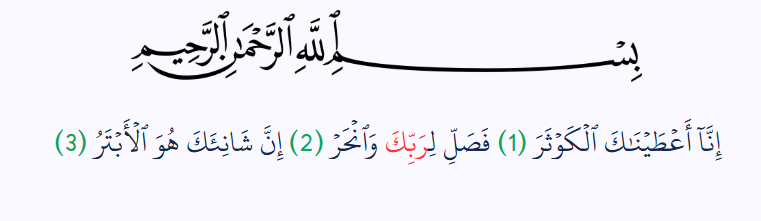
During these first listening sessions, focus on becoming familiar with the overall sound and flow of the Surah rather than trying to remember every word.
Pay close attention to correct pronunciation, ayah endings, vowel length, Tajweed, and the natural pauses between verses, while following the Arabic text with your eyes whenever possible.
Using the same reciter consistently can also make the sound pattern more familiar and easier to recall when you begin memorizing. Replay difficult words or phrases instead of simply continuing through the Surah, and try to notice how one ayah leads naturally into the next.
This listening stage gives you a clear recitation model to imitate and can reduce the risk of repeatedly practicing a word incorrectly.
If you would like to explore this topic further, E Quran School discusses related research and findings in its article on the scientific benefits of reading the Quran.

2. Read the Complete Surah Slowly
Once the recitation begins to sound familiar, open the Mushaf and read the Surah slowly for yourself. At this stage, your main goal is accuracy rather than speed or memorization.
Read one ayah at a time and pay close attention to the Arabic letters, Harakat, verse endings, and any sounds that feel difficult or unfamiliar.
Take extra care with similar-looking or similar-sounding letters, since small pronunciation differences can affect the accuracy of your recitation. If a particular word causes hesitation, isolate it, listen to the reciter again, and repeat it slowly before returning to the full ayah.
Reading carefully before memorizing gives you a stronger foundation because you are learning the correct form of each verse from the beginning.
Once the words can be read clearly and confidently from the Mushaf, you can move into repetition and memorization with fewer pronunciation mistakes to correct later.

3. Memorize the First Ayah
Begin with the first ayah, إِنَّا أَعْطَيْنَاكَ الْكَوْثَرَ, and avoid trying to memorize the entire verse immediately. Instead, divide it into smaller, manageable units — إِنَّا, then أَعْطَيْنَاكَ, then الْكَوْثَرَ.
Listen to each part carefully and repeat it aloud several times while looking at the Arabic text, making sure that the pronunciation and vowel sounds remain accurate.
Once each unit feels familiar, begin joining the words gradually. Practice إِنَّا أَعْطَيْنَاكَ together first, then add الْكَوْثَرَ and repeat the complete ayah several times. If you hesitate at one word, return to that specific part instead of restarting the entire verse every time.
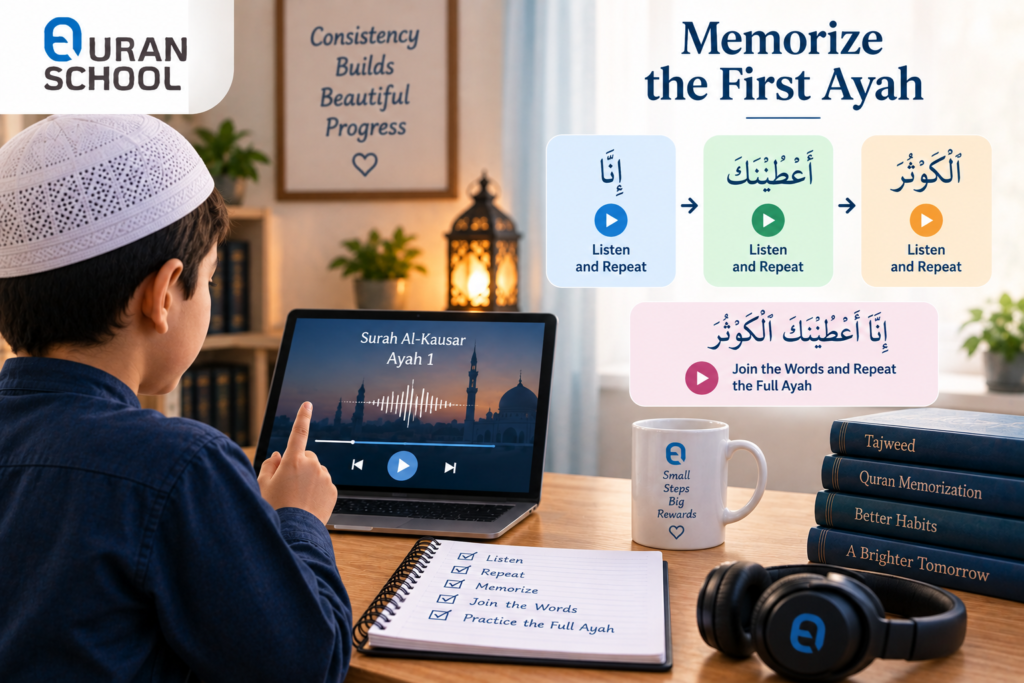
When you can read the full ayah comfortably from the Mushaf, look away and recite it from memory.
Repeat this memory test several times, checking the text afterward for any missing words or pronunciation mistakes. Do not move to the next ayah until you can recall the first one accurately and with reasonable confidence.
See Us in Action
Watch a quick snippet from our live, interactive classes below and see how our teachers make learning engaging for all ages!
Start Your Quranic Journey Today
Experience our interactive online classes with a dedicated tutor.
Get Your Free Trial4. Memorize the Second Ayah
Move next to the second verse, فَصَلِّ لِرَبِّكَ وَانْحَرْ, and use the same gradual method rather than trying to memorize the whole ayah at once. Divide it into three manageable sections: فَصَلِّ, لِرَبِّكَ, and وَانْحَرْ.
Listen carefully to each part, read it directly from the Mushaf, and repeat it aloud several times until the wording and pronunciation begin to feel natural.

Once the individual sections are secure, join them gradually into the complete ayah. Pay particular attention to any word that causes hesitation, and return to that section for additional repetition instead of repeatedly practicing parts you already know well.
Then look away from the Mushaf and test whether you can recite the entire second ayah independently.
Finally, connect Ayah 2 back to Ayah 1. Recite إِنَّا أَعْطَيْنَاكَ الْكَوْثَرَ and immediately continue with فَصَلِّ لِرَبِّكَ وَانْحَرْ. Repeat the two verses together several times so that the ending of the first ayah becomes a natural memory cue for the beginning of the second.
Read also : How to Master Surah An-Nasr: Easy Steps for Beginners
5. Memorize the Third Ayah
Now move to the final verse, إِنَّ شَانِئَكَ هُوَ الْأَبْتَرُ, and follow the same gradual process you used for the previous ayahs: listen, read, repeat, and recall. Begin by listening carefully to a reliable reciter, then read the ayah slowly from the Mushaf and repeat it aloud several times.

If any word feels difficult, isolate it and practice it separately before returning to the complete verse.
Once the wording and pronunciation feel familiar, look away from the Mushaf and attempt the ayah from memory. Repeat it independently several times rather than treating one successful recitation as proof that it is fully memorized.
If you hesitate or change a word, check the Arabic text, correct the mistake immediately, and test yourself again.
Next, strengthen the transition by reciting Ayah 2 followed directly by Ayah 3 several times. This helps the ending of the second verse become a natural cue for recalling إِنَّ شَانِئَكَ without needing a prompt.
Finally, recite the complete Surah in order — Ayah 1 → Ayah 2 → Ayah 3 — several times in a row without looking. The goal is not a single successful attempt, but stable recall across repeated recitations.
When you can consistently move through all three ayats with accurate wording, pronunciation, and smooth transitions, your memorization is becoming much more secure.
Read also: Learning Surah Ikhlas Made Easy: Meaning & Tajweed
6. Use the Listen–Read–Repeat–Recall Method
A simple memorization routine can make learning Surah Al-Kawthar more organized and effective, especially for beginners. Instead of repeating the verses randomly, use a clear listen, read, repeat, and recall cycle for each ayah.
This method helps you work on pronunciation and memorization together while gradually reducing your dependence on the Mushaf or a recording.
- Listen: Begin by hearing the ayah from a clear, reliable reciter before attempting to memorize it yourself. Listen more than once and focus on pronunciation, vowel length, Tajweed, and the natural flow of the words.
This gives you an accurate model to imitate instead of relying on your own guess about how unfamiliar words should sound.
- Read: Next, follow the Arabic text in the Mushaf while listening and then read the ayah aloud yourself.
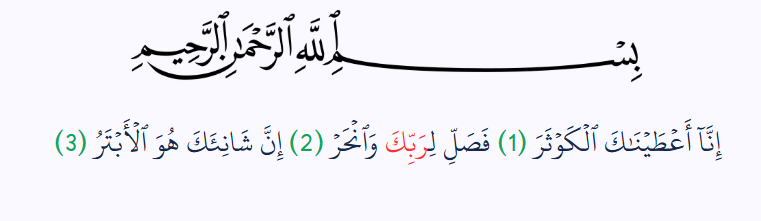
Connecting the sound you hear with the correct written words helps strengthen visual memory while also allowing you to notice letters, Harakat, and word endings that may be easy to miss through listening alone.
- Repeat: Say the ayah aloud several times while continuing to check the text. Keep your repetitions slow and deliberate, paying attention to pronunciation, word order, and any section where you repeatedly hesitate.
If one word is difficult, isolate it and practice it separately before returning to the complete verse.
- Recall: Finally, close the Mushaf or look away from the page and recite the entire ayah from memory. Try it more than once so that a single successful attempt is not mistaken for secure memorization. Each successful recall strengthens your ability to retrieve the verse without relying on visual or audio prompts.
Read also: How to Learn Surah Falaq: Step-by-Step Guide
7. Understand the Meaning of Each Ayah
You do not need to complete a detailed Tafsir study before beginning Hifz, but understanding the basic meaning of Surah Al-Kawthar can make the memorization process more connected and easier to follow.
Instead of remembering three ayahs only by their sounds, you can organize them around a simple progression: Blessing, Worship, and Reassurance. This gives your memory an additional way to recognize what comes next.
The first ayah begins with the blessing Allah granted to the Prophet ﷺ, the second directs him toward worship and sacrifice, and the final ayah provides reassurance concerning his enemy.
Remembering this progression can help prevent confusion about verse order, especially when you are practicing without looking at the Mushaf.
Try to recall the general meaning as you recite each ayah rather than treating the Arabic words as disconnected sounds.
Read also: Is Learning Tajweed Obligatory in Islam?
8. Practice Difficult Words Separately
If one word repeatedly causes mistakes — commonly أَعْطَيْنَاكَ, الْكَوْثَرَ, فَصَلِّ, وَانْحَرْ, شَانِئَكَ, or الْأَبْتَرُ — do not keep repeating the entire ayah and hoping the problem disappears. Instead, isolate the difficult word and give it focused attention.
Listen to a reliable reciter pronounce it several times, then repeat it slowly on its own until the letters, vowel sounds, and rhythm feel more controlled.
After that, place the word back into its short phrase, then into the complete ayah. This step-by-step method helps you correct the exact weak point without wasting time on words you already know well.
If the same mistake keeps returning, record yourself or ask a qualified teacher to check the word directly, especially if the difficulty involves Makharij or a subtle Tajweed detail.
Targeted practice like this can make memorization more accurate because you are not only remembering the verse, but also repairing the specific pronunciation issue that causes hesitation.
Once the word feels secure in isolation and in context, the full ayah usually becomes much smoother to recite from memory.
Learners who want extra guidance and live correction from a qualified tutor can explore the Hifz classes for adults offered by E Quran School, which are built around exactly this kind of structured, step-by-step memorization.

9. Connect All Three Verses
Verse linking is an essential part of how to learn Surah Kausar successfully, because being able to recite each ayah separately does not always mean you can recite the complete Surah without hesitation.
Some learners memorize the wording of all three verses correctly but pause when they reach the end of an ayah because the beginning of the next one has not yet become a strong memory cue.
Practice the transitions deliberately rather than always restarting from the beginning. First recite Ayah 1 → Ayah 2 several times, focusing on moving directly from الْكَوْثَرَ to فَصَلِّ. Then practice Ayah 2 → Ayah 3, connecting وَانْحَرْ naturally with إِنَّ شَانِئَكَ. If one transition causes more hesitation, isolate that pair and repeat it until it becomes comfortable.
Finally, recite Ayah 1 → Ayah 2 → Ayah 3 several times in a row without looking at the Mushaf. The goal is for the ending of each verse to naturally trigger the beginning of the next, allowing Surah Al-Kawthar to feel like one connected passage rather than three separately memorized ayahs.
Read also: How to Read Surah Yaseen Correctly Using Tajweed Rules
10. Recite Without Looking at the Mushaf
After you believe Surah Al-Kawthar is memorized, close the Mushaf and test yourself honestly rather than relying on how familiar the verses feel while looking at the page.
Try to begin the Surah immediately without hearing the first word or receiving any other prompt, then recite all three ayahs in the correct order while maintaining the pronunciation and Tajweed you practiced during memorization.
Do not consider one successful recitation enough. Repeat the complete Surah from memory several times, preferably with a short break between some attempts, to see whether your recall remains consistent.
Pay attention to any word you repeatedly forget, any transition where you hesitate, or any pronunciation that becomes less accurate when the text is no longer in front of you.
If a mistake appears, check only the specific word, phrase, or transition that caused difficulty, correct it, and then test yourself again from memory. The goal is to reach a point where you can recite Surah Al-Kawthar accurately and confidently more than once in a row without prompts.
That repeated, independent recall is a much stronger sign of secure memorization than simply recognizing the verses when you see or hear them.
This kind of testing also shows you exactly which parts of the Surah still need additional revision before you move on to new memorization. Once your recall remains stable across several attempts, continue reviewing the Surah regularly so that it stays strong in your long-term memory.

| START YOUR QURANIC JOURNEY TODAYExperience our interactive online classes with a dedicated tutor.▶ Get Your Free Trial |
11. Recite Surah Al-Kausar to a Qualified Teacher
Independent practice is valuable for building consistency, but it does not always reveal pronunciation mistakes that you have become accustomed to hearing in your own voice.
You may remember every word of Surah Al-Kawthar correctly while still making subtle errors in Makharij, letter characteristics, vowel length, or Tajweed. Because these mistakes can be difficult to recognize without trained feedback, regular correction from a qualified Quran teacher can make your memorization more accurate from the beginning.
A teacher can listen closely to your recitation, identify the exact letter, sound, or Tajweed rule that needs improvement, demonstrate the correct pronunciation, and ask you to repeat it until the difference becomes clear.
This is particularly helpful for non-native Arabic speakers who may naturally substitute unfamiliar Quranic sounds with sounds from their own language.
For learners who need this type of direct support, E Quran School’s Zoom classes provide live, one-to-one instruction with a dedicated tutor who listens to your recitation and corrects mistakes in real time.
Instead of discovering pronunciation problems after they have become established habits, you can receive immediate feedback while developing memorization, Tajweed, and recitation accuracy together.

A Simple 3-Day Plan for How to Learn Surah Kausar
You may be able to memorize Surah Al-Kausar in a single session, especially because it contains only three short ayahs. However, being able to repeat the Surah immediately after practicing it does not necessarily mean that the memorization is secure.
Spreading the process across three days gives your memory several opportunities to retrieve the verses after a break, identify weak points, and strengthen them through focused revision.
The following plan keeps the process simple: learn carefully, test yourself without looking, correct mistakes, and review before adding anything new. If you need longer than three days, simply extend the schedule rather than rushing. The goal is not to finish Surah Al-Kausar quickly, but to be able to recite all three ayahs accurately, confidently, and consistently from memory.
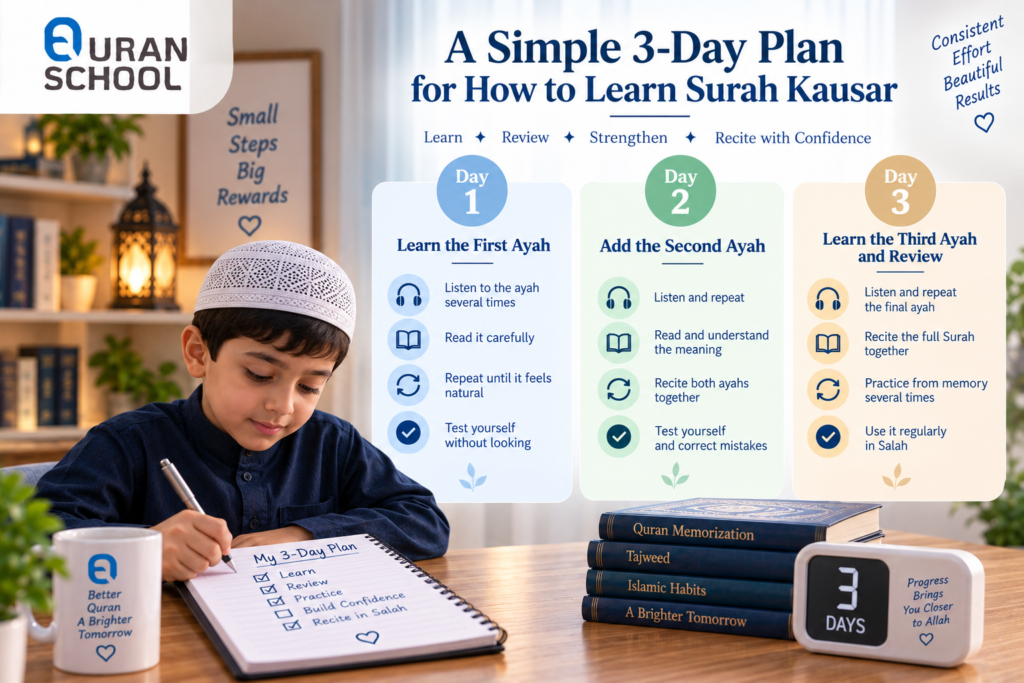
Day 1: Listening and the First Ayah
The first day should focus on building familiarity with Surah Al-Kawthar and establishing accurate pronunciation before trying to memorize too much. Give yourself time to listen to the complete Surah, follow the Arabic text, and notice how each ayah sounds and connects to the next.
- Listen to the complete Surah: Play Surah Al-Kawthar several times while following the Arabic text. Focus on pronunciation, vowel length, and the natural ending of each ayah.
- Read all three ayahs slowly: Read the Surah directly from the Mushaf and notice any words or sounds that feel difficult. Repeat those parts before beginning active memorization.
- Memorize the first ayah: Learn إِنَّا أَعْطَيْنَاكَ الْكَوْثَرَ phrase by phrase, then join the parts together. Once it feels comfortable, close the Mushaf and recite the ayah from memory several times.
Day 2: Review and Add the Second Ayah
On the second day, begin with a review before adding anything new. Testing yesterday’s ayah first will show whether it has remained secure in your memory and highlight any words that need extra attention. Once Ayah 1 feels stable again, you can move to Ayah 2 and gradually connect the two verses.
- Review Ayah 1 from memory: Before opening the Mushaf, recite إِنَّا أَعْطَيْنَاكَ الْكَوْثَرَ independently. If you hesitate or forget a word, check only the weak section, correct it, and test yourself again.
- Memorize Ayah 2 carefully: Listen several times to فَصَلِّ لِرَبِّكَ وَانْحَرْ, then divide it into short sections. Repeat each part while checking your pronunciation before joining them into the complete ayah and attempting it from memory.
- Connect Ayahs 1 and 2: Once Ayah 2 feels comfortable, recite Ayah 1 → Ayah 2 without stopping. Repeat the two verses together several times so that the ending of the first naturally triggers the beginning of the second.
Day 3: Complete and Test the Surah
The third day is about completing Surah Al-Kawthar and checking whether your memorization is genuinely secure. Begin by reviewing what you already know, then add the final ayah and spend the rest of the session strengthening transitions, testing independent recall, and correcting any remaining mistakes.
- Review Ayahs 1 and 2, then learn Ayah 3: Recite the first two ayahs from memory before looking at the Mushaf. Once they feel secure, memorize إِنَّ شَانِئَكَ هُوَ الْأَبْتَرُ using the same listen, read, repeat, and recall method.
- Connect the complete Surah: Practice Ayah 2 → Ayah 3 several times until the transition feels natural. Then recite Ayah 1 → Ayah 2 → Ayah 3 repeatedly so that all three verses become one connected sequence.
- Test and correct your memorization: Close the Mushaf and recite the complete Surah more than once without prompts. Finally, recite Surah Al-Kawthar to a qualified Quran teacher who can check your pronunciation, Makharij, Tajweed, and any mistakes you may not notice yourself.

| START YOUR QURANIC JOURNEY TODAYExperience our interactive online classes with a dedicated tutor.▶ Get Your Free Trial |
How to Learn Surah Kausar for Kids
For children, the memorization process should remain structured, gentle, and manageable without becoming exhausting.
Short, repeated sessions are usually easier to maintain than one long lesson, while immediate but patient correction helps children develop accurate pronunciation from the beginning. The priority should always be correct recitation and steady progress rather than speed.

- Play one ayah at a time: Let the child hear a clear recitation several times before asking them to repeat it independently.
- Break difficult words into smaller parts: Practice challenging words or phrases in short, manageable sounds before returning them to the complete ayah.
- Recite together first: Read the verse with the child initially, then gradually reduce your support until they can recall it independently.
- Correct pronunciation immediately: Gently correct mistakes as soon as they appear so that incorrect pronunciation does not become familiar through repetition.
- Review the Surah every day: Keep revision short and consistent, and once the recitation has been checked, encourage the child to use Surah Al-Kausar regularly in Salah.
Children should never be pressured to rush simply because Surah Al-Kausar is short. Some children may memorize it quickly, while others need additional time to strengthen pronunciation and recall.
E Quran School’s Quran courses for kids follow this gradual approach, with patient, qualified tutors who help children build accurate recitation, stronger memorization, and a positive Quran-learning habit from their earliest Surahs.

Common Mistakes When Learning Surah Al-Kausar
Even a three-ayah Surah can be memorized incorrectly if the learning process is rushed. Surah Al-Kausar is short, but short does not always mean effortless.
Because there are only a few lines to learn, beginners may be tempted to repeat the entire Surah quickly without first checking whether every letter, vowel, and word is being pronounced correctly.
Successful memorization requires more than simply remembering the general sequence of the verses. You need accurate pronunciation, correct word order, clear transitions between ayahs, and enough repetition to recite without relying on the Mushaf.
It is also important to correct mistakes early, since repeatedly memorizing an incorrect pronunciation can make that error harder to remove later.
Regular revision remains important even after all three ayahs can be recited from memory. A Surah that feels secure today can gradually weaken if it is not revisited.
The following mistakes are especially common among beginners and are worth watching for deliberately while learning Surah Al-Kausar so that your memorization remains both accurate and strong.
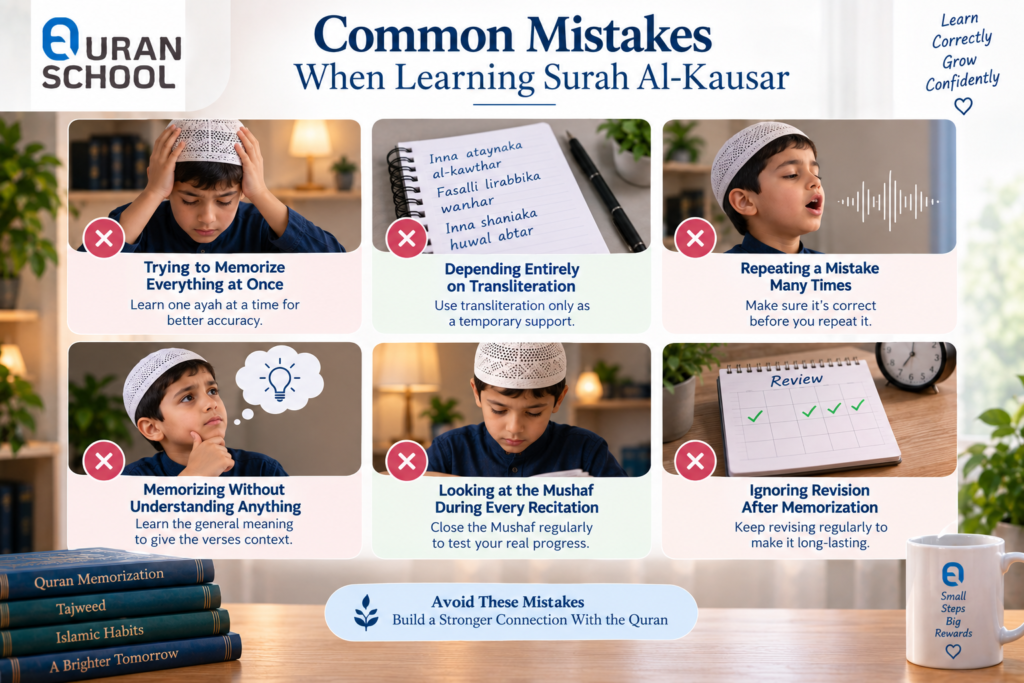
Trying to Memorize Everything at Once
Because Surah Al-Kausar contains only three short ayahs, it is tempting to repeat the entire Surah again and again until it seems memorized. While this may produce quick short-term results, it can allow pronunciation mistakes, missing words, or weak transitions between verses to go unnoticed.
Instead, learn one ayah accurately before adding the next. Once the first two ayahs are secure individually, connect them together, and then add the third. This gives you much greater control over both accuracy and retention.
Depending Entirely on Transliteration
Transliteration can be helpful for a beginner who is still developing Arabic reading skills, but it cannot perfectly represent every sound found in Quranic Arabic. Certain letters, articulation points, and pronunciation details simply do not have exact English equivalents.
For this reason, use transliteration only as a temporary learning aid, preferably alongside the Arabic text and an accurate audio recitation. Gradually reducing your dependence on transliteration will also help you become more comfortable reading directly from the Mushaf.
Repeating a Mistake Many Times
Repetition is one of the most effective memorization techniques, but it only strengthens whatever you are actually repeating. If you pronounce a word incorrectly twenty times, you may unintentionally train your tongue and memory to reproduce that same mistake automatically.
Before increasing the number of repetitions, check difficult words carefully by listening to a reliable reciter or asking a qualified teacher. Correcting a mistake early is usually much easier than trying to remove it after it has become part of your memorized recitation.
Memorizing Without Understanding Anything
You do not need advanced Arabic knowledge to memorize Surah Al-Kausar, but understanding its general message can make memorization much easier. Instead of remembering three unrelated lines of Arabic, you begin to see a simple progression in the Surah: Blessing → Worship → Reassurance.
This meaning-based structure gives your memory additional clues about what comes next. It also makes your recitation more meaningful because you have at least a basic understanding of the message behind the words you have memorized.
Looking at the Mushaf During Every Recitation
Reading repeatedly from the Mushaf is important during the early stages, but keeping the page open during every repetition can create a false sense of memorization. You may recognize each word immediately when you see it while still being unable to recall the same ayah independently.
Regularly close the Mushaf and attempt to recite the ayah from memory. If you become stuck, check the exact word you missed, repeat the passage correctly, and test yourself again. This kind of active recall gives you a much clearer picture of what you have actually memorized.
Ignoring Revision After Memorization
A Surah is not permanently memorized simply because you can recite it correctly once. Without revision, small parts can gradually become weaker, verse transitions may become uncertain, and pronunciation mistakes can begin appearing without you noticing.
Continue reviewing Surah Al-Kausar even after you can recite it confidently from memory. Include it in your regular Quran revision and recite it in Salah when appropriate. Short, repeated reviews over time are far more effective for long-term retention than memorizing the Surah once and then leaving it untouched.
Many learners also choose to revise short Surahs such as Al-Kausar after Fajr prayer, when they may have fewer distractions and can give their Quran revision focused attention before beginning the day. If you would like to explore this routine further, you can read about the benefits of reading Quran at Fajr on the E Quran School blog.

Experience Our Classes
Don’t just take our word for it-watch real-time recordings of our online classes below to experience our teaching style firsthand.
Start Your Quranic Journey Today
Experience our interactive online classes with a dedicated tutor.
Get Your Free TrialStart Your Quranic Journey Today
Learning Surah Al-Kausar is a meaningful first step, but consistent progress in Quran memorization becomes so much easier with the right guidance.
At E Quran School, our dedicated tutors work with you one-on-one, correcting your pronunciation and Tajweed as you go, so mistakes never turn into habits.
Whether you’re a beginner just starting your Hifz journey, a parent looking for a patient teacher for your child, or an adult returning to the Quran after years away, our interactive online classes are built around your pace and your goals.
Our Quran Courses
- Quran Recitation Classes
- Weekend Quran Classes
- Quran Reading Classes
- Online Quran Classes for Kids
- Learn Quran Online with Tajweed for Kids and Adults
- Online Quran Learning with Tajweed Course
- Quran Classes for Adults
- Female Quran Classes
- Female Quran Teacher for Ladies
- Learn Quran for Beginners
- Quran Qirat Learning Course
Start with a free trial class today and experience how much faster and more confident your memorization can become with a real tutor guiding every session:

| START YOUR QURANIC JOURNEY TODAYExperience our interactive online classes with a dedicated tutor.▶ Get Your Free Trial |
Conclusion
Learning how to learn Surah Kausar is a practical and achievable goal for beginners of every age and background. Although Surah Al-Kausar contains only three short ayahs, memorizing it well still requires more than repeating the verses until they sound familiar.
By listening carefully, reading slowly, memorizing one ayah at a time, understanding the basic meaning, practicing verse transitions, and reviewing consistently, you can build memorization that is both accurate and easier to retain.
Remember that speed is not the main goal. Take enough time to correct difficult words, strengthen pronunciation, apply the Tajweed rules you are learning, and test yourself regularly without looking at the Mushaf.
Continue reviewing the Surah after memorization and use it in Salah once your recitation has been checked so that the verses remain active in your memory rather than gradually fading.
Whether you are a parent guiding a child, a new Muslim developing your first Hifz habit, or an adult returning to Quran memorization after a long break, you do not have to work through every difficulty alone.
Structured guidance from a qualified tutor at E Quran School can help you identify pronunciation mistakes, improve Tajweed, and develop a memorization routine suited to your current level.
FAQs
What is Surah Al-Kausar?
Surah Al-Kausar is the 108th chapter of the Quran, made up of three ayahs, and is recognized as the shortest Surah in the entire Quran.
How many ayahs does Surah Al-Kausar have?
Surah Al-Kausar has exactly three ayahs, making it the shortest Surah in the Quran.
How long does it take to memorize Surah Al-Kausar?
Many beginners memorize Surah Al-Kausar in one to three short daily sessions using a step-by-step method, though the exact time varies by individual pace and prior experience.
Can beginners memorize Surah Al-Kausar without a teacher?
Beginners can memorize the basic wording independently, but a qualified teacher is strongly recommended to check pronunciation, Makharij, and Tajweed before the Surah is used regularly in Salah.
What does Al-Kawthar mean?
Al-Kawthar refers to abundant good and blessing granted by Allah to Prophet Muhammad ﷺ, and hadith literature also describes it as a specific river in Paradise.
Is Surah Al-Kausar recommended for recitation in Salah?
Yes, once memorized and pronounced correctly, Surah Al-Kausar can be recited after Al-Fatihah in daily prayers like any other short Surah.
Related Articles
Learn Quran











Leave a Reply