 Learn Quran
Every morning, before the world fills with noise, there is a window that most people sleep through. It opens at true dawn — when the sky turns from black to grey — and closes at sunrise. Muslims across centuries have recognized it as the most spiritually charged interval in the day.
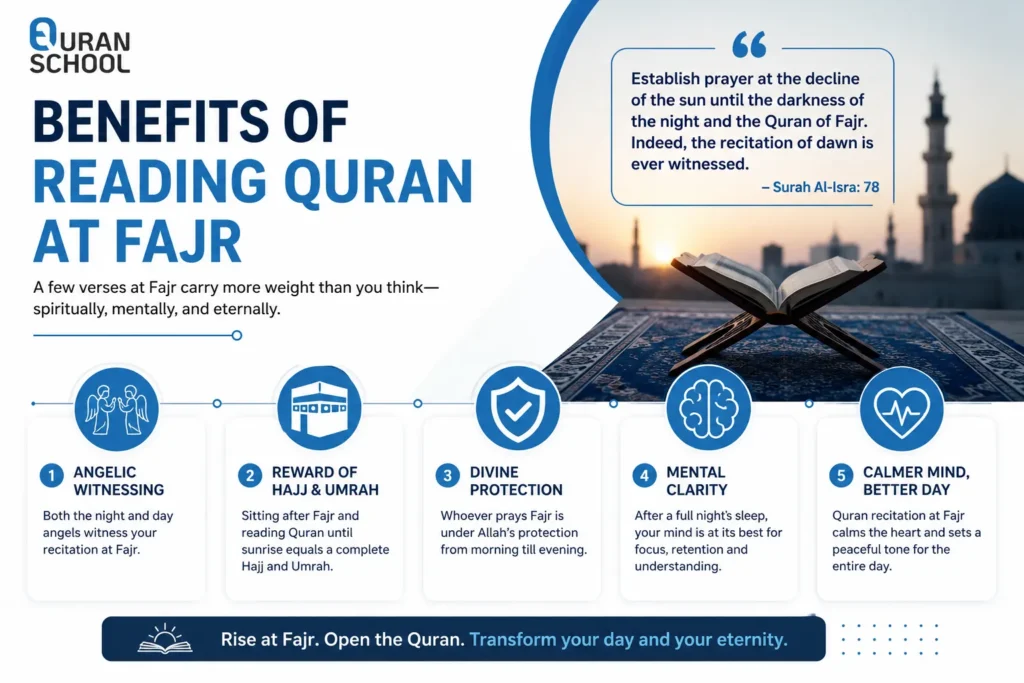
“Establish prayer at the decline of the sun until the darkness of the night and the Quran of Fajr. Indeed, the recitation of dawn is ever witnessed.” (Surah Al-Isra: 78) The benefits of reading Quran at Fajr are not vague promises of general goodness.
Each one is documented in the Quran or authentic Sunnah with the same precision the Prophet ﷺ used to describe the reward of every identified act of worship: angelic witnessing, protection for the day, a reward equivalent to Hajj and Umrah, and a rank in Paradise that ascends with every verse recited.
Whether you are in the US, UK, Canada, Australia, or anywhere else in the world, the math is the same and the method works: rise at Fajr, open the Quran, recite. What follows in your day — and in your account with Allah — shifts in proportion to that single daily choice.
Each benefit below builds on the one before it, moving from the moment of recitation outward — from spiritual weight to psychological effect to eternal consequence.
1. One Of The Benefits Of Reading Quran At Fajr Is That Both Shifts Of Angels Witness Your Recitation
The most singular benefit of Fajr recitation is one that cannot be replicated at any other time: the angels of the departing night shift and the angels of the arriving day shift are present simultaneously.
The Prophet ﷺ said: “The angels of the night and the angels of the day gather at the Fajr prayer.” (Bukhari, 649; Muslim, 649). Abu Hurairah رضي الله عنه, after narrating this, would add: “Read if you wish: ‘Indeed, the recitation of dawn is ever witnessed.'”
This dual witnessing happens only at Fajr and Asr. When the night angels ascend, their Lord asks: “How did you leave My servants?” The answer for those who recited at Fajr: “We found them reciting, and we left them reciting.” Your words are carried upward by two delegations — at no other prayer does this occur.
Read also: Benefits Of Reading Quran In The Morning
Start learn Quran with Tajweed with your first free class

2. Who Read Quran At Fajr Earns A Complete Hajj And Umrah
The Prophet ﷺ said: “Whoever prays Fajr in congregation, then sits remembering Allah until the sun rises, then prays two rak’ahs — it is as if he performed a complete Hajj and Umrah. Complete, complete, complete.” (Tirmidhi, graded Hasan Sahih by Al-Albani)
The Quran is, in the unanimous view of scholars, the highest form of dhikr. Imam an-Nawawi explicitly confirmed that Quran recitation falls within the “remembrance of Allah” referenced in this narration.
Sitting after Fajr prayer and reading the Quran until sunrise earns what this Hadith describes. No plane ticket, no visa, no financial outlay — offered every single morning to anyone who rises and recites.
Read also: 10 Benefits Of Reading Quran At Night
3. Read Quran At Fajr Grants Divine Protection That Extends Through Your Day
One of the most practically significant benefits of reading Quran at Fajr is the divine protection it activates for everything that follows. The Prophet ﷺ said: “Whoever prays Fajr is under the dhimmah of Allah.” (Muslim, 657). Imam an-Nawawi explained dhimmah as a guarantee — a divine covenant of safety from Fajr until evening.
Imam al-Tayyibi noted that Fajr was singled out specifically because performing it against the pull of sleep is a distinguishing mark of sincere faith. Beginning the day with Quran recitation deepens the act of worship and places the believer directly within this narration. The protection is real. The question is whether you rise to receive it.
If your students or children are building this habit early, a Quran Reading and Recitation Teacher who schedules sessions aligned to the Fajr window can anchor the practice through accountability — especially in the critical first weeks.

Read also: The Scientific Benefits Of Reading Quran Which Research Now Confirms
4. Reading Quran At Fajr Results In Mental Clarity That No Later Hour Can Replicate
Sleep performs a specific neurological function: it clears the metabolic waste products that accumulate in the brain during waking hours. The mind at Fajr, after completing a full sleep cycle, operates at its highest capacity for vocabulary retention, pattern recognition, and sustained focus.
Scholars understood this centuries before cognitive science confirmed it. Ibn Baz رحمه الله advised students to recite when “the heart and mind are present and unoccupied” — and identified the post-Fajr window as prime among all daily periods.
Those working on Hifz (memorization) consistently report that verses reviewed at Fajr lodge more firmly in memory than the same verses reviewed in the evening. At Fajr, you are not fighting distraction. Distraction simply hasn’t arrived yet.
See Us in Action
Watch a quick snippet from our live, interactive classes below and see how our teachers make learning engaging for all ages!
Start Your Quranic Journey Today
Experience our interactive online classes with a dedicated tutor.
Get Your Free Trial5. Reading Quran At Fajr Keeps The Autonomic Nervous System In A Calmer Baseline
The health benefits of reading Quran are both spiritual and physiological, and at Fajr they interact with the body’s natural state in measurable ways. Cortisol — the primary stress hormone — is at its lowest point upon waking, before external demands activate its release.
Beginning the day with measured, breath-regulated recitation keeps the autonomic nervous system in a calmer baseline for longer. Tartil — the slow, deliberate recitation style commanded in the Quran (73:4) — naturally regulates breathing at a pace associated with reduced heart rate and lower anxiety. These effects compound over time.
The practitioner who recites at Fajr daily is not only fulfilling a religious obligation — they are calibrating their entire physiological response to the day before the day has had a chance to set the terms.
Book a free trial class at E Quran School

Read also: 10 Spiritual Benefits Of Reading Quran
6. Reading Quran At Fajr Creates A Relationship With The Quran That Deepens Over Time
The benefits of Quran recitation extend far beyond individual sessions. Recitation is a skill, and like every skill, it compounds with consistent practice.
Those who read at Fajr every day find — and scholarship supports this — that their relationship to the text changes over months: vocabulary becomes intuitive, passages surface naturally in moments of stress or decision, and the Quran begins to function as an internal reference rather than an external text.
This compounding effect is precisely why the Prophet ﷺ described justified envy as belonging to one “whom Allah has given the Quran and he recites it night and day.” (Bukhari, Muslim).
The Fajr reader embodies this description in its most concentrated form. Those who are still building reading fluency benefit from free online Quran classes for adults that provide structured sessions timed to the Fajr window — pairing spiritual practice with skill development simultaneously.
7. Every Letter Yields Ten Rewards — Witnessed By Both Delegations
The Prophet ﷺ said: “Whoever reads a letter from the Book of Allah receives one reward, and that reward is multiplied by ten. I don’t say Alif Lam Mim is one letter — Alif is a letter, Lam is a letter, and Mim is a letter.” (Tirmidhi, Sahih).
This reward structure exists at all times. But at Fajr, with both delegations of angels recording the recitation, it carries an added layer of divine attention. A believer who reads three pages after Fajr — a modest, achievable target — crosses well over a thousand letters before the sun is fully up.
That is more than ten thousand individual rewards, witnessed and recorded by two simultaneous angelic delegations. The arithmetic here is not symbolic. It is the stated reward, available every morning, to anyone who rises and opens the Quran.
8. Quran Intercedes For You On The Day Of Judgment
Of all the habits a Muslim can build, few carry consequence across both lives. The Prophet ﷺ said: “Recite the Quran, for it will come on the Day of Resurrection as an intercessor for its companions.” (Muslim, 804). He also said: “Fasting and the Quran will both intercede for the servant on the Day of Judgment.” (Ahmad, graded Sahih)
The pages you recite at Fajr this morning do not disappear when the day begins. They become a witness — an advocate who will stand for you on the Day when advocates matter more than anything this world offers.
Scholars call this the “durable benefit” of consistent recitation: a transfer of spiritual capital from the present moment to the moment of greatest need.
Get a FREE Trial of our Quran with Tajweed Classes for Kids and Adults

9. Your Station In Paradise Rises With Every Verse You Read
Scholars have always insisted on learning the rules of recitation alongside the habit of daily reading. The Prophet ﷺ said: “It will be said to the companion of the Quran: ‘Recite and ascend, and recite with tartil as you used to in the world, for your station will be at the last verse you recite.'” (Abu Dawud, Tirmidhi, Sahih).
This Hadith reveals a direct, proportional relationship between the volume and quality of recitation in this life and the rank one holds in Paradise. Every Fajr session builds that rank, verse by verse, permanently.
For those serious about the benefits of reading Quran in Arabic with correct pronunciation, understanding how to learn Qirat of Quran is not a peripheral interest — it is the mechanism by which Fajr recitation maximizes its permanent reward.
Start A Free Trial For Your Quranic Journey Today

10. Reading Quran At Fajr Brings Barakah — Blessing — In Your Time And Daily Affairs
The Fajr Quran reader sits directly in the path of this prophetic dua, every single morning. The Prophet ﷺ made a specific supplication for this: “O Allah, bless my Ummah in their early mornings.” (Abu Dawud, Ibn Majah).
Practitioners who maintain this habit for months consistently describe a tangible shift: tasks that are expected to take hours are completed sooner, focus holds longer, the day flows rather than resists. Classical Islamic literature calls this barakah in time.
It is difficult to measure in any single session — but it accumulates, and those who have maintained the habit for long enough describe it as one of the most concrete changes they have experienced. The cause is not mysterious.
The one who begins the day having already worshipped, recited, and been covered by divine protection simply navigates the rest of the day differently.
Start Your Quranic Journey Today
Experience our interactive online classes with a dedicated tutor.
Get Your Free TrialHow To Build A Sustainable Fajr Quran Habit?
Knowing the rewards is necessary but not sufficient. Most people who struggle to maintain a Fajr Quran habit do so not because they lack sincerity, but because they lack a practical routine. The following principles can help turn good intentions into lasting consistency.
A. Build Your Habit On Structure, Not Motivation
Knowing the rewards is necessary but not sufficient. Most people who fail at Fajr Quran reading fail not from lack of sincerity but from lack of structure. These are the practitioner-tested principles that actually work.
B. Prepare For Success The Night Before
The first failure point is the night before, not the morning. Sleeping past midnight without a fixed alarm and a clear intention is how the habit ends before it begins. Performing ablution before sleeping—which the Prophet ﷺ encouraged—is associated in narrations with ease of rising.
C. Begin Your Recitation Immediately After Fajr
The second failure point is postponing recitation until “after I’ve settled.” Begin immediately after Fajr prayer, before anything else. The mind is clearest at that moment, and every delay introduces friction that often leads to distraction or postponement.

Experience Our Classes
Don’t just take our word for it—watch real-time recordings of our online classes below to experience our teaching style firsthand.
Start Your Quranic Journey Today
Experience our interactive online classes with a dedicated tutor.
Get Your Free TrialLearning To Recite Properly Through The Equran School Approach
Most online Quran platforms use generic Arabic phonics materials designed for native Arabic children — materials that assume a cultural and linguistic context most Western Muslims simply do not have.
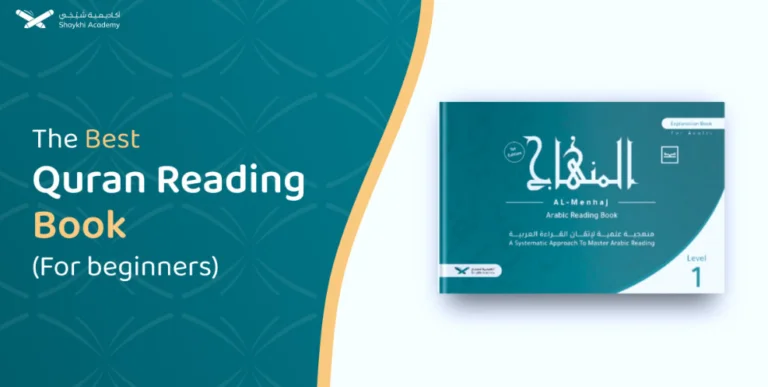
EQuran School developed the proprietary Al-Menhaj Book — authored by Luqman ElKasabany — specifically for non-Arabic speaking adults and children in Western contexts.
The methodology addresses the specific challenges of learners who did not grow up hearing Quranic Arabic, building a structured phonics pathway rather than assuming immersion-based familiarity.
The ability to learn Quran online from home with a methodology designed for your background — rather than adapted from a classroom built for native speakers — makes a measurable difference in the speed and confidence of progress. For those who want to go beyond recitation into understanding, the question of what we learn from the Quran is best explored through guided Tafsir study alongside reading practice.
EQuran School’s complete curriculum includes:
- Quran Reading Classes
- Quran Tafsir Course
- Zoom Quran Classes
- Online Arabic and Quran Classes
- Quran Qirat Learning Course
- Quran for Beginners Course
- Weekend Quran Classes
- Quran Ijazah Program
Begin Your Practice Of Reading Quran At Fajr With Expert Guidance
Your Fajr is already blessed. The question is what you do with it. EQuran School’s certified teachers offer flexible sessions aligned to your Fajr window across every timezone — US, UK, Canada, Australia, and beyond. Structured. Scheduled. Guided by instructors who understand what non-Arabic speaking Muslims actually need at every level.
Book a free trial class at E Quran School and experience personalized Quran instruction that adapts to your unique learning needs, Insha’Allah.

Start Your Quranic Journey Today
Experience our interactive online classes with a dedicated tutor.
Get Your Free TrialConclusion
The benefits of reading Quran at Fajr are not aspirational claims — they are documented, specific, and layered. Angels witness your words and carry them upward. Divine protection extends over your entire day. Your rank in Paradise ascends incrementally with every verse. Your mind operates at peak receptivity.
Your time carries barakah that practitioners consistently describe as one of the most tangible changes they have ever experienced. Ten benefits are documented in this article, but the underlying principle is simpler: Fajr is the moment the day is set.
The Prophet ﷺ did not recite 60 to 100 verses at Fajr because it was convenient. He did it because he understood what most of us are still learning — that Fajr is not just the beginning of the day. It is the axis around which the day turns.
Frequently Asked Questions
What does “Quran of Fajr” mean in Surah Al-Isra?
“Quran of Fajr” refers to Fajr prayer itself — specifically the Quran recited within it. Classical scholars including Ibn Kathir, Mujahid, Ad-Dahhak, and Ibn Zayd all interpreted the phrase (17:78) as referring to Fajr prayer rather than standalone recitation.
Is it better to read Quran before or after Fajr prayer?
Recitation inside the prayer itself is the highest form, as confirmed by an-Nawawi and Ibn Taymiyyah. After prayer, sitting with the Quran until sunrise carries the reward described in the Hajj-and-Umrah Hadith. Before prayer — in the last third of the night — falls under tahajjud and is also highly recommended.
How much Quran should I read at Fajr?
The Prophet ﷺ recited between 60 and 100 verses in Fajr prayer itself. After prayer, any amount is better than none. Beginners should start with half a page and build gradually — consistency over months matters far more than volume in individual sessions.
Can I read Quran at Fajr if I haven’t memorized much?
Reading from the mushaf (physical Quran) or a digital device is fully valid and encouraged. Recitation from memory is an additional level of reward, not a prerequisite. Those still learning to read fluently should use this time to read slowly and carefully, applying whatever Tajweed rules they know.
Why is tartil important for Fajr recitation specifically?
The Hadith that connects Quran recitation to one’s station in Paradise specifies “recite with tartil as you used to in the world.” Tartil — the measured, rule-governed recitation prescribed in Surah Al-Muzzammil (73:4) — is what determines the quality of recitation, not just its quantity.
How do I stop missing my Fajr Quran session?
The most common reason for missing Fajr Quran time is insufficient sleep — not weakness of faith. Establish a consistent sleep time, set the alarm before bed, and limit screen use in the final hour before sleeping.
Performing ablution before sleep and resolving the intention clearly are practices the Prophet ﷺ specifically linked to ease of rising. In the morning, begin recitation immediately after prayer — before checking messages or anything else.
Related Articles
Learn Quran











Leave a Reply