 Quran
Quran
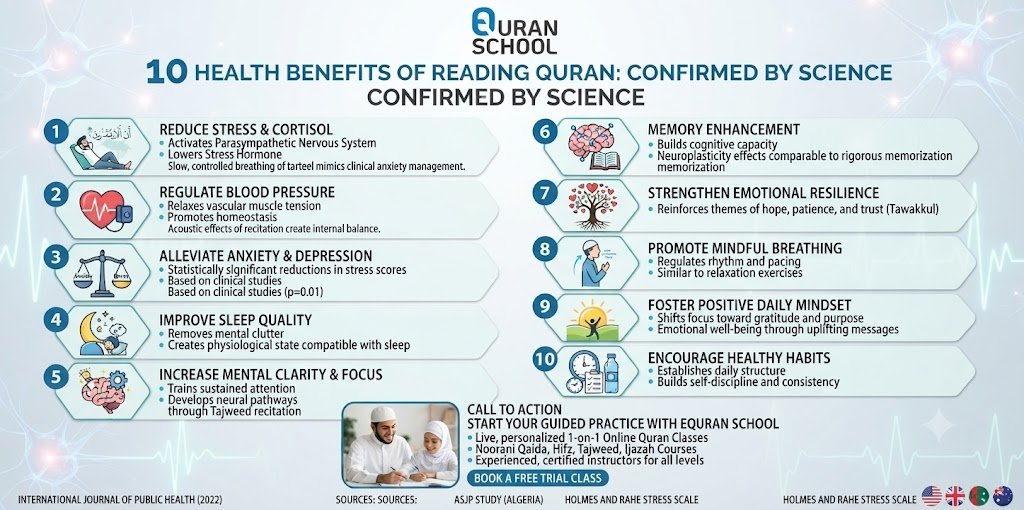
The health benefits of reading Quran operate through real physiological and psychological pathways — not vague claims. The source material draws from two distinct frameworks: Islamic scholarly consensus dating back to Ibn al-Qayyim and Ibn Taymiyyah, and 21st-century clinical research measuring cortisol, heart rate, blood pressure, and psychological stress scores.
A peer-reviewed study published in the International Journal of Public Health (2022) found statistically significant reductions in psychological stress scores among participants who listened to, recited, and reflected on the Quran — with changes significant at the p=0.01 level. The mechanisms are real, and they are worth understanding.
This article covers the core health benefits of reading Quran — mental, cognitive, and physical — along with what conditions make those benefits strongest, and how structured Quran learning deepens them.
1. Reduce Stress And Cortisol
Quran recitation activates the parasympathetic nervous system — the branch responsible for rest, calm, and recovery — and triggers a measurable drop in cortisol, the body’s primary stress hormone.
Research cited in the International Journal of Public Health (2022) confirms that recitation helps “improve the body’s chemical balance and eliminate negative thoughts.”
The rhythmic breathing pattern required during tarteel (measured recitation) is structurally similar to controlled breathing techniques used in clinical anxiety management — slow exhale, steady inhale, regulated pace.
This is the mechanism, not metaphor: controlled breath during recitation physically slows heart rate and suppresses stress hormone output.
Read also: 10 Benefits of Reading Quran in Arabic
Read Also: How to Learn the Quran?

2. Regulate Blood Pressure
The steady respiratory rhythm of Quran recitation directly relaxes vascular muscle tension and lowers heart rate, which produces a corresponding drop in blood pressure.
An Algerian study published in ASJP specifically measured what the researcher called “the physiological effect of hearing the sound of the Quran,” finding that the sound waves of Quran recitation at specific frequencies affect brain cells in a way that promotes homeostasis — the body’s internal balance.
This is not background noise producing relaxation; it is a specific acoustic effect tied to the structure of Quranic recitation.
Read Also: Learn Quran Alphabet
3. Alleviate Anxiety and Depression
Clinical studies applying the Holmes and Rahe Stress Scale to 39 participants with confirmed high psychological stress found that a Quran-based therapeutic program produced statistically significant reductions in stress scores — at the p=0.01 confidence level.
The research confirmed that all three modes of engagement — listening, reciting, and reflecting on meaning — each contribute independently to reducing anxiety and depression symptoms. Combining all three produced the strongest outcomes.
If you are working toward establishing a consistent recitation practice, the Online Quran Recitation Classes at EQuran School offer structured 1-on-1 sessions with qualified instructors who can guide proper pronunciation and tarteel from wherever you are.
Read also: The Importance of Learning and Teaching Quran

4. Improve The Quality of Sleep
Listening to or reading the Quran before sleep removes the mental clutter that delays rest — the replaying of the day’s events, anxious forward-planning, and emotional residue.
The mechanism is the same as cortisol regulation: the parasympathetic activation produced by recitation creates a physiological state that is compatible with the onset of sleep.
Scholars have long recommended reciting specific surahs before sleeping, and the physiological rationale now supports what was already a prophetic practice.
Book a FREE Trial Class in EQuran School

5. Increase The Mental Clarity and Focus
Daily Quran reading trains sustained attention. The rhythmic, rule-governed nature of Tajweed recitation requires the reader to hold multiple things simultaneously — correct pronunciation, breath control, meaning, and flow — which functions as deliberate cognitive training.
Many practitioners across the USA, UK, and Australia who establish a daily Quran habit report improved concentration and reduced mental scatter in their professional and academic lives. This is consistent with what we know about attention training: the brain strengthens the neural pathways it regularly uses.
Structured learning through the Quran for Beginners Course or the Noorani Qaida Course provides the foundational skills to read accurately, which is what makes this cognitive training effective. Inaccurate, halting reading produces frustration; fluent recitation produces focus.
Experience Our Classes
Don’t just take our word for it—watch real-time recordings of our online classes below to experience our teaching style firsthand.
Start Your Quranic Journey Today
Experience our interactive online classes with a dedicated tutor.
Get Your Free TrialRead also: 7 Benefits of Quran Recitation – A Complete Guide
6. Memory Enhancement and Cognitive Function
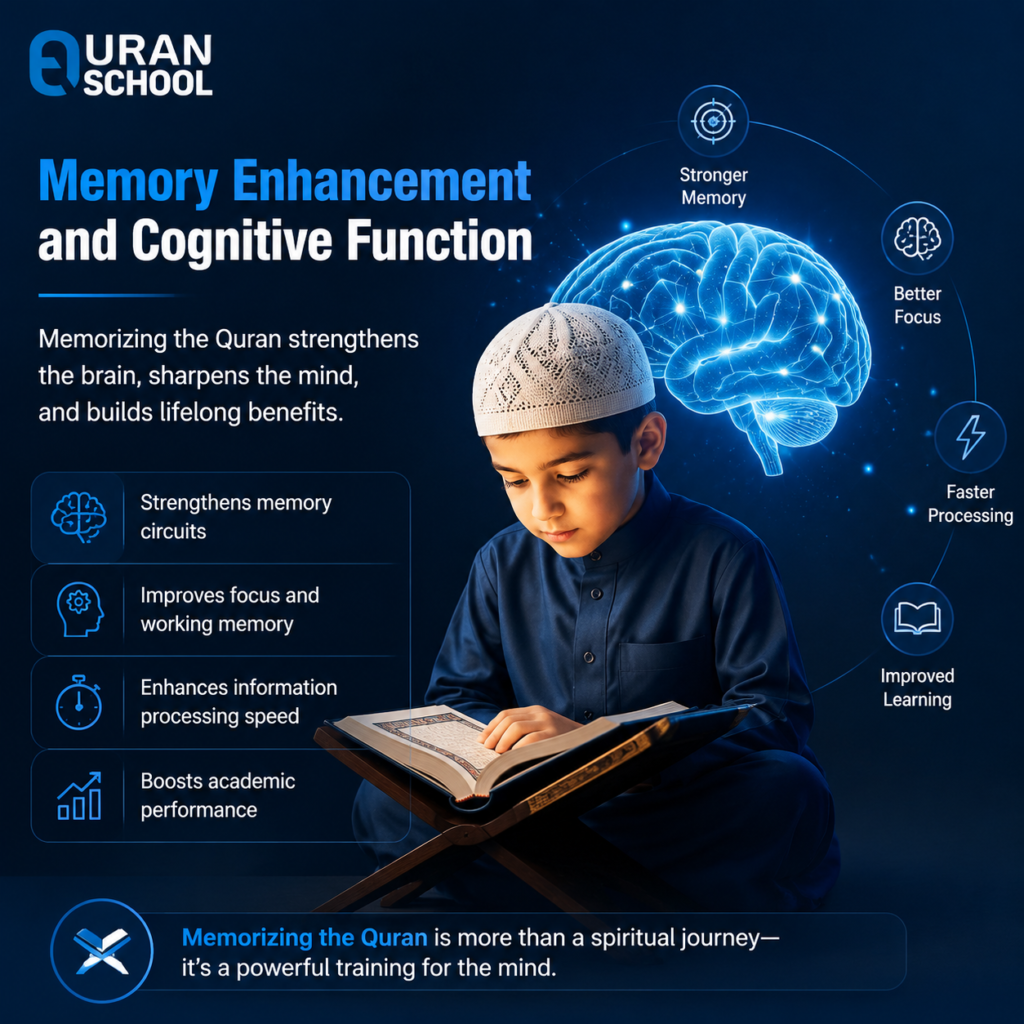
Memorizing Quran — even short portions — produces neuroplasticity effects comparable to other rigorous memorization disciplines. The process demands repeated retrieval, spaced review, and phonological precision — all three of which strengthen memory circuits.
Practitioners who memorize regularly report clearer recall, faster information processing, and stronger working memory. Children who memorize the Quran early are observed to perform better in school across subjects — not because of religious motivation alone, but because the memorization practice itself builds cognitive capacity.
Read also: The Best Online Quran Classes for Non-Arabic Speakers
This is why Hifz Classes for Adults and the Quran Memorization (Hifz) Course at EQuran School serve an audience far broader than those seeking the spiritual reward of memorization. The cognitive benefits are real and transferable.
7. Strengthen Emotional Resilience
One of the lesser-discussed health benefits of reading the Quran is its ability to build emotional resilience—the capacity to recover from setbacks, grief, and uncertainty. Regular recitation reinforces themes of hope, patience (sabr), trust in Allah (tawakkul), and divine mercy, helping believers process life’s difficulties with a healthier perspective.
From a psychological standpoint, repeated exposure to these messages encourages positive cognitive reframing, a technique commonly used in modern psychotherapy to reduce emotional distress. Rather than eliminating life’s challenges, Quran recitation helps individuals respond to them with greater emotional stability and inner strength.
Start Mastering the Quran from Home Today with Free Trial for your first session

8. Promote Mindful Breathing and Relaxation
Proper Quran recitation naturally encourages slow, controlled breathing. During tarteel, readers pause at appropriate places, regulate their breath, and maintain a steady rhythm throughout each verse. This breathing pattern resembles diaphragmatic breathing exercises that are widely recommended for relaxation and nervous system regulation.
Unlike passive relaxation techniques, Quran recitation combines mindful breathing with spiritual reflection, engaging both the body and the heart. Over time, this practice can help reduce physical tension, promote relaxation, and support overall well-being as part of a healthy daily routine.
Start learn Quran with Tajweed with your first free class

9. Foster a More Positive Daily Mindset
Beginning or ending the day with Quran recitation helps shift attention away from constant distractions and negative thought patterns toward gratitude, purpose, and hope. The Quran repeatedly reminds believers of Allah’s mercy, wisdom, and promises, creating a mindset centered on optimism rather than worry.
Psychologists recognize that regularly focusing on meaningful and uplifting messages can improve emotional well-being and strengthen long-term mental health. For Muslims, daily Quran recitation serves as both spiritual nourishment and a practical habit that encourages a calmer, more positive outlook on everyday life.
Join our Quran Tafsir Course and get a free trial

10. Encourage Healthy Daily Habits and Self-Discipline
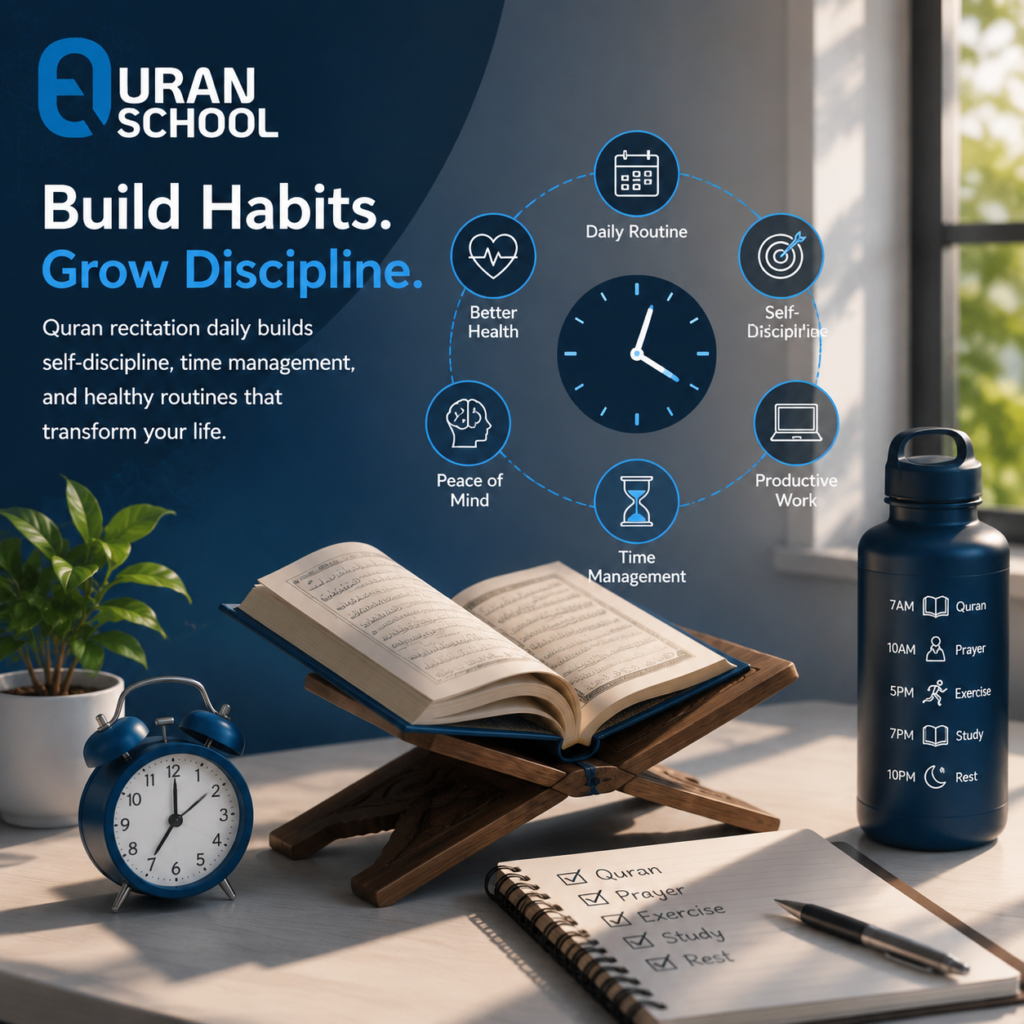
Consistent Quran recitation helps establish a structured daily routine, which is closely associated with better mental and physical health. Setting aside a specific time each day to read the Quran encourages discipline, time management, and healthy habits that often extend to other areas of life, such as maintaining regular sleep schedules, prayer, exercise, and productive work.
Behavioral research consistently shows that stable daily routines reduce decision fatigue and improve long-term well-being. By making Quran recitation a non-negotiable part of the day, many people develop greater self-control and consistency—qualities that support both psychological health and a balanced lifestyle.
Read also: How To Learn The Quran For Kid In 9 Proven Steps?
Framework To Maximize The Health Benefits Of Reading Quran
Most people do not fail at Quran practice because they lack motivation — they fail because they lack structure. Here is a practical framework, drawn from both scholarly tradition and what produces consistent results in learners across English-speaking countries:
A. Daily minimum:
15–20 minutes of focused, attentive recitation — not background audio.
B. Condition for effect:
The Algerian physiological study specifically notes that listening produces stronger effects than passive hearing because it requires single-pointed attention. The same applies to reading: distracted recitation produces less physiological benefit than concentrated recitation.
C. Progression path:
Begin with proper pronunciation through the Noorani Qaida Course or Quran for Beginners Course. Inaccurate reading creates cognitive dissonance that undermines the calming effect. Fluency is not optional — it is what makes the practice work.
For advanced learners the Quran Ijazah Program and Al-Azhar Quran Course represent a level of engagement with the text that deepens every benefit described above — through mastery, not just familiarity.
See Us in Action
Watch a quick snippet from our live, interactive classes below and see how our teachers make learning engaging for all ages!
Start Your Quranic Journey Today
Experience our interactive online classes with a dedicated tutor.
Get Your Free TrialStart Your Quran Practice with EQuran School
Whether you are in New York, London, Toronto, or Sydney, a consistent, guided Quran practice is now accessible without leaving your home. EQuran School connects students across the USA, Canada, the UK, Europe, and Australia with qualified, certified instructors for 1-on-1 online sessions at flexible times.
Our courses cover every level and goal: the Noorani Qaida Course for beginners building their first Arabic sounds, the Quran Memorization (Hifz) Course for those pursuing full or partial memorization, Hifz Classes for Adults, the Intensive Quran Course for learners who want faster progression, and the Quran Ijazah Program for those seeking certified mastery.
Every session is live, personalized, and designed to build the consistent practice that produces every health benefit described in this article.
E Quran School provides complete curriculum including:
- Online Arabic and Quran Classes
- Quran Qirat Learning Course
- Weekend Quran Classes
- Quran Reading Classes
- Skype Quran Classes
Book a free trial class at E Quran School and make steady progress with Quran lessons customized to your needs and pace, Insha’Allah.
Start Your Quranic Journey Today
Experience our interactive online classes with a dedicated tutor.
Get Your Free TrialConclusion
The health benefits of reading Quran are not symbolic — they are physiological, psychological, and cognitive. Cortisol drops during recitation. Blood pressure responds to the respiratory rhythm of tarteel. Anxiety scores fall measurably when Quran engagement is practiced consistently.
Memory circuits strengthen through memorization. Mental clarity improves through the attention training of daily reading.
The condition for all of this is the same one Ibn al-Qayyim stated eight centuries ago: the benefit comes to those who engage with sincerity, attentiveness, and correct practice. Distracted recitation is not the same as focused recitation — and no recitation is only as good as its consistency.
The path forward is straightforward: learn to read correctly, recite daily, and memorize what you can. EQuran School exists to make all three of those steps achievable for Muslims wherever they live.
Frequently Asked Questions
What are the health benefits of reading the Quran daily?
Daily Quran reading reduces cortisol levels, activates the parasympathetic nervous system, lowers blood pressure, improves sleep quality, and strengthens memory and focus.
Clinical research using the Holmes and Rahe Stress Scale confirmed statistically significant stress reduction (p=0.01) in participants who engaged with Quran through listening, reciting, and reflection.
Does listening to the Quran have the same health benefits as reading it?
Listening to the Quran produces strong immediate relaxation effects through acoustic mechanisms — sound wave frequencies that affect brain cell states and promote neurological balance.
Personal recitation adds respiratory regulation benefits that passive listening does not produce. For the fullest range of health benefits, combining listening and recitation is more effective than either alone.
Can reading the Quran help with anxiety and depression?
Yes. A peer-reviewed Algerian study applied a Quran-based therapeutic program to 39 participants with confirmed high stress and found significant reductions in psychological stress scores afterward.
The research confirmed that Quran engagement — through listening, reciting, and reflecting on meaning — contributes to the disappearance of anxiety symptoms and the restoration of psychological health.
Does memorizing the Quran improve memory and cognitive function?
Memorizing the Quran strengthens working memory, accelerates information processing, and builds sustained attention through the repeated retrieval and spaced review the process requires.
These cognitive effects are not limited to Quranic content — they transfer to general learning capacity, which is why children who memorize Quran typically demonstrate stronger academic performance across subjects.
How much Quran should I read daily to get health benefits?
Fifteen to twenty minutes of focused, attentive daily recitation is a practical minimum that produces consistent benefits.
The key variable is attentiveness — distracted background recitation does not activate the physiological mechanisms that produce stress reduction and relaxation. Quality and consistency matter more than duration.
Can beginners benefit from Quran reading before learning proper Tajweed?
Yes, but the benefit increases significantly with correct pronunciation. Accurate recitation — produced through proper Tajweed — creates the respiratory rhythm and phonological precision that drives the physiological effects.
Beginners benefit from starting with the Noorani Qaida Course or a Quran for Beginners Course to build foundational accuracy early, rather than correcting habits later.










Leave a Reply