 Quran
Quran
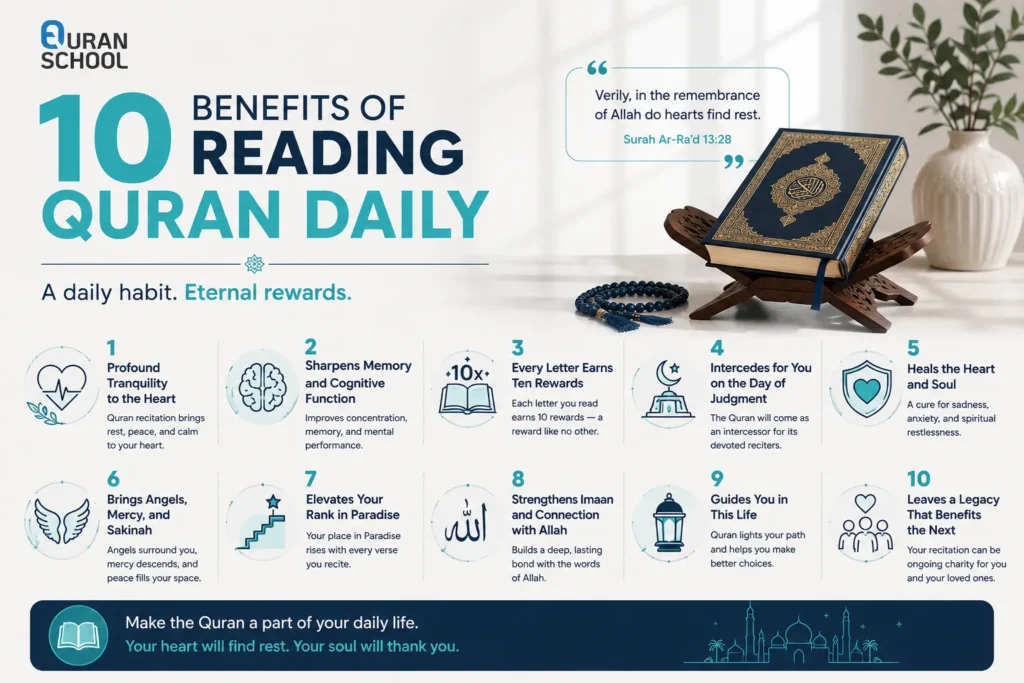
There is a question many Muslims carry quietly — not out of doubt, but out of longing: what changes when I read the Quran every single day? The answer, drawn from prophetic hadith, centuries of scholarship, and modern research, is more far-reaching than most people expect.
The benefits of reading Quran daily extend well beyond reward points on a spiritual ledger. Daily recitation reshapes the heart, settles the nervous system, sharpens the mind, and gradually reorients a person’s entire orientation toward life.
The Prophet ﷺ compared the believer who reads the Quran to an orange: beautiful on the outside and sweet within. That description is not metaphor — it is a practical outcome of sustained daily engagement with God’s words.
This article walks through ten specific, evidence-grounded benefits, explains the mechanism behind each one, and shows you how to build a sustainable daily practice — even if you’re starting from scratch.
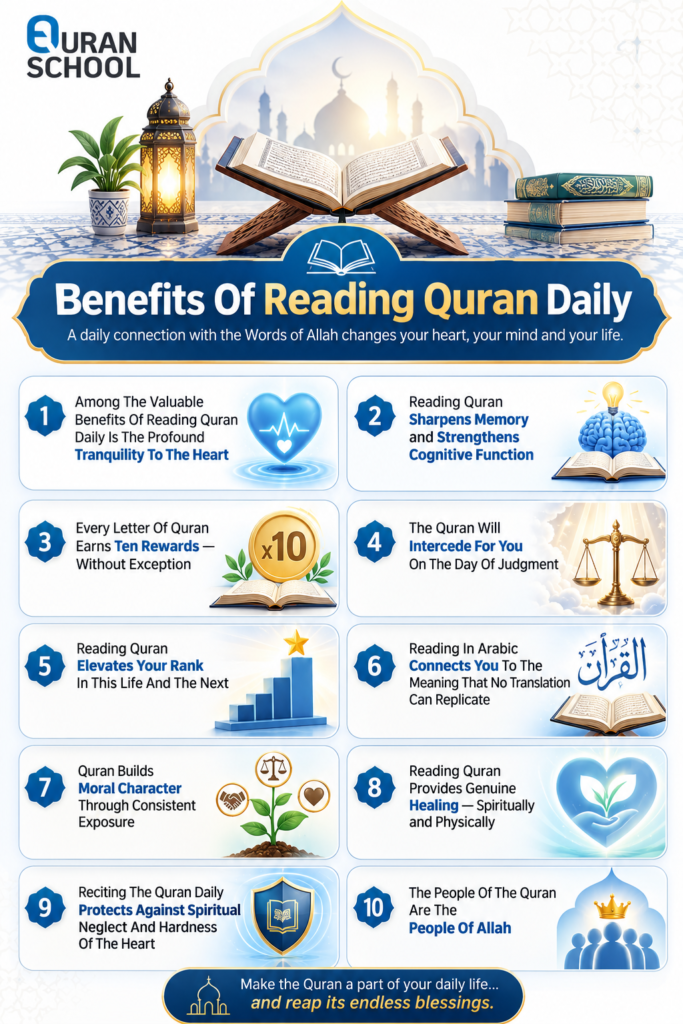
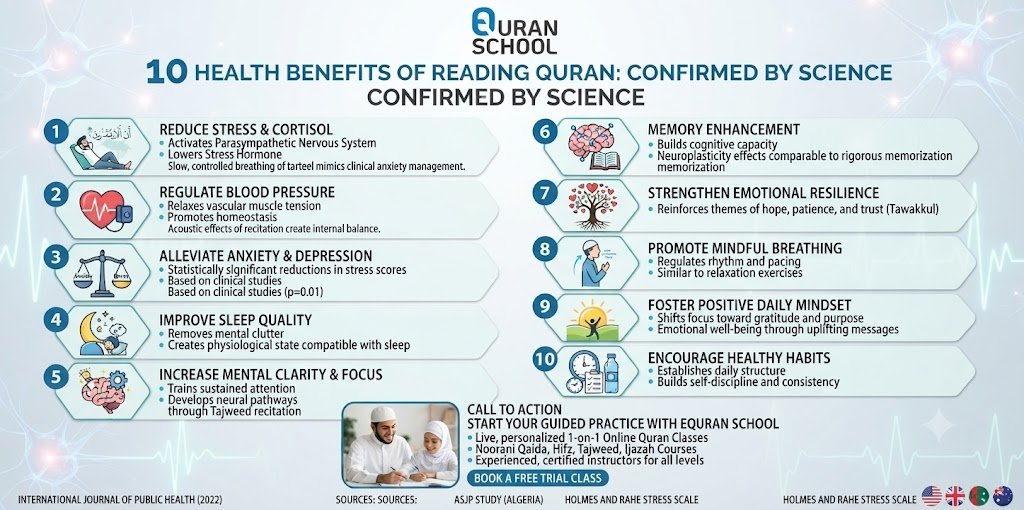
1. Among The Valuable Benefits Of Reading Quran Daily Is The Profound Tranquility To The Heart
The Quran is the supreme form of dhikr — and its effect on the heart is not symbolic. Allah says in the Quran: “Verily, in the remembrance of Allah do hearts find rest.” (Al-Ra’d: 28).
Decades of research in psychoneuroimmunology have found that contemplative practices — structured, attentive engagement with meaningful language — activate the parasympathetic nervous system, reduce cortisol, and prompt the brain to release endorphins, the body’s natural calming agents.
Quran recitation, particularly with tarteel (deliberate, measured pace), engages this exact mechanism. Studies conducted in Saudi Arabia found that students who maintained regular Quran recitation reported significantly higher levels of psychological stability than peers who did not.
This is why scholars of the past described the Quran as shifaa — a cure. Not a metaphor, but a description of what actually happens in a person’s inner state when they maintain consistent recitation.
The health benefits of reading Quran have been affirmed by both prophetic text and contemporary neuroscience, though believers have never needed science to validate what their hearts have always known.
Start Mastering the Quran from Home Today with Free Trial for your first session
Read also: Hadith About Reciting Quran Loudly – A Complete Guide

2. Reading Quran Sharpens Memory and Strengthens Cognitive Function
Neuroscientists studying memorization-intensive religious practices have consistently found that regular Quran recitation improves working memory, increases verbal fluency, and expands a person’s capacity for sustained attention.
A study examining Quran memorization and academic performance found that students who memorized more of the Quran consistently outperformed their peers — not just in Islamic subjects, but across disciplines.
The mechanism is not miraculous in the narrow sense — it is structural. Memorizing Arabic verse requires the brain to track rhythm, phonology, meaning, and sequence simultaneously. This cross-modal engagement creates stronger neural pathways than rote repetition of single-language content.
For those looking to build this habit in a structured way, a 30 day Quran reading schedule — moving through one juz per day during Ramadan, for example — provides the consistency that turns occasional reading into a genuine discipline.
Read also: 10 Benefits Of Reciting Quran Daily
Start Your Quranic Journey Today
Experience our interactive online classes with a dedicated tutor.
Get Your Free Trial3. Every Letter Of Quran Earns Ten Rewards — Without Exception
The arithmetic of Quran recitation is unlike any other act of worship. The Prophet Muhammad ﷺ said: “Whoever reads a letter from the Book of Allah will receive a hasanah (good deed) for it, and the hasanah is multiplied by ten. I do not say that Alif-Lam-Meem is one letter — rather, Alif is a letter, Lam is a letter, and Meem is a letter.” (Tirmidhi, hasan sahih)
The Quran contains approximately 323,015 letters. A person who reads one complete recitation earns over three million acts of reward — each multiplied further in months like Ramadan and the first ten days of Dhul Hijjah.
This is the core of what scholars call the benefits of Quran recitation: an unmatched economy of spiritual return that favors consistency over perfection. This reward applies whether you read fluently or struggle through the letters.
The hadith of A’isha (may Allah be pleased with her) makes this explicit — the one who recites with difficulty and stumbles receives two rewards, one for reading and one for the effort itself.
Read also: Quran Reading Plan for Beginners: A Step-by-Step Guide
4. The Quran Will Intercede For You On The Day Of Judgment
One of the greatest virtues of regularly reciting the Quran is that it will intercede on behalf of its devoted reciters on the Day of Judgment. The Prophet ﷺ said: “Read the Quran, for it will come on the Day of Resurrection as an intercessor for its companions.” (Muslim)
This intercession is not passive. In a hadith reported by Ahmad, the Quran meets its companion when the grave opens and says: “I am your companion the Quran, which kept you thirsty in the heat of midday and kept you awake at night.”
It then places the crown of honor on his head, wraps his parents in garments more valuable than all the wealth of this world, and continues to elevate him in the ranks of Paradise for as long as he recites.
The operative word in all these narrations is “companion” (sahib). Companionship, in Islamic ethics, implies regularity, familiarity, and devotion. A person who reads the Quran once a year is not a companion; a person who returns to it daily is.
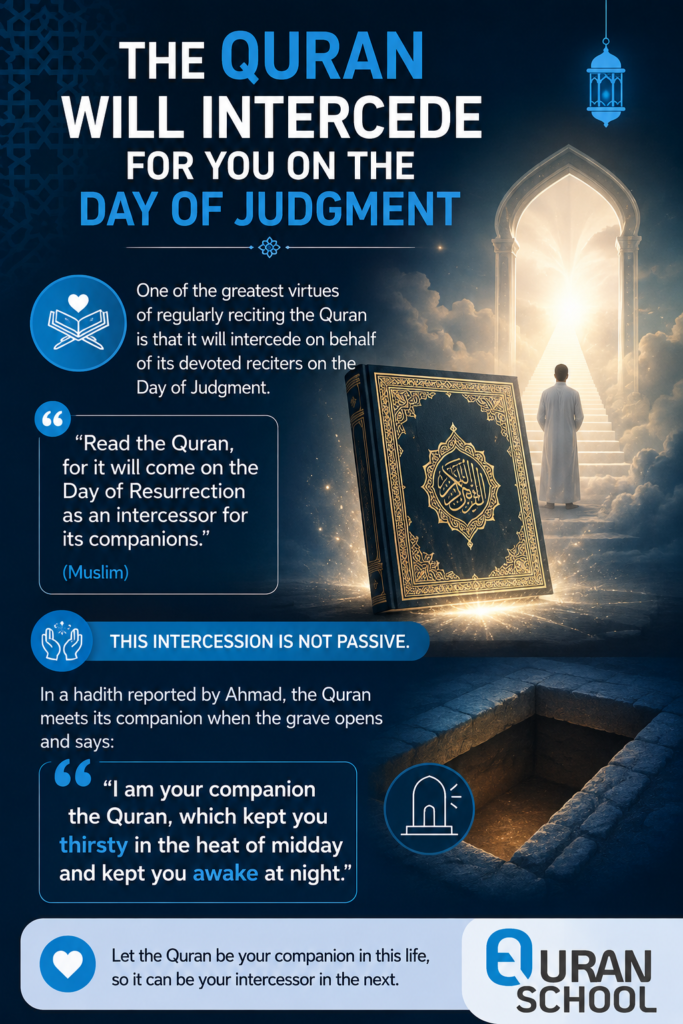
5. Reading Quran Elevates Your Rank In This Life And The Next
The Prophet ﷺ said: “Allah raises some people by this Book and lowers others by it.” (Muslim). The elevation is social, moral, and spiritual — it operates in both worlds simultaneously.
In this life, the person of Quran carries a presence, a quality of speech, and a calmness under pressure that others recognize without always being able to name. In the next, the person is told: “Read, and ascend — recite as you used to recite in the world, for your rank is at the last verse you recite.” (Ahmad, Abu Dawud, Tirmidhi)
The implication is striking: every verse memorized or read with care becomes a permanent step upward in eternal standing. No other act of worship encodes this vertical ascension so literally into its reward structure.
Understanding the broader benefits of reading Quran everyday from a long-term perspective means recognizing that the investment compounds across both lifetimes.
Book a free trial class at E Quran School

6. Reading In Arabic Connects You To The Meaning That No Translation Can Replicate
Translation carries meaning, but it cannot carry the Quran. When Allah says “We have sent it down as an Arabic Quran” (Yusuf: 2), this is not incidental — the sounds, rhythms, grammatical structures, and phonetic patterns of Quranic Arabic carry layers of meaning that no translation can replicate.
The benefits of reading Quran in Arabic include access to the precise theological vocabulary that forms the foundation of Islamic jurisprudence and creed, the experience of reciting the exact words the Prophet ﷺ recited, the reward structure of the hadith on letter-by-letter reward (which applies to the Arabic letters specifically), and the opening of Tajweed — the science of proper pronunciation that transforms recitation from words into something closer to dialogue.
Read also: Quran Learning Journey

7. Quran Builds Moral Character Through Consistent Exposure
A’isha (may Allah be pleased with her) described the Prophet’s ﷺ character as: “His character was the Quran.” This is the most precise statement ever made about the relationship between daily recitation and behavior — the Quran, when internalized, becomes character. This is not automatic.
The scholars distinguished between reading at the Quran and reading with the Quran. The first is a transaction, the second is a relationship. The person who reads daily with the intention of acting on what they encounter will find, gradually, that their responses to difficulty, their patience, their generosity, and their honesty are being quietly restructured.
The Quran is simultaneously a mirror and a curriculum — it shows you what you are and teaches you what to become. Understanding what we learn from the Quran goes far beyond historical stories and legal rulings.
Experience Our Classes
Don’t just take our word for it—watch real-time recordings of our online classes below to experience our teaching style firsthand.
8. Reading Quran Provides Genuine Healing — Spiritually and Physically
Ibn al-Qayyim, commenting on the following verse, wrote that the Quran is “the comprehensive cure for all diseases of the heart and body, and the diseases of this life and the next.” He was not engaging in hyperbole.
“And We send down from the Quran that which is a healing and a mercy for the believers.” (Al-Isra: 82). The healing of the Quran operates through at least two channels.
First, through the spiritual channel: the clarity it brings to the heart removes the anxiety, confusion, and despair that are preconditions for many mental and physical ailments.
Second, through the channel of contemplation (tafakkur): deep engagement with the Quran’s verses produces the same beneficial neurological responses that modern medicine now prescribes through mindfulness therapy, meditation, and cognitive restructuring.
Read also: 10 Benefits Of Reciting Quran Daily
9. Reciting The Quran Daily Protects Against Spiritual Neglect And Hardness Of The Heart
The Prophet ﷺ compared the person who memorizes the Quran to a camel tied by a rope: “If he keeps attending to it, he will keep it. If he releases it, it will go.” (Bukhari, Muslim). This is not a warning about memorization only — it is a description of the spiritual state that develops when a person disconnects from the Quran.
Classical scholars listed several effects of abandoning the Quran: darkness of the heart, narrowing of the chest, erosion of gratitude, weakening of resolve, and increasing difficulty in worship.
These are not punishments — they are the natural consequences of cutting oneself off from the primary source of spiritual nourishment. Just as the body deteriorates without food, the heart deteriorates without the Quran.
The importance of learning and teaching Quran lies partly here: a person who teaches what they know is less likely to abandon their daily practice, because accountability extends outward.
Read also: Learn Quran Online with Tajweed for Kids and Adults
10. The People Of The Quran Are The People Of Allah
The Prophet ﷺ said: “Allah has His own people among mankind.” They asked: “Who are they, O Messenger of Allah?” He said: “The people of the Quran — they are the people of Allah and His chosen ones.” (Ibn Majah, authenticated by Al-Albani)
This is the highest designation available to a human being in this life: to be named, through sustained relationship with the Quran, among those who belong specifically to Allah. It requires no scholarly credentials, no fluency beyond basic recitation, no perfection of any kind — it requires only consistent, devoted return to the Book, day after day, year after year.
Being among the ahl al-Quran does not mean reading the Quran only. It means being shaped by it, spreading it to others, building one’s daily life around its teachings, and — as the Prophet ﷺ said in his most famous statement about this subject — learn the Quran and teach it.
That last command is the completion of the first: the person who has received something this valuable is obligated to ensure others can receive it too.
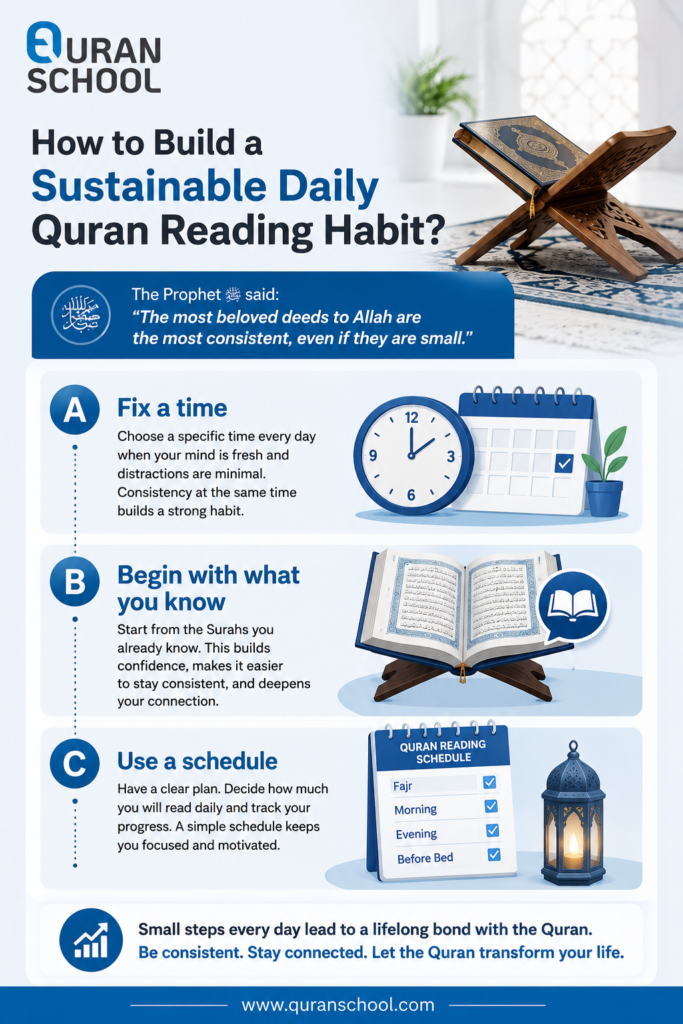
How to Build a Sustainable Daily Quran Reading Habit?
Consistency matters more than volume. The Prophet ﷺ said: “The most beloved deeds to Allah are the most consistent, even if they are small.”
A person who reads two pages every day without missing will complete the Quran six times in a year — more than the person who reads heavily for two weeks and then stops for three months. Three practical principles for daily recitation:
A. Fix a time
The best times, according to classical scholarship, are after Fajr and after Asr — periods of relative quiet when the mind is clear. After Fajr recitation is particularly powerful because Fajr prayer is witnessed by the angels, and what follows it carries that barakah.
B. Begin with what you know
Start with the surahs you already have memorized. Reciting from memory engages the brain differently than reading from the page — both are valuable, and beginning with the familiar lowers the activation threshold for the habit.
C. Use a schedule
For those who want to complete the full Quran within a month, dividing it into thirty equal portions — one juz per day — is the classical method used by companions and scholars across generations.
If you’re not yet confident in your recitation, Online Quran Recitation courses provide the phonics foundation and proper pronunciation guidance that makes independent daily reading sustainable. Learning correct tajweed early prevents the harder task of correcting ingrained errors later.
See Us in Action
Watch a quick snippet from our live, interactive classes below and see how our teachers make learning engaging for all ages!
Start Your Quranic Journey Today
Experience our interactive online classes with a dedicated tutor.
Get Your Free TrialStart Your Daily Quran Journey with EQuran School
EQuran School has helped thousands of Muslims across the English-speaking world build the skills, the habits, and the confidence to make the Quran a daily companion.
Whether you are a complete beginner who cannot yet read Arabic script, or an intermediate student who wants to deepen their tajweed or begin hifz — there is a structured path ready for you.
EQuran School’s complete curriculum includes:
- Al-Azhar Quran Course
- Quran Memorization (Hifz) Course
- Online Quran Learning with Tajweed Course
- Quran Tafsir Course
- Online Arabic and Quran Classes
- Quran Qirat Learning Course
- Noorani Qaida Course
Book a free trial class at E Quran School
Start Your Quranic Journey Today
Experience our interactive online classes with a dedicated tutor.
Get Your Free TrialConclusion
Reading Quran daily benefits are not abstract promises reserved for scholars or saints. They are documented outcomes — spiritual, psychological, cognitive, and physical — that begin accumulating from the very first consistent practice. Every letter earns tenfold reward. Every session of recitation deposits something into both the heart and the record that will be opened on the Day of Judgment.
The Quran intercedes for those who read it, elevates their rank in Paradise by the last verse they recite, brings tranquility to an anxious mind, sharpens memory, strengthens moral character, and marks the reader as belonging to the ahl al-Quran — the people specifically chosen by Allah.
The single most important decision is not how much to read, but whether to start — and then whether to return tomorrow. Two pages a day, read carefully, with the intention to understand and to act, will change a life more thoroughly than any self-improvement program ever could.
Frequently Asked Questions
What are the main benefits of reading the Quran daily?
Daily Quran recitation produces both immediate and long-term benefits across multiple dimensions. Each letter earns ten rewards that multiply with consistency. The Quran brings heart-level tranquility that researchers associate with reduced stress hormones and improved psychological stability.
Regular recitation sharpens memory, improves Arabic language proficiency, and gradually builds the moral character described in hadith as “the character of the Prophet ﷺ.” On the Day of Judgment, the Quran intercedes for those who maintained this relationship with it in their lifetimes.
How much Quran should I read each day to see benefits?
There is no minimum required for benefits to occur — even a few verses read with presence and intention produce reward and effect. For completing the Quran in a month, the standard division is one juz (approximately 20 pages) per day.
For beginners, starting with a consistent amount — even five minutes — and building gradually is more effective than ambitious targets that cannot be sustained. Consistency over quantity is the principle every classical scholar endorsed.
Does reading Quran in Arabic matter if I don’t understand it?
Yes — the letter-by-letter reward in the well-known hadith of Ibn Mas’ud applies to Arabic recitation specifically. Reading in Arabic also connects the reader to the sounds and rhythms of revelation in their original form, builds familiarity with Quranic vocabulary over time, and satisfies the conditions for valid recitation in prayer.
Can children benefit from daily Quran reading?
Children who begin early benefit disproportionately. The developing brain’s plasticity makes language acquisition and memorization easier in childhood than at any other stage of life. Children who build daily recitation habits before age ten are statistically more likely to continue the practice through adolescence and adulthood.
What if I struggle with Arabic pronunciation?
The Prophet ﷺ explicitly addressed this: “The one who recites the Quran while struggling and finding it difficult earns two rewards.” Struggling is not a sign of failure — it is a sign that the effort is real. The practical solution is to seek proper instruction early.
Is there a specific time of day best for Quran recitation?
Scholarship identifies after Fajr (dawn prayer) and after Asr (afternoon prayer) as particularly auspicious times — periods of angelic witness and relative stillness. Night recitation (tahajjud) is described in Surah Al-Muzzammil as producing the clearest understanding and deepest impression.









Leave a Reply