 Quran
Quran
Most beginners who want to read the Quran don’t fail because the Quran is too difficult — they fail because no one gave them a clear, ordered starting point. You open the Mushaf, feel overwhelmed, read for two days, stop, and repeat the cycle.
A Quran reading plan for beginners solves exactly that problem. It tells you where to start, how much to read each day, what to focus on at each stage, and what to do when you miss a session.
What You’ll Learn in This Article
- How to assess your level before choosing a daily reading target
- A practical 30-day Quran reading plan with weekly goals
- How to choose the right Mushaf and tools as a beginner
- The most common mistakes that slow beginners down — and how to avoid them
- How to stay consistent and what to do after a missed day
Quran Reading Plan for Beginners: Build Your Foundation Phase First
Before you set a daily page target, you need to know whether your Arabic reading is ready for it.
There are two types of beginners: those who can already read Arabic text with vowel marks (Harakat) slowly but correctly, and those who are still sounding out individual letters. Your plan looks different depending on which group you’re in.
If you cannot yet recognize Arabic letters in their different written positions — isolated, initial, medial, and final — your first priority is not a reading plan. It is a foundation phase that typically takes 4–8 weeks with consistent daily practice.
Work through the Noorani Qaida, a structured Arabic phonics primer used worldwide to bring complete beginners to basic Quranic reading. It covers letter recognition, short vowels (Fatha, Kasra, Damma), letter joining, Sukoon, Tanween, and Shaddah — in that order.
Read also: The Best Online Quran Classes for Non-Arabic Speakers
Read Quran Correctly Before Read it Faster
Reading fast is not the goal for a beginner. The goal is reading correctly.
The single most effective technique at this stage is imitation-based learning: listen to a qualified reciter reading the same passage you are about to read, then read it aloud immediately afterward.
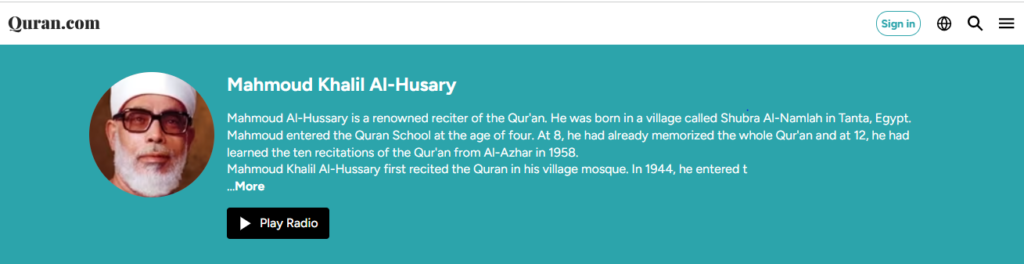
Your mouth learns correct pronunciation through imitation far faster than through rule memorization alone. Sheikh Mahmoud Khalil Al-Husary‘s recitation of the Hafs ‘an ‘Asim narration is widely recommended for learners — his pace is measured, his pronunciation is precise, and his recitation is freely available online.
Practice Imitation Correctly
- Listen to 3–5 verses once without reading along
- Listen again while following the Arabic text
- Read the same verses aloud immediately after
- Record yourself and compare your recitation to the original
Do not move to new verses until you can read the current ones without stopping to decode individual letters.
Read also: 30 Day Quran Reading Schedule
Learn Makharij (Articulation Points)
Makharij refers to the precise point in the mouth or throat where each Arabic letter is produced. English speakers consistently confuse letter pairs like ح and ه, ع and أ, ض and ظ.
These are not minor variations — they change the meaning of words in the Quran. Drilling these from the start prevents errors from becoming permanent habits that take months to correct later.
Read also: Learn Quran Online with Tajweed for Kids and Adults

Choose The Suitable Mushaf For You
The physical or digital Mushaf you use affects how easily you can read and track your progress.
Printed Mushaf Options
A color-coded Tajweed Mushaf (such as the Dar Al-Maarifah edition) marks each Tajweed rule in a distinct color — Ghunnah in green, Madd in red or blue, Qalqalah letters highlighted separately. For a beginner learning to apply rules alongside reading, this visual system accelerates recognition significantly.
If color-coding feels overwhelming at first, start with a standard clear-script Mushaf (the Madinah Mushaf is the globally recognized standard) and switch to the color-coded edition after 4–6 weeks.
Digital Quran Apps
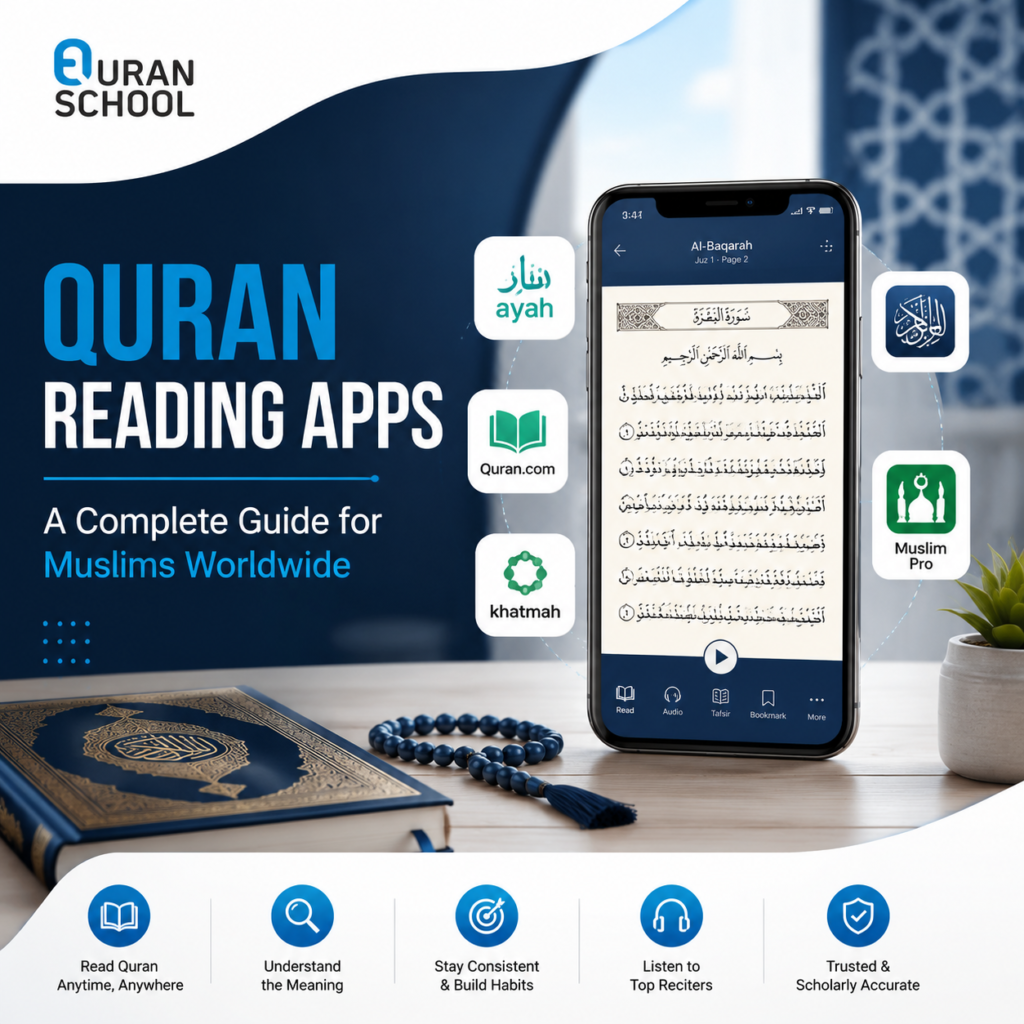
For learners in the US, UK, Canada, Australia, and beyond who study on the go, digital apps offer verse-by-verse audio playback, word-by-word translation, and progress tracking.
Quran.com and the Madinah Mushaf app are reliable options. Use them as supplements to a structured plan — not as a replacement for guided instruction.
Read also: The Best Online Quran Classes for Non-Arabic Speakers
Avoid Transliteration of Quran Verses
Avoid transliteration (writing Arabic sounds in English letters such as “Qul huwa Allahu ahad”) as a primary reading tool. It prevents you from learning to read the actual Arabic script, which is the goal.
A side-by-side English translation, however, is genuinely useful — understanding the general meaning of what you are reading improves concentration and builds a deeper connection to the text.
Read also: Interactive Quran Learning With Top Methods and Ways

See Us in Action
Watch a quick snippet from our live, interactive classes below and see how our teachers make learning engaging for all ages!
Start Your Quranic Journey Today
Experience our interactive online classes with a dedicated tutor.
Get Your Free TrialRead also: One Year Quran Reading Plan: Read the Entire Quran in 1 Year
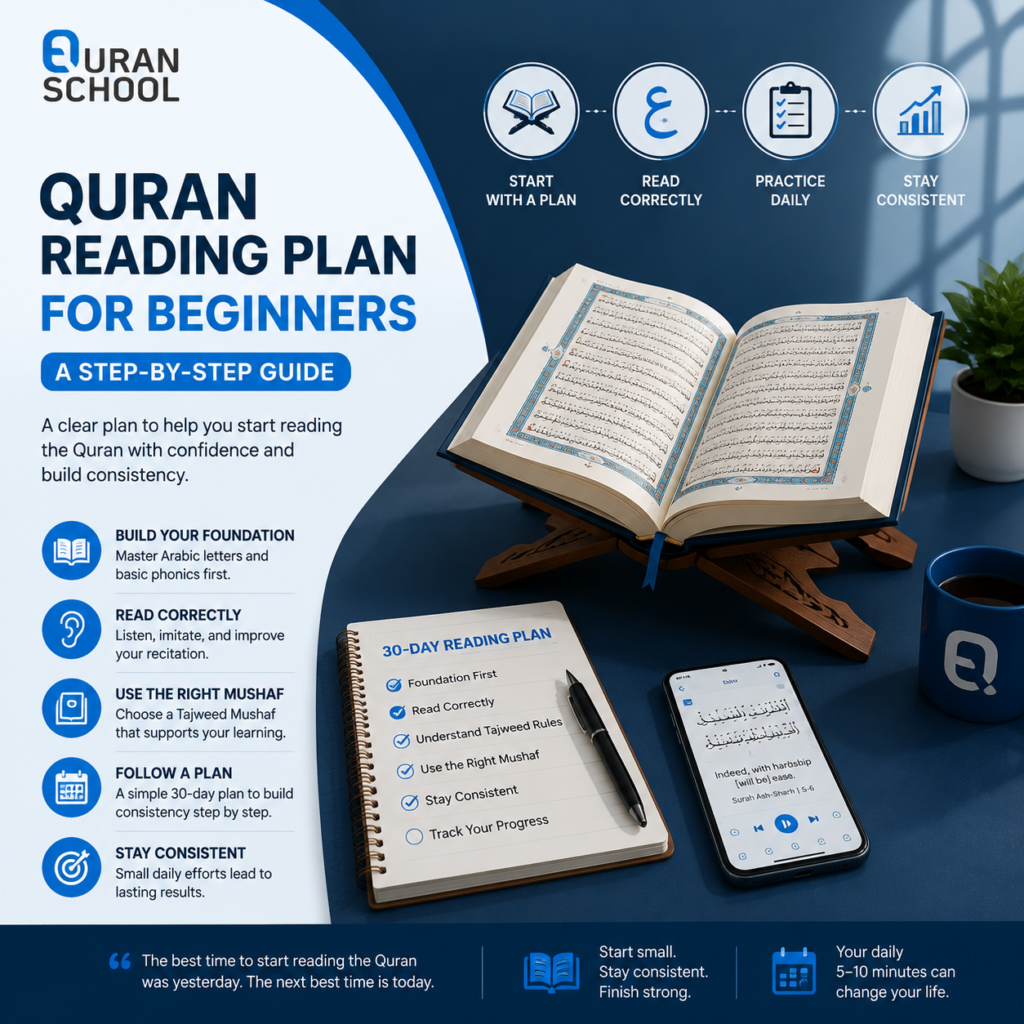
A Simple 30-Day Quran Reading Plan for Beginners
The Quran contains 604 pages divided into 30 Juz’, with each Juz’ covering exactly 20 pages. Every target below is grounded in that structure.
This plan assumes you can read Arabic text with Harakat slowly but correctly. If you are still in the foundation phase, follow the Noorani Qaida Course first and return to this schedule when you can read simple words fluently.
Week 1 — Start with Juz’ 30 (5–7 minutes daily)
Start with Juz’ 30 (the last section of the Quran), beginning from Surah An-Nas and reading backward toward Surah Ad-Duha.
- Daily target: 1 short Surah per day
- Focus: accurate pronunciation, not speed
- Listening practice: before reading each Surah, listen to it once with a reciter
Week 2 — Apply The Basic Rules of Reading (10 minutes daily)
Continue through Juz’ 30, reading 2–3 short Surahs per day. By the end of week 2, most beginners have completed or nearly completed Juz’ 30.
- Daily target: 2–3 short Surahs, or half a page
- Focus: applying basic rules — Madd lengths, Qalqalah, Sukoon
- Addition: begin tracking which letters you consistently mispronounce and drill those separately
Week 3 — Move to Juz’ 29 (15 minutes daily)
Move to Juz’ 29 or begin Surah Al-Fatiha and the opening pages of Surah Al-Baqarah. This is where beginners encounter longer verses for the first time.
- Daily target: half a page (approximately 7–8 lines in the standard Mushaf)
- Focus: reading complete verses without stopping mid-word
- Key rule to introduce: Noon Sakinah and Tanween — the four rulings of Izhar, Idgham, Iqlab, and Ikhfa
Week 4 — Establish the Habit of Reading (15–20 minutes daily)
Consolidate the habit. By day 30, your goal is not to have finished a large portion — it is to have read every single day, at a consistent time, with correct pronunciation improving steadily.
- Daily target: 1 page (achievable for most beginners at this stage)
- Focus: smoothness — no pausing between letters within a word
- Review: re-read week 1 Surahs to measure improvement
| Week | Daily Time | Daily Target | Cumulative Progress |
| Week 1 | 5–7 min | 1 short Surah | ~7 Surahs from Juz’ 30 |
| Week 2 | 10 min | 2–3 Surahs / half page | Juz’ 30 nearly complete |
| Week 3 | 15 min | Half a page | Opening of Al-Baqarah |
| Week 4 | 15–20 min | 1 page | Consistent 1-page daily habit |
Read also: Quran Reading Apps: A Complete Guide for Muslims Worldwide
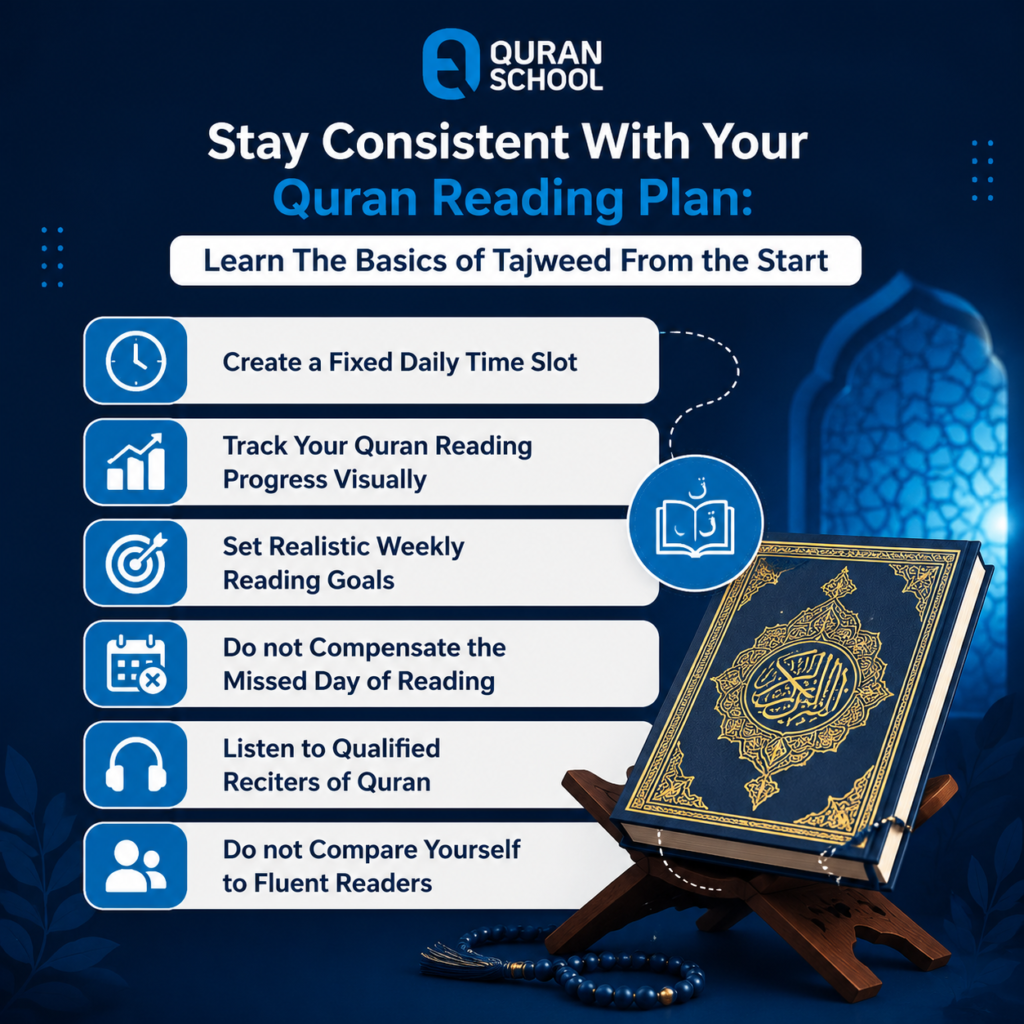
Stay Consistent With Your Quran Reading Plan
Consistency is the real challenge — not the content. Most beginners read well for 5–10 days and then stop because life interrupts and they don’t know how to restart.
Learn The Basics of Tajweed From the Start
You don’t need to master every Tajweed rule immediately, but learning the basics early prevents bad habits. Start with essential rules like letter pronunciation, elongation (Madd), and simple Ghunnah. Building a strong foundation will make future learning much easier.
Create a Fixed Daily Time Slot
Reading 10 minutes every day produces faster and more durable results than reading for 90 minutes once a week. The brain consolidates phonetic learning during rest — which means short, frequent sessions are neurologically superior to infrequent long ones.
After Fajr is widely recommended by scholars and supported by cognitive research: focus is sharpest, distractions are fewest.
Begin memorizing the Quran today—your first session is free

Track Your Quran Reading Progress Visually
Mark each completed session in a reading log — a simple calendar on paper or a note on your phone. The visible record of consecutive days creates a psychological commitment to not breaking the chain. When you see 12 days marked, skipping day 13 becomes harder.
Set Realistic Weekly Reading Goals
Avoid setting ambitious goals in week one. The most common reason beginners abandon their plan is burning out in the first two weeks after setting targets they cannot sustain. One page per day is a more reliable long-term target than three pages per day for most adults balancing work and family commitments.
Do not Compensate the Missed Day of Reading
Missing one day does not mean the plan has failed. The mistake beginners make is trying to compensate by doubling the next day’s reading. This creates pressure, disrupts the rhythm, and often leads to a second missed day.
The correct response: resume your normal daily target the next day as if nothing happened. Do not add the missed portion to the following session. Consistency over weeks matters far more than perfection on any single day.
Read also: Quran teacher on skype
Listen to Qualified Reciters of Quran
Listening to skilled Quran reciters helps you develop proper pronunciation, rhythm, and confidence. Choose one qualified reciter and follow along with the Mushaf while listening. Repeating after the reciter is one of the fastest ways to improve.
Do not Compare Yourself to Fluent Readers
Every fluent Quran reader was once a beginner. Avoid comparing your progress with others, as this can lead to frustration and discouragement. Instead, focus on improving a little each day and celebrate your own milestones.
Experience Our Classes
Don’t just take our word for it—watch real-time recordings of our online classes below to experience our teaching style firsthand.
Start Your Quranic Journey Today
Experience our interactive online classes with a dedicated tutor.
Get Your Free TrialStart Your Quran Reading Plan with EQuran School
A plan without a teacher gets you to a certain point — then stops. Errors you cannot hear yourself will calcify into permanent habits. Real-time correction from a qualified instructor is what separates steady progress from years of stagnation.
EQuran School connects students across the US, UK, Canada, Australia, and worldwide with Ijazah-certified instructors who specialize in teaching complete beginners. Every student receives a personalized learning path built around their current level, available time, and goals — one-on-one, online, at times that fit your schedule.
Your first lesson is free. Book it today and begin your Quran reading classes with a teacher who will tell you exactly where you stand and where to go next.
E Quran School provides complete curriculum including:
- Online Quran Learning with Tajweed Course
- Quran Tafsir Course
- Female Quran Classes
- Online Arabic and Quran Classes
- Quran for Beginners Course
- Noorani Qaida Course for Kids
- Quran Qirat Learning Course
Book a free trial class at E Quran School and experience personalized Quran instruction that adapts to your unique learning needs, Insha’Allah.
Start Your Quranic Journey Today
Experience our interactive online classes with a dedicated tutor.
Get Your Free TrialConclusion
A Quran reading plan for beginners works when it matches your actual starting level, gives you a manageable daily target, and tells you what to do when you miss a session.
The 30-day structure in this guide — starting from Juz’ 30, building toward one page per day, and prioritizing accuracy over speed — reflects what structured Quranic education has consistently proven effective for non-Arabic-speaking learners worldwide.
The plan is clear. Consistency is the commitment only you can make. Start today with whatever time you have — even 10 minutes — and let that be enough.
Frequently Asked Questions
How many pages should a beginner read per day?
A realistic beginner’s target is half a page to one page per day, equivalent to approximately 7–15 lines in the standard Madinah Mushaf. This target keeps sessions manageable (10–20 minutes), allows accurate pronunciation, and builds a sustainable daily habit.
Where should a beginner start reading in the Quran?
Start with Juz’ 30 — the final section of the Quran, which contains the shortest Surahs. These Surahs are brief, phonetically manageable, and already familiar to most Muslims from daily prayer. After completing Juz’ 30, move to Surah Al-Fatiha and then Surah Al-Baqarah from the beginning of the Mushaf.
How long does it take a complete beginner to read the whole Quran?
At half a page per day, completing the Quran takes approximately 3–4 years. At one page per day, approximately 1.5–2 years. At two pages per day, 10–12 months. These timelines assume consistent daily reading with no extended breaks and correct pronunciation — not rushed reading.
Can I learn to read the Quran without a teacher?
You can make initial progress independently using the Noorani Qaida and audio recitation. However, a teacher is necessary to identify and correct pronunciation errors you cannot hear yourself — particularly Makhraj mistakes and incorrect Madd lengths.
What is the best time of day to read the Quran as a beginner?
After Fajr (the early morning prayer) is the most recommended time — focus is sharpest, distractions are at their lowest, and the spiritual atmosphere supports concentration. Cognitive research independently supports early morning as the optimal window for phonetic learning and retention.
Do I need to understand Arabic to follow a Quran reading plan?
No. A Quran reading plan for beginners focuses on reading the Arabic script correctly — not on language fluency or grammatical understanding. Reading a side-by-side English translation of what you are reading each day deepens your connection to the text and improves concentration.










Leave a Reply