 Quran
How to help the kids to hifz Quran when you’re not sure where to begin? Every Muslim parent dreams of hearing their child recite the Quran from memory in Salah or at a family gathering, yet many feel lost at the start, especially if they cannot read Arabic themselves.
Successful Hifz for children rests on four pillars: correct reading before memorizing, age-appropriate daily targets, revision that always outweighs new memorization, and steady correction from a qualified teacher. Parents provide the routine and encouragement, while the teacher protects accuracy.
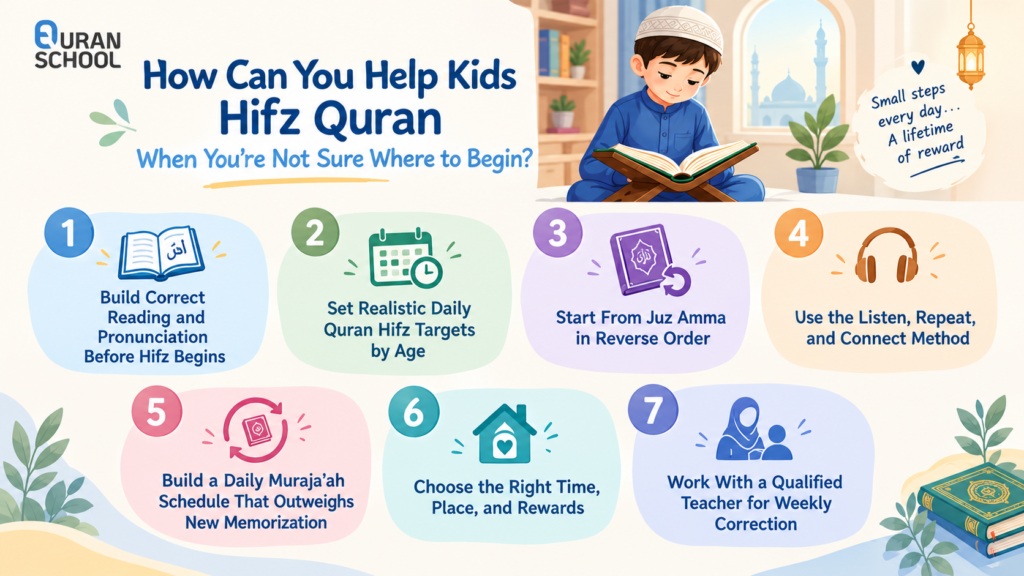
1. Build Correct Reading and Pronunciation Before Hifz Begins
Correct reading and clear pronunciation should be in place before Hifz begins, because a child memorizes exactly what they hear themselves say. A mistake repeated fifty times during memorization becomes very hard to remove later.
Common Pronunciation Mistakes Children Carry Into Hifz
The most common pronunciation mistakes children carry into Hifz involve letters with no English equivalent. Kids often replace ح with ه, turn ع into a plain alif sound, and soften the heavy ق into a light ك.
Take Surah Al-Ikhlas, usually among the first surahs a child memorizes:
قُلْ هُوَ اللَّهُ أَحَدٌ
Qul huwa Allahu ahad
“Say, ‘He is Allah, [who is] One.'” (Al-Ikhlas 112:1)
If the child pronounces the ح in “ahad” as a soft English h, the letter itself changes. A teacher catches this in seconds, but a parent without Tajweed training may never notice it before it becomes a habit.
Noorani Qaida Timeline for Young Children
A realistic Noorani Qaida timeline for young children aged 5 to 7 is three to six months, with four or five short lessons per week. Older children often finish faster because their attention spans are longer.
If your child has not yet completed this stage, the Noorani Qaida Course for Kids at EQuran School builds letter sounds, harakat, and joining in short, playful lessons, so Hifz later rests on a solid reading foundation.
Book Your Free Trial Today for the Noorani Qaida Course for Kids!
2. Set Realistic Daily Quran Hifz Targets by Your Child’s Age
Realistic daily Hifz targets depend on the child’s age, attention span, and reading level rather than on what other children achieve. Too large a portion causes frustration, while too small a portion slows momentum and confidence.
| Age | Daily New Memorization | Session Length | Daily Revision |
| 4 to 6 | 2 to 4 short lines (by listening) | 10 to 15 minutes | Last 3 surahs memorized |
| 7 to 9 | 3 to 5 lines | 20 to 30 minutes | Last 1 to 2 weeks of portions |
| 10 to 12 | Half a page | 30 to 45 minutes | Last week plus 2 old pages |
| 13 and above | One page | 45 to 60 minutes | Last week plus a quarter to half Juz |
Parents searching for how to memorize Quran fast for kids should know that speed comes from consistency, not large portions. Five lines every single day covers far more than a full page attempted twice a week.
Allah Himself has made this goal reachable for every child who keeps trying:
وَلَقَدْ يَسَّرْنَا الْقُرْآنَ لِلذِّكْرِ فَهَلْ مِن مُّدَّكِرٍ
Wa laqad yassarnal-Qur’ana lidh-dhikri fahal min muddakir
“And We have certainly made the Qur’an easy for remembrance, so is there any who will remember?” (Al-Qamar 54:17)
Read also: The Best Free Online Quran Classes for Kids
3. Start Quran Memorization From Juz Amma in Reverse Order
Starting memorization from Juz Amma in reverse order, beginning with An-Nas and moving back toward An-Naba, gives children quick wins. Short surahs are completed in days, which builds confidence before longer passages arrive.
After Juz Amma, most teachers move to Juz Tabarak (Juz 29) in the same reverse pattern. From there, the child either continues backward through Juz 28 or begins Al-Baqarah, depending on pace and retention.
Using One Printed Mushaf Throughout Your Kid’s Hifz
Using one printed Mushaf throughout Hifz matters more than most parents realize. Children memorize the visual position of each verse, so we recommend the 15-line Madinah Mushaf, where every page ends at the end of a verse.
Switching between apps, different prints, and screens confuses this visual memory. Keep one physical copy for memorization and revision, and let the child mark difficult words lightly in pencil.
Experience Our Classes
Don’t just take our word for it—watch real-time recordings of our online classes below to experience our teaching style firsthand.
Start Your Quranic Journey Today
Experience our interactive online classes with a dedicated tutor.
Get Your Free Trial4. Use the Listen, Repeat, and Connect Method for Memorizing New Verses
The listen, repeat, and connect method for new verses is the technique most Azhari tutors use with children. It builds memory through sound first, then through reading, then through linking verses into one flowing passage.
A. Listen to a Teaching Recitation First
Listening to a teaching recitation first lets the child absorb correct sounds before reading. The Mu’allim recording of Sheikh Al-Husary, which leaves pauses for repetition, works well. Play each verse five to ten times.
B. Connect Each Verse to the One Before It
Connecting each verse to the one before it prevents the common problem of knowing verses separately but freezing between them. Memorize verse one, then verse two, then recite both together before adding verse three.
Parents asking how to memorize the Quran for kids effectively often skip this linking step. Without it, the child recites fluently up to a verse ending, then pauses while searching for how the next verse starts.
5. Build a Daily Muraja’ah Schedule That Outweighs Your Child’s New Memorization
A daily Muraja’ah schedule that outweighs new memorization is what separates children who keep their Hifz from those who lose it. As a rule, revision time should be at least double the time spent on new verses.
The Prophet ﷺ warned about this directly:
“تَعَاهَدُوا الْقُرْآنَ، فَوَالَّذِي نَفْسِي بِيَدِهِ لَهُوَ أَشَدُّ تَفَصِّيًا مِنَ الْإِبِلِ فِي عُقُلِهَا”
“Keep on reciting the Qur’an, for, by Him in Whose Hand my life is, Qur’an runs away (is forgotten) faster than camels that are released from their tying ropes.” (Sahih al-Bukhari 5033)
Near Revision and Far Revision for Children
Near revision and far revision serve different purposes for children. Near revision covers the last five to ten pages memorized and is recited daily, while far revision rotates through older portions across the week.
A child who has memorized three Juz might revise one full Juz each day, completing all old portions every three days. Reciting memorized surahs in Sunnah and Nafl prayers adds valuable extra revision.
6. Choose the Right Time, Place, and Rewards for Quran Memorization
The right time, place, and rewards for memorization turn Hifz into a family habit rather than a daily battle. Most children memorize best after Fajr or soon after waking, when the mind is fresh and calm.
A. Create a Quiet Memorization Space at Home for Your Kid
A quiet memorization space at home should be free from screens, toys, and siblings’ noise. Using the same spot and the same Mushaf each day signals to the child that this is Quran time.
B. Motivate Children for Memorization Without Pressure
Motivating children without pressure is often the real answer to how to make your child memorize the Quran willingly. Praise effort more than results, use a sticker chart for completed surahs, and celebrate every finished Juz with family.
Remind them of the reward too. The Prophet ﷺ said:
“الْمَاهِرُ بِالْقُرْآنِ مَعَ السَّفَرَةِ الْكِرَامِ الْبَرَرَةِ، وَالَّذِي يَقْرَأُ الْقُرْآنَ وَيَتَتَعْتَعُ فِيهِ وَهُوَ عَلَيْهِ شَاقٌّ لَهُ أَجْرَانِ”
“One who is proficient in the Qur’an is associated with the noble, upright recording angels; and he who falters in it, and finds it difficult for him, will have a double reward.” (Sahih Muslim 798a)
Read also: The Best Quran Learning Games for Kids
7. Work With a Qualified Teacher for Weekly Quran Memorization Correction
Working with a qualified teacher for weekly correction protects everything the child memorizes at home. Even dedicated parents cannot reliably catch errors in Madd lengths, Ghunnah, or heavy letters without formal Tajweed training.
A good Hifz teacher listens to the new portion, checks near revision, tests random old pages, and flags Mutashabihat, the similar verses children often mix up across surahs like Al-Baqarah and Al-A’raf.
This is exactly how the Quran Memorization (Hifz) Course at EQuran School works, with Azhari tutors correcting every mistake in real time during one-on-one sessions and sending parents a clear plan for home practice.
Book Your Free Trial Today for Quran Memorization (Hifz) Course!

Common Mistakes Parents Make When Learning How to Help the Kids with Hifz Quran
Common mistakes parents make when learning how to help the kids with Hifz Quran usually come from love and enthusiasm, not neglect. Recognizing them early saves months of lost progress and protects the child’s attachment to the Quran.
1. Rushing New Memorization Before Revision Is Solid
Rushing new memorization before revision is solid is the biggest mistake. If a child stumbles more than three times on yesterday’s portion, pause new verses and strengthen review until it flows smoothly.
2. Comparing Your Child With Other Children
Comparing your child with other children who memorize faster damages motivation quickly. Every child has a different memory style, and steady progress with strong retention beats a fast pace that collapses later.
3. Using Hifz as a Punishment
Using Hifz as a punishment, such as extra pages for misbehavior, teaches the child to associate the Quran with discomfort. Keep memorization sessions emotionally safe, warm, and separate from household discipline.
Sample Weekly Quran Hifz Plan for School Age Children
A sample weekly Hifz plan for school-age children must fit around homework, activities, and family time. The plan below suits a child aged 8 to 11 with about 30 minutes of practice daily.
| Day | New Memorization | Revision | Teacher Session |
| Monday | 4 to 5 lines | Last 10 pages | Online class |
| Tuesday | 4 to 5 lines | 5 older pages | None |
| Wednesday | 4 to 5 lines | Last 10 pages | Online class |
| Thursday | 4 to 5 lines | 5 older pages | None |
| Friday | No new lines | Recite the week’s portion to a parent | None |
| Saturday | No new lines | Longer far revision session | Online class |
| Sunday | Rest | Light listening only | None |
Two days without new memorization might look slow, yet this pattern is how to memorize Quran fast for kids over the long term, because solid retention means fewer weeks lost re-memorizing forgotten pages.
Families with packed weekdays can move teacher sessions to weekends through Online Quran Classes for Kids, with female teachers available for parents who prefer one for their daughters.

See Us in Action
Watch a quick snippet from our live, interactive classes below and see how our teachers make learning engaging for all ages!
Start Your Quranic Journey Today
Experience our interactive online classes with a dedicated tutor.
Get Your Free TrialStart Your Spiritual Journey with E Quran School Today
Transform your understanding and recitation of the Holy Quran from the comfort of your home. At E Quran School, our certified tutors provide personalized, one-on-one guidance tailored to your pace and schedule. Whether you are looking for beginner Quran reading, advanced Tajweed, or Memorization (Hifz) courses, we have a program for you.
Our Quran Courses
- Quran Tafsir Course
- Zoom Quran Classes
- Skype Quran Classes
- Learn Quran Easily at Home
- Al-Azhar Quran Course
- Sunni Online Quran Classes
- Intensive Quran Course
- Online Quran Classes Based in Saudi Arabia
- Quran Teachers
- Noorani Qaida Course
Book your child’s free trial class today at EQuran School and let a certified teacher build a Hifz plan matched to your child’s age and pace.
Start Your Quranic Journey Today
Experience our interactive online classes with a dedicated tutor.
Get Your Free TrialConclusion
Knowing how to help the kids to hifz Quran comes down to a clear order: correct reading first, age-appropriate targets, Juz Amma in reverse, verse linking, and revision that always outweighs new memorization.
Small daily portions, one fixed Mushaf, a quiet space, and warm encouragement keep children consistent. Avoid comparisons and pressure, and treat every stumble as part of earning the double reward promised to those who struggle.
Parents supply the routine and the love, while a qualified teacher supplies precision. With both working together, Insha’Allah, your child’s Hifz will grow steadily and stay firm in Salah and throughout life.
Frequently Asked Questions About Helping Kids Memorize the Quran
Parents helping kids memorize the Quran often raise the same questions during the first months of Hifz.
What Is the Best Age for Kids to Start Hifz?
The best age for kids to start Hifz is usually between 5 and 7, once they can sit for 15 minutes and repeat sounds accurately. Younger children can begin by listening to short surahs.
How to Memorize Quran Fast for Kids Without Forgetting?
To memorize Quran fast for kids without forgetting, keep daily portions small, link each verse to the previous one, and give revision double the time of new memorization. Consistency matters more than portion size.
How to Make Your Child Memorize Quran When They Get Bored?
To make your child memorize Quran when they get bored, shorten sessions, switch activities every ten minutes, use recitation games, and let them recite to grandparents. Boredom usually signals sessions that are too long.
How Long Does It Take a Child to Memorize the Whole Quran?
A child usually takes two to four years to memorize the whole Quran with daily practice of about one page. Younger children, or those with irregular schedules, may need five years or more.
How to Help the Kids to Hifz Quran If Parents Cannot Read Arabic?
Parents who cannot read Arabic can still help the kids to hifz Quran by managing the routine, playing teaching recitations, tracking revision, and enrolling them with a qualified teacher who handles correction and Tajweed.
How to Memorize Quran for Kids Who Cannot Read Yet?
Kids who cannot read yet can memorize Quran through talqeen, the traditional method of hearing and repeating. A teacher or recording recites a short phrase, the child repeats it, and repetition continues until it sticks.











Leave a Reply