 Learn Quran

Many Muslims who are memorizing Surahs, reading the Mus’haf for the first time, or preparing for Salah ask the same honest question: is Tajweed obligatory? Islamic scholars answer this by separating two things that often get confused with one another.
Studying the theoretical rules of Tajweed — the technical names, the detailed classifications of letters, the categories of Noon and Meem — is a communal obligation (fard kifayah).
Correctly pronouncing the Arabic letters from their proper articulation points while actually reciting is an individual obligation (fard ayn) on every Muslim, according to the position held by most scholars who have written on this question.
This article explains what recognized scholarly sources — the Fiqh Encyclopedia, Ibn al-Jazari, Ibn Uthaymeen, and Ibn Baz – have said about whether Tajweed is obligatory, whether it is required in Salah, and whether you can recite the Quran without it.
Structured guidance from a live Tajweed course can also help you apply these rulings correctly rather than guessing on your own.
What You Will Learn in This Article
- The difference between fard kifayah (studying Tajweed theory) and fard ayn (applying correct pronunciation).
- What Ibn Uthaymeen and Ibn Baz ruled about reciting without full Tajweed.
- Whether Tajweed is specifically required during Salah.
- The minimum standard every reciter must meet, and where recommendation (mustahabb) begins.
- Two beginner Tajweed rules — Ghunnah and Qalqalah — you can start applying today.
Is Tajweed Obligatory?
Tajweed is the set of principles and rules used to recite the Quran accurately, giving every Arabic letter its proper pronunciation and characteristics.
It includes learning the correct Makharij (articulation points) of the letters, their Sifaat (characteristics), the proper length of vowel sounds through the rules of Madd, and practical rules such as Ghunnah, Qalqalah, Idgham, Ikhfa, and Iqlab.
Together, these principles help the reciter distinguish between similar Arabic sounds and avoid pronunciation errors that could affect the wording or, in some cases, the meaning of an ayah.
However, when asking whether Tajweed is obligatory, an important distinction needs to be made between reciting the Quran correctly and studying the complete theoretical science of Tajweed.
A Muslim should take reasonable care to pronounce the Quran correctly and avoid serious mistakes, particularly errors that alter letters, vowels, words, or meanings.
This practical level of accurate recitation is different from memorizing every technical term, classification, exception, and detailed rule found in advanced Tajweed books.
For this reason, the question of Tajweed being obligatory cannot always be answered by treating every part of the subject as though it has exactly the same ruling. The practical responsibility to protect Quranic recitation from significant errors and the academic study of Tajweed terminology and detailed theory should be considered separately.
Understanding this distinction makes it much easier to discuss what an ordinary Muslim needs to learn for correct Quran recitation and what belongs to a more advanced level of Tajweed study.
Theoretical Tajweed Knowledge Is Fard Kifayah
The detailed theoretical study of Tajweed is generally discussed as Fard Kifayah (a communal obligation).
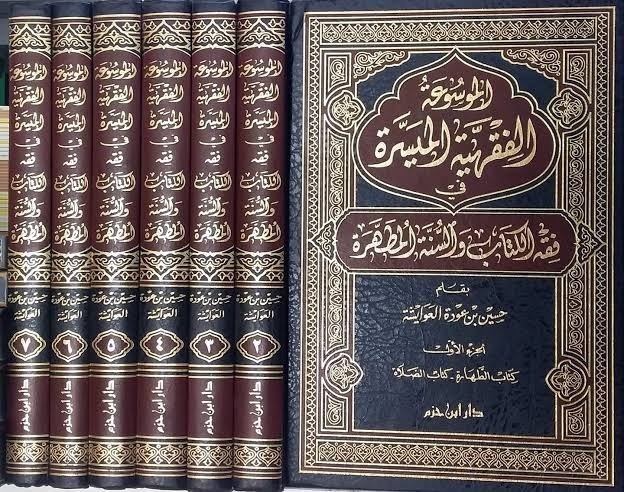
The Fiqh Encyclopedia (Al-Mawsu’ah Al-Fiqhiyyah) states: “There is no dispute that engaging in the study of Tajweed is Fard Kifayah [a communal obligation].
As for acting upon it, the earlier scholars of Qira’at and Tajweed held that adhering to all the foundations of Tajweed is obligatory, and one who neglects it is sinful.”
This distinction is important because the science of Tajweed contains a considerable amount of specialized terminology, classification, and technical detail.
A communal obligation means that the Muslim community must have enough qualified scholars, reciters, and teachers who study, preserve, teach, and transmit the science correctly. When a sufficient number of people fulfill this responsibility, the obligation is considered fulfilled on behalf of the wider community.
This ensures that accurate Quranic recitation and its established principles continue to be transmitted from one generation to the next.

This does not mean that every individual Muslim must memorize every technical term found in advanced Tajweed books. An ordinary reciter does not necessarily need to explain every category of Madd or list every characteristic of every Arabic letter from memory.
The detailed academic mastery of Tajweed as a science should therefore be distinguished from the practical level of correct recitation expected from the individual.
See Us in Action
Watch a quick snippet from our live, interactive classes below and see how our teachers make learning engaging for all ages!
Start Your Quranic Journey Today
Experience our interactive online classes with a dedicated tutor.
Get Your Free TrialPractical Application During Recitation Is Fard Ayn
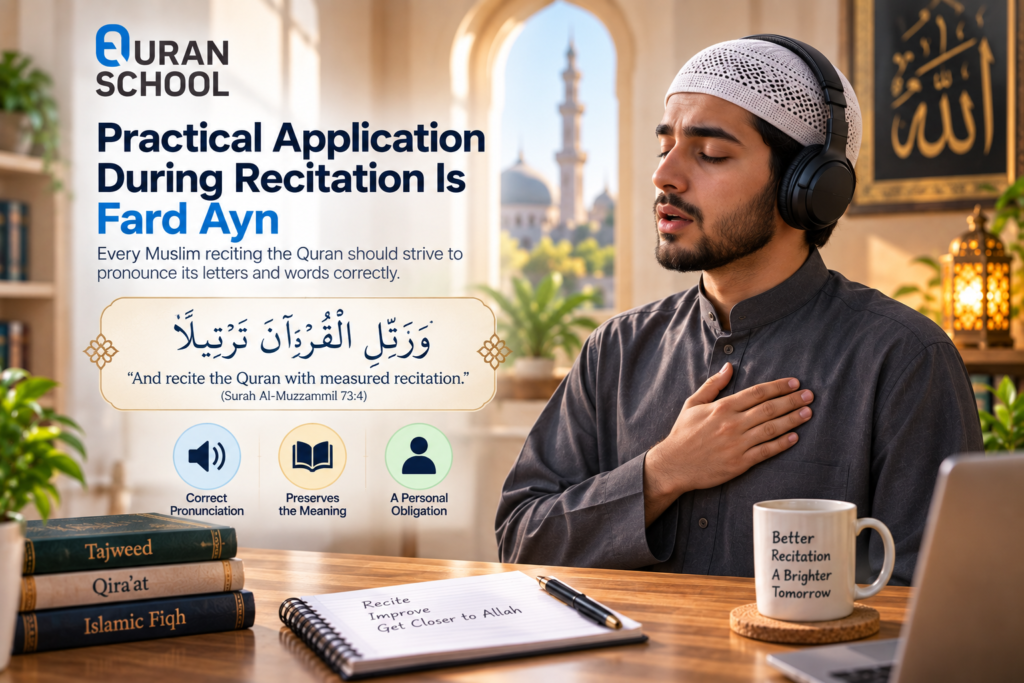
The practical application of correct Quranic recitation is commonly discussed differently. Scholars who describe it as Fard Ayn (an individual obligation) emphasize that each Muslim reciting the Quran should strive, according to their ability, to pronounce its letters and words correctly and avoid errors that alter the Quranic wording or meaning.
One of the principal Quranic evidences cited in this discussion is Allah’s command:
وَرَتِّلِ الْقُرْآنَ تَرْتِيلًا
“And recite the Quran with measured, distinct recitation.”
Tarteel has traditionally been associated with careful, deliberate Quran recitation. A well-known explanation attributed to Ali ibn Abi Talib (may Allah be pleased with him) describes it in terms of correctly articulating the letters and knowing the proper places to stop.
This highlights that good recitation involves more than simply recognizing Arabic words on the page; attention must also be given to pronunciation, clarity, and appropriate stopping.
For the individual learner, this means the priority should be practical accuracy rather than becoming overwhelmed by advanced terminology. A beginner should work on correct letters, vowels, and essential recitation rules gradually and seek correction where possible.
The obligation is also understood in light of a person’s ability and access to learning, so someone who is sincerely learning and struggling should continue improving rather than becoming discouraged by mistakes that they are actively trying to correct.
What Exactly Is Obligatory Within Tajweed?
Some scholars make a further distinction within the practical rules of Tajweed themselves, rather than assigning exactly the same ruling to every aspect of the science.
This distinction is useful because Tajweed includes both essential pronunciation that protects Quranic words from alteration and finer recitational qualities that perfect and beautify a person’s reading.
Obligatory: At the essential level, a reciter should pronounce the Quranic letters correctly and avoid substituting one letter for another or changing vowels in a way that alters the word or its meaning. Correct Makharij (articulation points) are therefore particularly important.
A clear pronunciation error, known as lahn jali, can affect the wording being recited and should be corrected as soon as the learner becomes aware of it and is able to do so.
Recommended or part of perfected recitation: Some scholars distinguish these essential requirements from the fuller application of detailed Tajweed refinements. Perfecting qualities such as precise timing, subtle characteristics of letters, and the finer aspects of recitation raises the accuracy and beauty of one’s reading.
The exact legal classification of particular Tajweed rules can differ among scholars, so it is more accurate not to assume that every technical rule automatically carries an identical ruling.
For readers who want to internalize both the essential and more advanced layers, a structured Tajweed course with a qualified tutor can make the distinction much clearer in practice.
Instead of simply memorizing definitions from a book, students can recite directly to a teacher, receive immediate correction, and gradually learn which mistakes need urgent attention and which areas represent further refinement of an already sound recitation.
Read also: hadith about reading Quran with Tajweed
Book a Free Trial in Our Online Quran Recitation Classes

Is Tajweed Obligatory in Salah?
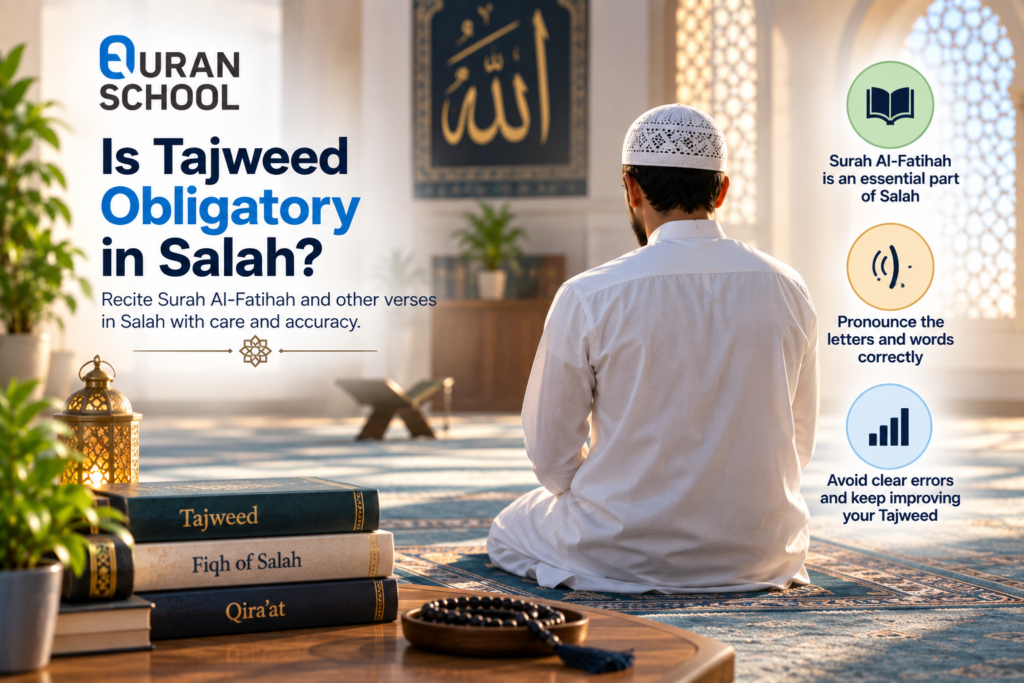
Tajweed becomes particularly important in Salah because Surah Al-Fatihah is an essential part of the prayer, and its wording should be recited correctly.
The worshipper should therefore take reasonable care to pronounce its letters, vowels, and words accurately, especially avoiding a clear error (lahn jali) that changes a letter or meaning.
This does not necessarily mean that someone must demonstrate mastery of every advanced Tajweed detail before their recitation can be acceptable.
A useful distinction can again be made between protecting the words from clear pronunciation errors and reaching the highest level of refined Tajweed performance. The latter is something a learner can continue developing through regular study and correction.
Muslims who are still memorizing Surahs for Salah can especially benefit from guided Hifz instruction.
When a teacher corrects pronunciation from the first few repetitions, the learner memorizes the correct wording and sound together rather than discovering much later that an established memorization habit needs to be changed.
Can You Recite Quran Without Tajweed?
A Muslim who has not yet mastered the complete science of Tajweed should not stop reciting the Quran because of that.
Scholars including Ibn Uthaymeen and Ibn Baz explained that a person may recite even without mastering the detailed Tajweed rules, while still taking care to preserve the letters and basic vowel sounds correctly.
This distinction is particularly encouraging for beginners. Someone who has only recently started reading Arabic may not yet understand Madd categories, Ghunnah, Idgham, Ikhfa, or the technical characteristics of every letter.
That does not mean they should wait until completing a Tajweed course before opening the Quran. They can continue reading while learning and correcting their recitation gradually.
At the same time, permission to recite while still learning should not become a reason to ignore mistakes that can be corrected. Listen carefully, practice difficult sounds, and recite to a knowledgeable teacher whenever possible. The goal is steady improvement according to your ability, not immediate perfection.
Read also: hadith about reciting Quran loudly
Ibn Uthaymeen’s Ruling
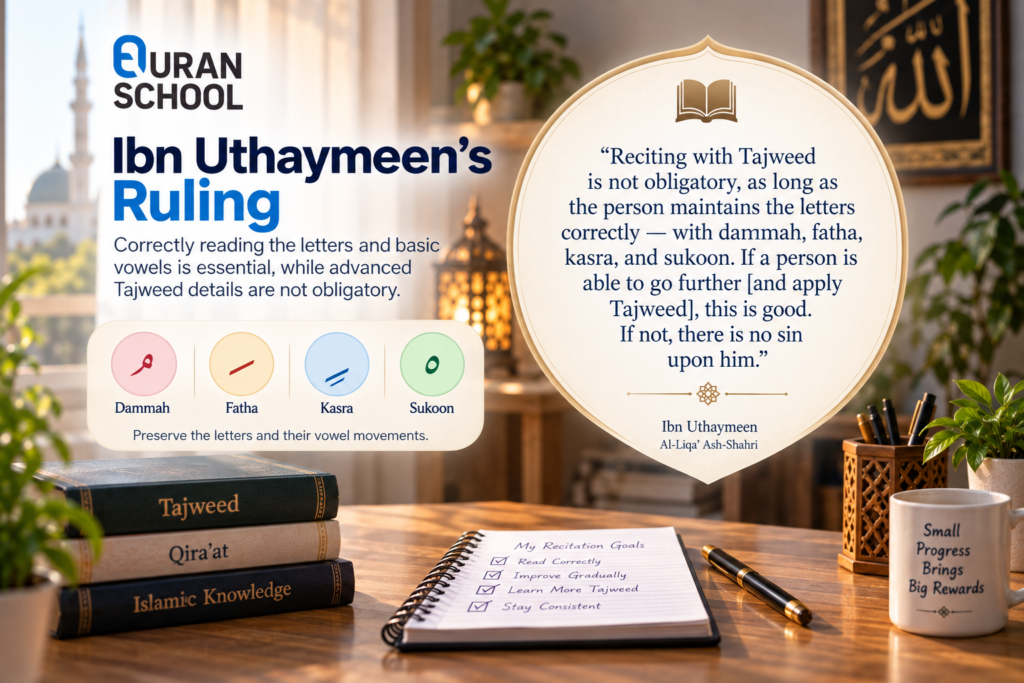
In Al-Liqa’ Ash-Shahri (The Monthly Meeting), Ibn Uthaymeen explained that applying Tajweed in its fuller technical sense is not obligatory provided that the reciter preserves the letters and their basic vowel movements correctly.
He stated: “Reciting with Tajweed is not obligatory, as long as the person maintains the letters correctly — with dammah, fatha, kasra, and sukoon. If a person is able to go further [and apply Tajweed], this is good. If not, there is no sin upon him.”

The important distinction here is between correctly reading the Quranic words and mastering every detailed aspect of Tajweed. A person should not deliberately replace letters, alter vowels, or distort words, but someone who has not yet perfected every advanced recitation rule can still read the Quran.
For beginners, this provides a practical path forward: first concentrate on accurate letters, Harakat, and clear Quran reading, then gradually improve your Tajweed through listening, study, and teacher correction.
Tajweed development can continue alongside regular recitation rather than becoming a barrier that prevents you from reading until you feel “perfect.”
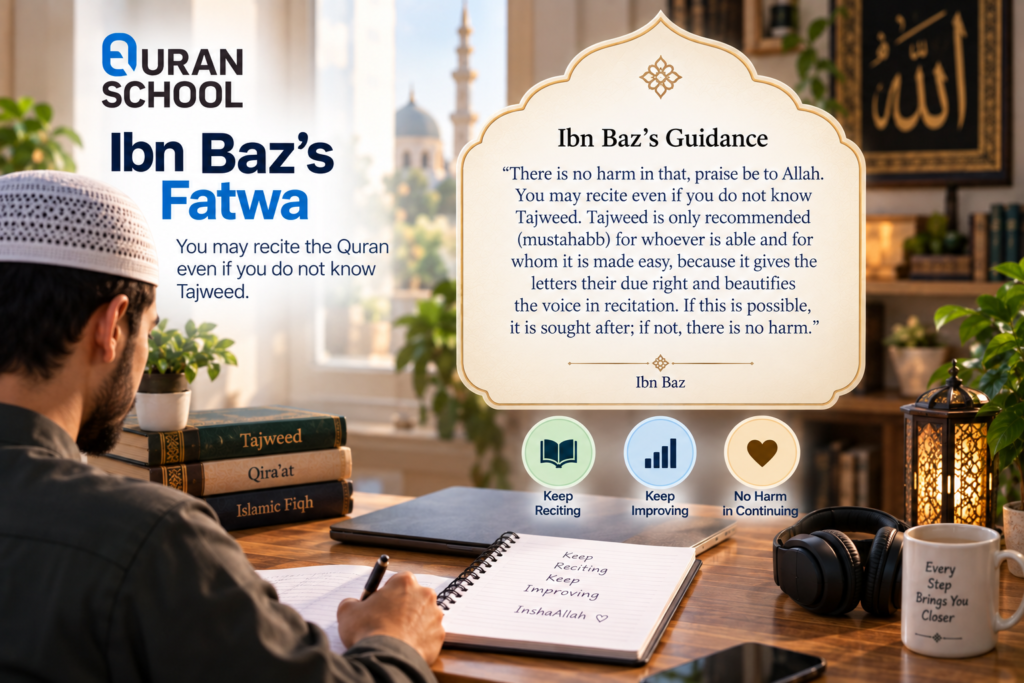
Ibn Baz’s Fatwa about reciting the Quran without knowledge of Tajweed
Ibn Baz was asked about reciting the Quran without knowledge of Tajweed and similarly explained that a Muslim may continue reciting even if they have not mastered Tajweed.
He stated: “There is no harm in that, praise be to Allah. You may recite even if you do not know Tajweed. Tajweed is only recommended (mustahabb) for whoever is able and for whom it is made easy, because it gives the letters their due right and beautifies the voice in recitation. If this is possible, it is sought after; if not, there is no harm.”
This should not be understood as suggesting that pronunciation is unimportant. Rather, the distinction is between being able to read the Quran correctly at a basic level and possessing complete technical mastery of Tajweed.
Learners should continue correcting mistakes and improving their recitation without believing that incomplete Tajweed knowledge prevents them from reading the Quran altogether.
Ibn Baz also supported his discussion with the authentic hadith concerning the person who finds Quran recitation difficult. This provides reassurance for learners who struggle with Arabic pronunciation: difficulty during the learning proces s is not a reason to abandon recitation.
Read also: benefits of reading Quran
A Muslim can continue reading, practicing, and seeking correction while gradually developing greater accuracy and confidence.
الْمَاهِرُ بِالْقُرْآنِ مَعَ السَّفَرَةِ الْكِرَامِ الْبَرَرَةِ، وَالَّذِي يَقْرَأُ الْقُرْآنَ وَيَتَتَعْتَعُ فِيهِ وَهُوَ عَلَيْهِ شَاقٌّ لَهُ أَجْرَانِ
“The one who is skilled in reciting the Quran is with the noble, righteous angelic scribes, and the one who recites the Quran and finds it difficult, stumbling over it, will have a double reward.”
Sahih al-Bukhari and Sahih Muslim
Ibn Baz also cited the following hadith to encourage continued learning even after this ruling:
خَيْرُكُمْ مَنْ تَعَلَّمَ الْقُرْآنَ وَعَلَّمَهُ
“The best among you are those who learn the Quran and teach it.”
Based on this view, a Muslim who has actually learned the obligatory Tajweed rules but does not apply them while reciting is considered sinful, while someone who has only ever learned to recite correctly — without formally studying Tajweed terminology — is not. You can read more on this theme in this article on Hadiths about reading the Quran.
Read also: The Best Online Quran Classes for Non-Arabic Speakers
What Does the Quran Say About Reciting With Tajweed?
The Quran does not use the later technical term “Tajweed” as the name of a formal science, but it does instruct Muslims to recite carefully and deliberately.
أَوْ زِدْ عَلَيْهِ وَرَتِّلِ ٱلْقُرْءَانَ تَرْتِيلًا ٤
or a little more-and recite the Quran ˹properly˺ in a measured way.
Scholars have connected Tarteel with clear pronunciation, measured reading, and giving proper attention to the words and pauses of the Quran.
Tajweed developed as a systematic way of preserving these qualities, helping reciters pronounce Quranic letters correctly, distinguish between similar sounds, and avoid errors while reciting.
the Quran also describes the manner of its own revelation using the same concept:
وَرَتَّلْنَاهُ تَرْتِيلًا
“And We have recited it in distinct, measured stages.”
Both this verse and Surah Al-Muzzammil (73:4) use the root associated with Tarteel, emphasizing deliberate and measured recitation rather than hurried reading. Classical discussions of Quran recitation connect Tarteel with clarity of pronunciation, careful articulation of the letters, and appropriate pausing.
These principles form an important part of the practical foundation upon which the later formal science of Tajweed developed.
For a learner, this means that Tajweed should not be approached simply as a collection of complicated technical terms.
Its practical purpose is to help you slow down, pronounce Quranic letters accurately, distinguish between similar sounds, observe appropriate elongations, and recite with greater clarity. You can begin developing these habits even before you have studied every advanced Tajweed rule.
Improve your Quran recitation from home with E Quran School through guided Quran and Tajweed lessons designed around your level and learning goals.

| START YOUR QURANIC JOURNEY TODAYExperience our interactive online classes with a dedicated tutor.Get Your Free Trial |
Reading Quran With Tajweed Rules: Two Basics You Can Apply Today
If you are beginning to read the Quran with Tajweed rules, you do not need to master the entire subject before applying anything practically.
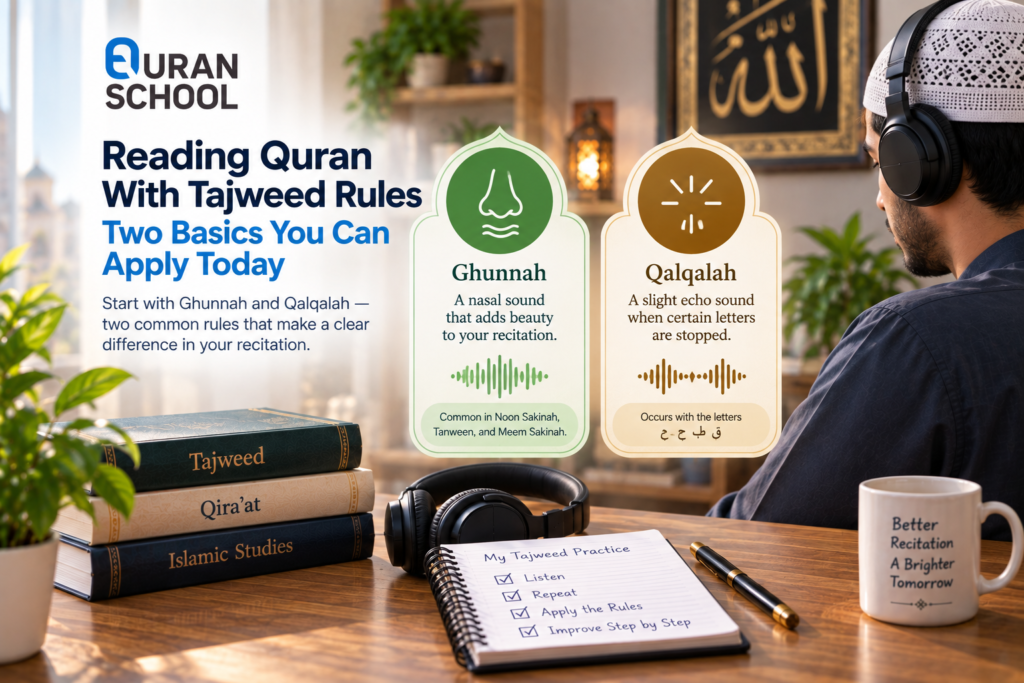
Two useful rules to begin recognizing are Ghunnah and Qalqalah because examples of both appear frequently throughout the Quran and allow beginners to hear a noticeable difference between ordinary pronunciation and controlled Tajweed application.
The best way to learn them is to combine a simple explanation with actual recitation. First understand what triggers the rule, then locate several examples in the Mushaf, listen to a qualified reciter pronounce them, and repeat them aloud.
Once you can recognize the rule in individual words, begin applying it naturally while reading complete ayahs.
1. Ghunnah — The Nasal Sound of Doubled Noon and Meem
Ghunnah is a nasal sound associated particularly with the letters Noon and Meem. One of the clearest places for beginners to recognize it is when Noon (نّ) or Meem (مّ) carries a Shaddah.
In this situation, the Ghunnah is maintained for approximately two counts, with the sound resonating through the nasal passage rather than being produced only from the mouth.
Examples of a doubled Noon include words such as إِنَّ, النَّاس, and جَنَّات, while doubled Meem can be heard in examples such as ثُمَّ, عَمَّ, and أُمُّهُ. Listen carefully to how a skilled reciter maintains the nasal quality without exaggerating it or shortening it so much that the Ghunnah disappears.
During practice, isolate the relevant word first and repeat it several times before placing it back into the complete ayah.
The aim is not simply to “make the sound longer,” but to develop the correct nasal quality and consistent duration until Ghunnah begins to occur naturally whenever you encounter the relevant Tajweed condition.
Join our Quran Tafsir Course and get a free trial

2. Qalqalah — The Gentle Bounce of a Sakin Letter
Qalqalah is a distinctive sound that occurs with five Arabic letters, traditionally collected in the phrase قُطْبُ جَدٍ (Qutb Jad): ق، ط، ب، ج، د.
When one of these letters is in a state of Sukoon—including when Sukoon results from stopping—the sound is articulated with a controlled rebound or echo rather than allowing the consonant to become unclear or disappear.
Beginners should be careful not to turn Qalqalah into a completely new vowel sound. The goal is a clear rebound of the consonant, not adding an extra Fatha, Kasra, or Damma after it.
Examples can be heard when stopping on words such as الْفَلَقْ, وَتَبْ, and أَحَدْ, where the final Qalqalah letter becomes particularly noticeable during a pause.
A useful practice is to listen to each example several times, repeat it slowly, and then compare your pronunciation with a qualified reciter.
Once you can produce Qalqalah accurately in isolated words, practice the same words within complete Quranic verses so that the rule becomes part of your normal recitation rather than an exaggerated sound added consciously each time.
Build stronger Quran reading and Tajweed skills with E Quran School through structured online instruction, practical recitation, and regular correction.

Ghunnah and Qalqalah provide a useful entry point into practical Tajweed, but they represent only a small part of the complete system. As your skills develop, you can progress into rules involving Noon Sakinah and Tanween, Meem Sakinah, Madd, heavy and light letters, and Waqf and Ibtida.
A guided Tajweed course with a live tutor can build on these foundations while allowing a teacher to listen to your recitation and correct mistakes in real time before they become established habits.
Read also: How to Learn Quran with Tajweed at Home
Why Voice Beautification and Full Tajweed Are Still Recommended
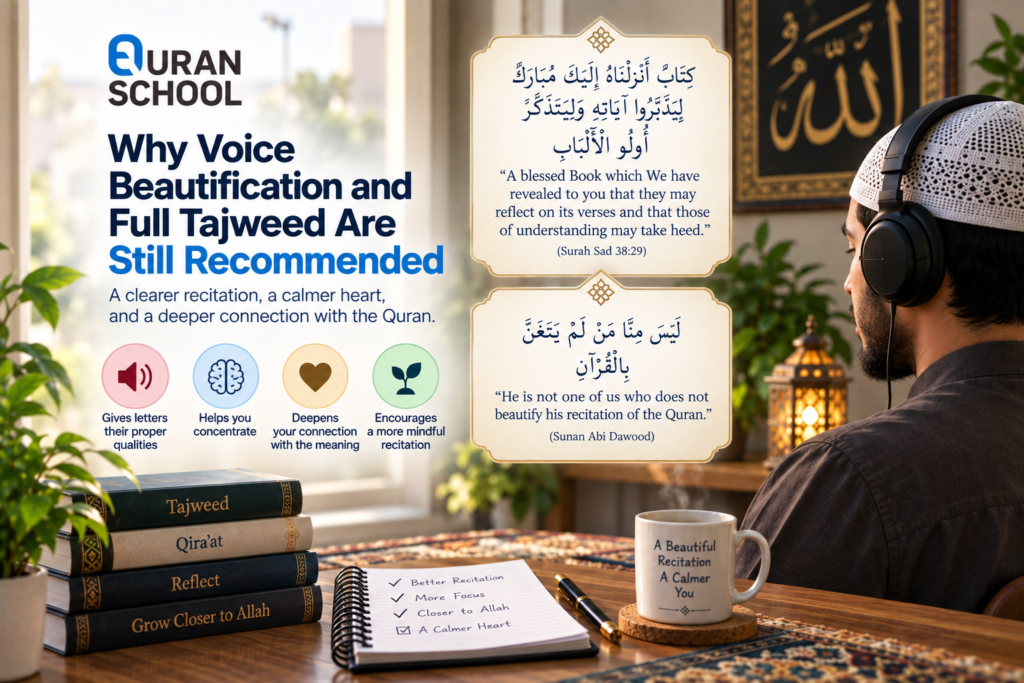
Even where the full technical application of Tajweed is not considered obligatory, striving to perfect one’s recitation and beautify the voice while reading the Quran remains highly encouraged.
Accurate Tajweed gives the letters their proper qualities and makes the recitation clearer, while a pleasant, natural voice can help the reciter slow down, concentrate on the words, and engage more deeply with their meanings.
The goal is not musical performance or showing off one’s voice, but to recite the words of Allah with care, reverence, and attentiveness.
This connection between recitation and reflection is especially important. Tajweed should not become an exercise in pronunciation that distracts completely from the meaning of the verses.
As technical accuracy gradually becomes more natural, the learner can give greater attention to Tadabbur (reflection), Khushu’ (attentiveness and humility), and understanding what is being recited. Allah says:
كِتَابٌ أَنزَلْنَاهُ إِلَيْكَ مُبَارَكٌ لِّيَدَّبَّرُوا آيَاتِهِ وَلِيَتَذَكَّرَ أُولُو الْأَلْبَابِ
“This is a blessed Book which We have revealed to you, that they might reflect upon its verses, and that those of understanding would be reminded.”
Beautiful and measured recitation can also benefit those who are listening. When Quranic words are pronounced clearly and recited without unnecessary rushing, listeners have a better opportunity to follow the verses and reflect on what they hear.
The Quran itself commands attentive listening:
وَإِذَا قُرِئَ الْقُرْآنُ فَاسْتَمِعُوا لَهُ وَأَنصِتُوا لَعَلَّكُمْ تُرْحَمُونَ
“And when the Quran is recited, then listen to it and pay attention, that you may receive mercy.”
The Sunnah also contains specific encouragement to beautify Quran recitation with the voice. Abu Hurairah (may Allah be pleased with him) narrated that the Prophet Muhammad ﷺ said:
لَيْسَ مِنَّا مَنْ لَمْ يَتَغَنَّ بِالْقُرْآنِ
“He is not one of us who does not recite the Quran melodiously.”
This encouragement should be understood alongside the priority of correct recitation. Beautifying the voice should support Tajweed rather than override it.
A reciter should not distort letters, exaggerate elongations, or change the natural structure of Quranic words simply to create a more impressive melody. Correct pronunciation and respect for the rules of recitation remain the foundation; vocal beauty is an additional quality built upon that foundation.
Another hadith expresses this encouragement directly:
زَيِّنُوا الْقُرْآنَ بِأَصْوَاتِكُمْ
“Beautify the Quran with your voices.”
Sunan Abu Dawud and Sunan an-Nasa’i
For beginners, this means there is no need to imitate the elaborate style of an experienced Qari immediately. Begin with correct letters, clear vowels, controlled Madd, proper Ghunnah, and measured pacing.
Read also: How Long Does It Take to Learn Tajweed?
As these fundamentals become stronger, a pleasant and natural recitation style can develop gradually. Accuracy should come first, while beauty grows from confidence, understanding, and repeated practice.
Reflecting on the rewards connected with Quran recitation can provide additional motivation to keep improving. You can explore this further in how many hasanat (good deeds) are earned for reading the Quran, as well as the wider scientific benefits of reading the Quran.
Together, these perspectives reinforce that improving recitation is not simply about technical perfection; it can become part of a broader effort to read the Quran consistently, reflect on its guidance, and strengthen one’s relationship with its message.
Experience Our Classes
Don’t just take our word for it—watch real-time recordings of our online classes below to experience our teaching style firsthand.
Start Your Quranic Journey Today
Experience our interactive online classes with a dedicated tutor.
Get Your Free TrialReady to Recite With Confidence, Not Guesswork?
Reading about the rules of Tajweed is a helpful first step, but real correction only happens when a qualified teacher hears your recitation and fixes your mistakes in real time.
If you’ve been reciting on your own and are unsure whether your makharij, ghunnah, or qalqalah are actually correct, this is exactly the gap a structured, one-on-one Tajweed program is built to close.
Platforms such as E Quran School Online make this guided approach accessible through live instruction, allowing students to combine personal practice with real-time correction as they gradually progress toward more complete and polished Tajweed.
Instead of guessing whether you’re applying these rules properly, you get live feedback after every verse, so correct pronunciation becomes a habit rather than a hope.
Our Quran Courses
- Quran Tafsir Course
- Zoom Quran Classes
- Skype Quran Classes
- Learn Quran Easily at Home
- Al-Azhar Quran Course
- Sunni Online Quran Classes
- Intensive Quran Course
- Online Quran Classes Based in Saudi Arabia
- Quran Teachers
- Noorani Qaida Course
- Noorani Qaida Course for Kids
- Quran Memorization (Hifz) Course
- Hifz Classes for Adults
- Quran Ijazah Program
- Online Arabic and Quran Classes

| START YOUR QURANIC JOURNEY TODAYExperience our interactive online classes with a dedicated tutor.Get Your Free Trial |
Conclusion
Tajweed carries two important levels of responsibility that should be distinguished clearly. Studying the complete theoretical science of Tajweed—including its terminology, classifications, detailed rules, and methods of transmission—is generally treated as a communal obligation (Fard Kifayah).
This means the responsibility is fulfilled when enough qualified scholars, Quran reciters, and teachers within the Muslim community learn the science thoroughly, preserve it accurately, and pass it on to future generations.
Every Muslim does not therefore need to become a specialist or memorize every technical Tajweed term.
The practical responsibility of the individual reciter is different. Correct Quran pronunciation, particularly avoiding clear mistakes such as substituting one letter for another or altering vowels in a way that changes a word or its meaning, is treated by many scholars as an individual obligation (Fard Ayn) according to the person’s ability.
This applies whether the Quran is being recited during Salah or outside the prayer. A beginner who struggles is expected to keep learning and correcting mistakes, but is not expected to achieve the same level of precision immediately as an experienced Qari.
At the same time, scholars such as Ibn Uthaymeen and Ibn Baz distinguished basic correct recitation from mastering the fuller technical refinements of Tajweed.
Applying the complete range of refined rules and beautifying the voice are highly encouraged, but a Muslim who preserves the Quranic letters and basic vowel sounds correctly while still developing these advanced skills should not abandon recitation out of fear of imperfection.
The authentic hadith mentioned above also gives particular encouragement to the person who struggles with Quran recitation while continuing to make the effort, describing two rewards for that sincere struggle.
Frequently Asked Questions
Is Tajweed obligatory?
Studying the detailed theoretical rules of Tajweed is fard kifayah (a communal obligation), while correctly pronouncing letters during recitation, without changing their meaning, is fard ayn (an individual obligation) on every Muslim.
Is Tajweed obligatory in Salah?
The same ruling applies inside Salah as outside it: correct pronunciation that avoids clear errors changing the meaning is required, while the fully refined rules of Tajweed are recommended but not obligatory in the prayer.
Can you recite Quran without Tajweed?
Yes. According to Ibn Uthaymeen and Ibn Baz, a Muslim may recite the Quran without knowing the formal rules of Tajweed, as long as the basic vowels and letters are pronounced correctly, and there is no sin in doing so.
What is the minimum Tajweed requirement for every Muslim?
The minimum is correctly articulating each letter from its proper point of articulation (makhraj) and avoiding any clear mispronunciation (lahn jali) that changes the meaning or structure of a word.
Do I need a teacher to learn Tajweed correctly?
Scholars note that listening to and reciting in front of a proficient teacher is the most reliable way to correct pronunciation mistakes, since errors in articulation are often difficult to notice without live correction.
What is the difference between studying Tajweed and applying it?
Studying Tajweed means learning its terminology and detailed classifications, which is a communal obligation. Applying it means actually pronouncing letters correctly while reciting, which is an individual obligation on every reciter.











Leave a Reply