 Learn Quran

Many Muslims today are searching for one practical answer: how to learn the Quran with Tajweed at home without commuting daily to a mosque or a memorization center.
The good news is that home learning can be highly effective when it follows a structured method rather than depending on random videos, occasional practice, or theoretical study alone.
The key is to start at your actual reading level and build each skill in the correct order. Accurate letter pronunciation comes before advanced Tajweed rules, and understanding a rule should always be followed by hearing it, practicing it in Quranic words and verses, and receiving correction.
In this comprehensive guide, we walk you through how to learn Quran with Tajweed at home step by step, beginning with assessing your current recitation and mastering the articulation points of Arabic letters (makharij).
From there, you will progress through short vowels, Noon Sakinah and Tanween, Meem Sakinah, Madd, Tafkheem and Tarqeeq, and Waqf and Ibtida.

1. Assess Your Current Quran Reading and Tajweed Level
The first step in how to learn Quran with Tajweed at home is not opening a Tajweed textbook or memorizing a list of rules. It is identifying your current level accurately. Two students may both describe themselves as beginners while needing completely different starting points.
Begin by reading a short passage of the Quran aloud, preferably something familiar such as Surah Al-Fatihah and several verses from Juz Amma. Try to read naturally without deliberately slowing down to hide areas of difficulty.
Pay attention to whether you can recognize letters easily, pronounce them clearly, maintain the correct vowels, and read connected words without frequent hesitation.
Then examine your Tajweed knowledge separately. Can you recognize Noon Sakinah and Tanween rules when they appear? Can you distinguish natural Madd from other forms of elongation? Do you understand basic stopping signs? More importantly, can you apply the rules while reading without constantly stopping to think about them?
Your level will generally fall into one of three broad categories:
- Level one: You struggle with Arabic letters, vowels, or basic Quran reading and do not yet understand Tajweed rules. Your priority should be pronunciation, makharij, and basic reading before advanced rules.
- Level two: You can read the Quran and may understand Tajweed theoretically, but your application is inconsistent. At this level, you need much more guided recitation, listening, and correction rather than simply studying additional definitions.
- Level three: You already apply most Tajweed rules reliably and want to refine subtle mistakes or progress toward advanced recitation and possibly ijazah. Your study should focus heavily on continuous recitation before a qualified teacher.

A teacher-led assessment is particularly useful because some mistakes are almost impossible for beginners to identify themselves. You may believe two letters sound different when an experienced teacher can hear that they are being produced from almost the same place. Starting with an accurate assessment prevents you from spending months practicing the wrong material.
2. Master the Correct Articulation Points of the Arabic Letters (Makharij)
Once you understand your level, make makharij your first technical priority. The articulation point of a letter is the place from which its sound originates, and accurate makharij form the foundation of correct Quranic recitation.
Arabic letters are produced through different areas of the vocal system, including the throat, tongue, lips, oral cavity, and nasal passage. Some letters may initially sound similar to learners, particularly if those sounds do not exist in their native language. However, in Quranic Arabic, each letter has its own identity and must remain distinguishable.
Do not study makharij only through diagrams. Choose one group of letters at a time, listen carefully to a qualified teacher or reliable recitation resource, and repeat the sounds aloud. Practice each letter in isolation first, then with Fatha, Kasra, and Damma, and finally inside Quranic words.
For example, if a particular throat letter is difficult, repeating entire pages of Quran may not fix it. Isolate that letter, learn where it should originate, compare it with nearby sounds, and practice short examples until your mouth becomes accustomed to the correct movement.
This is also one of the stages where direct correction matters most. A video can show you where the tongue should be positioned, but it cannot tell you whether your tongue is actually producing the correct result. Having a teacher listen prevents an incorrect sound from becoming reinforced through hundreds of repetitions.
Read more: 10 Spiritual Benefits of Reading the Quran.
Begin your journey of learning Quran Easily at Home in Our academy

See Us in Action
Watch a quick snippet from our live, interactive classes below and see how our teachers make learning engaging for all ages!
Start Your Quranic Journey Today
Experience our interactive online classes with a dedicated tutor.
Get Your Free Trial3. Practice the Short Vowels: Fatha, Kasra, and Damma
After establishing the basic makharij, focus on the three short vowels: Fatha, Kasra, and Damma. They may appear elementary, but inaccurate vowels can affect both the sound and meaning of Quranic words.
The goal is to pronounce each vowel clearly without turning it into an unnecessary elongation. A Fatha should not automatically become a long aa, a Kasra should not become a long ee, and a Damma should not become a long oo. Distinguishing short vowels from Madd is essential for accurate recitation.
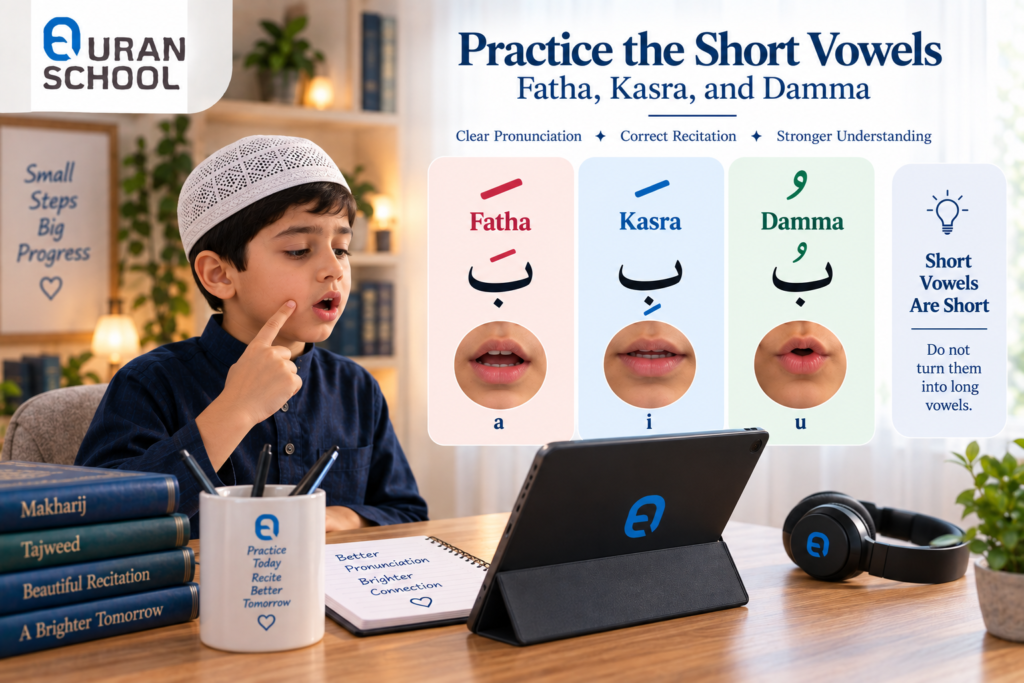
Practice the same letter with all three vowels so you can hear and feel the difference. Then combine letters into short words while maintaining their original articulation points.
This is important because some beginners pronounce a letter correctly in isolation but change its sound when a vowel or neighboring letter is added.
A simple home exercise is to dedicate several minutes each day to focused vowel drills before beginning Quran recitation. Once the sounds are stable individually, identify them in real verses and read slowly enough to preserve each vowel.
Read more: 10 Benefits of Reading the Quran with Tajweed

4. Learn the Rules of Noon Sakinah and Tanween
Once your basic pronunciation is reasonably stable, begin studying Noon Sakinah and Tanween, which introduce you to some of the most frequently encountered Tajweed rules in Quran recitation.
Learn the four main applications—Izhar, Idgham, Iqlab, and Ikhfa—and understand how the letter that follows Noon Sakinah or Tanween determines which rule should be applied. Rather than memorizing the trigger letters alone, look for examples directly in Quranic verses, listen carefully to how each example is recited, and then practice it aloud.
Because these patterns occur so frequently throughout the Quran, you will have many opportunities to reinforce them during your regular reading, helping you gradually move from consciously identifying each rule to applying it more naturally during continuous recitation.
There are four principal rules:
- Izhar: clear pronunciation.
- Idgham: merging.
- Iqlab: conversion.
- Ikhfa: concealment.
Do not try to memorize every letter associated with all four rules in one session. Begin with one rule, understand what causes it, learn its associated letters, and collect several Quranic examples. Listen to those examples from a skilled reciter before attempting them yourself.
Once you can identify the rule visually, focus on its sound. This distinction matters because a learner may correctly label a word as Ikhfa but still pronounce it incorrectly. Tajweed mastery means recognizing and producing the rule accurately.
You can also use a color-coded Tajweed Mushaf to help identify recurring patterns. Over time, try reading from a regular Mushaf as well so that you learn to recognize the rule from the letters rather than depending permanently on colors.

5. Study the Rules of Meem Sakinah
After Noon Sakinah and Tanween, move to Meem Sakinah, which has three principal cases: Ikhfa Shafawi, Idgham Shafawi, and Izhar Shafawi.
These rules are often easier for beginners to organize because there are fewer cases, but they still require careful listening and correct lip movement. Simply knowing which letter follows the Meem is not enough; you need to learn how the sound changes in each situation.
Study one case at a time and find several Quranic examples. Listen closely to the way a skilled reciter handles the Meem and pay particular attention to ghunnah where it applies. Then repeat the examples yourself.
Short Surahs are excellent practice material because familiarity with the verses frees your attention to concentrate on Tajweed. Instead of worrying about decoding unfamiliar words, you can focus specifically on what happens to the Meem Sakinah.
The Al-Azhar course provides a more comprehensive structured curriculum under qualified teachers.

6. Master the Essential Rules of Madd (Elongation)
Madd is one of the most noticeable features of Quranic recitation, but beginners frequently struggle with maintaining consistent lengths. Start with Madd Tabi’i, or natural Madd, before studying the secondary categories.
Natural Madd establishes your basic sense of timing because it is held for two counts. Practice it repeatedly until those two counts become consistent rather than changing according to your breath, speed, or melody.
After that foundation is secure, gradually study other types, including Madd Muttasil and Madd Munfasil. Instead of memorizing a large chart immediately, learn what causes each type of Madd, how it appears in Quranic text, and how it should sound during actual recitation.
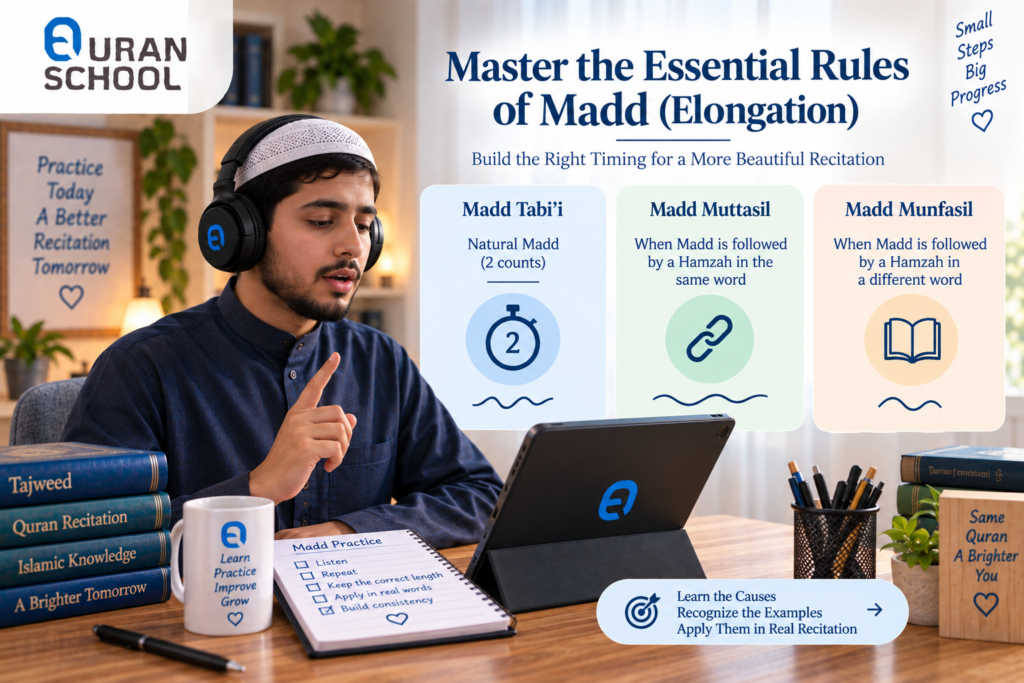
Listening is extremely important here. Select one reliable reciter and repeat a short passage containing several examples. Try to match the timing without exaggerating the sound or turning Tajweed practice into imitation of melody alone.
Recording yourself can also expose inconsistency. You may discover that one natural Madd lasts two counts while another lasts much longer even though the rule is the same. Identifying these differences is an important part of developing controlled recitation.
7. Practice Tafkheem and Tarqeeq Correctly
The next stage is learning Tafkheem and Tarqeeq, commonly described as heaviness and lightness. These qualities help preserve the correct sound of Arabic letters and give Quranic recitation its proper phonetic distinction.
Tafkheem does not mean speaking louder, and Tarqeeq does not mean speaking quietly. They describe the quality of the letter itself. Trying to create heaviness through volume is a common mistake and can result in an exaggerated sound.
Begin with letters whose heavy quality is consistent, then study cases where the ruling changes according to context, particularly the letter Raa. Listen to paired examples of heavy and light pronunciation so that your ear becomes sensitive to the contrast.

Practice slowly and avoid exaggeration. Correct Tajweed aims for precise pronunciation, not artificial vocal effects. Having a teacher listen at this stage can help you distinguish between genuine Tafkheem and simply forcing the sound.
8. Learn the Rules of Waqf and Ibtida
Learning Waqf and Ibtida, or stopping and starting, is essential because correct recitation involves more than pronouncing individual words. Where you stop can affect how a listener understands the meaning of a verse.
Begin by learning the common stopping signs found in the Mushaf. Understand which signs indicate that stopping is appropriate, where continuation is preferred, and where stopping may create a problem in meaning.

Then apply these signs during actual reading. Take a short passage and decide in advance where you would stop if you needed to breathe. Listen to a skilled reciter reading the same passage and compare their stopping choices with yours.
Learning basic meanings also becomes increasingly valuable at this stage. When you understand what a verse is saying, it becomes easier to recognize why stopping after a particular word may leave an incomplete idea or create an unintended connection with what follows.
9. Listen Regularly to Skilled Quran Reciters
Listening is one of the most powerful tools available to anyone learning Tajweed from home. Tajweed is transmitted through sound, so books and written explanations cannot fully teach you how correct recitation should actually sound.
Choose reciters known for clear, measured recitation, especially while you are still a beginner. Instead of listening passively for long periods, practice focused listening. Select several verses, listen to one verse, pause, repeat it aloud, and then listen again.
Pay attention to one skill at a time. During one session, focus on makharij. During another, listen for Madd. Later, concentrate on ghunnah, Tafkheem, Tarqeeq, or stopping.
Repeating the same verses over several days gradually develops a reliable “Tajweed ear.” You begin to notice when your pronunciation differs from the model even before you consciously identify the rule responsible.
It is also worth remembering that improving Quran recitation has a purpose beyond vocal performance. The virtue of careful and beautiful recitation is explored further in Hadiths About Reciting the Quran Beautifully, while The Reward for Reading the Quran discusses the wider merit of Quran recitation in a Muslim’s daily life.

10. Apply Each Tajweed Rule to Short Surahs and Surah Al-Fatihah
Application is where theoretical Tajweed becomes actual Tajweed. Every rule you study should quickly move from the notebook or textbook into real Quranic recitation.
Surah Al-Fatihah is an especially important place to practice because Muslims recite it repeatedly in Salah. The short Surahs of Juz Amma are also useful because many learners already know them, allowing greater concentration on pronunciation rather than word recognition.

Do not attempt to correct every aspect of a Surah simultaneously when you are still beginning. Read the same Surah several times with a different focus.
On the first reading, concentrate on makharij. On another, look specifically for Madd. Then repeat it while paying attention to ghunnah, heavy and light letters, and stopping.
Eventually, combine the skills and read normally. Your aim is to reach a point where the rules no longer feel like twelve separate things you must consciously remember. Correct pronunciation should gradually become your natural way of reading.
This application-based approach is central to how to learn Quran with Tajweed at home because it prevents Tajweed from becoming a subject you understand academically but cannot use during real recitation.
11. Record Your Recitation and Compare It With Correct Recitation
Recording your own voice is one of the simplest and most useful home-learning techniques. When you are actively reciting, part of your attention is occupied by reading the text, controlling your breath, remembering rules, and preparing the next word. As a result, you may not hear your own errors clearly.
Choose five to ten verses and record yourself reading them naturally. Then find a reliable recitation of exactly the same passage and compare the two phrase by phrase.
Listen specifically for differences in:
- Letter pronunciation and makharij.
- Madd lengths.
- Ghunnah.
- Tafkheem and Tarqeeq.
- Short vowels.
- Stops and starts.
- Overall consistency.
Keep a small error log rather than simply recording new passages every day. If the same mistake appears repeatedly, isolate it and practice it before recording yourself again.
However, self-recording has an important limitation: you can only correct mistakes that you are capable of recognizing. If your ear has not yet learned the difference between your pronunciation and the correct pronunciation, comparing recordings may not reveal the real problem.
That is why recording works best as a supplement to teacher correction rather than a substitute for it.
Read also: Benefits of Reading the Quran in the Morning
Start A Free Trial For Your Quranic Journey Today

12. Get Regular Correction From a Qualified Tajweed Teacher
The final step ties the entire home-learning process together: get regular correction from a qualified Tajweed teacher. You can study rules, listen to reciters, use books, and record yourself independently, but Tajweed ultimately requires another trained person to hear your recitation.
A teacher can detect mistakes that you may not even realize exist. More importantly, they can explain exactly what needs to change. Instead of simply telling you that a letter is incorrect, an experienced teacher can help you adjust the articulation point, tongue position, lip movement, timing, or sound quality.
Regular correction also prevents mistakes from becoming habits. Repeating an incorrect sound every day does not automatically bring you closer to the correct pronunciation; it can make the mistake more deeply established.
Online learning makes this correction possible without giving up the convenience of studying at home. A live one-to-one lesson allows the teacher to listen, stop you at the point of error, demonstrate the correct sound, and ask you to repeat it immediately.
Best Books for Beginners Learning Tajweed
Books can give your home Tajweed study a clear structure and provide a dependable reference whenever you need to revisit a rule. A well-organized Tajweed book can help you move through the subject systematically instead of learning disconnected rules from different sources.
It is particularly useful for studying Makharij diagrams, Sifaat, rule categories, Madd classifications, Noon Sakinah and Tanween, Meem Sakinah, Qalqalah, and Waqf and Ibtida, while also giving you Quranic examples that show where each rule appears.
Books are also valuable between lessons. If your teacher introduces a rule that you do not fully understand, you can return to the relevant chapter, review the explanation, and practice identifying additional examples in the Quran.

| Book | What Makes It Stand Out |
| At-Tajweed Al-Musawwar (Illustrated Tajweed) | A visual, simplified style with clear illustrations of the letters’ articulation points, well suited to visual learners. |
| Al-Muneer fi Ahkam At-Tajweed | A simplified arrangement of the rules, suitable for students studying them for the very first time without added complexity. |
| Hidayat Al-Mustafid fi Ahkam At-Tajweed | A short, focused treatise that helps beginners lock in the core rules quickly and clearly. |
| Tuhfat Al-Atfal and its commentaries | A short, easy-to-memorize versified text, suitable for both younger and older beginners alike. |
Why You Need a Specialized Online Teacher, Not Just Self-Study
Self-study is extremely useful for reviewing rules, listening to recitation, practicing Quranic examples, and building consistency between lessons. What it cannot reliably provide is objective correction.
The problem is simple: if you cannot hear that your pronunciation is wrong, you cannot reliably correct it yourself. A learner may repeatedly pronounce the same letter from an incorrect articulation point while believing it sounds identical to the reference recording.
A qualified teacher can hear these subtle differences immediately. They can also determine whether the real problem comes from makhraj, a letter characteristic, vowel length, ghunnah, Madd, Tafkheem, Tarqeeq, or another aspect of recitation.
This is precisely why specialized online Tajweed courses combine the flexibility of learning from home with direct, one-to-one follow-up. The learner can practice independently throughout the week and then use live sessions to correct mistakes, confirm progress, and determine what to work on next.
Book Your FREE Trial Lesson in Our Quan Classes for Adults in E Quran School
Experience Our Classes
Don’t just take our word for it-watch real-time recordings of our online classes below to experience our teaching style firsthand.
Start Your Quranic Journey Today
Experience our interactive online classes with a dedicated tutor.
Get Your Free Trial
Start Learning Tajweed From Home Today
If you want guidance while building this routine, E Quran School can help you learn Tajweed through structured online lessons tailored to your current recitation level.
With one-on-one instruction and direct teacher correction, you can work on Makharij, pronunciation, essential Tajweed rules, and practical Quran recitation step by step from home, without rushing through skills you have not yet mastered.
Our Quran Courses
- Quran Tafsir Course
- Zoom Quran Classes
- Skype Quran Classes
- Learn Quran Easily at Home
- Al-Azhar Quran Course
- Sunni Online Quran Classes
- Intensive Quran Course
- Online Quran Classes Based in Saudi Arabia
- Quran Teachers
- Noorani Qaida Course
- Noorani Qaida Course for Kids
- Quran Memorization (Hifz) Course
- Hifz Classes for Adults
- Quran Ijazah Program
- Online Arabic and Quran Classes
Booking a free trial lesson with a specialized teacher can give you a clear starting point.

Conclusion
Understanding how to learn the Quran with Tajweed at home becomes much simpler when you stop treating Tajweed as a long collection of rules that must be memorized all at once.
It is a gradual practical skill: assess your level, establish correct makharij, strengthen your vowels, learn the major rules in sequence, listen carefully, and immediately apply what you learn to Quranic verses.
Home study gives you the flexibility to repeat lessons, listen to skilled reciters, practice short Surahs, and record your recitation as often as necessary.
These tools can make a major difference when used consistently, but their effectiveness becomes much greater when they are combined with direct correction.
A qualified teacher provides the feedback that a book, video, or recording cannot provide on its own. By combining structured self-practice with regular teacher correction, you can build a home Tajweed routine that develops not only theoretical knowledge but increasingly accurate, confident, and consistent Quran recitation.
Frequently Asked Questions
Can I Learn Tajweed at Home Without a Teacher?
You can learn many of the basic theoretical rules independently through books, videos, and reliable online resources. You can also improve through focused listening and self-recording. However, practical Tajweed involves subtle pronunciation details that learners cannot always hear in their own voices.
How Long Does It Take to Learn the Basic Rules of Tajweed?
The timeline depends on your starting Quran reading level, pronunciation, frequency of practice, and access to correction. A learner who already reads Arabic accurately will usually progress through the theoretical rules more quickly than someone who first needs to rebuild their makharij and basic reading skills. With regular sessions and consistent practice, beginners can build a useful foundation over several months. Full, natural application during longer Quran recitation generally requires continued practice beyond simply completing a beginner Tajweed curriculum.
What Is the Difference Between Teaching Tajweed to Adults and to Children?
Children usually benefit from short lessons built around listening, imitation, repetition, and simple examples rather than lengthy theoretical explanations. The aim is to develop correct pronunciation habits naturally while maintaining engagement.
Adults can usually combine theoretical explanations with direct application and may progress through rule categories more systematically. In both cases, however, regular listening and direct correction remain essential.
Does Learning Online Give the Same Results as Learning in Person?
Online Tajweed learning can be highly effective when lessons are live and interactive rather than entirely prerecorded. The teacher should be able to hear the learner clearly, correct mistakes immediately, demonstrate the correct pronunciation, and ask the student to repeat it.
One-to-one online learning also provides additional flexibility in scheduling and allows students to work with teachers who may not be available locally. The quality of instruction, consistency of practice, and direct feedback are more important than simply whether the lesson takes place online or in the same physical room.
Where Should I Start If I Know Nothing About Tajweed at All?
Start with your Arabic letters, their correct articulation points, and basic vowel pronunciation before attempting to memorize advanced Tajweed rules. These skills form the phonetic foundation on which the rest of Tajweed depends.
Related Articles
Learn Quran











Leave a Reply