 Learn Quran
Pick up the Quran and read three letters — just Alif, Lam, Meem — and you have already earned thirty recorded good deeds according to an authenticated hadith narrated by Abdullah ibn Mas’ud. Now consider that the Quran contains more than 320,000 letters.
The Prophet Muhammad ﷺ was not speaking in approximations when he described what is the reward for reading quran. He gave a precise, verified number, and scholars have been running the calculation ever since.
This article covers what that reward actually is, stated in authentic Islamic texts, along with ten specific categories of reward documented across Sahih Muslim, Bukhari, Tirmidhi, and Ahmad.
Whether you are a fluent reciter or someone who stumbles through every line, the reward structure applies to you directly and in ways you may not have fully understood before.
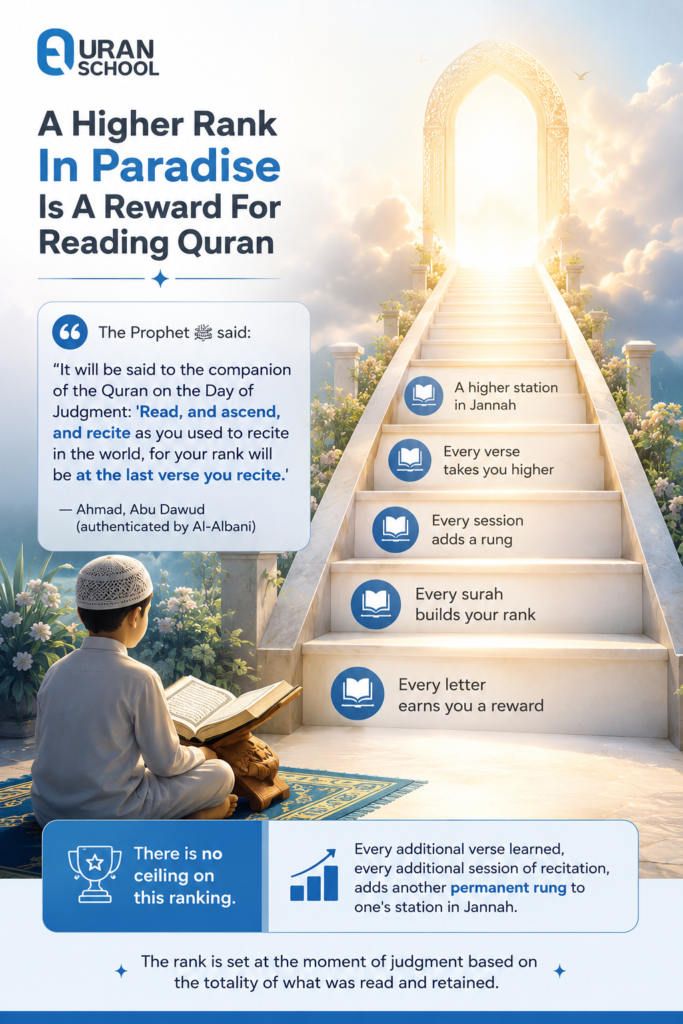
1. A Higher Rank In Paradise Is A Reward For Reading Quran
The Prophet ﷺ said: “It will be said to the companion of the Quran on the Day of Judgment: ‘Read, and ascend, and recite as you used to recite in the world, for your rank will be at the last verse you recite.'” — Ahmad, Abu Dawud (authenticated by Al-Albani). There is no ceiling on this ranking.
Every additional verse learned, every additional session of recitation, adds another permanent rung to one’s station in Jannah. The rank is set at the moment of judgment based on the totality of what was read and retained.
2. The Companionship of the Noble Angels
The Quran offers a unique honor to those who devote themselves to learning and reciting it with excellence, placing them in the company of the noble angels. Aisha (may Allah be pleased with her) reported the Prophet ﷺ as saying: “The one who is proficient in the Quran will be with the noble, righteous scribes.” Bukhari and Muslim.
The Safarah — a specific class of angels described in Surah Abasa (80:15–16) as honorable and dutiful — are among the most elevated of Allah’s creation. The proficient Quran reader is ranked alongside them in the Afterlife. This is a distinction the Prophet ﷺ reserved exclusively for those who mastered the Book.
Start Learn Quran Easily at Home with your first free class

3. Ten Good Deeds for Every Single Letter
This is the most quantifiable reward and the one the Prophet ﷺ was most specific about. Per the hadith of Ibn Mas’ud, each Arabic letter of the Quran earns one Hasanat, multiplied immediately to ten.
This applies to every form of reading, recitation for memorization, daily Wird, study, or looking up a verse in context. Even the Bismillah counts: scholars of the Permanent Committee for Islamic Research and Rulings confirmed it is a Quranic verse, and its 19 letters earn a minimum of 190 Hasanat per recitation. The math rewards consistency above almost every other variable.
Join our Quran Tafsir Course and get a free trial

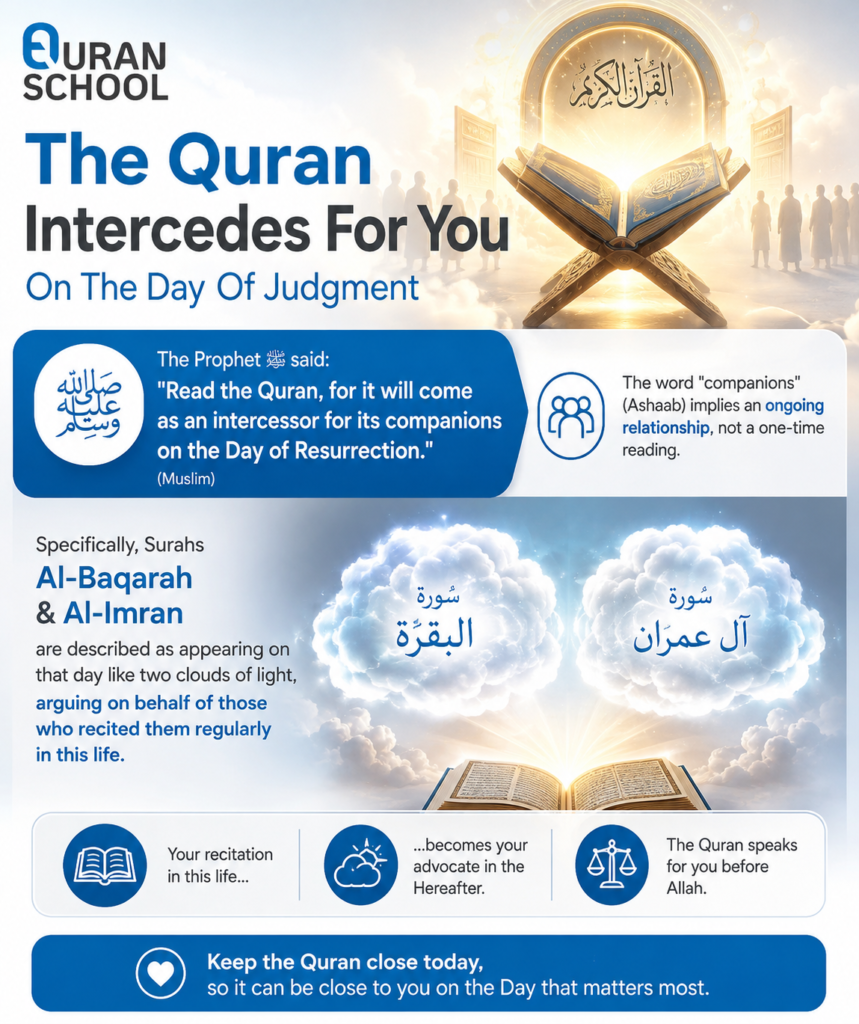
4. The Quran Intercedes For You On The Day Of Judgment
The Prophet ﷺ said: “Read the Quran, for it will come as an intercessor for its companions on the Day of Resurrection.” Muslim. The word “companions” (Ashaab) implies an ongoing relationship, not a one-time reading.
Specifically, Surahs Al-Baqarah and Al-Imran are described as appearing on that day like two clouds of light, arguing on behalf of those who recited them regularly in this life. This is not a metaphorical intercession — it is a literal advocate speaking for the reader before Allah.
5. Protection From Spiritual Heedlessness
Al-Ghaflah, the state of spiritual numbness that sets in gradually through distraction and neglect of Allah’s remembrance, is one of the most practically dangerous conditions a believer can fall into, precisely because it is imperceptible from the inside.
The Prophet ﷺ said: “Whoever reads ten verses at night will not be written among the heedless.”Al-Hakim (authenticated). The antidote in this narration is ten verses. Not a full Juz. Not a memorization session. Ten verses, read with intention, draw a protective line between the reader and spiritual decline.
Book a Free Trial in Our Quran Online Academy

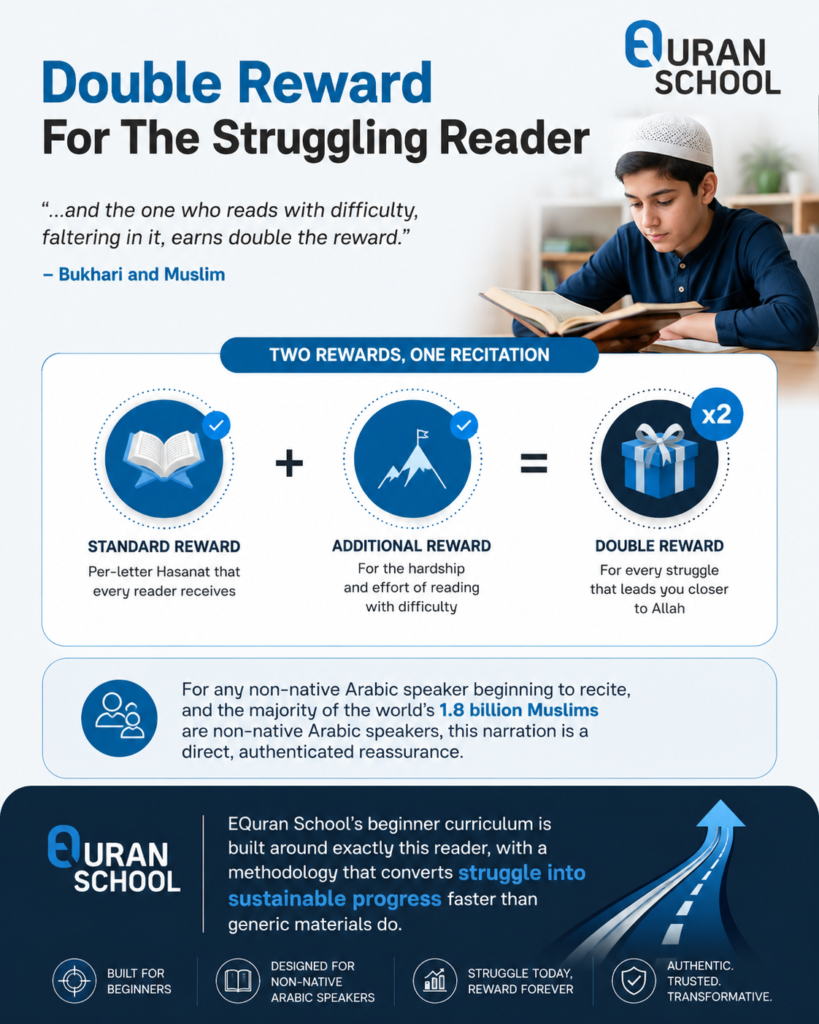
6. Double Reward For The Struggling Reader Of Quran
The same hadith that describes the fluent reader’s reward continues without qualification: “…and the one who reads with difficulty, faltering in it, earns double the reward.” Bukhari and Muslim.
Two rewards run simultaneously: the standard per-letter Hasanat that every reader receives, and an additional reward of reading Quran for the hardship of the effort.
For any non-native Arabic speaker beginning to recite, and the majority of the world’s 1.8 billion Muslims are non-native Arabic speakers, this narration is a direct, authenticated reassurance.
EQuran School‘s beginner curriculum is built around exactly this reader, with a methodology that converts struggle into sustainable progress faster than generic materials do.
7. Peace And Tranquility Descend During Quran Recitation
The Quran does more than guide the heart; its recitation creates an atmosphere of peace, mercy, and divine presence.
The Prophet ﷺ said: “No people gather in one of the Houses of Allah, reciting the Book of Allah and studying it among themselves, except that Sakinah (tranquility) descends upon them, mercy envelops them, the angels surround them, and Allah mentions them to those who are with Him.” Muslim.
This Sakinah is not a subjective impression. It is a specific divine mercy described in the same Quranic language used for the peace that descended on the Prophet ﷺ during the most difficult moments of his mission. It applies to communal recitation and to private daily reading alike.
Reserve your free trial lesson for Quran Reading Classes

8. Angels Surround The Quran Reciter
The narration of Al-Bara’ ibn Azib (in Bukhari and Muslim) records a man reciting Surah Al-Kahf at night while his horse stood tied nearby. A cloud descended and the horse began shying away from it.
In the morning, the Prophet ﷺ told him: “That was Sakinah that descended because of the Quran.” Classical scholars draw from this that the angels are present at every sincere recitation not only in group settings or mosques.
The presence of angels during personal recitation is a consistent element across multiple narrations, and it applies as much to a person reciting quietly at home as to a group recitation in a masjid.
9. Blessing In Time, Provision, And The Home
The Prophet ﷺ compared the house where Quran is regularly recited to a home filled with light and frequented by angels, in contrast to the house silent of Quran, which he described as comparable to a ruined structure.
Classical scholars including Ibn al-Qayyim observed that consistent Quran recitation draws Barakah, a quality of blessing that makes available time, relationships, and provision go further than they would otherwise.
Readers who establish a daily recitation habit consistently describe a sense of expansion in their daily experience that those without the habit do not report in the same way.
Begin memorizing the Quran today—your first session is free

10. Becoming Among The People Of Allah (Ahl Al-Quran)
Anas ibn Malik (may Allah be pleased with him) reported that the Prophet ﷺ said: “Allah has His own people from among humanity.” The Companions asked who they were. He answered: “They are the People of the Quran — the People of Allah and His elect.” Nasai, Ibn Majah.
The title Ahl al-Quran is not earned by a one-time achievement. It describes a person whose ongoing relationship with the Quran has become a defining characteristic — visible in how they speak, decide, and conduct themselves. It is the highest category of personal identification available to a Muslim in this life, above profession, nationality, and family lineage.
Read also: The Best Online Quran Classes for Non-Arabic Speakers
See Us in Action
Watch a quick snippet from our live, interactive classes below and see how our teachers make learning engaging for all ages!
Start Your Quranic Journey Today
Experience our interactive online classes with a dedicated tutor.
Get Your Free TrialHow Much Reward For Reading Quran?
The Quran contains more than 320,000 letters. At ten Hasanat per letter, the guaranteed minimum, a single complete recitation earns the reader a minimum of 3.2 million recorded good deeds. That figure is the floor, before any additional multiplication that Allah may grant for sincerity, time of year, or place of recitation. The breakdown by portion:
- One page: approximately 5,000 Hasanat
- One Juz (one of 30 equal portions): approximately 100,000 Hasanat
- One complete recitation: more than 3,000,000 Hasanat
A. Quran Recitation Brings Peace and Eases Anxiety
Allah ﷻ says: “Verily, in the remembrance of Allah do hearts find rest.” (13:28). This is presented in the Quran as a declarative fact. Regular recitation consistently produces a reduction in background anxiety, not through distraction, but because the act of Quran recitation simultaneously engages voice, hearing, memory, and intention in a way few other practices do.
Join our Noorani Qaida Course and get a free trial

B. Quran Recitation Invites Angels Into The Home
The Prophet ﷺ described the house where Quran is regularly recited as visited by angels and avoided by the Shayateen.
Parents who establish a daily recitation habit in the home are not only earning personal reward, they are shaping the spiritual atmosphere their children grow up inside. This is one of the most practical long-term returns of a consistent recitation practice.
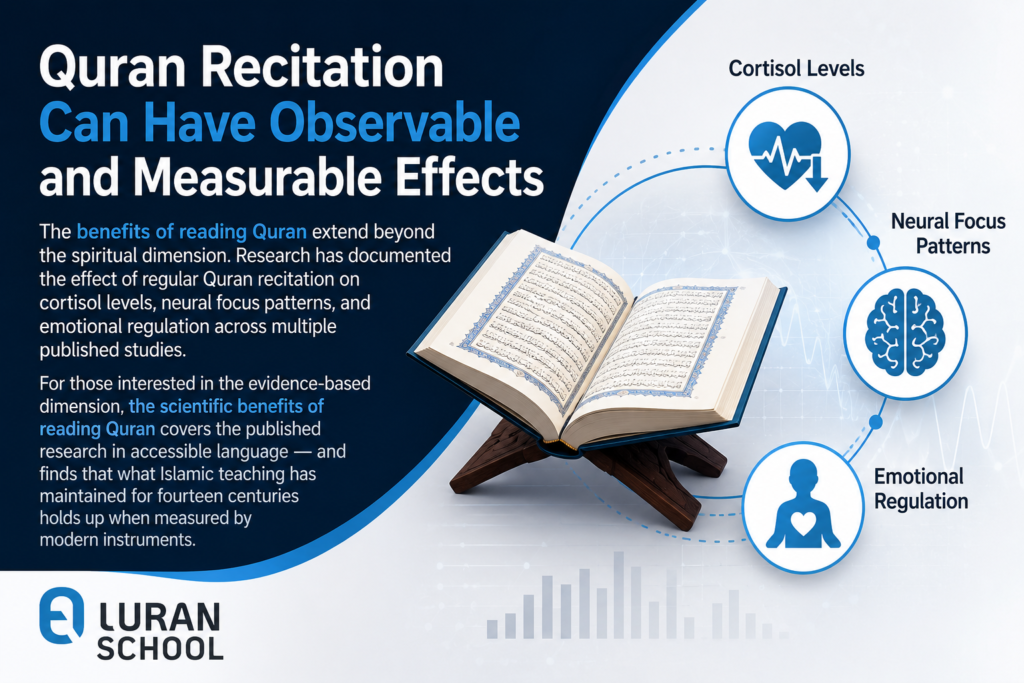
C. Quran Recitation Can Have Observable and Measurable Effects
The benefits of reading Quran extend beyond the spiritual dimension. Research has documented the effect of regular Quran recitation on cortisol levels, neural focus patterns, and emotional regulation across multiple published studies.
For those interested in the evidence-based dimension, the scientific benefits of reading Quran covers the published research in accessible language — and finds that what Islamic teaching has maintained for fourteen centuries holds up when measured by modern instruments.
How To Start Maximizing Your Reward?
Every letter earns ten Hasanat. The only variable is how many letters you read and how consistently you read them. Building a sustainable daily habit requires solving two practical problems: a reading plan and correct pronunciation. Both are solvable, and neither requires anything elaborate.
A. Build Your Quran Reading Schedule
Reading without a structured plan leads to irregular sessions and eventual abandonment. A 30 day Quran reading schedule distributes the full Quran evenly across one month — one Juz per day — the minimum pace that the Prophet ﷺ encouraged and the method historically favored by the Companions as a realistic daily commitment.
For those who want a framework that accounts for reading speed, daily time availability, and learning goals, a daily Quran reading plan and schedule offers a more adaptive structure that can be adjusted as proficiency grows.
B. Recite Quran With Tajweed
The Prophet ﷺ connected Quran recitation reward directly to quality: “Recite the Quran with its proper rules, for it was revealed with them.” The hadith about reading Quran with Tajweed establishes that mastering the rules of pronunciation is not an optional advanced study, it is a form of worship in itself, carrying its own category of reward distinct from the per-letter Hasanat.
EQuran School‘s Tajweed course is specifically designed to take readers from basic pronunciation correction to confident, rule-compliant daily recitation through live instruction.
Book a Free Trial in Our Online Quran Recitation Classes

C. Silent Or Loud Quran Reading Gets The Reward
Both silent and audible recitation earn the full per-letter reward. However, reciting aloud has specific additional merits in certain contexts, and certain narrations describe its particular impact on the listener and on the atmosphere of the space.
The hadith about reciting Quran loudly address when raising the voice carries additional reward and when silent recitation is the more appropriate choice.
D. Use The Right Tools To Read Quran
For building a daily recitation habit across a busy schedule, the right Quran reading apps eliminate the friction between intention and action, combining word-by-word displays, certified audio recitation, and progress tracking into one accessible format that works on any device, anywhere.
Experience Our Classes
Don’t just take our word for it—watch real-time recordings of our online classes below to experience our teaching style firsthand.
Start Your Quranic Journey Today
Experience our interactive online classes with a dedicated tutor.
Get Your Free TrialEquran School: A Purpose-Built System For Earning This Reward
Most online Quran platforms use generic Arabic phonics materials designed for native Arabic children. EQuran School developed the proprietary Al-Menhaj Book — authored by Luqman ElKasabany — specifically for non-Arabic speaking adults and children in Western contexts.
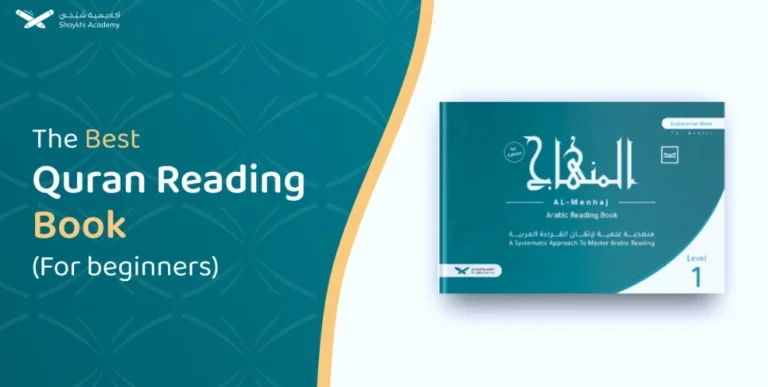
The methodology addresses the articulation challenges specific to English speakers: sounds that do not exist in English, letter distinctions that feel invisible at first, and pacing habits that need to be rebuilt rather than simply reinforced.
Whether you are in the US, UK, Canada, Australia, or anywhere else in the world, the math is the same and the method works. Live sessions run via Zoom on a schedule you set, with teachers who hold recognized Ijazah chains in Quranic recitation and are trained in the Al-Menhaj curriculum from day one.
EQuran School offers a full learning pathway from absolute beginner to Ijazah-certified reciter, with every level of the journey covered:
- Online Quran Learning with Tajweed Course
- Quran Tafsir Course
- Online Arabic and Quran Classes
- Quran Qirat Learning Course
- Noorani Qaida Course for Kids
- Online Quran Classes for Kids
- Zoom Quran Classes
- Quran for Beginners Course
- Weekend Quran Classes
- Quran Ijazah Program
Book your free trial class now and start earning your reward letter by letter.
Start Your Quranic Journey Today
Experience our interactive online classes with a dedicated tutor.
Get Your Free TrialConclusion
The reward for reading Quran is one of the most precisely documented forms of worship in Islamic teaching — ten Hasanat per letter, more than three million good deeds per complete recitation, intercession on the Day of Judgment, and a permanent rank in Paradise proportional to what a person reads and retains.
These are not general spiritual encouragements. They are specific, authenticated, and directed at every Muslim regardless of level, age, or linguistic background. The ten rewards covered in this article collectively explain why the Companions of the Prophet ﷺ treated daily recitation as irreplaceable.
Not as a minimum obligation to be technically satisfied, but as the single most efficient use of any available moment. Every letter they read was building something permanent. Every letter you read does the same.
The best way to learn Quran online is not the fastest app or the cheapest subscription. It is the method that results in consistent, correct daily recitation, one where pronunciation is corrected before errors calcify, the schedule fits real life, and the teaching is qualified enough to get you past the early obstacles that cause most independent learners to stop.
Frequently Asked Questions
What is the reward for reading one letter of the Quran?
Every letter of the Quran earns one Hasanat, immediately multiplied to ten — a guaranteed minimum of ten good deeds per letter. This is established in the authenticated hadith of Ibn Mas’ud recorded by Tirmidhi.
What is the reward for reading the Quran if I struggle with Arabic?
You earn double the reward. The Prophet ﷺ stated in an authenticated narration recorded by both Bukhari and Muslim that the reader who falters and finds recitation difficult receives two simultaneous rewards: one for the recitation itself and one for the effort and difficulty overcome.
Does the reward differ between reading from a physical Mushaf and reciting from memory?
Classical scholars, including Imam al-Nawawi, held that both methods earn the same per-letter reward. Some scholars noted that reading from the Mushaf adds the reward of gazing at the Book of Allah, while reciting from memory adds the reward of having preserved it in the heart. Neither form diminishes the reward of the other, and alternating between both is the practice of many of the great scholars of Quran.
Is there a specific reward for completing the entire Quran — one full Khatm?
Yes. Scholars note that completing the Quran carries a reward greater than the sum of individual letters alone, because the act of completion is itself a distinct form of devotion. The Companions maintained a deliberate habit of Khatm — some completing it weekly, some monthly — and the Prophet ﷺ encouraged the practice explicitly.
Does the Bismillah count toward the per-letter reward?
Yes. Scholars of the Permanent Committee for Islamic Research and Rulings confirmed that the Bismillah is a Quranic verse, and its 19 letters each carry the standard per-letter reward. That is a minimum of 190 Hasanat every time it is recited correctly.
What is the best time of day to read Quran for maximum reward?
The per-letter reward applies at any time of day without a stated reduction. However, night recitation holds a specific distinction in multiple Quranic verses and narrations — the Prophet ﷺ described it as particularly witnessed and accepted. Fajr recitation is also specifically mentioned in the Quran as witnessed by the angels of night and day simultaneously (17:78).










Leave a Reply