 Quran
Quran
Most Muslims who want to read Quran consistently fail not because of weak intention — they fail because they start with the wrong number. They pick a target that sounds right, find it unsustainable within two weeks, and quietly stop. A daily Quran reading plan that actually works starts with your available time, not with an aspirational number.
This guide gives you the exact schedules, the math behind them, and the practical structure to keep going past the first month.
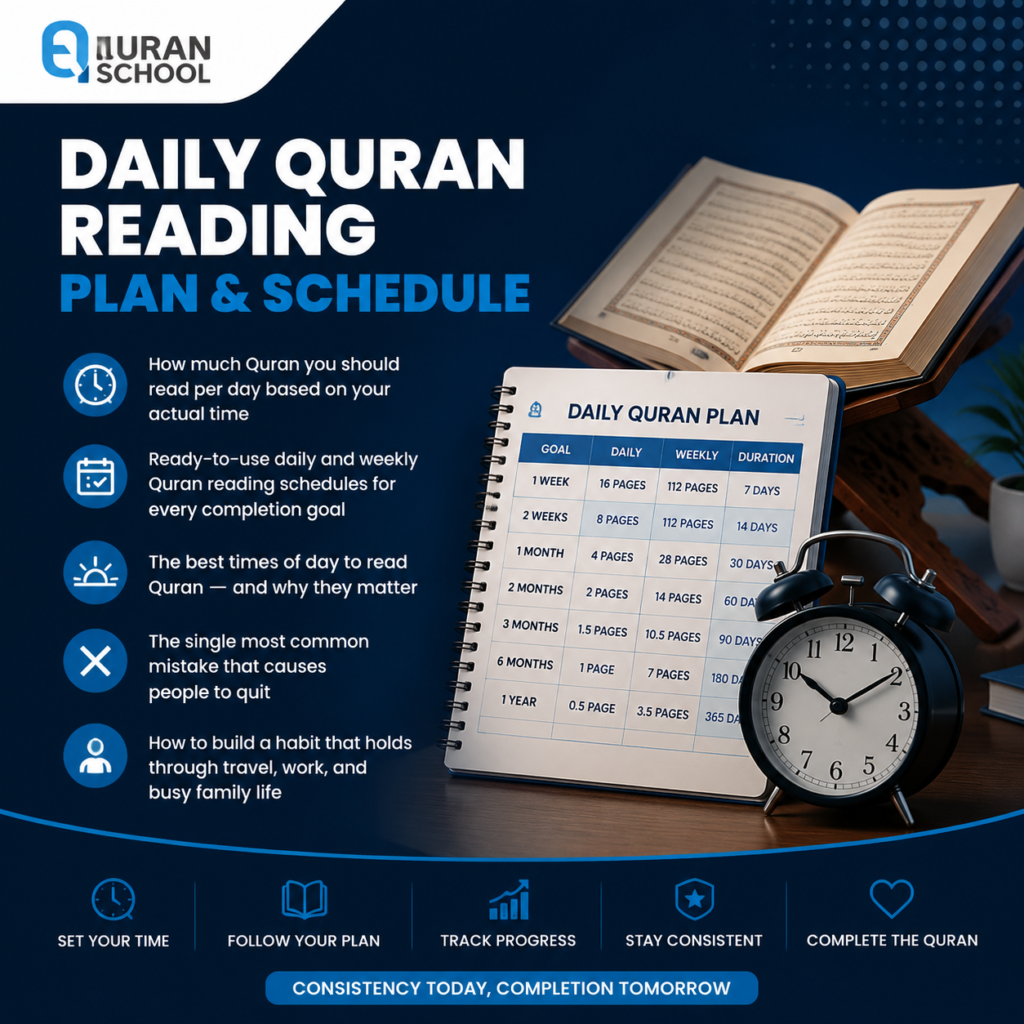
What You’ll Learn in This Article
- How much Quran you should read per day based on your actual time.
- Ready-to-use daily and weekly Quran reading schedules for every completion goal.
- The best times of day to read Quran — and why they matter.
- The single most common mistake that causes people to quit.
- How to build a habit that holds through travel, work, and busy family life.
The Right Amount of Quran to Read Each Day
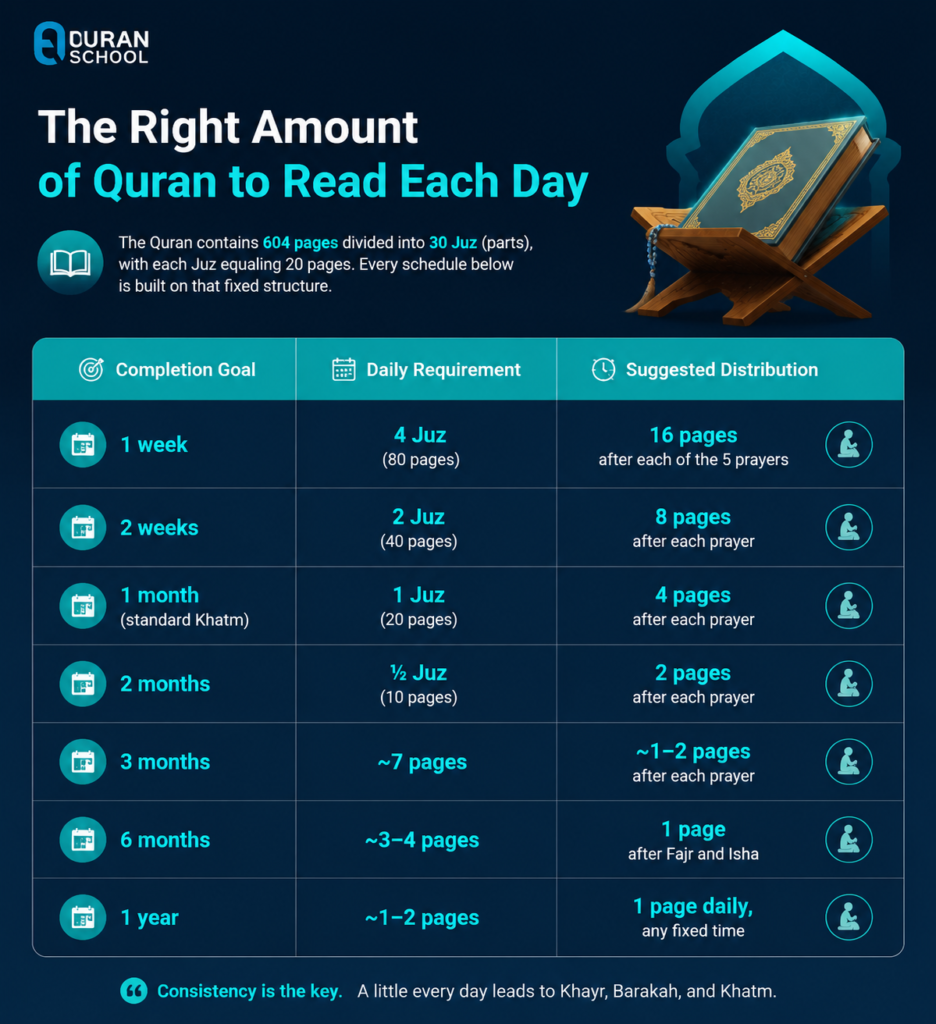
The Quran contains 604 pages divided into 30 Juz (parts), with each Juz equaling 20 pages. Every schedule below is built on that fixed structure.
| Completion Goal | Daily Requirement | Suggested Distribution |
| 1 week | 4 Juz (80 pages) | 16 pages after each of the 5 prayers |
| 2 weeks | 2 Juz (40 pages) | 8 pages after each prayer |
| 1 month (standard Khatm) | 1 Juz (20 pages) | 4 pages after each prayer |
| 2 months | ½ Juz (10 pages) | 2 pages after each prayer |
| 3 months | ~7 pages | ~1–2 pages after each prayer |
| 6 months | ~3–4 pages | 1 page after Fajr and Isha |
| 1 year | ~1–2 pages | 1 page daily, any fixed time |
The prayer-based distribution is not arbitrary. It converts one large daily target into five small sessions your brain handles more easily — and it anchors the habit to actions you already do every day, in addition it teach us how to dedicate time daily to read Quran.
Read Also: What We Learn from the Quran?
Build The Habit Of Quran Reading Daily
1. Choose One Fixed Time and Keep Consistent
The biggest predictor of consistency is a time slot that is genuinely yours. For most people in Western countries with standard work schedules, the two most reliable windows are after Fajr (before the day’s demands begin) and after Maghrib or Isha (when the household quiets down). Pick one. Start there.
EQuran School’s online Quran classes are structured around flexible scheduling precisely because students in different time zones — whether in New York, London, or Sydney — need a teacher who fits their morning, not the other way around.
2. Use One Type of Mushaf and Do not Change it
Reading from the same physical or digital copy every session is not a minor preference — your brain maps the location of verses on a page. Switching between different prints or apps disrupts that spatial memory and slows fluency over time.
3. Define Your Quran Reading Goal
Knowing whether you are aiming for one month or six months changes how you pace each session. Readers without a defined endpoint tend to read “as much as feels right,” which means they read less on hard days and eventually stop altogether.
4. Track Your Reading Progress Visually
Mark each Juz as you complete it. A simple chart or a Quran app with progress tracking provides concrete evidence of forward movement on days when motivation drops. Progress itself is a motivator.
Read also: Best Time to Learn Quran
Experience Our Classes
Don’t just take our word for it—watch real-time recordings of our online classes below to experience our teaching style firsthand.
Start Your Quranic Journey Today
Experience our interactive online classes with a dedicated tutor.
Get Your Free TrialDifferent Plans of Daily Quran Reading
A consistent daily Quran reading plan helps you build a lasting connection with the Quran while matching your available time and reading level. Whether you have 20, 30, or 60 minutes a day, choosing the right pace makes completing the Quran more achievable.
Read also: Quran Reading Plan for Beginners: A Step-by-Step Guide
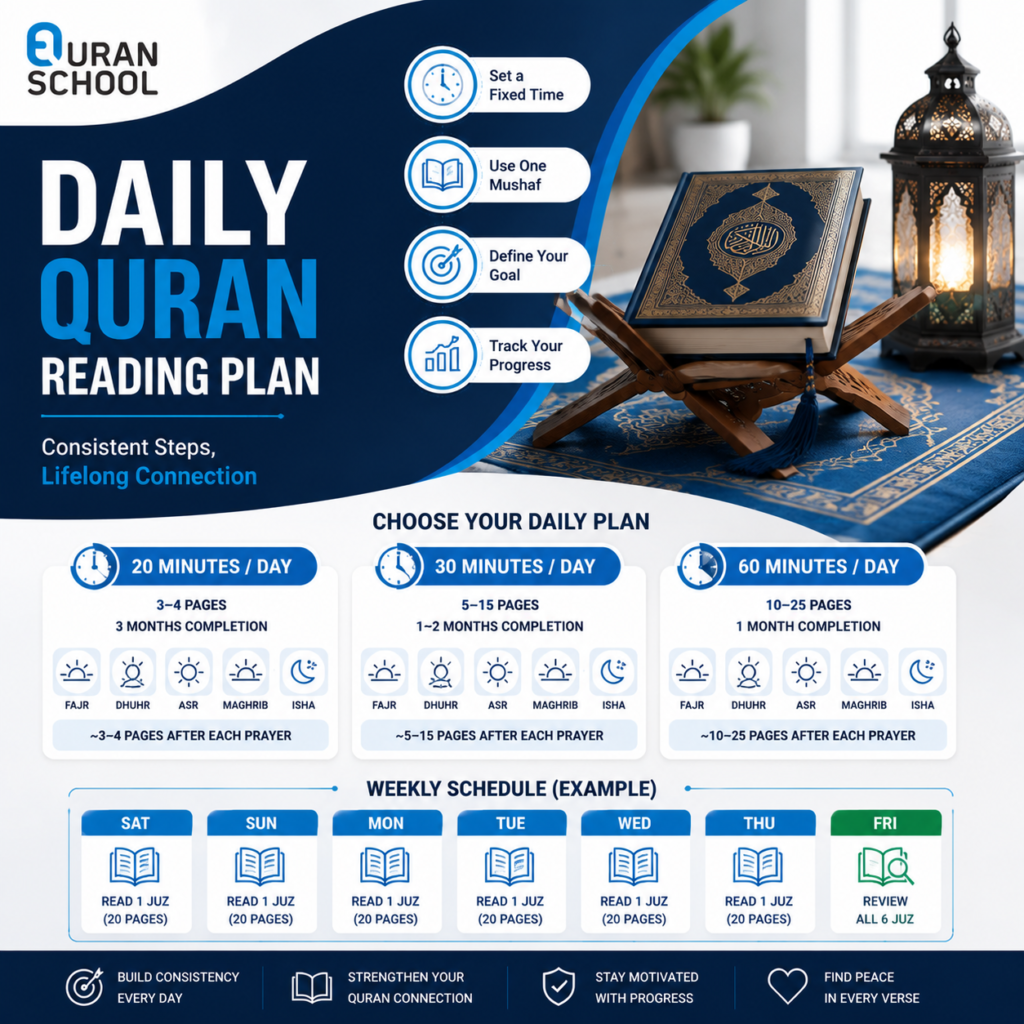
A. 20-Minute Daily Quran Reading Plan
Twenty minutes daily is the realistic minimum for a working adult or a busy parent in the US, UK, Canada, or Australia. It is enough to complete the Quran in approximately three months.
At 20 minutes, a beginner reads roughly 3–4 pages; an intermediate reader covers 5–7 pages. Use 15 minutes for new reading and 5 minutes to review yesterday’s pages aloud — that review session is what keeps the habit from becoming passive.
B. 30-Minute Daily Quran Reading Plan
Thirty minutes daily allows a comfortable one-month Khatm for intermediate and fluent readers, and a two-month completion for beginners.
| Level | Daily Pages | Monthly Total |
| Beginner | 5–6 pages | ~6 Juz |
| Intermediate | 8–10 pages | ~12–15 Juz |
| Fluent | 10–15 pages | Full Quran |
Split the 30 minutes into two 15-minute sessions — one after Fajr and one after Maghrib or Isha — rather than one single sitting. Retention is measurably better when the same material is encountered in two separate windows.
C. 60-Minute Daily Quran Reading Plan
Sixty minutes is the threshold at which a one-month Khatm becomes achievable at intermediate level, which is the classic Ramadan goal for most adult Muslims.
| Level | Daily Pages | Completion Timeline |
| Beginner | 10–12 pages | ~50 days |
| Intermediate | 18–20 pages | 30 days |
| Fluent | 20–25 pages | 24–30 days |
Fluent readers should not attempt all 20 pages in a single sitting. Two 10-page sessions — morning and evening — produce better Quran recitation quality and make it easier to maintain the habit across a full month.

A Weekly Quran Reading Schedule
This schedule completes one Juz per day across six days with one full review day. It suits an intermediate reader with 45–60 minutes available daily.
| Day | Task | Pages |
| Saturday–Thursday | Read new Juz (4 pages × 5 prayers) | 20 pages |
| Friday | Review the week’s 6 Juz in full | No new pages |
The Friday review session is the structural difference between a plan that holds for one month and one that collapses at week three. Without it, small errors and forgotten passages accumulate silently. Catching them weekly keeps the reading clean.
Read also: 30 Day Quran Reading Schedule
Do not Skip Review to Read More
The common mistake that derails more daily Quran reading plans than any other is treating review as optional. Readers who skip review to push ahead with new pages find that their earlier reading becomes vague and error-prone. Within two or three months, they are effectively re-reading material they thought they had covered.
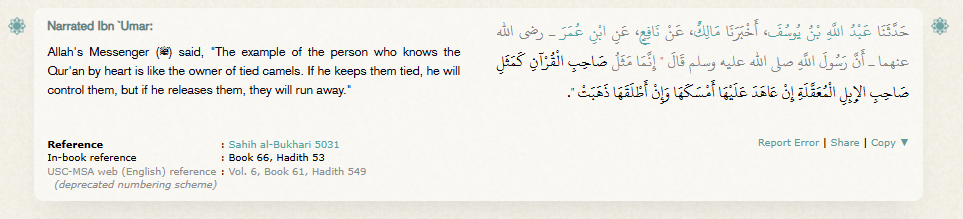
The Prophet ﷺ addressed this directly: “The example of the person who knows the Qur’an by heart is like the owner of tied camels. If he keeps them tied, he will control them, but if he releases them, they will run away.“ (Sahih al-Bukhari, 5031)
The practical rule: never read more than three new Juz in a week without reviewing the previous week’s Juz at least once.
Best Time of Day to Read Quran
After Fajr is the first best time supported by both classical Islamic scholarship and modern cognitive research. The mind has not yet absorbed the stimulation of the day. Focus is at its peak. There are no competing demands for the first 30–60 minutes after waking.
After Isha is the second-best window, particularly for people in full-time work or those managing children during the daytime. The household is quiet, the day’s obligations are complete, and reading before sleep allows the brain’s consolidation processes during sleep to reinforce what was read.
The weakest times are mid-afternoon and immediately after heavy meals — both are associated with reduced cognitive focus and higher likelihood of skipping the session entirely.
See Us in Action
Watch a quick snippet from our live, interactive classes below and see how our teachers make learning engaging for all ages!
Start Your Quranic Journey Today
Experience our interactive online classes with a dedicated tutor.
Get Your Free TrialStart Your Daily Quran Reading with a Qualified Teacher
Quran daily reading with correct Tajweed requires more than a schedule — it requires accurate pronunciation trained by a qualified instructor from the start. Errors embedded in early reading are significantly harder to correct later.
EQuran School provides 1-on-1 online Quran learning and recitation classes for students across the USA, Canada, UK, Europe, and Australia. Sessions are fully flexible, scheduled around your timezone, and taught by Ijazah-certified teachers with verified chain of transmission.

Whether you are starting from learning Quran alphabet or refining an existing recitation, your teacher structures a personal daily reading plan around your pace, your schedule, and your goal.
E Quran School provides complete curriculum including:
- Al-Azhar Quran Course
- Quran Memorization (Hifz) Course
- Online Quran Learning with Tajweed Course
- Quran Tafsir Course
- Online Arabic and Quran Classes
- Quran Qirat Learning Course
- Noorani Qaida Course
Book your free trial lesson at EQuran School

Start Your Quranic Journey Today
Experience our interactive online classes with a dedicated tutor.
Get Your Free TrialConclusion
A daily Quran reading plan works when it is built around your actual time, anchored to prayer, and supported by a weekly review day. The math is simple: 604 pages, divided by your available days, distributed across your five daily prayers. What separates readers who complete the Quran from those who stop at Juz 5 is not willpower — it is structure, a realistic target, and accountability. Build those three in from day one, and the daily Quran reading habit becomes one of the most sustainable practices in your life.
Frequently Asked Questions
How much Quran should I read a day to finish in one month?
You need to read 1 Juz (20 pages) per day — 4 pages after each of the five daily prayers. An intermediate reader completes this in about 45–60 minutes. Fluent readers finish in 30–40 minutes.
How do I start reading the Quran daily if I’ve never been consistent before?
Start with 10 minutes after Fajr only. Read a fixed amount — even two pages — every single day for 21 days before adding a second session. Consistency at a small amount builds the habit; volume comes after.
Is it better to read the Quranin one sitting or spread across the day?
Spread across the day, tied to the five prayers, is more effective for most people. Multiple short sessions improve retention and make it easier to maintain the habit through busy days. One long sitting once a week is far less effective than daily short sessions.
What if I miss a day on my Quran reading schedule?
Resume the next day at the same daily target. Do not try to double up to compensate — catching up rarely succeeds and often leads to full abandonment. The missed day is lost; the next day is not.
Can I read the Quranwithout knowing Arabic?
You can read Quran transliteration to understand meaning, but reciting the Arabic text requires learning the Arabic letters first. The Noorani Qaida is the standard starting point; most students can read basic Quranic Arabic within 3–4 months of consistent lessons.
How long does it take to read one Juz of the Quran?
One Juz (20 pages) takes 30–40 minutes for a fluent reader, 50–60 minutes for an intermediate reader, and 80–120 minutes for a beginner. These times assume correct Tajweed applied throughout.










Leave a Reply