 Quran

Many students recite Surah Al-Humazah fluently yet blur one small moment: the noon in layumbadhanna. That moment is governed by the Iqlab rules, one of the four rulings of noon saakinah and tanween, and getting it right changes how your recitation sounds to any qualified ear.
The Iqlab rules convert a noon saakinah or tanween into a hidden meem whenever the letter Ba follows. You close your lips lightly, hold a nasal ghunnah for two counts, then open into the Ba. One letter, one mouth shape, hundreds of occurrences across the Quran.
What You Will Learn About Iqlab Rules in This Article
- Explain the definition of Iqlab and why noon changes before Ba
- Spot the iqlab letters and their Mushaf signs instantly
- Pronounce the hidden meem with correct lip position and ghunnah
- Read iqlab examples in Quran from one word, two words, and tanween
- Avoid the mistakes teachers correct most often when applying Iqlab rules
What is the Definition of Iqlab in Tajweed?
The definition of Iqlab in Tajweed is converting a noon saakinah or tanween into a hidden meem when the letter Ba follows, pronounced with lightly closed lips and a nasal ghunnah lasting two counts.
When students ask what iqlab is in tajweed, I start with the word itself. Linguistically, Iqlab (إقلاب) means turning something from its original form. Technically, the noon sound is turned into a completely different sound.
Iqlab rules exist for a phonetic reason. Noon comes from the tip of the tongue, while Ba comes from the two lips. Moving quickly between these distant articulation points is heavy, so the tongue gives way to the lips.
Meem is the perfect bridge because it shares its articulation point with Ba and its nasal ghunnah with noon. Converting noon into meem keeps the nasal quality while preparing the lips for the Ba that follows.
At EQuran School, this reasoning opens the Iqlab rules lessons in our Online Quran Learning With Tajweed program, so students understand why a rule exists before drilling it with their Azhari tutors.
Book Your Free Trial Today for Online Quran Learning With Tajweed!

The Iqlab Letters and the Single Letter Ba
The iqlab letters list is the shortest in Tajweed, because Ba (ب) is the single letter that triggers this rule. Whenever noon saakinah or tanween meets Ba, Iqlab applies without any exception.
Students who ask what the letters of iqlab are are often surprised by this answer. Izhar has six letters, and Ikhfa has fifteen, yet Iqlab rests on one letter, making it the easiest ruling to spot.
Small Meem Sign Marking the Iqlab Letters in the Madani Mushaf
Mushaf signs make the iqlab letters easy to recognize while reading. In the Madani Mushaf, a small meem (ۢ) appears above the noon or replaces the second tanween mark, signaling that conversion is required.
Train your eye to scan for that small meem. Once children connect the symbol with the sound, they start applying the Iqlab rules automatically, even before memorizing the theory behind them.
Iqlab Noon Saakinah and Tanween Conditions
Iqlab noon saakinah and tanween cases follow identical Iqlab rules, but they appear in different positions. Knowing these positions helps you predict the conversion before your eyes even reach the Ba.
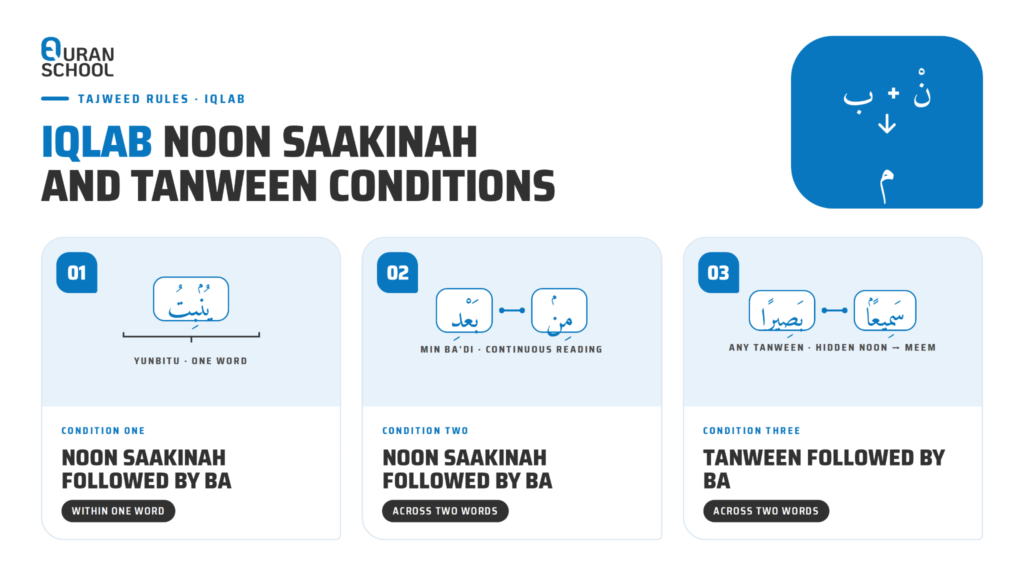
1. Noon Saakinah Followed by Ba Within One Word
Noon saakinah followed by Ba in one word appears mainly in words from the roots n-b-ʾ and n-b-t, such as anbi’hum and yunbitu. The conversion happens inside the word itself, with no pause possible.
2. Noon Saakinah Followed by Ba Across Two Words
Noon saakinah and Ba across two words occur when one word ends with a sakin noon and the next begins with Ba, as in min ba’di. Iqlab rules apply here only during continuous reading.
Stopping on that noon cancels the conversion completely, so the noon is pronounced clearly with its sukoon. Teachers test this detail during Waqf exercises, because many students keep the meem sound even after stopping.
3. Tanween Followed by Ba Across Two Words
Tanween followed by Ba always occurs across two words, since tanween only appears at the end of a word. Whether it is fathatain, kasratain, or dammatain, the hidden noon becomes a hidden meem.
Read also: What The Hadith About Reading Quran With Tajweed Reveals?
Three Core Iqlab Rules Every Reciter Must Apply
The core Iqlab rules come down to three actions every reciter must apply together, every single time. Missing any one makes the recitation incomplete, even if a casual listener barely notices the difference.
| Action | What Happens | Teacher’s Note |
| Conversion (Qalb) | Noon or tanween becomes meem | No trace of noon remains |
| Hiding (Ikhfa) | The meem is hidden, lips meet lightly | No pressure on the lips |
| Ghunnah | Nasal sound held through the nose | Two even, steady counts |
The rule of iqlab is therefore not a single change but a combined process. This is exactly where self-taught learners stumble, because reading a definition rarely shows them that all three actions happen in one breath.
Correct Iqlab Pronunciation with Light Lip Closure and Nasal Sound
Pronouncing Iqlab correctly depends on two physical details: lip closure and the nasal sound flowing through the nose. When students ask how to pronounce iqlab, I break it into small, separate movements.
Light Lip Closure for the Hidden Meem in Iqlab
The lip position during the hidden meem should be a light, relaxed meeting of the lips. Press them hard and you produce a full meem; leave them open and the meem disappears entirely.
Most Egyptian and Azhari teachers teach light closure, while some scholars allow a very slight gap between the lips. Both methods come through authentic chains of transmission, so follow your teacher’s approach consistently.
Daily Five-Minute Practice Drill for the Iqlab Sound
This practice drill for the Iqlab sound takes five minutes daily. Hum “mmm” with closed lips and feel the vibration in your nose, then pinch your nose gently; the sound should stop.
Next, read anbi’hum slowly, holding the nasal “mmm” for two counts before opening into Ba. Record yourself and compare it with a slow, Murattal recitation by a well-known reciter like Sheikh Al-Husary.
Most adult students apply the Iqlab rules confidently within two to three weeks of daily drills. Children usually need four to six weeks before they apply it consistently without reminders from their teacher.
See Us in Action
Watch a quick snippet from our live, interactive classes below and see how our teachers make learning engaging for all ages!
Start Your Quranic Journey Today
Experience our interactive online classes with a dedicated tutor.
Get Your Free TrialIqlab and Ghunnah Length in Recitation
Iqlab and ghunnah are inseparable, because the ghunnah (also written gunnah) keeps the hidden meem audible. Without the correct length, the conversion becomes a weak, swallowed sound that teachers correct immediately.
The ghunnah in Iqlab lasts two counts (harakat), roughly the time needed to fold one finger at a steady pace. Measure it against your own recitation speed rather than a fixed number of seconds.
Speed changes the absolute length but not the proportion. In Hadr, fast recitation, the counts shrink; in Tahqiq, slow recitation, they stretch. The Iqlab rules keep the same ratio as every other two-count ghunnah.
Iqlab Examples in Quran with Recitation Notes
These iqlab examples in Quran cover all three positions, so you can hear the Iqlab rules in context. Read each verse slowly first, then at normal speed, focusing on the transition into Ba.
One-Word Iqlab Example in the Verb Anbi’hum
Iqlab in one word appears clearly in this verse from Surah Al-Baqarah, where the noon saakinah meets Ba inside anbi’hum. Notice that the transliteration is written with an “m” to reflect the actual sound.
قَالَ يَا آدَمُ أَنبِئْهُم بِأَسْمَائِهِمْ
Qala ya Adamu ambi’hum bi-asma’ihim
“He said, ‘O Adam, inform them of their names.'” (Al-Baqarah 2:33)
Two-Word Iqlab Example in the Phrase Min Ba’di
Iqlab across two words appears in min ba’di, a phrase repeated many times throughout the Quran. Here the noon at the end of min converts into a hidden meem before the Ba of ba’di.
الَّذِينَ يَنقُضُونَ عَهْدَ اللَّهِ مِن بَعْدِ مِيثَاقِهِ
Alladhina yanqudoona ‘ahdallahi mim ba’di meethaqihi
“Who break the covenant of Allah after contracting it.” (Al-Baqarah 2:27)
Tanween Iqlab Examples with Fathatain and Dammatain
Iqlab with tanween appears in this verse from Surah Al-Waqi’ah, where the fathatain on jaza’an meets the Ba of bima. The tanween’s hidden noon becomes a hidden meem with ghunnah.
جَزَاءً بِمَا كَانُوا يَعْمَلُونَ
Jaza’am bima kanu ya’maloon
“As a reward for what they used to do.” (Al-Waqi’ah 56:24)
The same tanween pattern with dammatain closes many verses describing Allah’s knowledge, giving you frequent chances to practice:
إِنَّ اللَّهَ عَلِيمٌ بِذَاتِ الصُّدُورِ
Innallaha ‘aleemum bidhatis-sudoor
“Indeed, Allah is Knowing of that within the breasts.” (Aal-Imran 3:119)Read also: Tajweed Symbols And Stop Signs In The Quran Explained With Examples
Noon Saakin Iqlab Examples from Short Surahs and Familiar Verses
Noon saakin iqlab examples from short surahs and familiar verses suit children and beginners, since these passages are often already memorized. Students can then focus entirely on the Iqlab rules rather than recalling words.
| Word | Location | Position |
| لَيُنۢبَذَنَّ (layumbadhanna) | Al-Humazah 104:4 | One word |
| لَنَسْفَعًۢا بِالنَّاصِيَةِ (lanasfa’am bin-nasiyah) | Al-‘Alaq 96:15 | Tanween fathatain |
| سَمِيعٌۢ بَصِيرٌ (samee’um baseer) | Al-Mujadilah 58:1 | Tanween dammatain |
| مِنۢ بَعْدِ (mim ba’di) | Al-Baqarah 2:27 | Two words |
Busy professionals usually fix their tajweed fastest in our Quran Classes for Adults.
Book Your Free Trial Today for Quran Classes for Adults!
Comparison Table of Iqlab and the Other Noon Saakinah Rules
Iqlab compared with the other noon saakinah rules is the smallest category, yet it carries a unique sound change. This table places all four rulings side by side for quick revision.
| Rule | Letters | What Happens to the Noon | Ghunnah |
| Izhar | ء هـ ع ح غ خ | Pronounced clearly | No extended ghunnah |
| Idgham | ي ر م ل و ن | Merged into the next letter | With ghunnah in ي ن م و only |
| Iqlab | ب | Converted into a hidden meem | Two counts |
| Ikhfa | The remaining 15 letters | Hidden between Izhar and Idgham | Two counts |
Difference Between Iqlab and Ikhfa Shafawi Before Ba
Iqlab versus Ikhfa Shafawi confuses many students because both produce a hidden meem before Ba. The difference lies in the source, since Iqlab starts with noon while Ikhfa Shafawi starts with an original meem saakinah.
In Surah Al-‘Adiyat, rabbahum bihim contains Ikhfa Shafawi, not Iqlab, because the meem is written in the word. The sound is nearly identical, but Ijazah examiners expect you to name each rule correctly.
Common Iqlab Mistakes Reciters Make and Their Corrections
Common Iqlab mistakes usually come from reading what is written rather than applying the Iqlab rules behind the text. Teachers see the same three errors repeatedly among students who learned from transliteration alone.
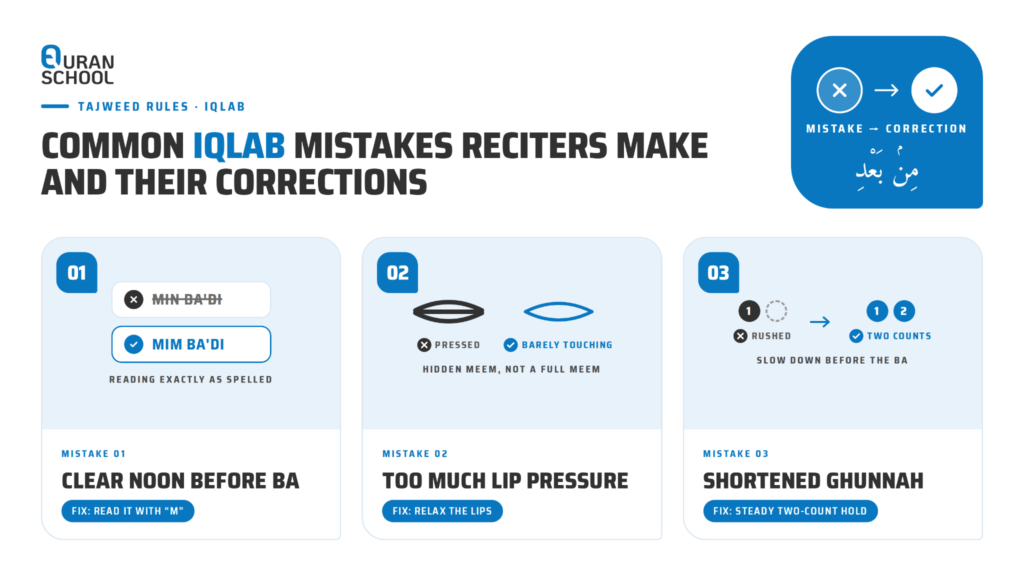
1. Clear Noon Mistake Before Ba and Its Correction
Pronouncing a clear noon before Ba is the most frequent error, especially among English speakers reading min ba’di exactly as spelled. Teachers correct it by having students read a transliteration written with “m.”
2. Excessive Lip Pressure Turning Iqlab into a Full Meem
Pressing the lips too hard turns the hidden meem into a fully pronounced meem, which sounds like Idgham rather than Iqlab. The fix is relaxing the lips until they barely touch each other.
3. Shortened Ghunnah Mistake in Fast Recitation
Cutting the ghunnah short happens when learners rush toward the Ba, particularly in fast recitation. A steady two-count hold, practiced with finger counting, usually corrects this within a few weeks of attention.
Many sisters hesitate to recite aloud in front of male teachers, which delays these corrections. Our Female Quran Classes give them a comfortable space where a female Azhari tutor corrects every ghunnah and lip position live.
Book Your Free Trial Today for Female Quran Classes!
Start Your Spiritual Journey with E Quran School Today
Transform your understanding and recitation of the Holy Quran from the comfort of your home. At E Quran School, our certified tutors provide personalized, one-on-one guidance tailored to your pace and schedule. Whether you are looking for beginner Quran reading, advanced Tajweed, or Memorization (Hifz) courses, we have a program for you.
Our Quran Courses
- Quran Recitation Classes
- Weekend Quran Classes
- Quran Reading Classes
- Online Quran Classes for Kids
- Learn Quran Online with Tajweed for Kids and Adults
- Online Quran Learning with Tajweed Course
- Quran Classes for Adults
- Female Quran Classes
- Female Quran Teacher for Ladies
- Learn Quran for Beginners
- Quran Qirat Learning Course
Book your free trial class today at EQuran School and hear the difference in your very next recitation, Insha’Allah.
See Us in Action
Watch a quick snippet from our live, interactive classes below and see how our teachers make learning engaging for all ages!
Start Your Quranic Journey Today
Experience our interactive online classes with a dedicated tutor.
Get Your Free TrialConclusion
Iqlab rules rest on one simple sound change, where noon saakinah or tanween becomes a hidden meem before Ba, carried by a two-count ghunnah. Its single trigger letter makes it the easiest noon ruling to recognize.
Correct application depends on soft lip closure, a steady nasal sound, and continuous reading. Practicing iqlab examples from familiar short surahs builds accuracy far faster than memorizing definitions without listening carefully to your own recitation.
Every learner benefits from a qualified ear that catches the small slips recordings miss. With daily practice and live correction, the Iqlab rules will soon feel natural on every page you recite, Insha’Allah.
Frequently Asked Questions About Iqlab Rules
What Is Iqlab in Tajweed?
Iqlab in Tajweed is the ruling where noon saakinah or tanween is converted into a hidden meem before the letter Ba, recited with lightly closed lips and a nasal ghunnah lasting two counts.
What Are the Letters of Iqlab?
The letters of Iqlab consist of only one letter, Ba (ب). Whenever noon saakinah or tanween is followed by Ba, in one word or across two words, the rule of iqlab applies.
How to Pronounce Iqlab Without Pressing the Lips?
To pronounce Iqlab without pressing the lips, let them meet softly as if resting, then hum a nasal meem for two counts. Keep your teeth slightly apart and your tongue relaxed throughout.
How Long Is the Ghunnah in Iqlab?
The ghunnah in Iqlab lasts two counts, the same as Ikhfa and Idgham with ghunnah. When studying Iqlab and gunnah together, remember that the count follows your recitation speed rather than a stopwatch.
Does Iqlab Apply If I Stop on the Noon?
Iqlab does not apply if you stop on the noon, because the Ba never follows in your reading. The noon is pronounced clearly with sukoon, since Iqlab rules apply only in continuous recitation.
Where Can I Find More Noon Saakin Iqlab Examples?
You can find noon saakin iqlab examples by scanning a Madani Mushaf for the small meem sign above a noon or tanween. Surah Al-Baqarah alone provides plenty of practice for Iqlab rules.











Leave a Reply