 Learn Quran
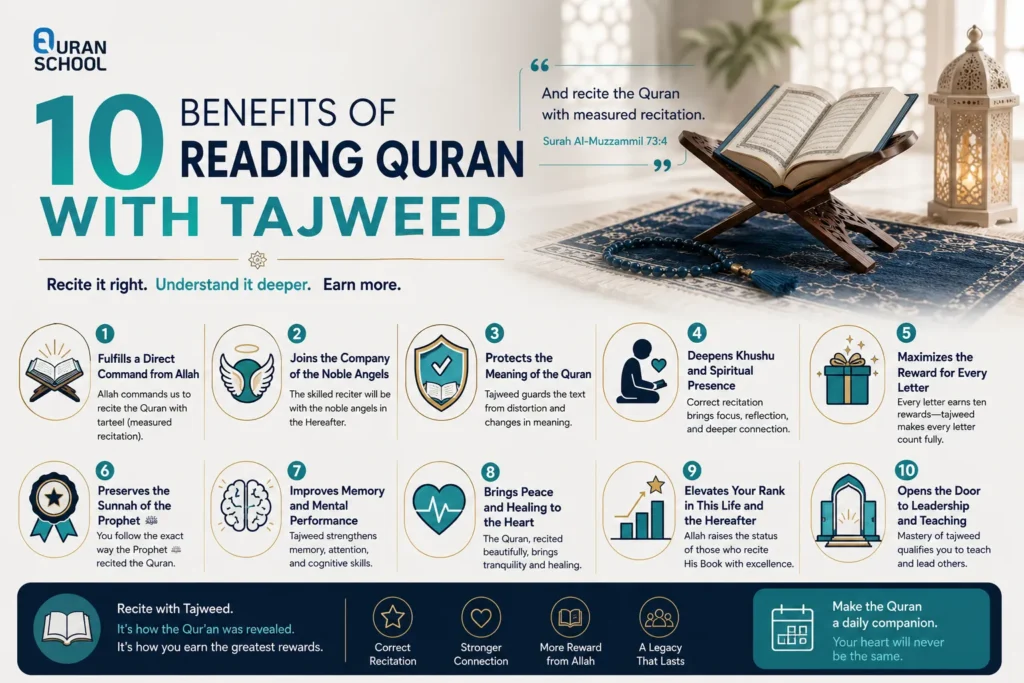
Reading the Quran is one of the highest acts of worship in Islam — but reading it with tajweed transforms that worship into something more: a living connection to the word of Allah, transmitted faithfully from the Prophet ﷺ through generations of scholars and reciters to you.
The benefits of reading Quran with Tajweed go far beyond sounding beautiful. They touch your spiritual rank, your understanding of the text, your mental wellbeing, and your standing in the Hereafter.
Tajweed — from the Arabic root jawwada, meaning to do something excellently — is the science of reciting each letter of the Quran from its correct point of articulation, with its proper characteristics, in the manner in which the Prophet ﷺ received and taught it.
It is not ornamentation layered onto the text; it is the text, recited as Allah intended it to be heard. In this guide will find the most remarkable ten benefits of reading Quran with Tajweed.
1. Fulfilling A Direct Command From Allah Represents The First Benefit Of Reading Quran With Tajweed
The Quran is not simply encouraged to be read carefully — Allah commands it. In Surah Al-Muzzammil (73:4), He says: “And recite the Quran with measured recitation.” The word used — tarteel — refers precisely to what scholars later codified as tajweed: deliberate, articulate, accurate delivery of each letter and its qualities.
Imam Ali ibn Abi Talib (may Allah be pleased with him) defined tarteel as “the beautification of the letters and the knowledge of the stopping points.” Imam Ibn al-Jazari, one of the greatest authorities on Quranic recitation, went further in his famous couplet: “Taking tajweed is an absolute obligation — whoever does not apply tajweed to the Quran is sinful.” Following this command is not optional; it is the foundational reason every other benefit on this list exists.
Read also: 10 Benefits Of Reciting Quran Daily
2. Joining The Company Of The Noble Angels When Read Quran with Tajweed
One of the most cited hadiths on recitation comes from the Prophet ﷺ: “The one who is skilled in the Quran will be with the noble, righteous scribes — the angels. And the one who recites it and finds it difficult, stammering through it, will have two rewards.” (Sahih Muslim, 798)
The hadith draws a clear distinction: the skilled reciter — the one who has applied tajweed and achieved fluency — earns the companionship of the angels. This is not a metaphor; it is a rank in the Hereafter tied directly to the quality of recitation. The benefits of Quran recitation that reach beyond this world begin here, with the daily choice to recite correctly.
Master Quran Recitation Today with your first free class
3. Reading Quran With Tajweed Protects The Meaning Of The Quran
Arabic is a language where a single vowel change can reverse the meaning of a sentence. Tajweed exists, in large part, as a protection system — a set of rules that guards the text from distortion (lahn).
Scholars categorize errors into two types: lahn jali, a clear mispronunciation that changes meaning, and lahn khafi, a subtler error that does not alter meaning but violates the proper delivery.
Consider the word “كَفَرَ” (kafara, he disbelieved) versus “كَفَّرَ” (kaffara, he expiated). The consonants are identical; the distinction lies in the doubling of the middle letter. Confuse them in a verse of the Quran, and the meaning shifts entirely.
The benefits of reading Quran in Arabic with tajweed include this vital protection: the tongue is trained to produce the right sound, in the right context, without guessing.
Read also: 10 Benefits Of Reading Quran Daily
4. By Reading Quran With Tajweed You Deepen Khushu And Spiritual Presence
Reciting with tajweed naturally slows you down. The rules of madd (prolongation), ghunna (nasalization), and qalqala (vibration) require the reciter to be present with each syllable and each letter. This is not coincidental — it is the mechanism by which the heart receives what the tongue delivers.
Scholars throughout history have observed that proper recitation opens the reader to tadabbur — deep, reflective engagement with the Quran’s meanings. Allah says: “A blessed Book We have revealed to you, so that they may reflect upon its verses, and that those of understanding may be reminded.” (Surah Sad, 38:29).
When the lips are disciplined, the mind follows. This deepening of engagement with the text reveals what we learn from the Quran at a level that hurried, uncorrected reading rarely reaches.
Read also: 9 Hadiths About Reading Quran With Difficulty
Book a free trial class at E Quran School

5. You Maximize The Reward For Every Letter When Read Quran With Tajweed
The Prophet ﷺ said: “Whoever recites a letter from the Book of Allah will have a reward for it, and that reward will be multiplied tenfold. I do not say that Alif-Lam-Mim is a letter, but rather Alif is a letter, Lam is a letter, and Mim is a letter.” (Tirmidhi, hasan sahih)
Every letter carries a reward. The skilled reciter does not add or drop letters; they give each one its full articulation, its correct duration, and its proper quality. Tajweed, in this sense, is the most precise way to maximize the return on every moment spent with the Quran.
Mastery of recitation also places you in the lineage of companions who learned directly from the Prophet ﷺ — a chain of transmission that tajweed as a science was specifically designed to preserve.
Read also: 9 Hadiths About Reciting Quran Beautifully
See Us in Action
Watch a quick snippet from our live, interactive classes below and see how our teachers make learning engaging for all ages!
Start Your Quranic Journey Today
Experience our interactive online classes with a dedicated tutor.
Get Your Free Trial6. Your Quran Reading With Tajweed Guards Your Prayer From Error
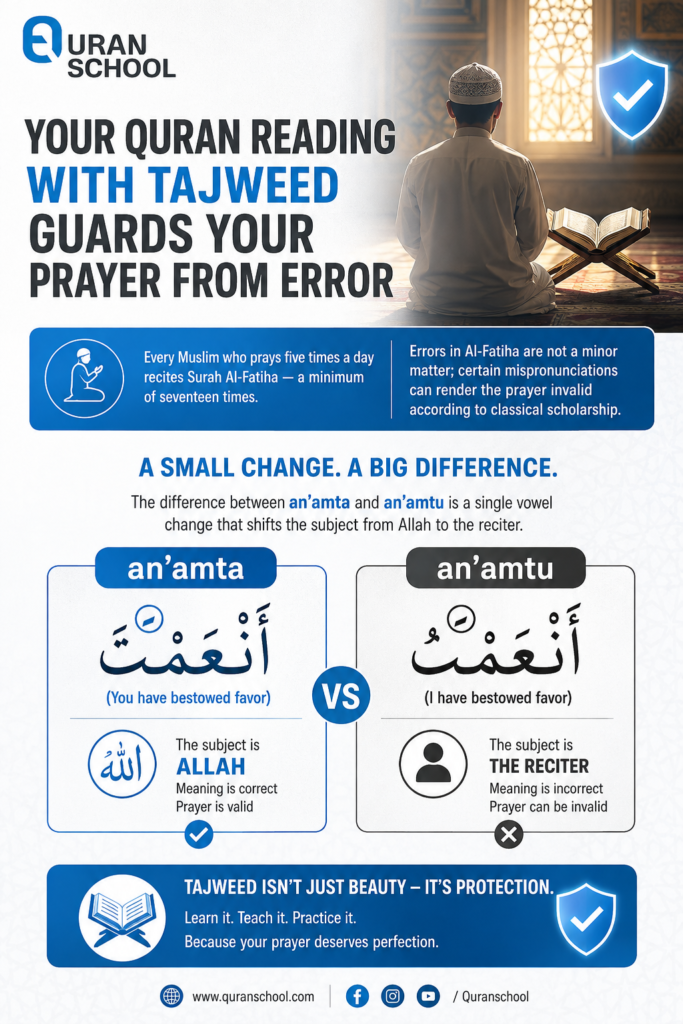
Every Muslim who prays five times a day recites Surah Al-Fatiha — a minimum of seventeen times. Errors in Al-Fatiha are not a minor matter; certain mispronunciations can render the prayer invalid according to classical scholarship.
The difference between an’amta (You have bestowed favor) and an’amtu (I have bestowed favor) is a single vowel change that shifts the subject from Allah to the reciter. Tajweed trains the tongue so that these distinctions become automatic, protecting the validity of your prayer without requiring conscious effort each time.
This is why Quran recitation classes should always incorporate foundational tajweed from day one — not as an advanced add-on, but as the framework that makes every subsequent recitation correct before bad habits have a chance to settle in.
Read also: 8 Hadiths About Reading Quran In 3 Days
7. By Reading Quran With Tajweed You Connect To An Unbroken Chain Of Transmission Traceable Back To The Prophet ﷺ
Tajweed is not a scholarly invention or a later addition to the Quran. It is the manner in which Jibreel (AS) conveyed the Quran to the Prophet ﷺ, who conveyed it to the companions, who conveyed it to the successors, and so on down an authenticated, unbroken chain to teachers alive today.
Every certified tajweed instructor carries an isnad — a chain of transmission traceable back to the Prophet ﷺ himself. When you learn from a certified teacher, you are not just learning rules from a textbook. You are entering that chain.
This is why scholars insist that tajweed cannot be fully learned from recordings or written materials alone — the oral transmission, the live correction from a teacher who has themselves been corrected, is what the science preserves. Grasping the importance of learning and teaching Quran in this historical sense reveals tajweed as a sacred trust carried forward across fourteen centuries.
Read also: 10 Benefits Of Reading Quran Daily
8. While You Read Quran With Tajweed, You Experience Real Health and Psychological Benefits
Research in psychology and neuroscience increasingly confirms what Islamic tradition has always taught: the recitation of the Quran, done correctly, produces measurable calm, lowers physiological stress markers, and promotes focused awareness.
The deliberate breathing patterns required by tajweed — sustaining vowels, controlling airflow during prolongation — mirror techniques found in therapeutic breathwork practices associated with reduced anxiety and improved mental clarity.
The health benefits of reading Quran are most fully realized through tajweed, because the rules themselves structure how the voice, breath, and attention work together during recitation. This alignment is not accidental. It reflects a design in which the act of worship serves both the spiritual and physical dimensions of the human being simultaneously.
9. Reading Quran With Tajweed Sets You As A Positive Example For Your Children And Community
There is a well-known hadith: “The best among you is the one who learns the Quran and teaches it.” (Sahih Bukhari, 5027) When a parent recites correctly, children absorb the sounds before formal instruction begins.
When a community member recites with tajweed in congregational prayer, the standard is raised for everyone within earshot. To learn the Quran and teach it — as the hadith describes the best of people — requires that what you transmit is accurate.
Reciting with tajweed ensures that the version of the Quran you model for others, consciously or not, is the version Allah revealed and the Prophet ﷺ delivered. The benefits of reading Quran do not stay with the individual; they radiate outward to every person who learns from watching you.
Join our Noorani Qaida Course and get a free trial

10. Your Reading Quran With Tajweed Elevates Your Rank in the Hereafter
The Prophet ﷺ said: “It will be said to the companion of the Quran: ‘Recite and ascend, and recite as you used to recite in the world, for your rank will be at the last verse you recite.'” (Abu Dawud, Tirmidhi — hasan)
The Hereafter rank of the Quran’s companion is determined by the verses recited over a lifetime — and by implication, by the quality of that recitation. Tajweed is the discipline that makes every verse, from the first to the last, a high-quality act of worship.
No investment a Muslim makes in their spiritual life has a clearer connection to the rank that awaits on the other side.
Begin memorizing the Quran today—your first session is free

How Tajweed Transforms Daily Recitation Over Time?
Tajweed shapes not only the way you recite the Quran but also how you connect with it throughout your life.
A. Tajweed Deepens Your Relationship with the Quran
Beyond the individual benefits above, tajweed has a cumulative effect on how a Muslim engages with the Quran across their entire life. Many students who commit to proper recitation report that the Quran grows more meaningful the more precisely they read it — not because the text has changed, but because their relationship with it has deepened.
B. Tajweed Brings Greater Value to Daily Quran Reading
This transformation is felt in daily habits as well. A well-planned 30 day Quran reading schedule, for example, becomes significantly more valuable when each session involves correct recitation rather than racing through pages. The spiritual weight of each verse is experienced more fully when the tongue is disciplined and the heart is present.
C. Combine Tajweed with Dua for Lasting Spiritual Growth
Those who couple their study with dua for learning Quran—asking Allah to ease their path to His Book and make it a source of light in their lives—find that the supplication and the effort reinforce each other. The pursuit of correct recitation becomes itself a form of worship that asks for and receives divine assistance.
A well-planned 30 day Quran reading schedule, for example, becomes significantly more valuable when each session involves correct recitation rather than racing through pages. The spiritual weight of each verse is experienced more fully when the tongue is disciplined and the heart is present.
Read also: Reward For Reading Quran And The Blessings That Follow
Why EQuran School Stands Apart for Non-Arabic Speaking Learners?
For Muslims living outside Arabic-speaking countries, finding authentic tajweed instruction has historically meant either traveling, depending on inconsistent local mosque programs, or working with textbooks designed for native Arabic speakers — none of which adequately serve adult learners or children raised in Western contexts.
EQuran School was built specifically to solve this problem, and its approach begins with a foundational insight that most online platforms miss entirely. Most online Quran platforms use generic Arabic phonics materials designed for native Arabic children.
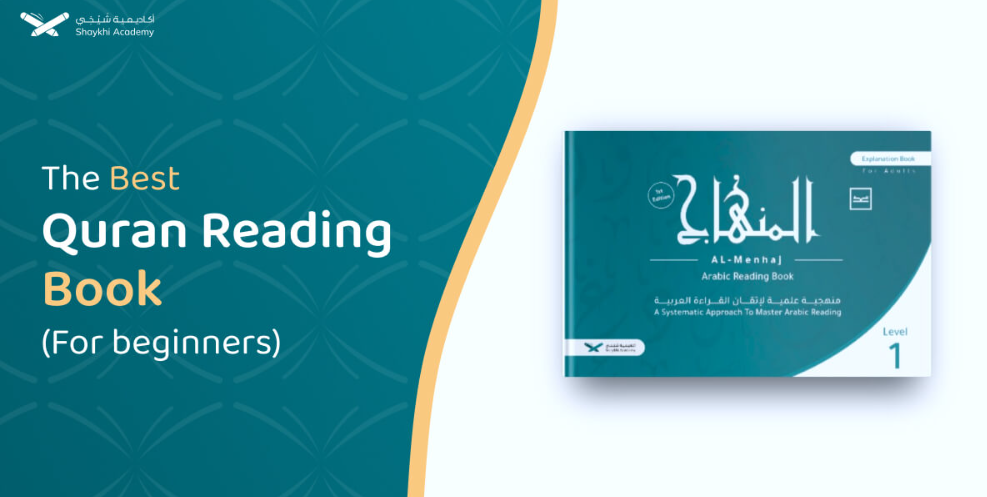
EQuran School developed the proprietary Al-Menhaj Book — authored by Luqman ElKasabany — specifically for non-Arabic speaking adults and children in Western contexts.
It is the only structured curriculum of its kind built around how non-native learners actually acquire Quranic pronunciation, sequencing the material in a way that matches the genuine learning trajectory of someone whose mother tongue is English or another non-Arabic language.
Experience Our Classes
Don’t just take our word for it—watch real-time recordings of our online classes below to experience our teaching style firsthand.
Start Your Quranic Journey Today
Experience our interactive online classes with a dedicated tutor.
Get Your Free TrialStart Your Spiritual Journey with E Quran School Today
Transform your understanding and recitation of the Holy Quran from the comfort of your home. At E Quran School, our certified tutors provide personalized, one-on-one guidance tailored to your pace and schedule. Whether you are looking for beginner Quran reading, advanced Tajweed, or Memorization (Hifz) courses, we have a program for you.
EQuran School’s complete offering covers every stage of Quranic learning:
- Quran Reading Classes
- Quran Ijazah Program
- Online Quran Learning with Tajweed Course
- Quran Tafsir Course
- Zoom Quran Classes
- Online Arabic and Quran Classes
- Quran Qirat Learning Course
- Quran for Beginners Course
Book a free trial class at E Quran School and experience personalized Quran instruction that adapts to your unique learning needs, Insha’Allah.

Start Your Quranic Journey Today
Experience our interactive online classes with a dedicated tutor.
Get Your Free TrialConclusion
The benefits of reading Quran with tajweed span every dimension of a Muslim’s life — religious, spiritual, psychological, and linguistic. Proper recitation fulfills a divine command, protects the meaning of the text from distortion, earns the companionship of the angels, guards the validity of daily prayer, and builds a connection to an unbroken chain of transmission that runs back to the Prophet ﷺ himself.
What every benefit on this list shares is that none of them can be fully realized through careless recitation. Tajweed is the discipline that converts the habit of reading into an act of precision, devotion, and excellence — jawdah, the quality from which the word tajweed takes its name. The Quran deserves that from every one of us, and the reward it returns in this life and the next is beyond calculation.
Frequently Asked Questions
What is the difference between reading the Quran and reading it with tajweed?
Reading the Quran means engaging with its words and meanings in any form. Reading with tajweed means doing so while applying the rules of articulation, letter qualities, and duration that govern correct recitation.
Tajweed is not a separate activity added onto reading — it is how the Quran was revealed and transmitted, and it governs how each letter should sound in its context.
Is learning tajweed obligatory for all Muslims?
Scholars distinguish between two categories. Learning the theoretical rules of tajweed is a collective obligation (fard kifaya): if qualified people in a community master it, the obligation is met collectively.
Applying the essential rules during recitation — avoiding clear mispronunciations that change meaning — is an individual obligation (fard ayn) on every Muslim who recites the Quran.
Can I learn tajweed online, or do I need to be physically present with a teacher?
You need a qualified teacher — but not necessarily in the same room. Online platforms that offer live, one-on-one instruction with certified teachers who can hear and correct your recitation in real time are fully capable of transmitting tajweed correctly.
How long does it take to learn the fundamentals of tajweed?
A motivated adult student working with a qualified teacher two or three sessions per week typically develops a functional command of the core tajweed rules within three to six months.
What should a beginner focus on first in tajweed?
Begin with makharij al-huruf — the points of articulation for each Arabic letter. Many non-Arabic speakers have never produced certain Arabic sounds before, so this is where accuracy is built from the ground up.
At what age can children begin learning tajweed?
Children can begin learning basic Quranic letter sounds as early as age four or five, developing an ear for correct pronunciation through repetition and song. Formal tajweed instruction — including the named rules and their categories — becomes accessible from around age seven, when children can understand and apply principles systematically.
Related Articles
Learn Quran










Leave a Reply