 Learn Quran
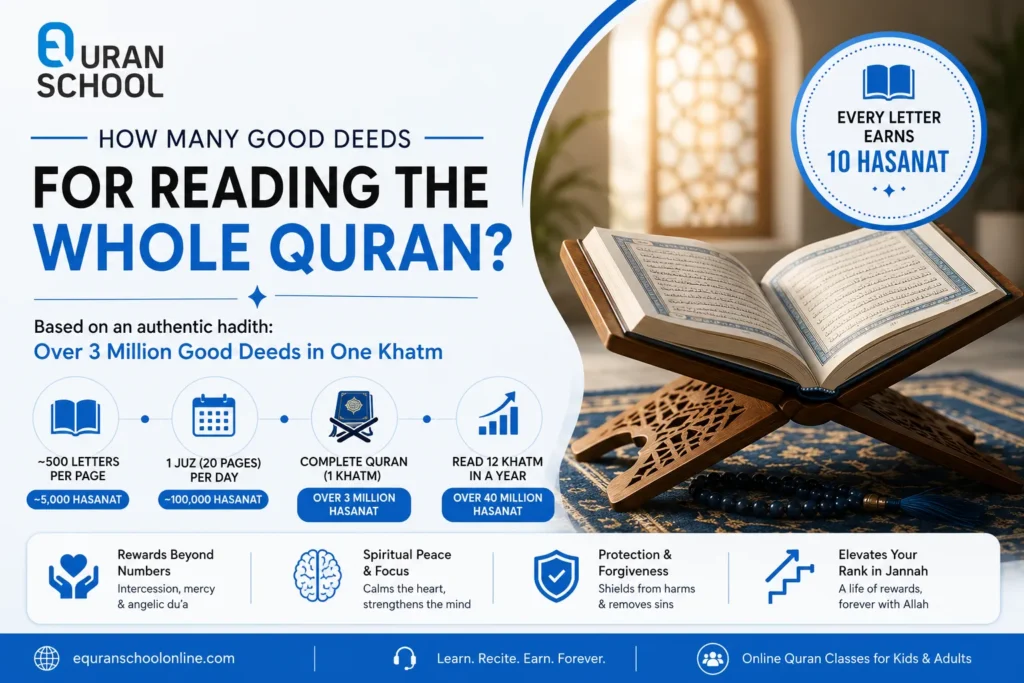
The question seems simple, but the answer carries a weight most Muslims have never measured precisely. Based on an authenticated hadith of the Prophet ﷺ, reading the Quran from cover to cover earns the reciter over three million hasanat in a single khatm — and that figure is the minimum, before Allah’s additional multiplication enters the picture.
Understanding how many good deeds for reading the whole Quran you actually earn, broken down letter by letter and page by page, can permanently shift how you approach every session with the Book of Allah.
This article unpacks the full calculation, addresses the scholarly nuance around what counts as a “letter,” and walks through every category of reward — hasanat, intercession, angelic du’a, and eternal rank — that a complete Quranic reading unlocks.
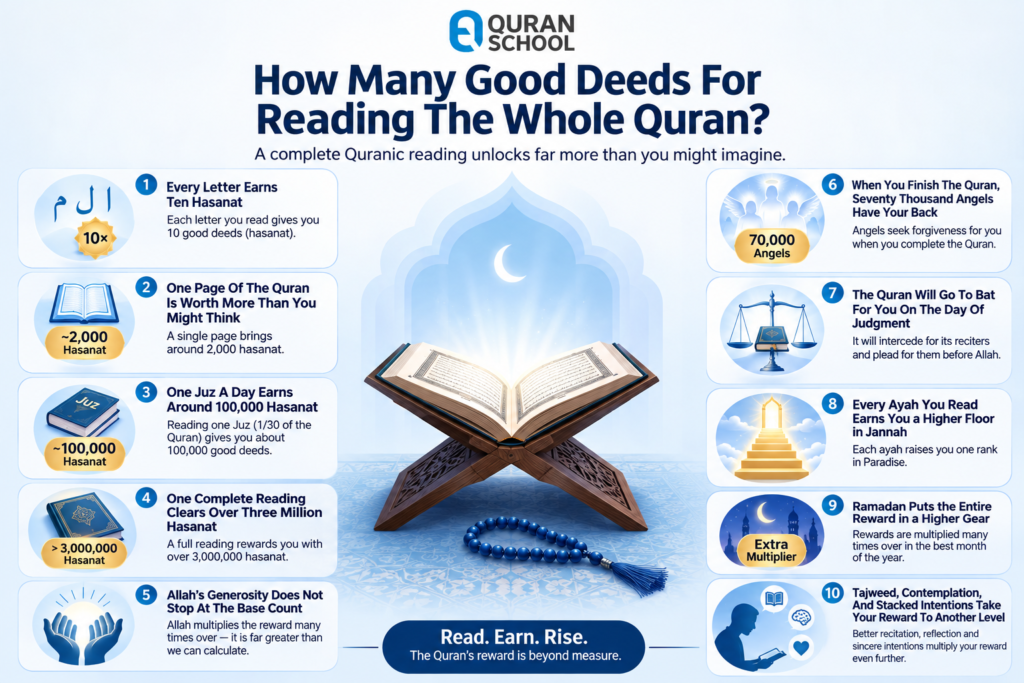
1. Every Letter Earns Ten Hasanat So How Many Good Deeds For Reading The Whole Quran?
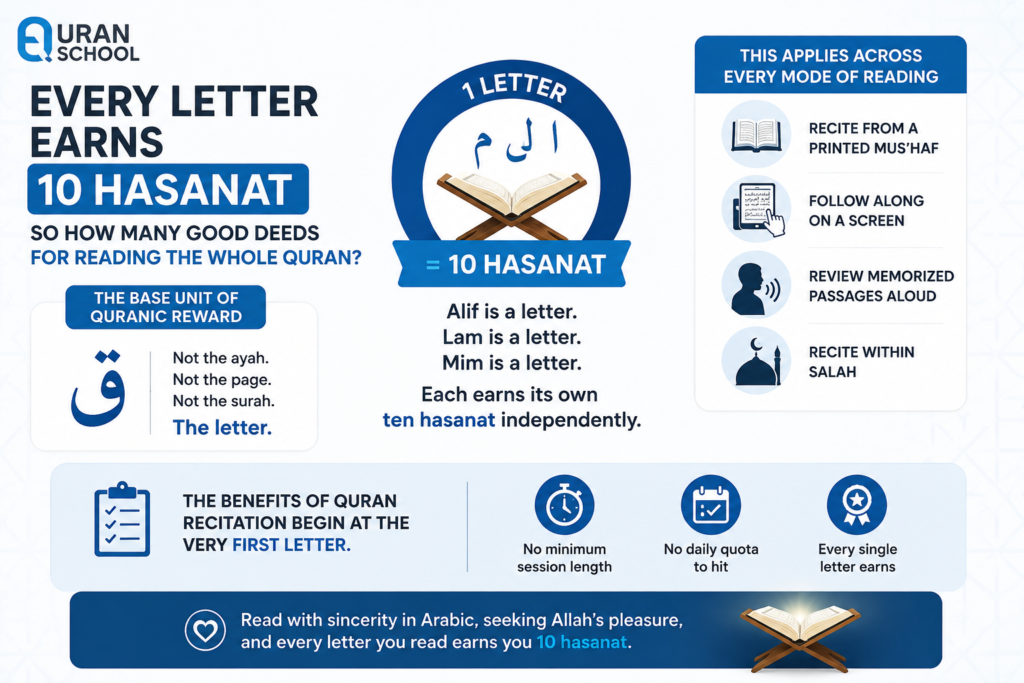
The base unit of Quranic reward is the single letter. Not the ayah, not the page, not the surah — the letter. The Prophet ﷺ made this precise: Alif is a letter, Lam is a letter, Mim is a letter. Each earns its own ten hasanat independently.
This applies across every mode of reading. Whether you recite from a printed mushaf, follow along on a screen, review memorized passages aloud, or recite within salah — the ruling covers you, provided you read sincerely in Arabic. As clarified by scholars, anyone who reads with the intention of seeking Allah’s pleasure, regardless of pace, level, or setting, falls within the scope of this promise.
The benefits of Quran recitation begin at the very first letter. There is no minimum session length, no daily quota to hit before the reward starts counting. Every single letter earns.
Read also: Benefits Of Reading Quran At Fajr
2. One Page Of The Quran Is Worth More Than You Might Think
A standard Madinah-print mushaf page contains approximately 500 letters. At ten hasanat per letter, each page yields roughly 5,000 hasanat. The exact number shifts slightly from page to page depending on how much text appears on that particular side — but 5,000 is the working estimate used by scholars and Islamic educators internationally.
Knowing how many hasanat for reading Quran in the time, like five thousand hasanat as mentioned above, takes most adults to read four to six minutes of measured Arabic text. Understanding what we learn from the Quran in terms of spiritual guidance is valuable.
But knowing the numerical return attached to the act of reading makes daily recitation feel less like an obligation and more like an investment that compounds with every session.
Two pages after Fajr and two pages after Isha puts 20,000 hasanat on your ledger before the morning is over.
Get a FREE Trial of our Quran with Tajweed Classes for Kids and Adults
See Us in Action
Watch a quick snippet from our live, interactive classes below and see how our teachers make learning engaging for all ages!
Start Your Quranic Journey Today
Experience our interactive online classes with a dedicated tutor.
Get Your Free Trial
3. One Juz A Day Earns Around 100,000 Hasanat
The Quran is divided into 30 ajzaa. Each juz contains approximately 20 pages, and at 5,000 hasanat per page, one complete juz of recitation returns around 100,000 hasanat. This is not a rounded estimate invented for persuasion — it is the direct product of the letter-count calculation applied to a standard juz volume.
For anyone following a 30 day Quran reading schedule — one juz per day across a single month — the cumulative total exceeds three million hasanat by the end of that cycle.
The consistency of one juz daily is one of the most consistently recommended habits among serious students of the Quran, and the reward math explains why the scholars who recommend it do so with such conviction.
Read also: Benefits Of Reading Quran At Fajr
4. One Complete Reading of the Quran Clears Over Three Million Hasanat
This is the headline figure, and the arithmetic is direct.
~323,671 letters × 10 hasanat per letter = 3,236,710 hasanat per complete khatm.
Sheikh Muhammad al-Hamoud al-Najdi, using a letter count of 340,740 drawn from classical sources, arrived at 3,407,400. Both calculations land above three million. If you complete the Quran twelve times across a year — once per month — the total reaches more than forty million hasanat by year’s end.
Whether you are in the US, UK, Canada, Australia, or anywhere else in the world, the math is the same and the method works — ten hasanat per letter, applied to every letter of every surah, from Al-Fatihah to Al-Nas.
Readers who have explored the benefits of reading Quran for spiritual peace and guidance will find this quantified dimension adds something concrete: three million individually recorded good deeds, earned from a book that fits in one hand.
Read also: Quran Learning Journey

5. Allah’s Generosity Does Not Stop At The Base Count
The three million hasanat are not necessarily the limit of what a person may earn. Allah says, “And Allah multiplies for whom He wills” (Al-Baqarah: 261). This reminds us that His generosity can go far beyond the basic reward for each letter. There are several factors the reciter controls that are associated with higher multiplication:
A. Read Quran with Tadabbur to Deepen Your Reward
Reading the Quran with genuine reflection can add another dimension to your recitation. Think about the meaning of the verses and how their guidance applies to your life. Reciting during salah, virtuous times, or with sincere intention can also make your worship more meaningful.
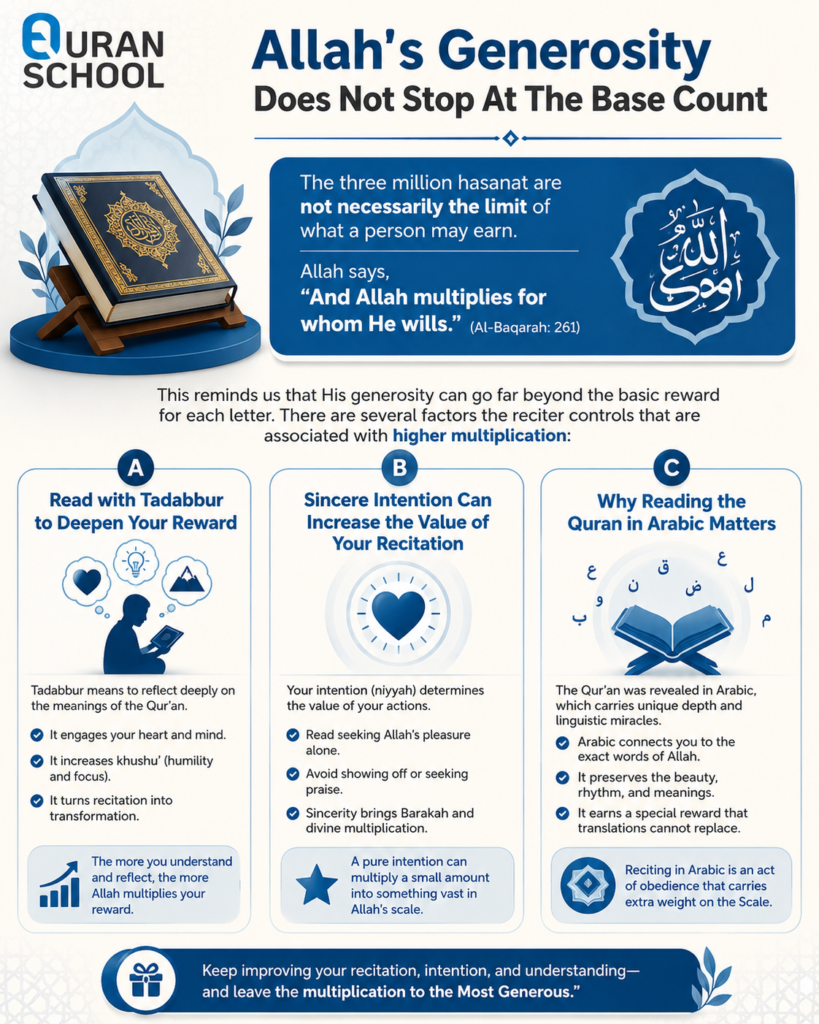
B. Sincere Intention Can Increase the Value of Your Recitation
Before opening the Quran, renew your intention and remind yourself why you are reading. Reading in a state of purification and seeking Allah’s pleasure can turn a regular reading session into a more purposeful act of worship. Sincerity is at the heart of every deed.
C. Why Reading The Quran In Arabic Unlocks Its Full Reward ?
The benefits of reading Quran in Arabic carry direct relevance here. The reward of one hasanah for each letter refers to reciting the Quran in its revealed Arabic language. Reading in Arabic also allows those who understand it to engage more deeply with the meanings of the verses. This deeper reflection, or tadabbur, can enrich the spiritual experience of recitation.
Master Arabic Language Today and start a FREE Trial

Read also: What The Hadith About Reading Quran With Tajweed Reveals?
6. When You Finish The Quran, Seventy Thousand Angels Have Your Back
Completing a full khatm carries rewards that sit outside the per-letter formula entirely. Narrations from the Tabi’in — most prominently associated with Mujahid ibn Jabr — describe 70,000 angels seeking forgiveness on behalf of the person who completes the Quran. If the completion happens during the day, the angels continue until nightfall; if it happens at night, they continue until the following morning.
Scholars note that these narrations trace back to the early pious generations (mawquf) rather than to the Prophet ﷺ as a direct marfu’ hadith. They represent well-attested statements of the Salaf and are consistent with the honor the Quran receives across the authenticated hadith literature.
It was also a reported practice of Anas ibn Malik رضي الله عنه to gather his household at the moment of completing a khatm to make du’a together, treating the occasion as a spiritually elevated moment worthy of collective supplication.
If you want to start building toward your first khatm with a structured plan, the best way to learn Quran online that scholars and educators consistently recommend is guided, one-on-one instruction with real-time feedback — not passive video or app-based study.
Read also: One Year Quran Reading Plan
Start Your Quranic Journey Today
Experience our interactive online classes with a dedicated tutor.
Get Your Free Trial7. The Quran Will Go To Bat For You On The Day Of Judgment
This reward stands apart from every numeric calculation. On the Day of Resurrection, the Quran itself — not a ledger total, not a recorded score — will appear and intercede directly for those who gave it time in this life. The Prophet ﷺ said: “Read the Quran, for it will come on the Day of Resurrection as an intercessor for its companions.” (Muslim)
A second narration describes the moment in striking terms: the Quran will come as a pale figure and say to its companion, “Do you recognize me? I am the one who kept you awake at night and made you thirsty during the day” — then it will be granted its intercession. (Tabarani, authenticated by Al-Albani in Al-Silsila Al-Sahiha)
Parents considering the long-term stakes of Quranic education — for themselves or for their children — will find this hadith settles the question. It is at the heart of what the importance of learning and teaching Quran comes down to: not a cultural inheritance to be passed along, but preparation for a day when no other advocate will carry the same weight.
Reserve your free trial lesson for Quran Reading Classes

Read also: How Many Good Deeds For Reading The Whole Quran?
8. Every Ayah You Read Earns You a Higher Floor in Jannah
Al-Khattabi commented on this in a passage that scholars have quoted across generations: the levels of Jannah correspond to the verses of the Quran. The Prophet ﷺ said: “It will be said to the companion of the Quran: Read, rise, and recite as you used to recite in the world. Your station will be at the last ayah you recite.” (Abu Dawud, authenticated by Al-Albani)
The reader who completes the Quran fully is told to ascend to the highest level. Those who read more in this life occupy higher stations in the next. What this means practically is that every khatm is not merely earning hasanat — it is building a permanent elevation in the afterlife.
A one-time completion is meaningful, but the station rises with every ayah recited across a lifetime of consistent recitation. This is precisely why Quran recitation for beginners is not a transitional phase to move past as quickly as possible — it is where the upward trajectory starts.
Every first attempt at reading Al-Fatihah, every stumbling recitation of Al-Baqarah, every carefully pronounced letter of any surah is contributing to that rising station from day one.
Start A Free Trial For Your Quranic Journey Today

9. Ramadan Puts the Entire Reward in a Higher Gear
Ramadan holds a position unlike any other month in the reward structure of Quranic recitation. The Quran declares it explicitly: “The month of Ramadan in which the Quran was sent down as guidance for mankind” (Al-Baqarah: 185).
The Prophet ﷺ reviewed the entire Quran with Jibreel every Ramadan, completing it twice in his final year — a practice that set the tone for how the Salaf approached the month. Scholars affirm that the elevated spiritual environment of Ramadan — fasting, night prayer, heightened taqwa, concentrated du’a — creates conditions in which the quality and likely the multiplication of rewards is amplified beyond the standard calculation.
The ten-hasanat-per-letter foundation does not change, but the context Allah has sanctified raises what that foundation can build into. The pious predecessors lived this understanding. Abdullah ibn Masud رضي الله عنه completed the Quran once every three nights during Ramadan.
Others among the Tabi’in compressed their khatm cycle to every seven nights, and some to daily completions in the final ten nights. These were people who had understood the math and arranged their lives accordingly.
Book a FREE Trial Class for Your Child in Our Noorani Qaida Course for Kids

Read also: Ramadan Quran Reading Chart and Schedule
10. Tajweed, Contemplation, And Stacked Intentions Take Your Reward To Another Level
The baseline reward is guaranteed for sincere recitation in any form. But how you read — and what you intend before you begin — meaningfully affects the quality and potential multiplication of that reward. This is where the reciter has direct, practical agency. Two dimensions shape this most significantly:
A. Reading With Tajweed Is Not A Luxury, It Is What The Quran Deserves
The command to recite with tarteel (measured, careful recitation) comes directly from Allah: “And recite the Quran with tarteel” (Al-Muzzammil: 4). Tajweed is the practical fulfillment of that command — giving every letter its articulation, its point of exit, and its proper timing.
Scholars note that careful, tajweed-accurate recitation engages the tongue, the mind, and the heart in ways that rushed reading cannot. It is also what makes Arabic recitation intelligible and reverent in a way that befits the Quran’s standing. For non-Arabic speakers, the assumption that tajweed is inaccessible is worth examining directly.
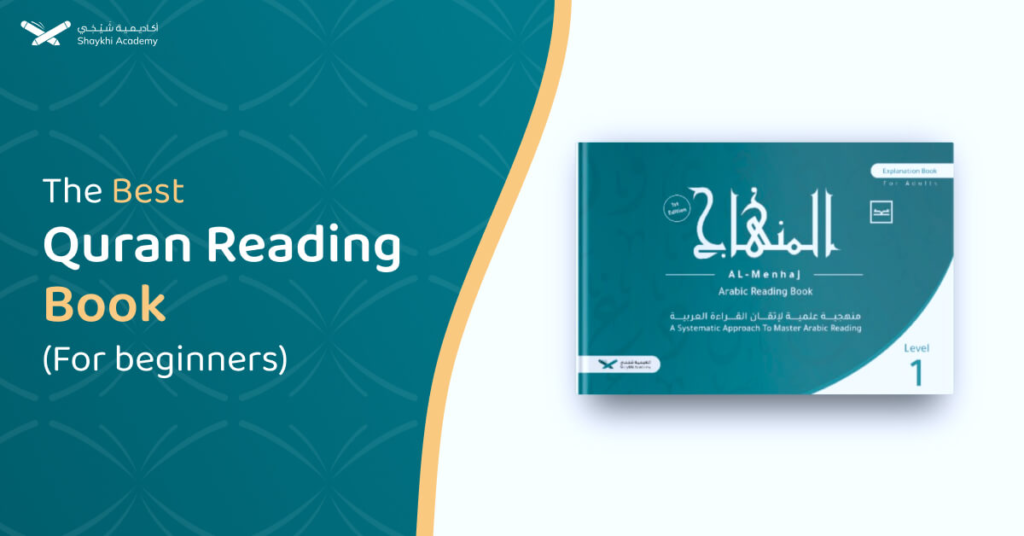
Most online Quran platforms use generic Arabic phonics materials designed for native Arabic children. EQuran School developed the proprietary Al-Menhaj Book — authored by Luqman ElKasabany — specifically for non-Arabic speaking adults and children in Western contexts.
B. Multiple Worship’s Intentions Can Multiply Your Reward
The scholars of the early generations taught that a single act of worship performed with multiple sincere intentions earns a distinct reward for each one. Imam Yahya ibn Abi Kathir said: “Learn intention, for it reaches further than the action.”
Each session with the Quran can simultaneously hold the intention of fulfilling Allah’s command to recite, accumulating hasanat, seeking intercession on the Day of Judgment, rising in rank in Jannah, seeking peace of heart, and preparing to learn the Quran and teach it to your children or community.
Beginning every session by reciting a dua before starting Quran class embeds this intention-setting as a consistent habit rather than an occasional afterthought.
For students who want to go deeper into the meaning alongside the recitation, an online Quran tafsir course turns reading into informed, reflective engagement — the quality of recitation scholars most closely associate with the highest divine multiplication.

Experience Our Classes
Don’t just take our word for it—watch real-time recordings of our online classes below to experience our teaching style firsthand.
Start Your Quranic Journey Today
Experience our interactive online classes with a dedicated tutor.
Get Your Free TrialLearn At EQuran School Where Every Letter You Read Is Built On A Solid Foundation
Understanding how many good deeds for reading the whole Quran you earn is motivation. Having a teacher who makes sure your recitation is accurate, consistent, and progressing — that is what turns motivation into a measurable lifelong practice.
EQuran School connects students across the English-speaking world with qualified, native Arabic-speaking teachers for structured, one-on-one online Quran instruction.
The school’s curriculum covers the full spectrum of Quranic study — from students encountering the Arabic alphabet for the first time to advanced students working toward full memorization and ijazah.
Students who investigate the health benefits of Reading Quran — documented across Islamic scholarship and increasingly referenced in contemporary wellness research — consistently find that accurate, contemplative recitation produces outcomes that passive listening and rushed reading do not.
EQuran School’s complete curriculum includes:
- Online Quran Classes for Kids
- Learn Quran Easily at Home
- Weekend Quran Classes
- Zoom Quran Classes
- Quran Memorization (Hifz) Course
- Online Quran Learning with Tajweed Course
- Online Arabic and Quran Classes
- Quran Qirat Learning Course
- Noorani Qaida Course
Book your free trial class today at E Quran School and begin the khatm that earns over three million hasanat.
Start Your Quranic Journey Today
Experience our interactive online classes with a dedicated tutor.
Get Your Free TrialConclusion
The question of how many good deeds for reading the whole Quran produces a number that is textually grounded and arithmetically clear: over three million hasanat for one complete reading, with Allah’s multiplication available beyond that for every sincere, attentive reciter.
Behind that number stand the 70,000 angels whose du’a follows the one who completes a khatm; the Quran that will appear on the Day of Judgment to intercede when no other advocate has the same standing; and the station in Jannah that rises with every ayah, accumulating across every reading across a lifetime.
The early Muslims understood all of this not as theology to be studied but as a reality to be lived. They recited before Fajr when the rest of the household slept. They reviewed between prayers. They competed to complete more in Ramadan. The dua for learning Quran was on their lips before they opened the mushaf, and gratitude was there when they closed it.
Three million hasanat is not an abstraction. It is the return on one reading of a book that fits in one hand. If you are not yet reading consistently — or if you are, but want to raise the accuracy and depth of your recitation — the path is open, the reward is waiting, and the first letter earns the moment you begin.
Frequently Asked Questions
How many hasanat do you earn for reading the whole Quran?
Reading the entire Quran earns a minimum of approximately 3,236,710 hasanat. This is calculated from the authenticated hadith that assigns ten hasanat to every Arabic letter recited, applied to the Quran’s approximate letter count of 323,671. Allah multiplies this base reward further for whoever He wills, based on the quality of the recitation and the sincerity of the reader.
Does the 10-hasanat-per-letter rule apply to the Basmalah?
Yes. The Basmalah — “Bismillah al-Rahman al-Rahim” — is a Quranic verse. It appears as an independent ayah at the beginning of every surah except Al-Tawbah, and as part of an ayah in Surah Al-Naml. The Permanent Committee for Islamic Research and Fatwa confirmed that the Basmalah is Quranic text, meaning every letter it contains earns the same ten hasanat as any other letter of the Quran.
Does the reward apply only to Arabic recitation?
The letter-count reward described in the hadith applies to the Arabic letters of the Quran specifically. Reading a translation or transliteration does not carry the same ruling. For students who cannot yet read Arabic, learning to read the Arabic text correctly is the priority — once they can read it, the full reward becomes accessible to them on every letter.
How many hasanat does one juz earn?
Each juz contains approximately 20 pages, and at roughly 5,000 hasanat per page, one complete juz earns around 100,000 hasanat. This figure was cited by Sheikh Abdul Karim al-Khudayr based on the standard letter-count calculation and is widely referenced by Islamic educators internationally.
Is there extra reward for completing the Quran in Ramadan?
Yes. Ramadan is the month in which the Quran was revealed, and scholars affirm that the elevated spiritual conditions of the month — fasting, night prayer, heightened consciousness of Allah — create an environment in which divine multiplication is expected to be greater than in other periods.
The ten-hasanat-per-letter foundation applies as always, but the multiplication that Allah grants above that base is associated with the sanctity of the month.
Can children earn the same hasanat for reading the Quran?
Children who have reached the age of discernment and recite sincerely earn reward according to the same principle. Scholars generally hold that children’s deeds are recorded from the age of tamyiz (the ability to distinguish right from wrong). Beginning Quranic recitation early builds both the habit and the reward from the formative years forward.


Leave a Reply