 Learn Quran

The Prophet Muhammad ﷺ was precise about how the Quran should be read — not just the words, but the pace. One of the most practically consequential pieces of prophetic guidance on this subject comes from a single conversation with Abdullah ibn Amr ibn al-As: the hadith about reading Quran in 3 days.
Abdullah ibn Amr ibn al-As asked the Prophet ﷺ: “O Messenger of Allah, in how many days should I complete the Quran?” The Prophet replied: “In one month.” Ibn Amr said he had the strength for more.
They went back and forth, one month became twenty days, twenty became ten, ten became seven, until the Prophet said: “Read it in seven days, and do not exceed that.” Ibn Amr still pressed further. At that point, the Prophet drew a firm line: “He will not understand it, whoever reads it in less than three days.”
This article covers the hadith’s exact wording, its authentication, the scholarly debate it generated, and a practical method that makes three-day completion both spiritually sound and physically achievable.
Master Quran with our Online Quran Recitation Course and start your journey to fluency

1. The Hadith About Reading Quran In 3 Days Where Every Term Carries A Ruling
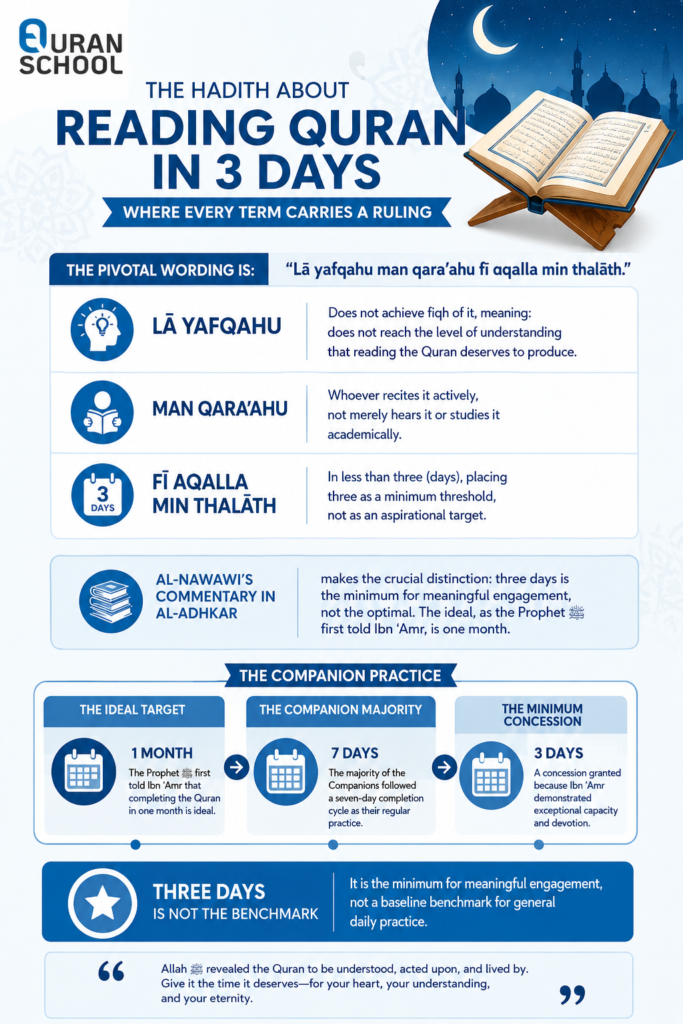
The pivotal wording is: “Lā yafqahu man qara’ahu fī aqalla min thalāth.” Breaking it down:
- Lā yafqahu — does not achieve fiqh of it, meaning: does not reach the level of understanding that reading the Quran deserves to produce
- Man qara’ahu — whoever recites it actively, not merely hears it or studies it academically
- Fī aqalla min thalāth — in less than three (days), placing three as a minimum threshold, not as an aspirational target
Al-Nawawi’s commentary in al-Adhkar makes the crucial distinction: three days is the minimum for meaningful engagement, not the optimal. The ideal, as the Prophet first told Ibn Amr, is one month. The Companion majority followed a seven-day completion cycle as their regular practice. Three days was a concession granted because Ibn Amr demonstrated exceptional capacity and devotion — not a baseline benchmark for general daily practice.
2. Why Consistent Daily Quran Recitation Outranks Completion Targets?
The hadith about reading Quran in 3 days does not stand alone. It belongs to a wider body of prophetic teaching on the hadith about reading Quran daily — the principle that steady, unbroken engagement with the Quran holds a distinct rank of its own.
The Prophet ﷺ said: “Whoever reads a letter from the Book of Allah earns one good deed, and that good deed is multiplied by ten.” (Al-Tirmidhi, authenticated). This multiplied reward applies to every session, however brief.
The benefits of Quran recitation accumulate differently than periodic completion sprints: regular readers retain vocabulary more effectively, maintain a stronger relationship with familiar passages, and are less vulnerable to the forgetting the Prophet warned about.
A 30 day Quran reading schedule — one Juz per day — is the pace the Prophet first recommended to Ibn Amr and maps perfectly onto the length of Ramadan. For most Muslims, this remains the most sustainable baseline outside of special seasons. It preserves comprehension reliably and builds the daily reading habit that the prophetic tradition consistently favors over occasional intensity.
For a broader study of what the Prophet taught about Quran reading and its rewards, the collection of hadith about reading Quran covers the full range of prophetic guidance on recitation practice.
Read also: Reward For Reading Quran And The Blessings That Follow
Discover the profound wisdom and guidance of the Holy Book with a FREE Trial

3. How To Read 10 Juz Per Day Without Running Out Of Steam?
To complete the Quran in three days, a person reads 10 Juz daily. The Quran contains 30 Juz; in the standard Uthmani Mushaf, each Juz is approximately 20 pages. Ten Juz equals roughly 200 pages per day.
At a measured Hadr pace — the faster of the recognized recitation modes, with clear pronunciation — one Juz takes approximately 20 minutes. Ten Juz therefore requires around 3.5 hours of recitation per day. Distributed across five prayer times, that averages roughly 40 minutes per session — a pace that is demanding but physically realistic.
A practical daily distribution:
- After Fajr: 3 Juz (approximately 60 minutes)
- After Dhuhr: 2 Juz (approximately 40 minutes)
- After Asr: 2 Juz (approximately 40 minutes)
- After Maghrib: 2 Juz (approximately 40 minutes)
- After Isha: 1 Juz (approximately 20 minutes)
Whether you are in the US, UK, Canada, Australia, or anywhere else in the world, the math is the same and the method works — the decisive variable is whether prayer-time anchors are used to distribute the load evenly across the day, rather than stacking all reading into one exhausting block.
Across the three days:
- Day 1: Juz 1–10 (Surah al-Fatiha through the end of Surah al-Tawbah)
- Day 2: Juz 11–20 (Surah Yunus through the end of Surah al-Ankabut)
- Day 3: Juz 21–30 (Surah al-Rum through Surah al-Nas)
See Us in Action
Watch a quick snippet from our live, interactive classes below and see how our teachers make learning engaging for all ages!
Start Your Quranic Journey Today
Experience our interactive online classes with a dedicated tutor.
Get Your Free Trial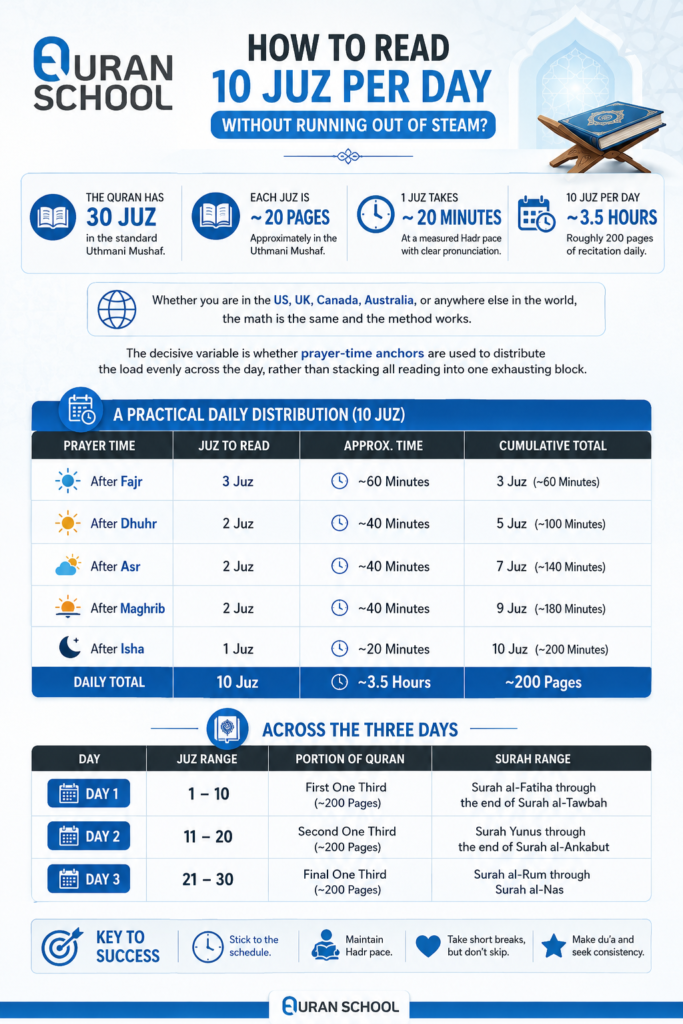
4. Is It Permitted To Finish Reading Quran In Less Than 3 Days? Scholars Draw The Line
The majority position, held by Imam Ahmad, Ishaq ibn Rahawayh, Abu Ubayd, and others, is that completing the Quran in less than three days as a regular habit contradicts clear prophetic guidance.
The Companion evidence is corroborating: Ibn Masud’s statement — “Do not read the Quran in less than three days” — was transmitted with a sound chain through Sa’id ibn Mansur, as Ibn Hajar confirmed in Fath al-Bari. Muadh ibn Jabal held the same view independently.
Ibn Rajab al-Hanbali documented a distinction that later scholars widely adopted: the three-day rule governs ongoing routine. In special seasons — Ramadan, particularly the last ten nights, or when a person is present in Makkah during Hajj or Umrah — the Companions themselves increase their pace without condemnation.
Ibn Rajab recorded that al-Shafi’i completed the Quran sixty times in Ramadan outside of prayer alone. The broader scholarly understanding is that the three-day hadith was issued for normal conditions, not for seasons of exceptional spiritual concentration and reduced worldly distraction.
Recite Quran with Confidence Today through Quran Classes for Adults at EQuran School

5. The Reward For Completing The Quran From The Authentic Hadiths
Reaching the last verse carries a specific elevation in rank, completion is not spiritually neutral. The Prophet ﷺ said: “Read the Quran and rise in rank, recite slowly as you used to recite in this world, for your rank will be at the last verse you recite.” (Abu Dawud, al-Tirmidhi — authenticated).
The Companion reports add texture. Sa’d ibn Abi Waqqas said: “If the completion coincides with the beginning of the night, the angels pray for the reciter until morning. If it coincides with the end of the night, they pray until evening.”
Anas ibn Malik gathered his family to supplicate together whenever he completed the Quran. These practices reflect a collective understanding — shared across generations of the Salaf — that Khatm al-Quran is an event worth marking, not merely a milestone to log privately.
The reward is also quantifiable. A full completion of 30 Juz means reciting over one million Arabic letters, each carrying at minimum ten good deeds — a calculation explored in detail in the how many hasanat for reading Quran breakdown. Separately, the health benefits of reading Quran extend into measurable physical outcomes.
Begin memorizing the Quran today—your first session is free

6. Recitation Style During A Three-Day Completion
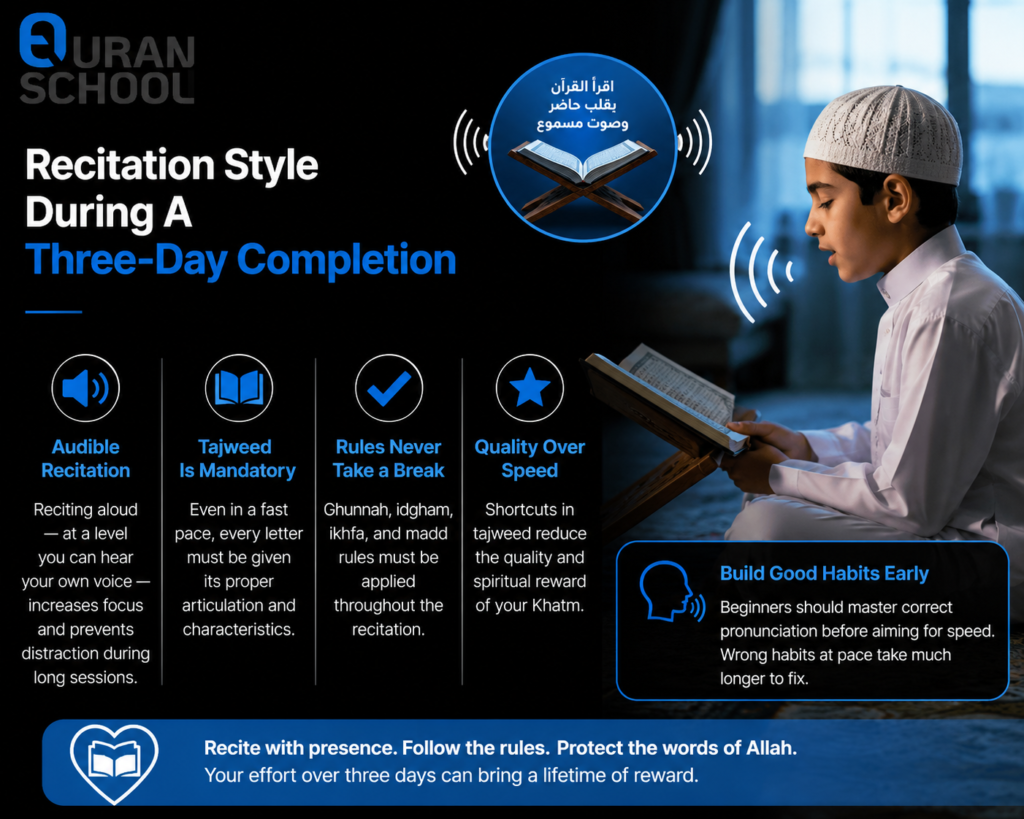
The manner of recitation during a three-day effort carries both spiritual and practical weight. The hadith about reciting Quran loudly establishes that both silent and audible recitation carry reward. Audible recitation — at a level where one hears one’s own voice — tends to produce greater focus and reduces the risk of the mind drifting, which becomes a real challenge during sessions lasting an hour or more.
Tajweed remains obligatory at any pace. Al-Hadr is a recognized and valid recitation mode, but it requires every letter to receive its articulation point and inherent characteristics without distortion.
Ghunnah, idgham, ikhfa, and the rules of madd must still apply throughout. A reader who shortcts tajweed during a three-day Khatm sacrifices recitation quality that cannot be recovered retroactively — and the spiritual reward follows the quality of recitation.
Quran recitation for beginners must establish correct pronunciation habits well before speed is pursued. Incorrect articulation at pace embeds as habit far faster than correct articulation does, and takes significantly longer to correct afterward. It is always faster to learn right the first time, even if the early pace feels slow.
7. The Teach-It Principle Clarifies Why Quran Completion Must Lead Somewhere
The Prophet ﷺ said: “The best among you are those who learn the Quran and teach it.” (Bukhari). This hadith places Khatm al-Quran within a larger frame: reading the Quran is a stage in a cycle of learning and transmission, not a destination in itself.
A Muslim who completes the Quran in three days and immediately uses that renewed familiarity to teach a passage to a child, explain a verse to a spouse, or reinforce a student’s lesson lives this principle directly. The three-day completion becomes preparation for transmission rather than a numbers exercise.
The importance of learning and teaching Quran is recognized in Islamic scholarship as a collective obligation, not a personal virtue alone. Communities where Quran transmission is actively practiced produce more consistent reciters, stronger memorization networks, and greater generational continuity in Quran knowledge.
Learn Noorani Qaida Online Now and Let us make it easy for you.

8. Three Tested Methods For Reading Quran Faster Without Losing The Thread
This is the real problem the hadith addresses. The Prophet’s warning was not abstract — rushing through the Quran without reflection was a recognizable failure mode even among devoted early Muslims, which is why la yafqahu was stated with such directness.
Three approaches that experienced reciters use to bridge speed and comprehension:
A. Read Each Page Twice
At Hadr pace, read each page once for fluency, then pause briefly and scan it a second time for any phrase that stands out or that you want to hold in mind before moving on. This adds approximately five minutes per Juz but significantly improves retention across three consecutive days of reading.
Start A Free Trial For Your Quranic Journey Today

B. Pair Recitation Sessions With Tafsir Study
An online Quran Tafsir course provides the interpretive framework that makes individual ayahs recognizable on sight. When a reader already knows the context, occasion of revelation, and core meaning of major sections, recitation becomes active recognition rather than passive decoding.
Scholars consistently make this point: the three-day minimum exists to protect reflection — but if meaning has been studied in advance, each session carries more comprehension per minute without requiring a slower pace.
C. Use Each Prayer-Time Gap As A Reflection Anchor
Rather than treating each reading session as a sprint to the next Juz count, spend the first two minutes of each session recalling one idea from the previous sitting. This creates continuity across three days and prevents the experience from feeling like a disconnected marathon through text. The prayer itself naturally reorients focus and intention before returning to the Mushaf.
Get a Free Trial of our Quran with Tajweed Classes for Kids and Adults

Experience Our Classes
Don’t just take our word for it—watch real-time recordings of our online classes below to experience our teaching style firsthand.
Start Your Quranic Journey Today
Experience our interactive online classes with a dedicated tutor.
Get Your Free TrialStart Your Quran Journey With Equran School
A three-day Khatm feels spiritually rich rather than mechanically exhausting when the recitation foundation is solid. Correct pronunciation, confident articulation, and a reading pace that does not require constant conscious effort, these qualities come from instruction, not repetition alone.
Most online Quran platforms use generic Arabic phonics materials designed for native Arabic children. EQuran School developed the proprietary Al-Menhaj Book — authored by Luqman ElKasabany — specifically for non-Arabic speaking adults and children in Western contexts.
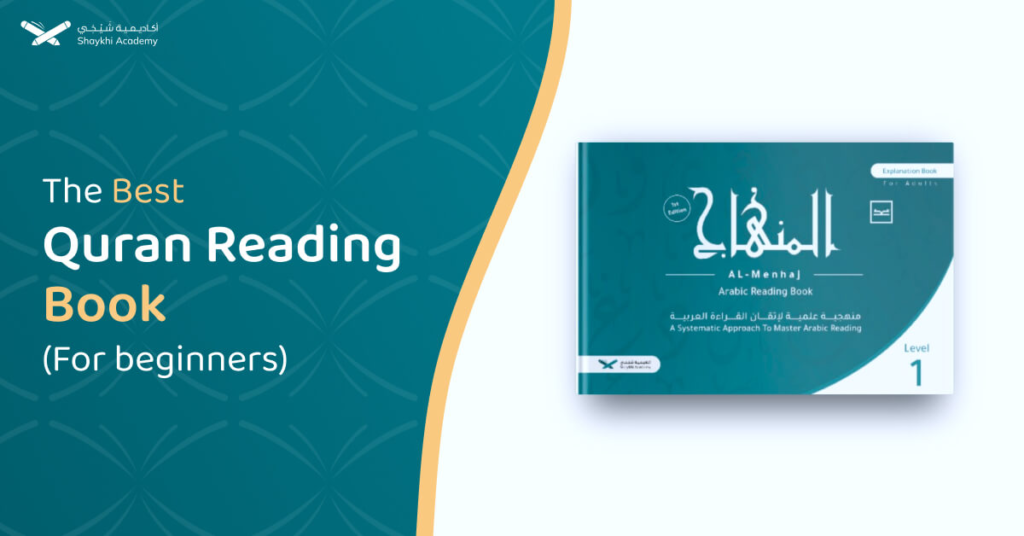
The approach teaches Arabic letter recognition and Quran reading through a structured sequence designed for those who did not grow up with the language, making the path to fluent recitation significantly shorter than standard curricula offer.
EQuran School provides a complete curriculum through live, one-on-one sessions with qualified instructors:
- Quran Memorization (Hifz) Course
- Online Quran Learning with Tajweed Course
- Quran Tafsir Course
- Online Arabic and Quran Classes
- Quran Qirat Learning Course
- Noorani Qaida Course for Kids
- Online Quran Classes for Kids
- Learn Quran Easily at Home
- Weekend Quran Classes
- Zoom Quran Classes
Book a free trial class at EQuran School and enhance your spiritual growth through the study of the Quran.

Start Your Quranic Journey Today
Experience our interactive online classes with a dedicated tutor.
Get Your Free TrialConclusion
The hadith about reading Quran in 3 days is not a personal challenge to aim for — it is a floor the Prophet ﷺ established to protect the dignity of engagement with the Quran. The conversation with Ibn Amr ended at three days not because that is the ideal, but because it is the lowest level at which meaningful comprehension remains possible for the committed, capable reciter operating under ordinary daily conditions.
The practical upshot is clear: 10 Juz per day, distributed across the five prayers, produces a pace that is achievable and spiritually honest. The benefits of reading Quran reach every letter recited — but the benefits scholars spent centuries analyzing, and that the Companions modeled through lived practice, come from reading with presence and intention.
Understanding what we learn from the Quran means engaging it at a level where its guidance actually lands — and that kind of engagement is built through consistent daily reading, structured instruction, and the intention to pass on what has been received.
For a Muslim who wants to make the three-day Khatm a spiritually meaningful experience rather than a logistical race against the clock, the path begins with proper recitation instruction. The foundation determines the ceiling.
Frequently Asked Questions
What is the hadith about reading the Quran in 3 days?
The hadith states: “He will not understand it, whoever reads the Quran in less than three days.” Narrated by Abdullah ibn Amr ibn al-As, it appears in Sunan Abi Dawud (no. 1394), Jami’ al-Tirmidhi (no. 2949), and Sunan Ibn Majah (no. 1347), and is authenticated as sahih by Imam al-Albani and Imam al-Nawawi.
Does reading the Quran in less than 3 days invalidate the recitation reward?
No. Al-Iraqi and the majority of classical scholars clarified that what la yafqahu negates is comprehension — not the reward for recitation itself. Every letter recited carries the promised ten good deeds regardless of pace. What diminishes is the quality of understanding, not the validity of the act.
How many pages must I read each day to complete the Quran in 3 days?
The standard Mushaf contains approximately 604 pages. Completing it in three days requires reading around 200–202 pages per day, which equals 10 Juz. At a measured Hadr pace, one Juz takes approximately 20 minutes, placing the total daily reading time at roughly 3.5 hours — manageable when spread across five prayer sessions of around 40 minutes each.
Are there circumstances where completing the Quran faster than 3 days is acceptable?
Yes, according to the classical scholarship. Ibn Rajab al-Hanbali documented that the three-day rule governs regular practice, not exceptional seasons. During Ramadan and for a visitor performing Hajj or Umrah in Makkah, the Salaf increased their pace beyond the standard minimum. Al-Shafi’i completing the Quran sixty times in Ramadan outside of prayer is among the most frequently cited examples.
What dua should I read before beginning a Quran reading session?
Reading a dua for learning the Quran before recitation is part of established Sunnah practice. The obligatory step before beginning is A’udhu billahi min al-shaytani al-rajim, as directed in Surah al-Nahl (16:98), followed by Bismillah. Many scholars recommend adding a brief personal supplication asking Allah for focus, comprehension, and blessing in the time spent with the Quran.
How can I build recitation speed without compromising tajweed?
Articulation and tajweed must be correct before speed is pursued. Once the articulation points and rules are mastered at a slower pace, faster reading comes naturally through practice without introducing errors. Live instruction is the most effective path: a teacher who hears an error at the moment of production can prevent it from becoming a habit.











Leave a Reply