 Learn Quran

Surah Yaseen is one of the most read surahs in the Quran. People read it at home. They read it in gatherings. They read it beside someone who is ill. Many of us know long parts of it by heart. Fewer of us read it the right way.
Tajweed is what closes that gap. It is the set of rules that shows you how each letter of the Quran should be said. Where it sits in the mouth. How long it is held. When to stretch it, and when to soften it. These rules reach us through the way of Hafs an Asim.
Reading Surah Yaseen with tajweed is a skill you build in order, not all at once. The six steps below move you through four stages.
First, you hear the sound. Then, you see the rules on the page. After that, you produce them with your own mouth. Last, you have them checked by someone who can hear what you cannot.
Do not jump ahead, because each step rests on the one before it. Work through verses 1 to 12 first, and the same method will carry you through the rest of the surah. Give it fifteen focused minutes a day and you will feel the change within a week.

1. Listen To The Verse Before You Read It
Play one verse from a careful reciter. Listen without reading. Then play it again. Your ear needs the sound before your mouth can copy it. This is how children learn to speak, and it is how you learn to recite. You cannot produce a sound you have never really heard.
Pick a slow, clear recitation to learn from. A slow style gives you time to hear each rule as it passes. Fast recitation is beautiful, but it hides the detail you are trying to catch. Listen to the same verse three or four times.
Make each pass do a different job. On the first pass, just listen. Close your eyes if it helps. Let the shape of the verse settle in your ear. On the second pass, follow the words in the mushaf while the reciter reads. Now the sound and the text join up.
On the third pass, listen for one thing only. How long does the reciter hold a nasal sound? Which letters come out heavy and full? Where does he stop to breathe?
Stay with one reciter while you learn a passage. Ten reciters give you ten slightly different models, and your ear will not settle on any of them. One reciter, heard often, becomes a clear model you can measure yourself against. You can enjoy other reciters outside your practice time.
Use the quiet parts of your day for this. The drive to work. The kitchen. The few minutes before sleep. Listening costs you nothing, and it builds the ear you will need in every step that follows.
One warning. Copy the rules, not the melody. A reciter’s tune is his own. The tajweed is what you are after.
Read also: What The Hadith About Reading Quran With Tajweed Reveals?
2. Read the Verses From A Colour-Coded Tajweed Mushaf
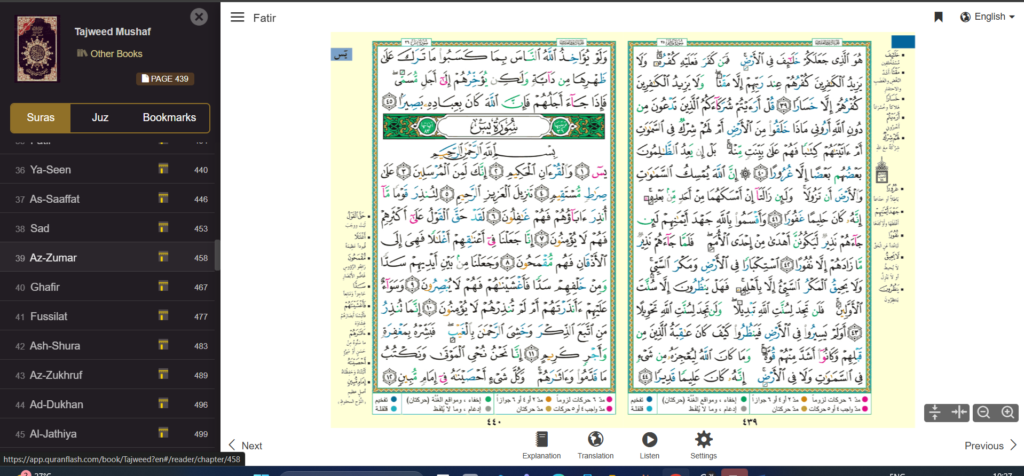
A tajweed mushaf colours each rule right where it falls in the text. Ikhfa, idgham, iqlab, and the madd rules all show up as colour on the page. You do not have to recall them. You can see them.
This matters more than it sounds. Knowing a rule and spotting it are two different skills. Many learners can list the four rules of nun sakinah and still miss them while reading. The colour closes that gap for you.
Start with the key. Every tajweed mushaf prints one, usually at the front or the back. It tells you which colour stands for which rule. Spend a few minutes with it before you read a single verse. Editions differ, so do not assume the colours match another copy you have seen.
Then, read with your eyes open for colour. When you hit a coloured word, stop. Name the rule out loud. Say what it asks you to do. Then, read the word again and do it. This sounds slow. It is. It also works far faster than reading the whole page and hoping.
Use it on the same twelve verses again and again. Yaseen gives you a lot of colour in a small space, so the same rules keep coming back. That repeat is what moves a rule from the page into your memory.
A printed copy and an app both work. A phone or tablet is easier to carry, and many Quran apps have a tajweed view you can switch on. A printed mushaf is easier on the eyes for long sessions. Use whichever one you will actually open.
One last thing. The colours are a support, not a home. Once verses 1 to 12 feel steady, read them from a plain mushaf with no colour at all. If the rules still come out right, they are yours.
If they slip, go back to the coloured copy for a while. That switch is the real test, and most self-learners never make it, because they never picked up a tajweed mushaf in the first place.
3. Hunt One Rule At A Time While Reading The Verses
Do not try to apply every rule at once. Take one rule and sweep the page for it. Here is why this works. Your attention is small.
Ask it to watch for nine rules in one reading, and it will watch for none of them well. Ask it to watch for one, and it will catch every case on the page.
So make each reading a hunt with one target. Start with ikhfa, because it is the most common rule in this surah. Read verses 1 to 12 and look for nothing else. Mark each case in pencil, or write the words in a notebook.
You should find eight. Six of them sit in the table further down in this guide. The other two are تُنذِرْهُمْ in verse 10 and تُنذِرُ in verse 11.
Then, go back to verse 1 and hunt something new. Idgham on the next pass. Then iqlab and izhar. Then the two meem rules. Then the madd rules. Then qalqalah last, since it is the quickest to spot.
Say the rule name out loud as you mark it. Name the letter that caused it, too. Ikhfa, before the dhal. Iqlab, before the ba. That habit is what turns a colour on the page into a rule you own.
By the end, you will have read the same twelve verses seven or eight times. That is the point. Each pass is short and easy, and each one adds a layer. Reading them once while trying to hold every rule in your head is harder work with less to show for it.
Keep your marked list. It becomes a map of the passage. When you start reading out loud in the next step, you already know what is coming and where.
One more gain from this. Hunting a rule teaches you the letters that trigger it, not just the rule itself. After a few passes you stop asking what ikhfa is. You start seeing a silent nun, looking at the letter after it, and knowing what to do. That is the skill you are really after.
See Us in Action
Watch a quick snippet from our live, interactive classes below and see how our teachers make learning engaging for all ages!
Start Your Quranic Journey Today
Experience our interactive online classes with a dedicated tutor.
Get Your Free Trial4. Break The Verse Down And Repeat It
Read the verse slowly. Slower than your final pace. Slow reading is not a weaker version of good reading. It is how good reading is built.
Start by cutting the verse into small pieces. Two or three words each. Cut at a natural break, never in the middle of a rule.
Take verse 9 as an example. Break it into three pieces:
- وَجَعَلْنَا مِن بَيْنِ أَيْدِيهِمْ
- سَدًّا وَمِنْ خَلْفِهِمْ سَدًّا
- فَأَغْشَيْنَاهُمْ فَهُمْ لَا يُبْصِرُونَ
Read the first piece on its own. Then, the second. Then, the third. A long verse stops feeling long once it is three short jobs instead of one big one.
Now repeat. Read the first piece until it comes out right five times in a row. Not five times in total. Five times in a row, with no slip.
If you slip, stop at once. Do not push through and hope the next one is better. Fix the word, then start your count again. A repeated error is still learning. It just teaches your mouth the wrong thing, and wrong habits are much harder to undo than new ones are to build.
Read out loud every time. Reading in your head skips the muscles you are training. Your tongue and lips need the reps, not your eyes.
When all the pieces are clean, join them. Read the whole verse from start to end, still slowly. Then, read it again at your normal pace. If the rules hold at normal pace, the verse is done for now.
Then, join it backwards. Read the verse before it, then this one, with no pause between them. Most errors hide at the join, not inside the verse. This is also where you find the stops your breath can carry.
Keep the sessions short. Fifteen focused minutes a day will beat two hours on a Friday. Your mouth learns the way your body learns any other movement, a little at a time, with rest in between.
Open each new session with what you did yesterday. Read the old verses first, then add the new one. In a week, you are not reading one verse. You are reading a passage.
Read also: Learning Quran with Tajweed at Home Made Easy
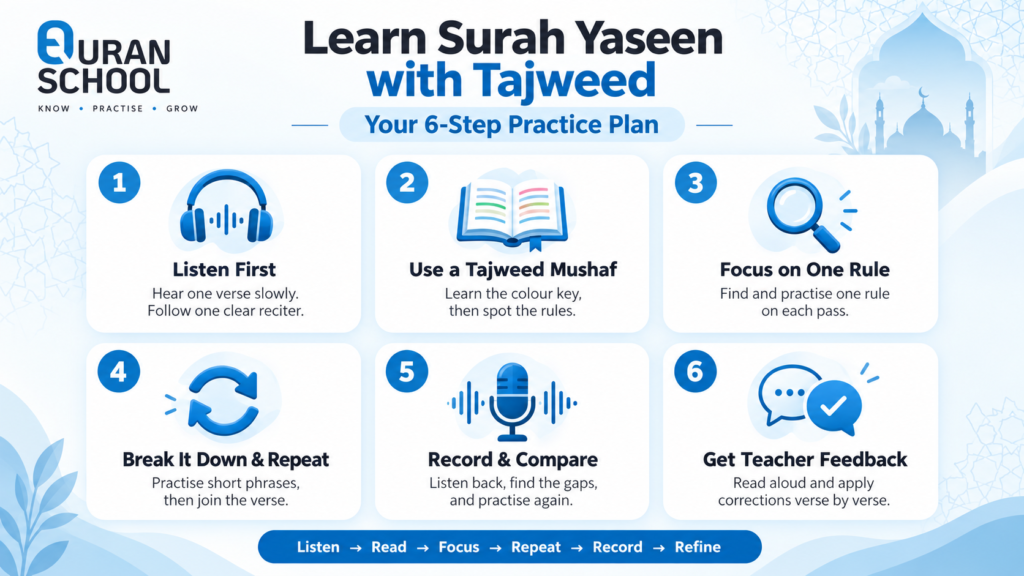
5. Record Yourself While Reading, And Compare Your Recordings Of The Same Verse
Record your own reading of the verse. Then, play the reciter. Then play yours. You cannot judge your reading while you are doing it.
Two things get in the way. Your voice reaches you through your own head, so it never sounds to you the way it sounds to a listener. And while you read, your mind is busy reading. It hears what you meant to say, not what came out.
A recording removes both problems. It hands you your own reading as a listener hears it. You do not need any gear.
The voice recorder on your phone is enough. Sit somewhere quiet, hold the phone a hand’s width away, and read the verse once at your normal pace. Do not perform. Read it the way you would read it in prayer.
Then listen in this order. The reciter first. You second. The reciter once more. That last play is what makes the gap clear, because you now know exactly what to listen for.
Use a checklist while you listen, one item per play. Play it once and listen only to the ghunnahs. Are they held, or are they rushed? Play it again and listen only to the long sounds. Did you hold الْمُرْسَلِينَ for the same count both times it came?
Play it a third time for the heavy letters. Then once more for the qalqalah, and for where you took a breath.
Write down what you find. One line is enough. Then take those notes back into the previous step and drill only those words. Do not re-record the whole verse to fix one letter.
Keep every recording. Make a folder and date the files. In week one they will make you wince, and that feeling passes.
In week four, you will play that first file again and hear how far the same mouth has come. Very few things keep a learner going like real proof of progress.
Record the same verse again a few days later, without listening to the old one first. Then compare the two. If the same error shows up in both, it is not a slip. It is a habit, and habits need a teacher.
Read also: How to Read Quran with Tajweed: Full Guide
6. Get Corrected By A Teacher
Tajweed has always been passed down face to face. A teacher reads. The student reads back. The teacher corrects what is wrong. That is called talaqqi. It is how the Quran has moved from one age to the next since it was first revealed. It was never learned from a book alone, because a book cannot hear you.
Some errors you cannot catch alone. You cannot hear what nobody taught you to hear. A slightly wrong ض. A heavy letter read light. A ghunnah held for one count instead of two. To your ear it all sounds close enough. To a trained ear it is a clear, named error with a clear fix.
A recording tells you that something is off. A teacher tells you what is off and why.
Here is what a good session looks like. You read a few verses out loud. The teacher stops you at the word that went wrong. They say it the right way. You say it back. They have you repeat it in the phrase, then in the whole verse, until it holds. You leave with two or three things to work on, not twenty.
Come prepared, and you will get far more from the time. Bring the list you marked while hunting rules. Bring the words your recordings kept catching. Open the session by saying what you think is weak. A teacher who knows your weak spots works fast. They can fix in ten minutes what you have circled for a month.
Ask for a little, not a lot. Two fixes you can drill this week beat ten you will forget by Tuesday.
A few things matter when you pick a teacher. Look for someone trained in tajweed, not only in memorising. Some teachers hold an ijazah. That is a written permission to teach, passed down through a chain of teachers. Look for someone who corrects you every time, kindly and without rushing.
Working through Surah Yaseen alone and unsure if you have it right? Have a look at our qualified teachers at EQuran School Online, pick the one who suits you best, and click Free Trial. One session is enough to show you which rules to fix first.

What Does It Mean To Read Surah Yaseen With Tajweed?
It means every letter, every nasal hold, and every stretch follows the rules of Hafs an Asim. Not only in the verses you know well. In every verse, from يس to the last line.
That is a higher bar than it sounds. Most readers apply the few rules they picked up by ear and miss the rest. Tajweed is not a feel for the sound. It is a set of rules you can check, word by word. Surah Yaseen is a strong place to start. Here is why.
It opens with the letters يس. So you face a six-count stretch in the very first word. Its verses are short. That gives you a small, complete unit to drill each time. And it is packed with nun sakinah and tanween rules. All four of them show up in the first twelve verses.
Learn this surah well and you have drilled most of the rules you need for the rest of the Quran.
You may also like: 10 Benefits of Reading Quran with Tajweed That Every Muslim Should Know
What Should You Know Before You Start Surah Yaseen?
There are four basics. Skipping them is the main reason people get stuck.
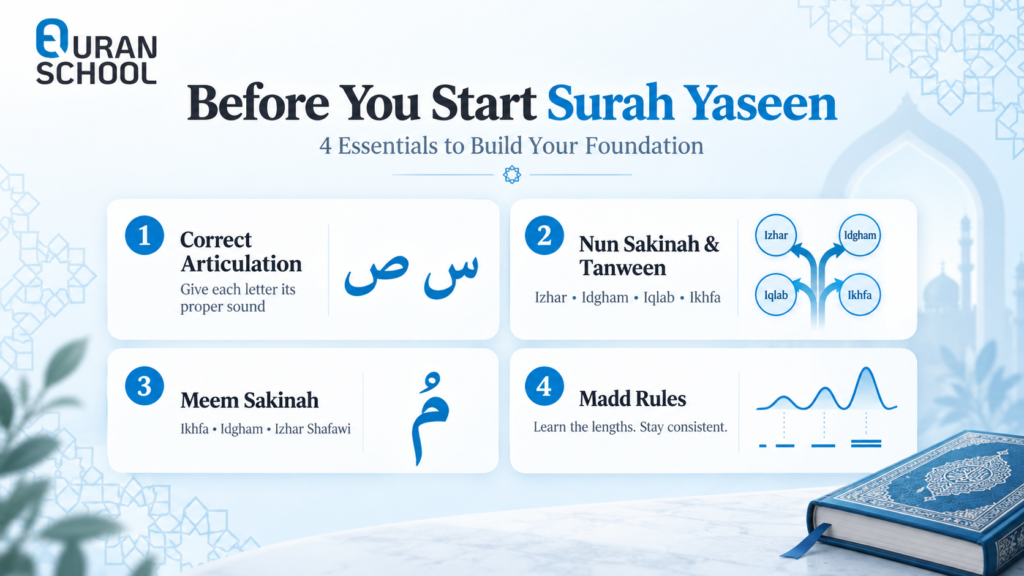
1. The Correct Articulation Of Each Letter
No rule works if the letter itself is wrong. The gap between س and ص changes the meaning. So does the gap between د and ض, or ه and ح. Rule knowledge will not save a letter made in the wrong spot.
Surah Yaseen tests this fast. Verse 4 puts ص and س in the same short phrase: عَلَىٰ صِرَاطٍ مُّسْتَقِيمٍ. Read it out loud right now and listen to yourself. Did the two letters come out as two different sounds, or did they blur into one?
2. The Rules Of Nun Sakinah And Tanween
There are four: izhar, idgham, iqlab, and ikhfa. These are the most common rules in the surah.
Learn them as a simple choice, not a list. Look at the letter that comes next. Then apply the rule that matches it.
3. The Rules Of Meem Sakinah
There are three. Ikhfa shafawi comes before ب. Idgham shafawi comes before another م. Izhar shafawi comes before every other letter.
Yaseen uses all three, often close together.
فَهُم مُّقْمَحُونَ and فَهُمْ لَا يُؤْمِنُونَ sit one verse apart. They take opposite rules.
4. The Madd Rules
Madd means you hold a sound longer. The natural madd is two counts. That is your base. On top of it sit four more.
- Madd muttasil is 4 or 5 counts, and you must apply it. Madd munfasil is also 4 or 5 counts in Hafs.
- Madd arid happens when you stop at the end of a verse, and you may pick 2, 4, or 6 counts.
- Madd lazim is always 6 counts, with no choice.
Being steady matters more than the length you pick. Pick one length and keep it.
Read also: The Ultimate Method for Learning Surah Al-Lail and Retaining It
Tajweed In Surah Yaseen, Verses 1 To 12
Learn this block first. Drill one table at a time, then read the whole passage.
Nun Sakinah And Tanween
You will find them in four different rules: izhar, idgham, iqlab, and ikhfa. Which one applies is decided by a single thing: the letter that comes straight after the silent nun or the tanween. So, learn them as a choice you make each time, not as a list you recite.
This is the busiest rule family in Surah Yaseen, and you will meet it far more often than any other. Get it steady in these twelve verses, and you have the most common rule set in the whole Quran under control.
| Verse | Word or phrase | Rule | What to do |
| 4 | صِرَاطٍ مُّسْتَقِيمٍ | Idgham with ghunnah | Merge the tanween fully into the meem. Hold 2 counts |
| 5 | تَنزِيلَ | Ikhfa | Hide the nun before ز. Hold the ghunnah 2 counts. Tongue stays off the roof of the mouth |
| 6 | لِتُنذِرَ | Ikhfa | Hide the nun before ذ. Hold 2 counts |
| 6 | قَوْمًا مَّا | Idgham with ghunnah | Merge the tanween fully into the meem |
| 6 | أُنذِرَ | Ikhfa | Hide the nun before ذ |
| 8 | أَغْلَالًا فَهِيَ | Ikhfa | Hide the tanween before ف. Hold the ghunnah |
| 9 | مِن بَيْنِ | Iqlab | Turn the nun into a hidden meem before ب. Lips touch lightly |
| 9 | سَدًّا وَمِنْ | Idgham with ghunnah | Merge the tanween into the و |
| 9 | وَمِنْ خَلْفِهِمْ | Izhar halqi | Say the nun clearly before خ. No ghunnah hold |
| 10 | وَسَوَاءٌ عَلَيْهِمْ | Izhar halqi | Say the tanween clearly before ع |
| 10 | أَنذَرْتَهُمْ | Ikhfa | Hide the nun before ذ |
| 10 | تُنذِرْهُمْ | Ikhfa | Hide the nun before ذ |
| 11 | تُنذِرُ | Ikhfa | Hide the nun before ذ |
| 11 | بِمَغْفِرَةٍ وَأَجْرٍ | Idgham with ghunnah | Merge the tanween into the و |
| 11 | وَأَجْرٍ كَرِيمٍ | Ikhfa | Hide the tanween before ك. Hold the ghunnah |
| 12 | شَيْءٍ أَحْصَيْنَاهُ | Izhar halqi | Say the tanween clearly before the hamzah |
| 12 | إِمَامٍ مُّبِينٍ | Idgham with ghunnah | Merge the tanween fully into the meem |
Meem sakinah
Verses 1 to 12 show only two of the three meem sakinah rules. The third one is ikhfa shafawi. It happens when a silent meem is followed by ب, and there you hide the meem instead of saying it clearly.
Bring your lips together lightly, without pressing, and hold the ghunnah for two counts. You meet it later in the surah, in verse 65, in أَرْجُلُهُم بِمَا.
| Verse | Word or phrase | Rule | What to do |
| 6 | فَهُمْ غَافِلُونَ | Izhar shafawi | Say the meem clearly before غ. No nasal hold |
| 7 | فَهُمْ لَا | Izhar shafawi | Say the meem clearly before ل |
| 8 | فَهُم مُّقْمَحُونَ | Idgham shafawi | The two meems become one. Hold 2 counts |
| 10 | أَمْ لَمْ | Izhar shafawi | Say the meem clearly before ل |
Madd
The same word can take two different rules. A madd is not fixed to the word. It depends on what you do at the end of it.
Keep reading and الْحَكِيمِ in verse 2 is a plain 2-count madd. Stop on it and the same word becomes madd arid, held for 2, 4 or 6. Keep reading and سَدًّا in verse 9 merges into the word after it. Stop on it and the double fatha turns into a 2-count madd iwad. The word on the page did not change. Your breath did.
So ask one question before you judge any madd. Am I stopping here, or carrying on? Answer that first, then apply the rule.
| Verse | Word or phrase | Rule | What to do |
| 1 | يس | Madd lazim harfi | Hold the يا 2 counts and the سين 6. The nun is said clearly into وَالْقُرْآنِ, not merged |
| 2 | الْقُرْآنِ | Madd badal | Hold the آ 2 counts. This is a stretch, not an echo |
| 2 | الْحَكِيمِ at a stop | Madd arid | Hold 2, 4, or 6 counts. Pick one length and keep it |
| 6 | مَّا أُنذِرَ | Madd munfasil | Hold 4 or 5 counts in Hafs |
| 6 | آبَاؤُهُمْ | Madd muttasil | Hold 4 or 5 counts. You must apply this one |
| 10 | سَوَاءٌ | Madd muttasil | Hold 4 or 5 counts |
Read also: 9 Hadiths About Reciting Quran Beautifully
Ghunnah And Qalqalah
Ghunnah and qalqalah carry much of the beauty people hear in a trained recitation. Ghunnah is the nasal sound that comes from the nose, held for two counts, and it lives in every doubled nun and meem, as well as inside idgham, ikhfa and iqlab.
Qalqalah is the light bounce you hear on ق ط ب ج د when one of them carries a sukoon. Both tend to go wrong in the same direction, which is too much — a ghunnah stretched past its count, or a bounce turned into a small extra vowel.
Just remember that they are rules first, not ornament. Read them because they are due, and the beauty comes with them.
| Verse | Word or phrase | Rule | What to do |
| 3 | إِنَّكَ | Ghunnah on the doubled nun | Hold 2 counts, through the nose |
| 7 | لَقَدْ | Qalqalah sughra | Light echo on the د. Do not add a vowel |
| 8 | إِنَّا | Ghunnah on the doubled nun | Hold 2 counts |
| 9 | يُبْصِرُونَ | Qalqalah sughra | Light echo on the ب |
| 11 | إِنَّمَا | Ghunnah on the doubled nun | Hold 2 counts |
The other 71 verses run on the same rules you have just met. What changes is the pace, and the number of choices you have to make in a row. That is where most learners start to drift without hearing it.
You can carry this method through the rest of the surah on your own. And if you would like a second pair of ears while you do, the Learn Quran Online with Tajweed course at EQuran School is built for exactly this.

What Is The Right Way To Read Surah Yaseen?
You read Surah Yaseen the same way you read any other surah. Start with the istiadhah and the basmalah. Then, read the surah from start to end, without breaks in the wrong places. Keep your heart present and think about the meaning.
You do not have to read it a set number of times. You do not have to read it at a set hour. And you do not have to repeat any word or verse a fixed number of times.
This matters for learners, and here is why. Much of what you find online about Surah Yaseen is not about reading it correctly at all. It is about using it to get a wish granted, with counts and set phrases attached to certain words.
Search for how to read Surah Yaseen, and those pages will meet you first. Follow them, and you will spend your practice time counting repeats instead of fixing your letters — and your reading will not move forward.
What Is The Mubeen Method In Reading Surah Yaseen?
Mubeen method is a well-known practice that tells you to stop at each of the seven verses that end with the word مُبِين. You then say a set dua at each stop.
Some versions tell you to start the surah again until you hit a target count. Others tell you to repeat the word يس seven times, or to repeat certain verses 14, 16, or 70 times.
Fatwa bodies such as Islamweb have answered this directly. Picking out words or verses for a fixed count has no basis in an authentic report from the Prophet, peace be upon him. Nor does tying a set dua to a set word. These are passed-around habits, not Sunnah.
What is clear is simple. Read the Quran well and with a present heart. Then ask Allah for what you need, in this life and the next. You do not have to follow a form or a count that was never taught.
Many reports about the special merits of Surah Yaseen are graded weak by hadith scholars. That is one more reason to treat this surah the way you treat the rest of the Quran.
Read also: How Long to Master Tajweed: A Quick Guide
What Mistakes Do Learners Make Most In Surah Yaseen?
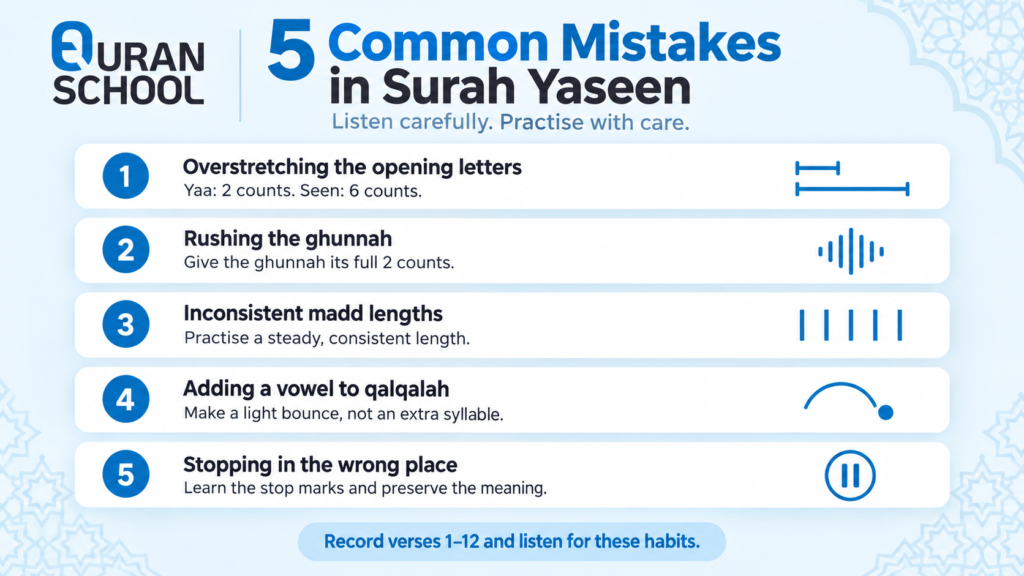
The same five errors come up again and again in this surah. Almost none of them comes from not knowing the rule. They come from habit, from reading in a hurry, or from copying a reciter’s feeling instead of his tajweed.
Each one is small enough to slip past you, and steady enough to follow you for years if nobody points it out. Read the list below, then record yourself reading verses 1 to 12 and see how many of them you can hear in your own voice.
- Stretching يس too far. Six counts means six counts. Many learners hear moving recitations and stretch it much longer. That is still an error.
- Rushing the ghunnah. Ikhfa and idgham need a real two-count hold. This surah is full of ikhfa. So a short ghunnah means dozens of errors in one reading.
- Madd lengths that shift. You cannot hold الْمُرْسَلِينَ for four counts and يُبْصِرُونَ for two in the same sitting. Both lengths are allowed on their own. Mixing them is not. Make the same length for both of them.
- Adding a vowel to qalqalah. لَقَدْ is not read as laqada. The echo is a bounce of the letter. It is not a new syllable.
- Stopping in the wrong place. Your breath decides where you stop. A stop in the middle of a phrase can break the meaning. Learn the stop marks in the mushaf along with the sound rules. They are part of a correct reading.
Experience Our Classes
Don’t just take our word for it—watch real-time recordings of our online classes below to experience our teaching style firsthand.
Start Your Quranic Journey Today
Experience our interactive online classes with a dedicated tutor.
Get Your Free TrialHow Long Does It Take To Learn Surah Yaseen With Tajweed?
There is no set timeline. Anyone who gives you one is guessing. A few things decide it. How well you read Arabic letters now.
Whether you already know the nun sakinah and madd rules. How often you practise. And most of all, whether someone qualified is correcting you.
Here is what can be said fairly. If you already read Arabic and know the basic rules, you will move through this surah faster.
Short daily sessions hold better than long, rare ones. Some learners settle verses 1 to 12 within a few weeks of daily work, and others take longer, which is normal rather than a sign of failure.
Expect the pace to be uneven. The first twelve verses are the slow ones, because you are learning the rules and the surah at the same time. After that, the same rules keep returning, so later verses usually take less time than the ones before them.
The six-step loop gives you a better measure than any timeline. At the end of each session, ask one question. Can I read this verse correctly without thinking about it? If yes, that verse is done. If no, it is tomorrow’s work. Count the verses you have made solid, not the days you have spent.
Read also: Daily Quran Reading Plan and Schedule – Complete Guide
Learn Surah Yaseen The Way It Was Meant To Be Learned
Tajweed was passed from teacher to student, face to face, for a reason. The errors that matter most are the ones you cannot hear in yourself.
A colour-coded mushaf shows you where a rule sits. A recording tells you that something sounds off. But only a trained tutor can tell you that your ض is coming from the wrong part of the tongue. Or that your ghunnah is a count short. Or that you have been reading a heavy letter light for months.
At EQuran School Online, Surah Yaseen is taught the way it was always meant to be taught. You read, your tutor listens, and the correction comes in the moment — not a week later, when the habit has already set.
Our certified tutors work through the text with you verse by verse, fixing the letter, the ghunnah or the madd while the sound is still fresh in your mouth.
Little by little, the rules stop being something you have read about and become part of how you read. And you set the pace, whether that is one verse a session or a full page.
Before you decide, take a moment to see what our students say about learning with us.

You may be starting from the Arabic letters. You may be polishing a reading you already have. The path is the same. It is structured, corrected, and steady.
Our Quran Courses
- Quran Recitation Classes
- Weekend Quran Classes
- Quran Reading Classes
- Online Quran Classes for Kids
- Learn Quran Online with Tajweed for Kids and Adults
- Online Quran Learning with Tajweed Course
- Quran Classes for Adults
- Female Quran Classes
- Female Quran Teacher for Ladies
- Learn Quran for Beginners
- Quran Qirat Learning Course
Book a session and find out where your reading really stands.

Conclusion
Learning to read Surah Yaseen with tajweed is a clear, finite task. It is not a vague hope. You are not trying to become a reciter overnight. You are working through 83 short verses with a fixed set of rules, in an order that makes sense.
Run the six steps, one verse at a time. Listen first. Read from a tajweed mushaf. Hunt one rule per pass. Repeat the verse until it holds. Record yourself and compare. Then get corrected by someone who can hear what you cannot.
Build the four basics as you go: the letters and where they come from, the rules of nun sakinah and tanween, the rules of meem sakinah, and the madd lengths. Every rule in this surah is made of those four things, so time spent there is never wasted.
Ignore the repeat methods that have no basis. They teach you nothing about reading, and they eat the hours you could have spent fixing your letters.
Start with verses 1 to 12. They hold almost the full rule set in a very small space. Once they are solid, the rest of the surah runs on rules you already know, and the work shifts from learning them to holding them steady over longer stretches.
So go slowly. Keep your sessions short and regular. Read out loud, even when nobody is listening. And keep in mind what all of this is for. Not a count, and not a number of days, but reading the words of Allah the way they were meant to be read.
Frequently Asked Questions
What Are The Tajweed Rules In Surah Yaseen?
Surah Yaseen holds the full set of rules used in Hafs an Asim. That means the four rules of nun sakinah and tanween, the three rules of meem sakinah, the madd rules, and qalqalah. The opening يس takes a six-count madd lazim.
Can I Learn Surah Yaseen With Tajweed On My Own?
You can get far alone. Listening, a colour-coded mushaf, and recording yourself all help. But some errors in letters and ghunnah length cannot be caught alone. You cannot hear what nobody taught you to hear. Tajweed is passed on through talaqqi, which means direct correction by a teacher.
Why Does يس Need Six Counts?
The letter name سين is spelled with a madd letter followed by a silent nun. That makes it madd lazim harfi. Madd lazim is always six counts, with no other option. The يا before it is a natural madd of two counts.
Should I Repeat يس Seven Times Or Stop At Every مُبِين?
No authentic report from the Prophet, peace be upon him, backs these habits. Islamweb and other fatwa bodies say fixed counts and set duas inside Surah Yaseen have no basis in the Sunnah. Read the surah well, then make dua freely.
Which Verses Of Surah Yaseen Should I Learn First?
Verses 1 to 12. They hold ikhfa, idgham, iqlab, izhar halqi, both meem rules, qalqalah, and four kinds of madd. That is the full rule set in one short block.
Do I Need A Special Tajweed Mushaf For Surah Yaseen?
You do not have to use one. But it is one of the best learning aids there is. It shows each rule at the exact word where it applies, so you do not have to recall it.
Sources
Related Articles
Learn Quran











Leave a Reply