 Learn Quran

Surah An-Nasr is one of the easiest surahs to learn, with only three verses and 19 words, and most people can memorize it in one sitting. The harder part is saying it the right way.
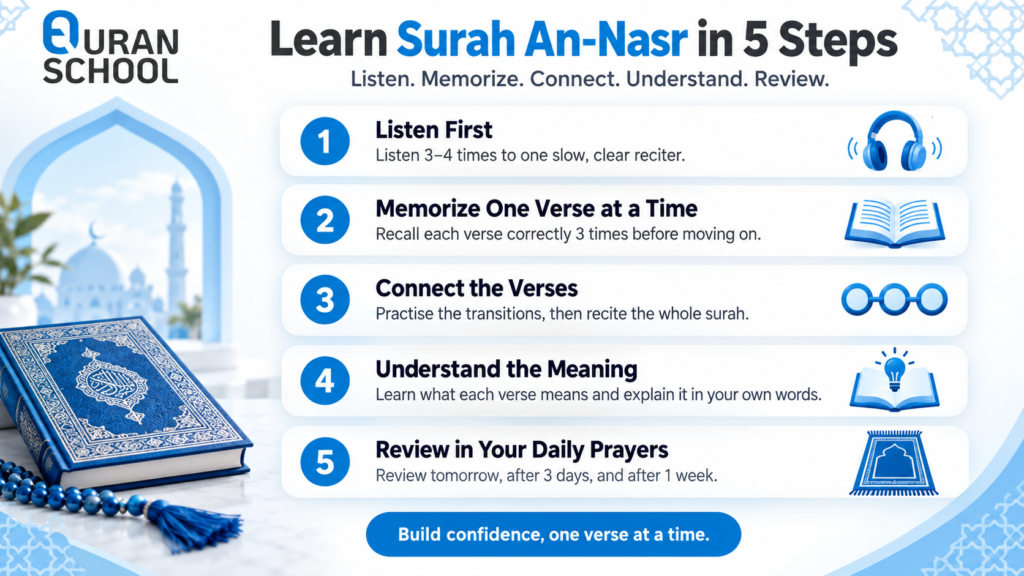
To learn Surah An-Nasr, you listen to it first, memorize one verse at a time, join the verses together, learn what the words mean, and then review it in your daily prayers.
Most adults finish all five steps in about 20 minutes, while children may need two or three short sessions.
Thus, let’s walk together through each step, and also cover the meaning of the surah. We will highlight the tajweed rules in every verse, and the mistakes that make a good recitation sound wrong.
Step 1: Listen To Surah An-Nasr Before You Read It
Play Surah An-Nasr by a good reciter and listen to it three or four times without trying to read along or repeat it yet. Just listen.
This may feel like wasted time, but it is not, because this is how the Qur’an was first taught: the Prophet ﷺ heard it, then repeated it, and his Companions learned it the same way.
Your ear picks up the sound of a verse much faster than your eye picks up the rules behind it. Choose a slow, clear recitation made for learners rather than a fast one, since recordings in the murattal style, like those of Shaykh Mahmoud Khalil Al-Husary, are used in Qur’an schools for this exact reason.
Stay with the same reciter until the surah is solid, because different reciters hold the long sounds for different lengths and stop in different places, and switching between them leaves your memory with a blurred version of the surah.
On the first listen, take in the sound of the whole surah; on the second, follow the Arabic text with your eyes; on the third and fourth, notice where the reciter stops, which sounds he holds longer, and where he hums a letter.
Read also: 10 Prophetic Hadith About Reading Quran
Step 2: Learn One Verse At A Time
Play verse 1, pause the recording, and say it out loud five to seven times, keeping your eyes on the Arabic text even if you cannot read Arabic yet, because your brain is learning the shape of the words while your ear learns the sound.
Say it out loud rather than in your head, since silent reading feels faster but does not build the same memory: memorizing the Qur’an uses your voice, your ears, and your eyes together, and leaving one of them out makes the memory weaker.
Then, close the muṣḥaf and test yourself by saying the verse from memory three times in a row with no mistakes, and if you stumble on the second try, start the count again from zero. Only now move to verse 2 and do the exact same thing, then verse 3.
Here is the rule that matters most: do not add a new verse until the last one is perfect three times in a row, because almost everyone who forgets a short surah skipped this step, got each verse roughly right, and moved on, and roughly right feels fine on the same day but does not survive a week.
An adult usually needs three to five minutes per verse, while a child may need a full short session for one verse, and that is normal.
Step 3: Connect The Three Verses Together So The Surah Flows As One
Verses learned on their own are stored on their own, so you have to link them on purpose. Start by saying verses 1 and 2 together five times without stopping in between, then add verse 3 and say all three together ten times from beginning to end.
Do this from memory with the muṣḥaf closed, because reading the joins off the page does not train the link, it only trains your eyes. After that, practise the two joining points on their own, since these are the exact spots where people freeze.
The first join is the end of verse 1 into the start of verse 2, wal-fatḥ … wa ra’ayta, and the second is the end of verse 2 into the start of verse 3, afwājā … fa-sabbiḥ. Say each pair of words five times as if they were one short phrase, and the gap between the verses will close.
Next, test the links from the inside: start at wa ra’ayta and carry on to the end without help, then start at fa-sabbiḥ and finish the surah. If you can only begin from the first word of the surah, the three verses are still three separate pieces in your memory and are not yet joined.
Keep going until you can enter the surah from any verse and come out the other side. Finish this step by saying the whole surah once while you are doing something else, such as walking or tidying up, because a surah that survives a small distraction is a surah that has truly been linked together.
Step 4: Understand What Surah An-Nasr Is Actually Saying
Read the word-by-word meaning in the table further down this page, then say the surah again while you think about what each line means as you say it.
Meaning is not extra information on top of memorization, it is part of the memorization itself, because words that carry a picture in your mind stay with you far longer than sounds you cannot explain.
The surah has a very simple flow, and once you see it you will find the order of the verses almost impossible to mix up.
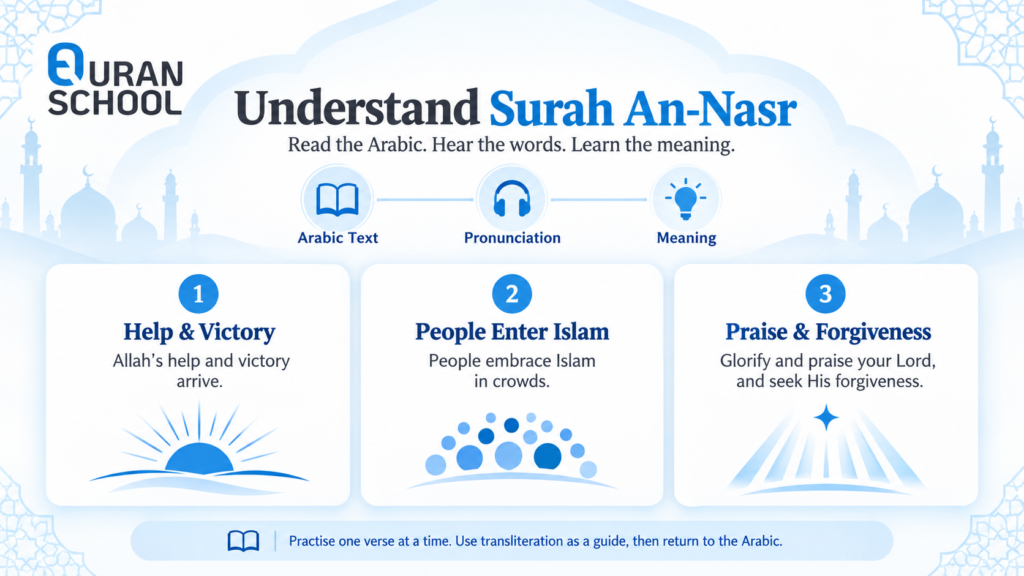
Verse 1 is the event: the help of Allah arrives and Makkah is opened. Verse 2 is the scene that follows: people come into Islam in large groups, one wave after another, not one person at a time. Verse 3 is the response Allah commands: praise your Lord, glorify Him, and ask Him to forgive you. Event, then scene, then response.
Notice that the response is not celebration or pride, and that is the heart of the surah. The greatest victory in the life of the Prophet ﷺ was answered with tasbīḥ and istighfār. When you understand this, the last verse stops being a set of Arabic sounds and becomes something you can feel, and feeling is what memory holds on to.
It also protects you from a common slip, because learners who do not know the meaning often swap the order of the verses or blend similar-sounding words, while learners who know the story never do.
See Us in Action
Watch a quick snippet from our live, interactive classes below and see how our teachers make learning engaging for all ages!
Start Your Quranic Journey Today
Experience our interactive online classes with a dedicated tutor.
Get Your Free TrialStep 5: Lock The Surah In By Reading It In Your Daily Prayers
Memorizing a surah and keeping a surah are two different jobs. This last step decides whether Surah An-Nasr is still with you next year.
Start with spaced review. Say the surah from memory the next morning. Say it again three days later. Then again after a week, and once more after a month. Each round takes less than a minute. Each one tells your brain that this is worth keeping.
Then move the surah into your salah. This is where the real work happens. Read Surah An-Nasr after al-Fātiḥah in the second rak’ah of your sunnah prayers. Do this every day for a full week.
Praying with a surah is the strongest review there is. You recite from memory with no text in front of you. You go at a steady pace. And you are standing before Allah, which sharpens your focus like nothing else. It also costs you no extra time, because you were going to pray anyway.
If your mind goes blank in the middle, stay calm. Move on to another short surah you know well. After the prayer, go back and repeat the weak verse ten times.
After that first week, keep the surah in rotation. Read it in your prayers once or twice a week with the other short surahs you know. Then say it once from memory at the start of every month. A surah you keep reading in salah is a surah you will not lose.
A teacher makes all of this much faster. AtEQuran School, you read one-to-one to a qualified Qur’an and Tajweed teacher. They hear your mistakes and fix them before they turn into habits. Take a look at our Learn Quran Easily at Home course. You can start with a free evaluation session to meet your tutor first.

What Is Surah An-Nasr?
Surah An-Nasr is the 110th surah of the Qur’an. It has three verses and 19 words. It is in Juz’ 30 and was revealed in Madinah. Its name means “The Help” or “The Victory.” The name comes from the first words, idhā jā’a naṣru-llāh.
It has a second name too: Surat at-Tawdi’, which means the Surah of Farewell. The Companions understood from it that the Prophet’s ﷺ work was done and his time was near.
Ibn ‘Abbas said that Surah An-Nasr was the last full surah to be revealed (Sahih Muslim). In the muṣḥaf it sits between Surah Al-Kāfirūn and Surah Al-Masad, near the very end.
Because it is short and easy to say, it is one of the first surahs most children learn after al-Fātiḥah.
The victory it speaks about is understood by most scholars to be the opening of Makkah, which took place in the eighth year after the Hijrah. The Prophet ﷺ passed away not long after this surah came down.
Read also: Learning Surah Al-Zalzalah Made Simple: Recitation and Memorization Guide
Surah An-Nasr: The Arabic Text, How To Say It, And What It Means
The table below gives you the full surah in three columns: the Arabic text, how it sounds in English letters, and what it means.
Read across one row at a time so you see the words, hear them, and understand them together. Start with verse 1 and do not move down the table until that row feels clear.
بِسْمِ اللَّهِ الرَّحْمَٰنِ الرَّحِيمِ
| # | Arabic | How it sounds | What it means |
| 1 | إِذَا جَاءَ نَصْرُ اللَّهِ وَالْفَتْحُ | Idhā jā’a naṣru-llāhi wal-fatḥ | When the help of Allah has come, and the victory, |
| 2 | وَرَأَيْتَ النَّاسَ يَدْخُلُونَ فِي دِينِ اللَّهِ أَفْوَاجًا | Wa ra’ayta-n-nāsa yadkhulūna fī dīni-llāhi afwājā | and you see the people entering the religion of Allah in crowds, |
| 3 | فَسَبِّحْ بِحَمْدِ رَبِّكَ وَاسْتَغْفِرْهُ ۚ إِنَّهُ كَانَ تَوَّابًا | Fa-sabbiḥ bi-ḥamdi rabbika wastaghfirh, innahu kāna tawwābā | then praise your Lord and ask Him to forgive you. He is always ready to accept repentance. |
Learn from a muṣḥaf with full vowel marks. English spelling of the sounds is only a helper. It cannot show you a heavy letter or a long sound. Learners who use it alone often have to fix their pronunciation later.
Look at the Arabic column each time you practise, even if you cannot read it yet. Your eyes will slowly start to match the shapes to the sounds you already know.
Notice the small mark ۚ in verse 3, which is a stopping sign, not a letter, and it tells you that you may pause there. Each verse also ends at a natural stop, so you can take a breath after every one.
Try to leave the transliteration behind within your first week, and learning the Arabic letters through a Noorani Qaida course is the fastest way to do that for good.
Read also: How to Learn Surah Lahab: Step-by-Step Guide
What Does Surah An-Nasr Mean, Word By Word?
Below is the surah broken into small word groups with the meaning of each one. This is the fastest way to understand the surah if you do not speak Arabic, because you learn it in small pieces instead of one long translation.
Cover the right column with your hand, say the Arabic, and check whether you remember the meaning.
| Arabic | Meaning |
| إِذَا | when |
| جَاءَ | has come |
| نَصْرُ اللَّهِ | the help of Allah |
| وَالْفَتْحُ | and the victory (most scholars say this means the opening of Makkah) |
| وَرَأَيْتَ | and you see |
| النَّاسَ | the people |
| يَدْخُلُونَ فِي دِينِ اللَّهِ | entering the religion of Allah |
| أَفْوَاجًا | in crowds, group after group |
| فَسَبِّحْ | so glorify (say Subḥān Allah) |
| بِحَمْدِ رَبِّكَ | with praise of your Lord |
| وَاسْتَغْفِرْهُ | and ask Him to forgive you |
| إِنَّهُ كَانَ تَوَّابًا | He is always ready to accept repentance |
Learn these twelve word groups, and you understand the whole surah. Most of them are
short and easy, and some will already be familiar from other surahs you know. The one word with no simple English match is afwājā, which means people arriving in waves, one group after another.
Notice also that the name of Allah appears twice, in naṣru-llāh and in dīni-llāh, yet these two are not pronounced the same way. That difference is the first rule we will look at in the next part.
Tajweed Rules In Surah An-Nasr, Verse By Verse
Tajweed is the set of rules that tells you how each letter of the Qur’an should be pronounced. Surah An-Nasr is short, but it holds a good number of these rules, which makes it an excellent surah to practise on.
The tables below go verse by verse and show you three things: the word, the rule inside it, and what to actually do with your mouth. When a rule says “two counts,” that means the time it takes to say “one, two” at a calm, steady speed.
Verse 1: إِذَا جَاءَ نَصْرُ اللَّهِ وَالْفَتْحُ
Idhā jā’a naṣru-llāhi wal-fatḥ
| Word | Rule | How to read it |
| إِذَا | Madd tabī’ī (natural long sound) | Hold the long sound for two counts. |
| جَاءَ | Madd muttaṣil (joined long sound) | Hold it longer, four or five counts. Beginners nearly always cut this one short. |
| نَصْرُ اللَّهِ | Heavy lām | The letter before it carries a ḍammah, so the lām in Allah is full and heavy. |
| وَالْفَتْحُ | Clear lām (lām qamariyyah) | Say wal-fatḥ, not waf-fatḥ. |
Verse 2: وَرَأَيْتَ النَّاسَ يَدْخُلُونَ فِي دِينِ اللَّهِ أَفْوَاجًا
Wa ra’ayta-n-nāsa yadkhulūna fī dīni-llāhi afwājā
| Word | Rule | How to read it |
| وَرَأَيْتَ | Pronounce the hamzah | Say wa-ra-‘ay-ta, not warayta. |
| النَّاسَ | Idghām with ghunnah | The lām drops into the nūn. Hum the nūn for two counts: an-nās. |
| يَدْخُلُونَ | Light qalqalah on the dāl | Give the dāl a small bounce: yad-khulūn. |
| دِينِ اللَّهِ | Light lām | The letter before it carries a kasrah, so the lām in Allah is light. This is the opposite of verse 1. |
| النَّاسَ, يَدْخُلُونَ, فِي, دِينِ | Madd tabī’ī | Two counts each. |
| أَفْوَاجًا | Long sound at a stop | If you stop here, say afwājā and hold it for two counts. If you carry on, the ending blends softly into the fā’ that follows. |
Verse 3: فَسَبِّحْ بِحَمْدِ رَبِّكَ وَاسْتَغْفِرْهُ ۚ إِنَّهُ كَانَ تَوَّابًا
Fa-sabbiḥ bi-ḥamdi rabbika wastaghfirh, innahu kāna tawwābā
| Word | Rule | How to read it |
| بِحَمْدِ | Clear mīm | Close your lips and say it plainly. Do not hum it. |
| وَاسْتَغْفِرْهُ | Light ra | Say wastagh-fir-hu with a thin ra, never a heavy one. This is the most common error in the surah. |
| وَاسْتَغْفِرْهُ (the hā’) | No extra length | The letter before it is silent, so keep the hā’ short. Do not stretch it. |
| ۚ | Stop mark | This mark tells you that you are allowed to stop here. |
| إِنَّهُ | Ghunnah on the doubled nūn | Hum for two counts. Then hold the hu for two counts if you carry on to the next word. |
| كَانَ | Madd tabī’ī | Two counts. |
| تَوَّابًا | Long sound at a stop | Say tawwābā and hold it for two counts. |
You may also like: What The Hadith About Reading Quran With Tajweed Reveals?
Five Mistakes Learners Make In Surah An-Nasr
Surah An-Nasr is short, so most people assume there is not much to get wrong. In practice, the same five errors show up again and again, and four of them are about pronunciation rather than memory.
None of them will stop your prayer from being valid, but each one changes how the words sound. The hard part is that you cannot hear these mistakes in your own voice, so read through the list below and check yourself against it honestly.
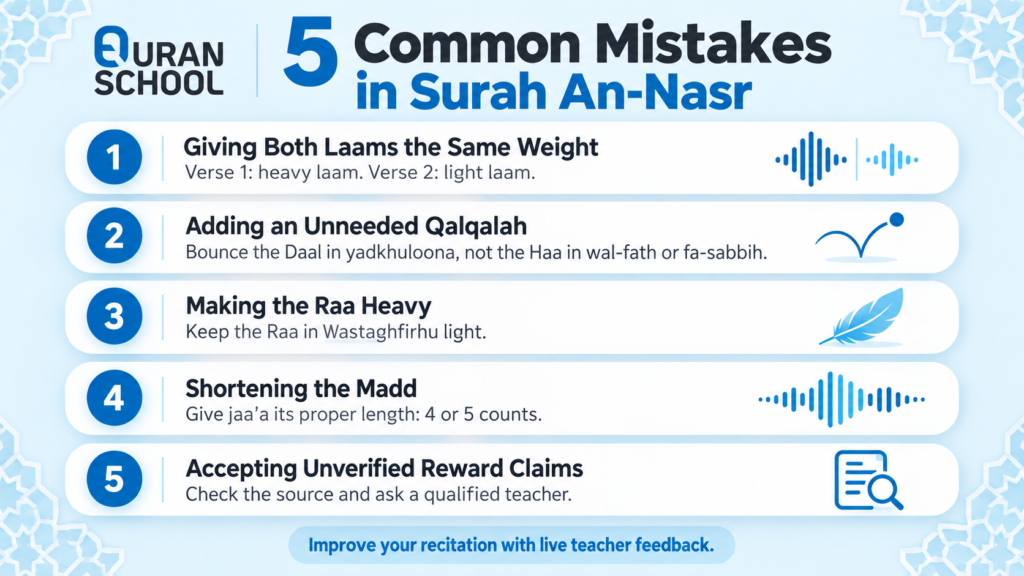
- Saying both Allah words the same way. This is the hardest part of this surah. In verse 1, naṣru-llāh has a heavy lām. In verse 2, dīni-llāh has a light lām. Same word, same surah, opposite rule. If you use one weight for both, one of them is wrong.
- Adding a bounce that is not there. Some sources say there is a qalqalah in الْفَتْحُ and in فَسَبِّحْ. That is not correct. Both words end in ḥā’, and ḥā’ is not a qalqalah letter. The only qalqalah in this surah is the dāl in يَدْخُلُونَ.
- Making the ra in وَاسْتَغْفِرْهُ heavy. English speakers roll it by habit. Here it must be thin and light.
- Cutting the long sound in جَاءَ short. Four or five counts feels too long at first. Count it out loud until it feels normal.
- Believing rewards that are not proven. Some posts online say you get a set reward if you read this surah a certain number of times on a certain day.
These claims are not found in the authentic books. What is authentic is this: ‘A’ishah said that after this surah came down, the Prophet ﷺ often said in his bowing and prostration, “Subḥānaka-llāhumma Rabbanā wa bi-ḥamdika, Allāhumma-ghfir lī” (Sahih al-Bukhari and Sahih Muslim). Ask a qualified teacher before you act on any claim you read online.
Want to know which of these you are doing? Our Learn Quran Online with Tajweed for Kids and Adults course is built for exactly this.
You read out loud to a qualified teacher; they stop you at the moment an error happens, and they show you how to fix it. Book a free evaluation session and find out where your recitation stands.

How To Teach Surah An-Nasr To Children
Surah An-Nasr works well for children. It is short, the story is clear, and the lesson is easy to use.
- Start with a question (2 minutes). Ask, “What do you do when you win something?” Let them answer. Then say that Allah gave the Prophet ﷺ the biggest win of all, and told him what to do about it.
- Read and repeat (6 minutes). Read one verse clearly. Have the child say it back five times. Do not fix every letter yet. Get the whole verse first.
- Explain in easy words (4 minutes). Verse 1: Allah’s help came and Makkah was opened. Verse 2: people joined Islam in big groups. Verse 3: so praise Allah and ask Him to forgive you.
- Check and apply (3 minutes). Ask the child to say the surah from memory. Then ask, “So what do you say when something good happens?” The answer is Subḥān Allah, alḥamdulillāh, astaghfirullāh. Now the surah is a habit, not just words.
Short daily sessions work best for children. Ten minutes a day for three days beats thirty minutes once.

Read also: How To Learn The Quran For Kids
How Long Does It Take To Learn Surah An-Nasr?
Most adults memorize the words of Surah An-Nasr in 15 to 20 minutes. Most children need two or three short sessions.
But memorizing the words and keeping them are two different timelines. Day one gives you the words. The first week is what makes them stay. A good plan is about ten minutes a day for seven days, rather than one long sitting. For children, ten minutes a day for three days works better than half an hour at once.
Your own speed depends on a few simple things. If you already read Arabic letters, you will move faster than someone reading from English spelling. If you are starting from transliteration, add a few extra days and expect to fix some pronunciation later.
Correct recitation takes longer than memorizing. The long sounds, the two lām rules, and the light ra are hard to check on your own.
A few sessions with a teacher usually sort them out. Nobody can promise you an exact number of days, because it depends on your age, your Arabic, your practice, and how often you read the surah in your prayers.
Read also: How to Learn Surah Al-Lail So You Never Forget It
How To Know If You Really Memorized Surah An-Nasr
Feeling like you know a surah and actually knowing it are not the same thing. Right after a practice session, the words are still fresh in your short-term memory. That makes everything feel easy, and many people stop there.
The real test is whether the surah is still there when the page is closed and your mind is somewhere else. Run these four checks before you call Surah An-Nasr finished.
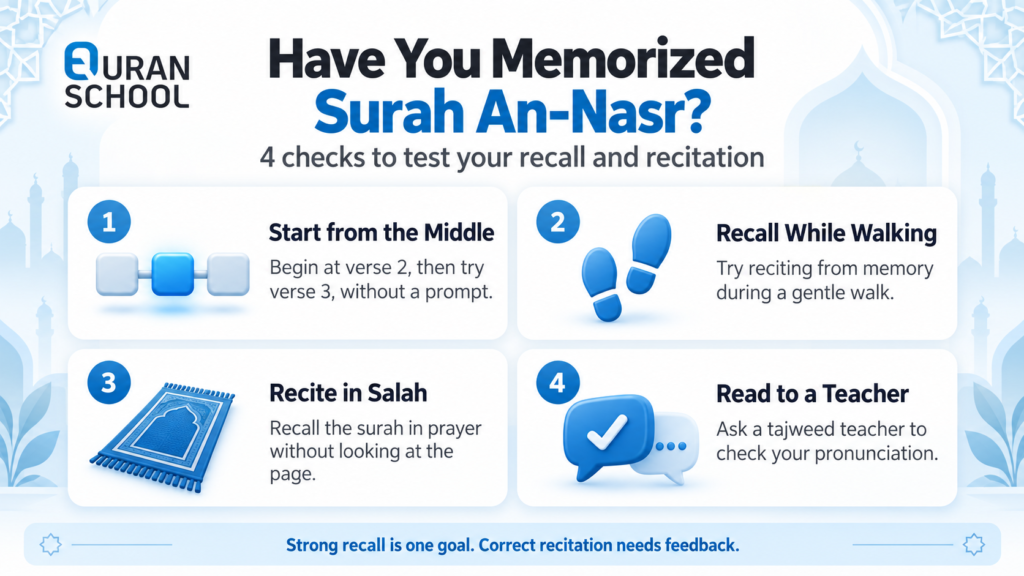
- Start from the middle. Begin at wa ra’ayta and finish the surah with no help. Then try starting at fa-sabbiḥ. If you can only begin from the first word, the verses are still stored as separate pieces.
- Say it while busy. Try it while walking, cooking, or driving. Memory that only works in a quiet room is not ready yet. A distraction pulls away part of your attention, so whatever survives is the part that is truly stored.
- Read it in salah. If it holds up in prayer, it is solid. In salah there is no page to look at and no one to prompt you. That is why one week of praying with the surah is worth more than another hour of drilling.
- Read it to a teacher. You can catch a missing word on your own. You cannot catch a heavy lām on your own. Your ear has already accepted your own pronunciation as correct, so it will not flag the error. Only someone trained in tajweed can hear what you cannot.
If you pass the first three but not the fourth, you have memorized it. You have not yet confirmed that you say it correctly. Those are two different things, and only one of them can be checked alone.
Experience Our Classes
Don’t just take our word for it—watch real-time recordings of our online classes below to experience our teaching style firsthand.
Start Your Quranic Journey Today
Experience our interactive online classes with a dedicated tutor.
Get Your Free TrialLearn Surah An-Nasr The Right Way With A Teacher
You can memorize three verses on your own today. Saying them correctly is what a teacher is for. The errors that matter here are the ones you cannot hear in your own voice.
EQuran School is an online Quran academy offering one-to-one lessons for adults and children, anywhere in the world. Your teacher listens to you read, corrects your pronunciation on the spot, and builds a review plan that carries you from single surahs to full Hifz.
What you get with EQuran School:
- One-to-one classes, never a group. The full session is yours, so every mistake gets caught and fixed.
- A time that fits your week. Lessons run on Zoom or Skype, including weekend classes if weekdays are hard.
- Female teachers for ladies. Sisters can learn with a qualified female teacher in a comfortable setting.
- Classes built for kids. Short, patient sessions designed for how children actually learn.
- A clear path, not one-off lessons. Start with Noorani Qaida or Quran for beginners, move on to Tajweed and recitation, then go as far as Hifz, Tafsir, or an Ijazah.
- Try before you pay. Your first evaluation session is completely free, so you can meet your tutor and see the teaching style first.
Our Quran Courses
- Quran Tafsir Course
- Zoom Quran Classes
- Skype Quran Classes
- Learn Quran Easily at Home
- Al-Azhar Quran Course
- Sunni Online Quran Classes
- Intensive Quran Course
- Online Quran Classes Based in Saudi Arabia
- Quran Teachers
- Noorani Qaida Course
- Noorani Qaida Course for Kids
- Quran Memorization (Hifz) Course
- Hifz Classes for Adults
- Quran Ijazah Program
- Online Arabic and Quran Classes
Book your free evaluation session with EQuran School →

Conclusion
Learning Surah An-Nasr has two parts. First you memorize three short verses. Then you learn to say them correctly.
The method is simple and it works in order. Listen first. Learn one verse at a time. Join the verses so they flow as one. Learn what the words mean. Review the surah in your prayers. Then read it out loud to someone who can correct you.
Do not rush the early steps. A verse that is solid today saves you from relearning it next month, and the few extra minutes you spend on verse 1 are the reason verse 3 will hold.
Give the same care to the tajweed, especially the two different ways the name of Allah is read in this surah, the light ra in wastaghfirh, and the long sound in jā’a. These are small details, but they are what separates a recitation that is roughly right from one that is truly correct.
Keep the meaning close as well. Once you can picture the victory arriving, the people entering Islam in waves, and the command to praise Allah and seek His forgiveness, the surah stops being three lines of Arabic and becomes something you carry with you.
Frequently Asked Questions
How Long Does It Take To Memorize Surah An-Nasr?
Most adults memorize the three verses in 15 to 20 minutes. Most children need two or three short sessions. Learning the tajweed takes longer and is easier with a teacher.
Is Surah An-Nasr Makki Or Madani?
Surah An-Nasr is a Madani surah. It was revealed in Madinah, near the end of the Prophet’s ﷺ life. Ibn ‘Abbas said it was the last full surah to be revealed (Sahih Muslim).
Why Is Surah An-Nasr Called Surat At-Tawdi’?
Surah An-Nasr is called Surat at-Tawdi’, the Surah of Farewell, because it hinted that the Prophet’s ﷺ mission was complete. ‘Umar ibn al-Khattab and Ibn ‘Abbas spoke about this meaning, as recorded in Sahih al-Bukhari.
What are the main tajweed rules in Surah An-Nasr?
The main rules are the long madd in jā’a (4–5 counts), a heavy lām in naṣru-llāh and a light lām in dīni-llāh, a doubled nūn with ghunnah held two counts in an-nās, a light bounce on the dāl in yadkhulūn, a clear mīm in bi-ḥamdi, a light ra in wastaghfirh, and a two-count hold on afwājā and tawwābā at a stop.
Can I Learn Surah An-Nasr Without Knowing Arabic?
Yes. Many people with no Arabic learn Surah An-Nasr by listening and repeating. Use English spelling of the sounds only as a short-term helper. It cannot show letter weight or sound length, so check your reading with a teacher.
What Does “Afwājā” Mean In Surah An-Nasr?
Afwājā means “in crowds” or “group after group.” It describes people joining Islam in large waves, not one by one.
What Is The Main Lesson Of Surah An-Nasr?
The main lesson is that victory comes from Allah alone. When success comes, the right response is humility, not pride. Praise Allah, thank Him, and ask Him to forgive you.











Leave a Reply