 Learn Quran

Learning how to learn Surah Lahab is one of the most encouraging starting points for anyone building a habit of Quran memorization, because the surah is short, clearly structured, and rich in meaning despite having only five ayahs.
Surah Lahab is the 111th surah of the Quran and consists of five short ayahs. It is also known as Surah Al-Masad, and it addresses Abu Lahab, an uncle of the Prophet Muhammad ﷺ who openly opposed his message, along with his wife.
The surah teaches that wealth, social status, and family connections cannot protect a person who deliberately rejects guidance. This message makes it a meaningful short surah to memorize, not only because of its length but because of the lesson it carries.
This guide walks you through a complete, practical method for memorizing Surah Lahab, also known as Surah Al-Masad, whether you are a complete beginner, a parent teaching a child, or an adult strengthening your Hifz journey.

1. Listen to Surah Lahab Several Times First
Before attempting to memorize anything, begin by listening carefully to a clear, accurate recitation of the complete Surah Lahab several times while following the Arabic text in the Mushaf. At this stage, do not pressure yourself to remember every word.
المصحف المعلم محمود خليل الحصري سورة المسد
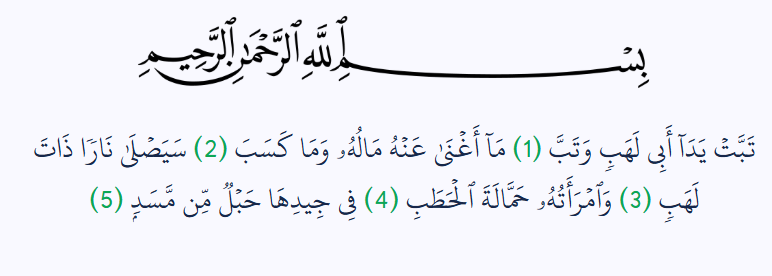
Your goal is simply to become familiar with the Surah’s overall sound, rhythm, pronunciation, and verse sequence. Using the same reliable reciter during your early practice can also give your ear a consistent model to imitate when you begin reciting independently.
As you listen, pay close attention to where each ayah begins and ends, how individual Arabic letters are pronounced, where sounds are lengthened, and how the reciter pauses or connects words.
If a particular word sounds difficult, replay it several times while looking directly at its Arabic spelling. Try to recognize the difference between what you think the word should sound like and how it is actually recited.
Once the complete Surah begins to sound familiar, try listening and quietly repeating short phrases after the reciter. You do not need to memorize them yet; simply imitate the pronunciation as closely as possible.
2. Read Surah Lahab Slowly From the Mushaf
Once the recitation begins to feel familiar, open the Mushaf and read the Surah slowly while looking directly at the Arabic text. At this stage, speed is not the goal; accuracy is far more important.
Move through each word carefully and give yourself enough time to recognize the letters, vowel marks, and word endings instead of trying to imitate the pace of an experienced reciter.
Pay particular attention to the Harakat, Shaddah, and Sukoon, since these small marks directly affect how a word is pronounced. Notice where a consonant is doubled because of a Shaddah, where a letter carries no vowel because of a Sukoon, and whether the correct short vowel is a Fatha, Kasra, or Damma.
Reading these details accurately from the beginning helps prevent small mistakes from becoming part of what you eventually memorize.
If you hesitate over a particular word, isolate it instead of repeatedly struggling through the complete ayah. Listen to that word again, read it slowly from the Mushaf, and repeat it several times on its own.
Then place it back into the surrounding phrase and finally recite the complete ayah. This targeted practice allows you to spend more time on the exact areas that need improvement.
Whenever possible, rely primarily on the Arabic text rather than transliteration. Transliteration can provide temporary support for complete beginners, but it cannot represent every Arabic sound or Tajweed detail precisely.

3. Memorize Surah Lahab One Ayah at a Time
Begin with the first ayah and repeat it slowly while looking directly at the Mushaf. Read it several times aloud, paying attention not only to the words but also to correct pronunciation, Harakat, Tajweed, and the natural flow of the verse.
If the ayah contains a difficult word or phrase, break it into smaller sections and practice those parts separately before joining them together again.
After several careful repetitions, look away from the Mushaf and try to recite the complete ayah from memory. This active recall is important because recognizing a verse while looking at the page is different from being able to retrieve it independently.
Begin memorizing the Quran today and your first session is free

If you forget a word, change the word order, or hesitate for too long, check the exact section in the Mushaf immediately, correct yourself, and repeat it several times before testing your memory again.
Do not rush to the next verse simply because you have managed to recite the current ayah correctly once. Aim to recite it accurately several times in a row without looking, maintaining the same pronunciation and word order each time.
Consistent recall is a much stronger indication that the verse is becoming secure in your memory.
Once the first ayah feels stable, move to the next one and follow the same process. Then begin connecting the new ayah with the verse you already know.
Read Also: dua before starting Quran
See Us in Action
Watch a quick snippet from our live, interactive classes below and see how our teachers make learning engaging for all ages!
Start Your Quranic Journey Today
Experience our interactive online classes with a dedicated tutor.
Get Your Free Trial4. Use the Look, Read, Cover, and Recite Method
This simple four-part cycle — look, read, cover, and recite — gives your memorization practice a clear structure and prevents you from depending too heavily on the Mushaf. Begin by looking carefully at the ayah and reading it aloud several times.
Pay attention to the exact wording, pronunciation, Harakat, and verse ending rather than simply trying to repeat it as quickly as possible.
Next, cover the text or close the Mushaf and recite the ayah entirely from memory. When you finish, uncover the page and compare your recitation with the actual Arabic wording. Check carefully for missing or added words, incorrect endings, misplaced vowels, or any section where you hesitated.
If you discover a mistake, correct it immediately rather than continuing with the incorrect version. Repeat the difficult word or phrase a few times, return it to the complete ayah, and then cover the text and test yourself again. Continue this cycle until you can reproduce the verse accurately several times without looking.

This method strengthens active recall, which is one of the central skills involved in memorization. Instead of merely recognizing the ayah when you see or hear it, you are training your mind to retrieve the complete verse independently whenever you need to recite it.
Read also: Understanding and Learning Surah An-Nasr: A Straightforward Guide
5. Understand the Meaning of Each Ayah While You Memorize
Memorization becomes easier when Arabic words are connected to meaning rather than stored only as unfamiliar sounds.
You do not need to complete an advanced Tafsir study before memorizing Surah Lahab, but understanding the basic message of each ayah can give your memory another way to organize the verses.
Instead of relying entirely on sound and repetition, you begin to recognize the sequence of ideas and use the meaning as a cue for what comes next.
Surah Lahab describes Abu Lahab’s hostility toward the Prophet Muhammad ﷺ and makes clear that his wealth and what he acquired would not save him. The Surah continues by describing his punishment and mentions his wife and her role in hostility as well.
Understanding this progression helps the five ayahs feel like one connected message rather than five separate lines to memorize.
The Surah is also connected to a well-known narration about the Prophet ﷺ calling the Quraysh together at Mount Safa to warn them, after which Abu Lahab responded with hostility.
Book a Free Trial in Our Online Quran Recitation Classes of E Quran School

The Narration Behind Surah Lahab
The following hadith is widely reported in the books of Hadith and provides important context for understanding the revelation of Surah Lahab.
It describes how the Prophet Muhammad ﷺ gathered the tribes of Quraysh at Mount Safa and first asked whether they would believe him if he warned them of an approaching enemy.
After they acknowledged his truthfulness, he warned them of the punishment to come and called them to take his message seriously. Abu Lahab responded dismissively and harshly, rejecting the warning rather than accepting it. Surah Lahab was then revealed concerning him.

Understanding this background helps learners see that the Surah addresses a real moment of open opposition to the Prophet ﷺ, making its message and sequence easier to understand while memorizing.
عَنِ ابْنِ عَبَّاسٍ، أَنَّ النَّبِيَّ صلى الله عليه وسلم خَرَجَ إِلَى الْبَطْحَاءِ فَصَعِدَ الْجَبَلَ، فَنَادَى: يَا صَبَاحَاهْ، فَاجْتَمَعَتْ إِلَيْهِ قُرَيْشٌ، فَقَالَ: أَرَأَيْتَكُمْ لَوْ أَخْبَرْتُكُمْ أَنَّ خَيْلًا بِالْوَادِي تُرِيدُ أَنْ تُغِيرَ عَلَيْكُمْ، أَكُنْتُمْ مُصَدِّقِيَّ؟ قَالُوا: نَعَمْ، قَالَ: فَإِنِّي نَذِيرٌ لَكُمْ بَيْنَ يَدَيْ عَذَابٍ شَدِيدٍ، فَقَالَ أَبُو لَهَبٍ: تَبًّا لَكَ سَائِرَ الْيَوْمِ، أَلِهَذَا جَمَعْتَنَا؟ فَنَزَلَتْ: تَبَّتْ يَدَا أَبِي لَهَبٍ وَتَبَّ
“Narrated Ibn Abbas: The Prophet ﷺ went out to the valley and climbed the mountain, calling, ‘O people, gather!’ When Quraysh had gathered around him, he said, ‘If I told you that horsemen were approaching in the valley to raid you, would you believe me?’ They said, ‘Yes.’ He said, ‘Then I am a warner to you before a severe punishment.’ Abu Lahab said, ‘May you perish for the rest of the day! Is this why you gathered us?’ Then it was revealed: Perish the hands of Abu Lahab, and perish he.”
Sahih al-Bukhari, Book of Tafsir
6. Connect Every New Ayah to the Ones Before It
Once Ayah 2 is memorized, avoid practicing it only as an isolated verse. Recite Ayahs 1 and 2 together several times so that the ending of the first ayah begins to trigger the opening of the second automatically.
When you memorize Ayah 3, add it to the sequence and practice Ayahs 1–3 from the beginning. Continue in the same way with Ayahs 4 and 5 until all five verses of Surah Lahab can be recalled as one connected passage.
This cumulative approach means that every time you learn a new ayah, you are also revising everything you memorized before it. By the time you reach the final verse, the earlier ayahs will already have been retrieved and repeated many times, helping them become more stable in your memory.
Pay particular attention to the transition points between verses, because this is often where beginners hesitate even when they can recite each ayah perfectly on its own. If one transition repeatedly causes difficulty, practice those two ayahs together several times instead of restarting the entire Surah.
Read also: 30 day Quran reading schedule

| START YOUR QURANIC JOURNEY TODAYExperience our interactive online classes with a dedicated tutor.Get Your Free Trial |
7. Recite the Entire Surah Without Looking
Once all five ayahs are memorized individually and you have practiced connecting them, close the Mushaf and recite Surah Lahab from beginning to end without any prompts.
Pay attention not only to whether you remember the words, but also to the correct verse order, pronunciation, Tajweed, and transitions between ayahs. Repeat the complete Surah several times rather than treating one successful attempt as proof that your memorization is fully secure.
If you make a mistake, identify exactly where the problem occurred. Check the specific word, phrase, or transition in the Mushaf, repeat that section several times, and then place it back into the complete ayah.
This targeted correction is usually more efficient than restarting the entire Surah every time you forget one word.
A useful test is to step away from your memorization for a while and return later without listening to the recitation or looking at the Mushaf first. Try to begin Surah Lahab immediately and complete all five ayahs independently.
If you can still recall the Surah accurately after a break, your memorization is becoming more stable rather than depending only on recent repetition.
Learning alongside a certified Quran tutor can make this process more efficient and accurate. A teacher can identify mistakes in pronunciation, Makharij, Tajweed, or wording as soon as they occur and help you correct them before they become established through repetition.
Book a free trial class at E Quran School

| START YOUR QURANIC JOURNEY TODAYExperience our interactive online classes with a dedicated tutor.Get Your Free Trial |
How to Memorize Surah Lahab Faster Without Sacrificing Accuracy
Many beginners want to know how to learn Surah Lahab fast, especially because it contains only five short ayahs.
However, speed should never come at the cost of correct recitation. Memorizing an incorrect word, vowel, or pronunciation and repeating it many times can make the mistake much harder to correct later.
A faster approach is not simply to increase the number of repetitions. Instead, make every repetition purposeful by combining careful listening, accurate reading, active recall, and immediate correction. This allows you to strengthen memorization without repeatedly practicing errors.
Short, focused sessions of around ten to twenty minutes can also make the process more manageable. Concentrate fully during each session, take a break when necessary, and return later for another memory test rather than forcing yourself through one long period of repetition.
Read also: Master Tajweed Quran at Home: Step-by-Step

1. Listen Before You Try to Memorize
Always listen to a full, clear recitation of Surah Lahab before attempting to memorize individual ayahs. Follow the Arabic text in the Mushaf while listening so that you can connect the sound of each word with its written form.
المصحف المعلم محمود خليل الحصري سورة المسد
بِسْمِ اللَّهِ الرَّحْمَٰنِ الرَّحِيمِ
تَبَّتْ يَدَا أَبِي لَهَبٍ وَتَبَّ مَا أَغْنَىٰ عَنْهُ مَالُهُ وَمَا كَسَبَ سَيَصْلَىٰ نَارًا ذَاتَ لَهَبٍ وَامْرَأَتُهُ حَمَّالَةَ الْحَطَبِ فِي جِيدِهَا حَبْلٌ مِنْ مَسَدٍ
In the Name of Allah—the Most Compassionate, Most Merciful.
May the hands of Abu Lahab perish, and he himself perish! Neither his wealth nor his worldly gains will benefit him. He will burn in a flaming Fire, and so will his wife, the carrier of thorny kindling. Around her neck will be a rope of palm-fibre.
Pay attention to letter pronunciation, vowel length, Tajweed, verse endings, and natural pauses. If a word sounds unfamiliar, replay it several times and follow it carefully in the Arabic text before attempting to repeat it yourself.
This listening stage gives you an accurate model to imitate and is particularly valuable for non-Arabic speakers. It reduces the risk of guessing how Arabic words should sound or relying too heavily on English transliteration during memorization.
2. Stay With One Reciter During the Learning Stage
Choose one clear and reliable reciter during the early memorization stage and use the same recording consistently. Hearing the same pronunciation, rhythm, and pacing repeatedly helps your ear become familiar with the sound pattern of the Surah.
Switching frequently between different reciters can introduce variations in pace, stopping, and recitation style.
These differences are normal, but they may create unnecessary distraction for a beginner who is still trying to establish a stable memory of the verses.
Once Surah Lahab is firmly memorized and your recitation has been checked, you can comfortably listen to other qualified reciters. During the learning stage, however, consistency keeps your listening model simple and predictable.
Read also: benefits of reading Quran
3. Recite Aloud Rather Than Silently
Whenever possible, recite Surah Lahab aloud during memorization practice rather than repeating everything silently in your mind. Hearing yourself makes it easier to notice when a word is missing, an ending changes, or your pronunciation does not match the recitation you have been following.
Reciting aloud also allows you to work on Hifz and pronunciation simultaneously. Slow down around difficult words and repeat them individually before placing them back into the complete ayah.
You can occasionally record your recitation and compare it with your chosen reciter as an additional self-check. This does not replace teacher feedback, but it may help you recognize obvious differences in pronunciation, pacing, or hesitation that you did not notice while reciting.
4. Test Yourself Without Looking at the Mushaf
Do not assume that an ayah is memorized simply because you can recite it while looking at the page. After several repetitions, close the Mushaf and attempt the entire ayah from memory without listening to the beginning of the verse first.
Once you finish, open the Mushaf and compare your recitation with the actual text. Look for missing words, incorrect endings, changed word order, or places where you hesitated, then correct those specific sections immediately.
5. Ask a Qualified Teacher to Correct Your Recitation
Independent practice can help you make steady progress, but it has an important limitation: you may not recognize pronunciation mistakes that have already become familiar to your own ear. Repeating them more often can then strengthen the incorrect version alongside your memorization.
A qualified Quran teacher can listen for mistakes involving Makharij, letter characteristics, vowel length, Tajweed, and wording. They can demonstrate the correct sound and ask you to repeat it immediately, allowing the problem to be addressed before it becomes a deeply established habit.
Read also : Step-by-Step Instructions for Reading Surah Yaseen with Tajweed
Common Mistakes When Learning Surah Lahab
Most beginner difficulties with learning Surah Lahab are not necessarily caused by a weak memory. They often come from the way the memorization process is approached.
Rushing through the verses, practicing inconsistently, depending too heavily on transliteration, or stopping revision immediately after the first successful recitation can all make a short Surah feel more difficult than it actually is.
Because Surah Lahab contains only five ayahs, beginners may assume that they should be able to memorize it almost immediately. However, short length does not remove the need for accurate pronunciation, Tajweed, strong verse connections, and regular revision. Finishing quickly is less useful if the Surah is forgotten a few days later or has been memorized with repeated pronunciation mistakes.
Recognizing the following common mistakes can help you build a more reliable memorization routine. The goal is not simply to remember all five ayahs once, but to reach a point where you can recite Surah Lahab accurately, connect its verses naturally, and retain it over time.

Memorizing the Whole Surah at Once
Trying to memorize all five ayahs in a single block may produce quick short-term familiarity, especially after listening to the Surah repeatedly. However, being able to repeat the entire Surah immediately after hearing it does not necessarily mean that every verse has been securely memorized.
A better approach is to memorize one ayah at a time. Learn the first verse until you can recall it independently, then move to the second and connect the two. Continue adding each new ayah to the verses you have already memorized until all five become one continuous sequence.
This cumulative approach also strengthens the transitions between ayahs, which are often where beginners hesitate. Instead of knowing five separate verses but struggling to remember which one comes next, you gradually train the ending of each ayah to become a cue for the beginning of the following verse.
Reading Too Quickly
Beginners sometimes try to imitate the speed of an experienced reciter because they associate fast, smooth recitation with fluency.
However, increasing your pace before your pronunciation is stable can cause letters, Harakat, and vowel lengths to become unclear, particularly when you are still learning unfamiliar Arabic sounds.
During memorization, deliberately slow your recitation down. Give yourself enough time to pronounce every letter clearly, recognize Shaddah and Sukoon, observe vowel lengths, and apply the Tajweed rules you currently understand.
If one word repeatedly causes difficulty, isolate it and practice it slowly before returning to the complete ayah.
Depending Completely on Transliteration
Transliteration can provide temporary support for someone who is completely new to Arabic, but it should not become the main text used for Quran memorization. English letters cannot fully represent every Quranic Arabic sound, articulation point, vowel quality, or Tajweed detail with complete accuracy.
If you rely entirely on transliteration, you may begin pronouncing Arabic words according to familiar English sound patterns. Instead, listen carefully to a reliable reciter while following the actual Arabic text in the Mushaf, gradually learning to associate the written Arabic letters with the sounds you hear.
Think of transliteration as a temporary bridge rather than a permanent replacement for Quranic Arabic. As your letter recognition and reading ability improve, reduce your dependence on it and practice reading directly from the Mushaf.
This will support not only Surah Lahab memorization but also your future Quran reading and Hifz.
Book a free trial class at E Quran School

Ignoring Tajweed Errors
It is easy to focus so heavily on remembering the words that pronunciation and Tajweed become secondary concerns. However, repeatedly memorizing a word incorrectly can make the wrong pronunciation feel natural, which may require additional effort to correct later.
Try to combine memorization with accurate recitation from the beginning. Listen closely to each ayah, compare your pronunciation with a reliable reciter, and pay attention to Makharij, vowel length, letter characteristics, and the Tajweed rules that apply to the words you are learning. Difficult sections should be corrected before they are repeated dozens of times.
Whenever possible, recite Surah Lahab to a qualified Quran teacher during or shortly after the memorization process. A teacher can detect subtle mistakes that you may not hear yourself and help you correct them immediately, allowing your memory to become associated with the accurate form of the verse.
Reviewing Only Once
Being able to recite Surah Lahab immediately after memorizing it can feel like the process is finished, but immediate recall is not the same as stable long-term retention. The verses may still be strongly present because you have just repeated them many times during the same session.
Return to the Surah later that day and again the following day without listening to a recording or looking at the Mushaf first. Attempt the complete Surah from memory and identify any words, ayahs, or transitions that have weakened. Correct those specific sections and then test yourself again.
Continue including Surah Lahab in your regular Quran revision even after you begin memorizing something new. Repeated retrieval across several days and weeks helps keep the wording, verse order, pronunciation, and transitions active in your memory.
Experience Our Classes
Don’t just take our word for it-watch real-time recordings of our online classes below to experience our teaching style firsthand.
Start Your Quranic Journey Today
Experience our interactive online classes with a dedicated tutor.
Get Your Free TrialStart Learning Surah Lahab and the Quran With a Qualified Teacher
Reading a guide like this one can take you a long way, but it cannot listen to you recite or catch the exact moment a letter or vowel slips. That gap is where self-study usually falls short, no matter how disciplined the learner is.
Live correction from a certified teacher closes this gap. Instead of wondering whether your Tajweed is correct, you recite directly to someone trained to hear these differences, and they correct you the moment a mistake happens, before it settles into memory.
E Quran School offers one-on-one online classes built around exactly this kind of guided memorization, whether you are a beginner, a parent looking for a class for your child, or an adult returning to Quran memorization after a break.
Our Quran Courses
- Quran Tafsir Course
- Zoom Quran Classes
- Skype Quran Classes
- Learn Quran Easily at Home
- Al-Azhar Quran Course
- Sunni Online Quran Classes
- Intensive Quran Course
- Online Quran Classes Based in Saudi Arabia
- Quran Teachers
- Noorani Qaida Course
- Noorani Qaida Course for Kids
- Quran Memorization (Hifz) Course
- Hifz Classes for Adults
- Quran Ijazah Program
- Online Arabic and Quran Classes
Book a free trial class at E Quran School and experience personalized Quran instruction.

| START YOUR QURANIC JOURNEY TODAYExperience our interactive online classes with a dedicated tutor.Get Your Free Trial |
Conclusion
Learning how to learn Surah Lahab successfully comes down to a few simple habits practiced consistently rather than complicated memorization techniques. Begin by listening carefully to a reliable reciter, read each verse slowly from the Mushaf, and make sure your pronunciation is reasonably accurate before repeating it many times.
Then memorize one ayah at a time, test yourself without looking, and gradually connect each new verse with the ayahs you have already learned.
Understanding the general meaning of Surah Lahab can also make the memorization process more meaningful and organized. Instead of remembering five separate strings of Arabic words, you begin to recognize the progression of the Surah and use each idea as a cue for the verse that follows.
Combine this understanding with active recall, careful Tajweed practice, and regular correction whenever you discover a weak word or transition.
Most importantly, continue revising Surah Lahab after you have memorized all five ayahs. Test yourself later the same day, return to the Surah the following day, and keep it within your regular Quran revision routine. Reciting from memory after a break is a much stronger test of retention than repeating the Surah immediately after an intensive memorization session.
Surah Lahab’s five short ayahs make it a manageable starting point for beginners, but the skills you develop while learning it extend far beyond this single Surah.
The habits of careful listening, accurate reading, gradual memorization, active recall, verse linking, understanding meaning, and consistent revision can become the same method you use when progressing to longer Surahs.
Frequently Asked Questions About Learning Surah Lahab
What is Surah Lahab?
Surah Lahab is the 111th surah of the Quran, also known as Surah Al-Masad, containing five ayahs about Abu Lahab’s opposition to the Prophet Muhammad ﷺ and the consequences he and his wife faced.
How many ayahs does Surah Lahab have?
Surah Lahab has five ayahs, making it one of the shortest surahs in the Quran and a common starting point for new memorizers.
Why was Surah Lahab revealed?
According to the narration discussed earlier in this guide, it was revealed after Abu Lahab publicly dismissed the Prophet’s ﷺ warning at Mount Safa, showing that wealth and status could not protect him from the consequences of rejecting the message.
Is Surah Lahab easy for beginners to memorize?
Yes, its short length and repeated structure make it accessible for beginners, though learners should still focus on correct pronunciation rather than rushing through it.
How long does it take to memorize Surah Lahab?
This varies by learner. Some can memorize it in a single focused day, while others benefit from spreading it across four to seven days, as outlined in the daily plan in this guide.











Leave a Reply