 Learn Quran

Learning a short Surah is one of the most rewarding ways to build a stronger, more personal connection with the Quran, and Surah Al-Falaq is one of the best places to begin.
If you have been searching for how to learn Surah Falaq, this guide gives you a complete, practical method that takes you from your very first listening session to confident, long-term memorization.
Surah Al-Falaq contains only five verses, yet it carries a powerful and protective message. Because it is short, many beginners assume it can be memorized instantly through repetition alone. In reality, learning it correctly means combining careful listening, verse-by-verse memorization, an understanding of the meaning, accurate pronunciation, and a consistent revision routine.
This guide is written for adults learning independently, parents teaching their children, new Muslims, and any student who wants to recite Surah Al-Falaq confidently and correctly.
1. Listen to Surah Al-Falaq Before Memorizing It
Before you begin repeating individual verses, take some time to build familiarity with Surah Al-Falaq through careful and repeated listening.
(الشيخ الحصري – -سورة الفلق (مرتّل
بِسْمِ اللَّهِ الرَّحْمَٰنِ الرَّحِيمِ
قُلْ أَعُوذُ بِرَبِّ الْفَلَقِ
مِن شَرِّ مَا خَلَقَ
وَمِن شَرِّ غَاسِقٍ إِذَا وَقَبَ
وَمِن شَرِّ النَّفَّاثَاتِ فِي الْعُقَدِ
وَمِن شَرِّ حَاسِدٍ إِذَا حَسَدَ
Say, “I seek refuge in the Lord of the daybreak, from the evil of what He has created, and from the evil of the night when it grows dark, and from the evil of those who blow on knots, and from the evil of an envier when they envy.”
Hearing the complete Surah first allows your ears and mind to become accustomed to its pronunciation, rhythm, verse order, pauses, and recurring sounds before you actively try to memorize anything. This preparation can make individual ayahs feel less unfamiliar when you begin working on them.
Listening first also helps you notice difficult words, similar verse endings, and unfamiliar Arabic sounds that may require extra attention later.
By developing a clear mental impression of how the Surah should sound, you create a stronger foundation for accurate memorization and reduce the risk of repeatedly practicing incorrect pronunciation.
Once the Surah becomes familiar to your ear, you can begin memorizing it verse by verse with greater confidence and focus.
- Begin by listening to the complete Surah several times before attempting to memorize any of its verses.Choose one reliable, well-known reciter and use the same recording during the early stages rather than switching between different recitation styles.Pay particular attention to letters, words, or sounds that feel unfamiliar or difficult to pronounce. Replay these sections slowly and compare what you hear with the written Arabic text. Identifying difficult pronunciation early can prevent you from memorizing a verse incorrectly and having to relearn it later.
2. Read the Entire Surah Slowly
After becoming familiar with the sound and rhythm of Surah Al-Falaq through repeated listening, the next step is to connect what you hear with the Arabic text in front of you.
Reading directly from the Mushaf helps you pay closer attention to each letter, vowel mark, word, and verse ending while comparing your pronunciation with the recitation you have already heard several times.
At this stage, your priority should be accuracy rather than speed or memorization. Reading each ayah slowly gives you time to notice difficult sounds, correct pronunciation mistakes, and become more comfortable with the words before trying to memorize them.
Building this accurate reading foundation from the beginning can make the later repetition and memorization stages smoother and reduce the need to correct mistakes after they have already become familiar.
- Once you have listened to Surah Al-Falaq enough times to become familiar with its overall sound, the next step is to read it carefully for yourself.
- Read Surah Al-Falaq slowly from the Mushaf or another reliable Quran text, giving careful attention to the Arabic letters, vowel marks, pronunciation, and basic Tajweed.
- Work with one verse at a time. Read the ayah aloud, pause, and then compare your recitation with the recording you used during the listening stage
- Most importantly, avoid assuming that because Surah Al-Falaq is short, it should also be recited quickly. Short Surahs still require careful pronunciation, proper Tajweed, and controlled pacing.

See Us in Action
Watch a quick snippet from our live, interactive classes below and see how our teachers make learning engaging for all ages!
Start Your Quranic Journey Today
Experience our interactive online classes with a dedicated tutor.
Get Your Free Trial3. Memorize Surah Al-Falaq One Ayah at a Time
Rather than trying to repeat all five verses of Surah Al-Falaq together from the beginning, memorize each ayah individually and then connect it gradually to the verses you have already learned.
This keeps the memorization process manageable and allows you to focus fully on the wording, pronunciation, and sequence of one verse at a time. Do not move forward simply because you have repeated an ayah several times; continue until you can recite it confidently without looking at the Mushaf.
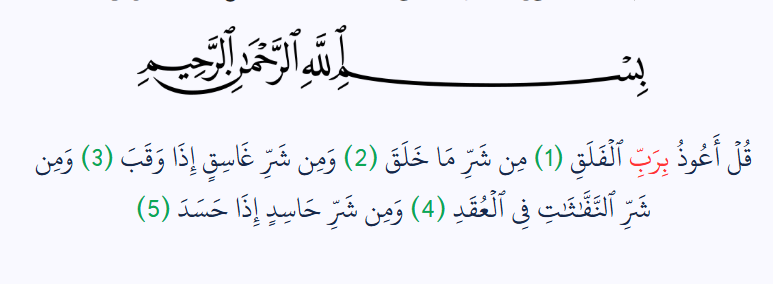
Start with Ayah 1 and repeat it until you can recite it independently. Then learn Ayah 2 in the same way before joining Ayahs 1–2 together. Once that sequence feels secure, memorize Ayah 3 and recite Ayahs 1–3 from the beginning. Continue the same process with Ayah 4, then add Ayah 5 and finally recite the entire Surah from beginning to end without looking.
If you hesitate when connecting two verses, return to the transition between them and repeat it several times rather than restarting the entire Surah after every mistake. Pay particular attention to similar sounds, verse endings, and any words that repeatedly cause hesitation.
This targeted repetition can strengthen the weaker parts of your memorization without wasting time repeatedly practicing sections that are already secure.
This cumulative memorization method is especially useful for a short Surah because every new ayah automatically creates another opportunity to review everything that came before it.
Working with a live tutor through a program such as E Quran School Online allows a teacher to hear your recitation directly and correct it in real time, which is difficult to achieve through recordings alone.

4. Use Deliberate Repetition Instead of Rushing
Once you begin memorizing individual ayahs, repetition becomes the main tool for moving each verse from short-term familiarity into stronger recall. However, effective repetition is more than saying the same words again and again.
Each repetition should help you strengthen the wording, improve pronunciation, notice mistakes, and become less dependent on looking at the Mushaf.
A simple repetition routine also gives your memorization session a clear structure. By moving gradually from careful listening to reading aloud, reciting from memory, and checking for errors, you reinforce the ayah in several different ways.
This can make memorization more focused and help you correct mistakes before they become part of your regular recitation.
- Repetition is one of the simplest and most effective tools for Quran memorization, but it works best when it is focused and deliberate rather than mechanical.
- Begin by listening to the ayah three times, paying close attention to pronunciation, rhythm, and Tajweed. Then read it aloud five times while looking at the Arabic text, making sure that every word is clear and accurate.
- Finally, recite the complete ayah once more from memory without looking. If you can recite it accurately and confidently, you can begin connecting it to the previous ayah or move on to the next part of your memorization.
Read also : How to Learn Surah An-Nasr Quickly and Correctly
5. Understand the Basic Meaning of Each Ayah
Memorizing the words of Surah Al-Falaq becomes easier when you also understand the message that connects its five ayahs.
Instead of treating each verse as an isolated line, learning its general meaning helps you see how the Surah develops from seeking refuge with Allah to asking for protection from several specific forms of harm.
This meaning-based approach gives your memory an additional cue when you forget what comes next. As you recite, you can follow the logical progression of the Surah’s message, allowing the meaning of one ayah to lead naturally into the next.
Understanding the meaning of Surah Al-Falaq can make memorization easier because the five ayahs are no longer experienced as separate lines that must be remembered in order. Instead, they become one connected message centered on seeking Allah’s protection.
When you understand what each verse is saying and how it leads into the next, the meaning itself can become a useful cue for remembering the sequence.
You can also explore the benefits of reading the Quran in Arabic to understand how reading the original Arabic text can strengthen your connection with the Quran and support more accurate recitation.

6. Focus on Correct Arabic Pronunciation
As your memorization of Surah Al-Falaq becomes stronger, it is important to make sure that the verses you remember are also being pronounced correctly.
Memorizing quickly is not helpful if incorrect letter sounds or Tajweed mistakes become part of what you repeatedly practice. This is especially important for non-native Arabic speakers, who may find some Quranic sounds unfamiliar at first.
For this reason, pronunciation practice should develop alongside memorization rather than being left until the end.
Taking extra time to identify difficult words, listen carefully, repeat them slowly, and receive corrections when possible can help you build a more accurate version of the Surah in your memory from the beginning.
- Being able to recall every word of Surah Al-Falaq from memory is important, but memorization and correct pronunciation are not the same skill.
- When you encounter a difficult word, isolate it from the rest of the ayah and practice it slowly on its own. Listen carefully to how a reliable reciter pronounces each letter, repeat the word several times, and then place it back into the complete verse.
- You can also compare your pronunciation directly with a qualified reciter or teacher and pay attention to differences in Makharij, vowel sounds, elongation, and other Tajweed details.

7. Learn the Basic Tajweed Rules in Surah Al-Falaq
After you can remember the verses of Surah Al-Falaq with fewer pauses and mistakes, the next step is to refine the way you recite them through Tajweed. Memorization gives you the words, while Tajweed helps you pronounce those words more accurately and give each letter its proper sound and characteristics.
You do not need to study every Tajweed rule at once. Instead, focus on the rules that appear directly in Surah Al-Falaq and practice them as part of your regular repetition.
This allows memorization and correct recitation to develop together, helping you build a version of the Surah in your memory that is not only easy to recall but also clearer and more accurate when recited aloud.
- Once the verses of Surah Al-Falaq begin to feel comfortable in your memory, shift more of your attention toward Tajweed and accurate recitation.
- Listen carefully for where sounds are lengthened, where letters need clear articulation, and where the recitation naturally connects or pauses. This makes Tajweed easier to recognize in real Quranic recitation and gives each rule an immediate practical purpose.
For learners who need direct feedback, guided lessons can make this process more accurate and structured.
The Quran course with Tajweed is designed around this kind of applied practice, helping students identify recitation mistakes, understand the relevant Tajweed rules, and practice them directly while reading the Quran.

| GET PERSONAL TAJWEED CORRECTIONWork one-on-one with a qualified tutor to perfect your Surah Al-Falaq recitation.Explore the Tajweed Course |
8. Connect the Five Ayahs Into One Smooth Recitation
Once you can recite each ayah of Surah Al-Falaq from memory, the next goal is to connect the verses smoothly without hesitation. Knowing every ayah individually does not always mean that you can immediately recall which verse comes next, especially if most of your practice has focused on memorizing one verse at a time.
This is why the transitions between ayahs need their own practice. Strengthening these connections helps your mind recognize the end of one verse as a cue for the beginning of the next.
With focused repetition, the Surah gradually begins to feel like one continuous, connected passage rather than five separately memorized verses.
- Many students reach a stage where they can recite every ayah of Surah Al-Falaq correctly on its own, yet still hesitate when trying to recite the entire Surah from beginning to end.
- Begin by practicing verse pairs rather than always restarting from the beginning: recite Ayahs 1–2 together several times, then 2–3, 3–4, and finally 4–5.
- Pay particular attention to the first word of each new ayah, because it can act as a memory trigger for what comes next.
- Throughout this practice, maintain a calm and steady recitation pace. Do not rush simply because the individual words are already memorized.
Read also: How to Learn Surah Ikhlas: Memorization & Meaning
9. Recite Surah Al-Falaq in Salah
Once you can recite Surah Al-Falaq from memory during regular practice, the next step is to use it naturally in your Salah.
Reciting a newly memorized Surah in prayer is different from repeating it while studying because you no longer have the Mushaf, a recording, or repeated prompts to help you remember what comes next.
This makes Salah a valuable way to test and strengthen your memorization in a real recitation setting. It can quickly reveal which verses are secure and where you still hesitate, forget a word, or struggle with a transition.
By noticing these weaker points and reviewing them afterward, you can gradually make your recall of Surah Al-Falaq more stable, smooth, and confident.
- Using a newly memorized Surah in Salah is one of the most practical ways to strengthen it because you have to retrieve the verses from memory without looking at the Mushaf or following a recording.
- Once your recitation feels reasonably confident, begin including Surah Al-Falaq after Surah Al-Fatihah in your Salah.
- Pay attention to any place where you hesitate, forget the opening of the next ayah, or feel uncertain about a word.
- Treat this stage as a test of genuine recall rather than simple repetition. When you can consistently recite Surah Al-Falaq in Salah without prompts, confusion, or repeated hesitation, it is a strong sign that the Surah is becoming more firmly established in your memory.
Read also : How to Perfect Your Recitation of Surah Yaseen with Tajweed
10. Follow a Structured Revision Schedule
Successfully reciting Surah Al-Falaq from memory for the first time is an important milestone, but strong memorization depends on what you do afterward.
Newly memorized verses can begin to fade when they are not revisited regularly, even if they felt completely secure on the day you learned them.
For this reason, revision should be treated as part of the memorization process rather than an optional final step. Reviewing the Surah the next day, using it in Salah, and testing yourself again after several days helps strengthen long-term recall.
A simple revision routine can also reveal weak verses or transitions early, giving you the opportunity to correct them before they become harder to remember.
- Memorization is not complete on the first day you manage to recite Surah Al-Falaq without looking at the Mushaf. New memorization needs regular revision before it becomes stable enough to recall easily over time.
- Begin by reciting the complete Surah five times from memory the day after learning it. Try not to look at the Mushaf immediately when you hesitate.
- During the same week, recite Surah Al-Falaq regularly in Salah so that you continue retrieving it naturally without prompts.
- After this first week, do not simply move on and forget about the Surah. Keep Surah Al-Falaq within your ongoing weekly Quran revision cycle, even after you begin memorizing new Surahs.

A 5-Day Plan for Learning Surah Al-Falaq
If you would like a simple and manageable schedule for how to learn Surah Al-Falaq, spreading the memorization across five days can work well for many learners. Since the Surah contains only five ayahs, there is no need to rush through all of them in a single sitting.
Dividing the process gives you more time to focus on accurate pronunciation, strong recall, smooth verse transitions, and regular revision.
The purpose of this five-day plan is not simply to reach the final ayah as quickly as possible. Each day combines new memorization with review of what you learned previously, so the earlier verses continue becoming stronger as you progress.
If any ayah still feels weak at the end of a session, spend additional time on it rather than forcing yourself to follow the schedule exactly.
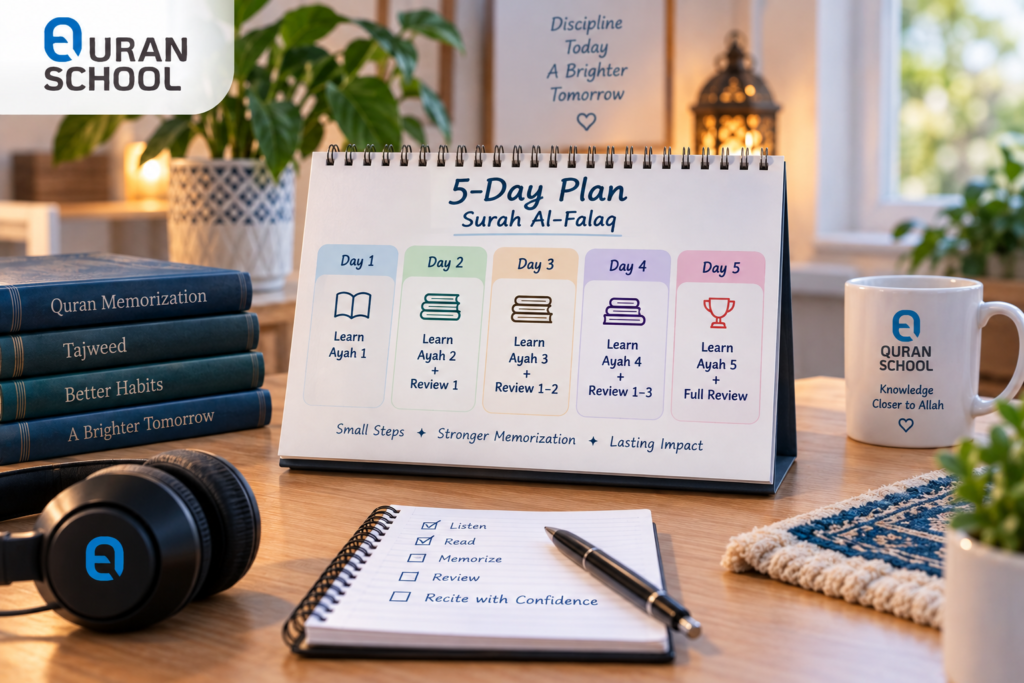
Day 1: Listen and Learn Ayah 1
Use the first day to become familiar with Surah Al-Falaq as a complete Surah before concentrating on memorization. Listen to a clear, reliable reciter several times while following the Arabic text with your eyes.
Pay attention to the overall rhythm, pronunciation, pauses, and the way each ayah ends. This gives you an initial mental picture of the Surah before you begin actively memorizing it.
After listening to the complete Surah, focus only on Ayah 1 قُلْ أَعُوذُ بِرَبِّ ٱلْفَلَقِ. Listen to the verse several times, read it slowly from the Mushaf, and then repeat it aloud. Once the wording and pronunciation feel familiar, begin attempting it without looking at the text.
Day 2: Learn Ayah 2 and Review Ayah 1
Begin Day 2 by testing yesterday’s memorization before looking at the Mushaf. Recite Ayah 1 from memory and notice whether any word, pronunciation, or part of the verse causes hesitation. If necessary, check the Arabic text or listen to the reciter again, correct the weak point, and repeat the ayah until it feels secure.
Next, begin memorizing Ayah 2 مِن شَرِّ مَا خَلَقَ using the same listening-and-repetition method. Break the verse into smaller phrases if necessary, particularly if you are a complete beginner or still developing confidence in reading Arabic.
Once Ayah 2 can be recited independently, begin practicing Ayahs 1 and 2 together. Give particular attention to the transition between them. Repeat the two-verse sequence several times without looking so that your mind begins to associate the end of Ayah 1 automatically with the beginning of Ayah 2.
Day 3: Learn Ayah 3
Day 3 should begin with revision rather than immediately adding another verse. Try to recite Ayahs 1 and 2 together from memory and check whether the transition you practiced yesterday is still secure. If either verse has weakened overnight, spend a few minutes strengthening it before moving forward.
Then focus on Ayah 3 وَمِن شَرِّ غَاسِقٍ إِذَا وَقَبَ, listening carefully to its pronunciation and repeating it slowly from the Arabic text before attempting it from memory. Give extra attention to any unfamiliar words or sounds instead of approximating them simply to complete the verse.
Day 4: Learn Ayahs 4 and 5
Day 4 introduces the final two verses, so begin with a careful review of Ayahs 1 through 3. Recite them without looking first, then check the Mushaf to identify any mistakes. Correct those errors before adding new material so that weak earlier memorization does not become harder to repair later.
Learn Ayah 4 وَمِن شَرِّ ٱلنَّفَّـٰثَـٰتِ فِى ٱلْعُقَدِ carefully through listening, reading, and repetition, then connect it to Ayah 3. Once that transition feels comfortable, move to Ayah 5 وَمِن شَرِّ حَاسِدٍ إِذَا حَسَدَ and follow the same process.
Although you are learning two verses on this day, accuracy should still come before speed. If Ayah 4 requires more time, it is perfectly reasonable to delay the final verse rather than rush.
Finish the session by attempting to recite the complete Surah from Ayah 1 to Ayah 5 without looking. Note any place where you hesitate or forget what comes next, then return specifically to that section for additional repetition.
Day 5: Test and Correct
Day 5 is a revision and testing day, so do not add any new memorization. Begin by reciting the entire Surah without looking at the Mushaf, listening to a recording, or giving yourself prompts. This will show you whether the verses are genuinely available from memory or whether some parts still depend on recent repetition.
Recite Surah Al-Falaq from memory several times at different points throughout the day rather than completing all your repetitions in one sitting.
Read also: A Step-by-Step Guide to Learning Surah An-Nas Easily
Common Mistakes When Learning Surah Al-Falaq
Understanding how to learn Surah Al-Falaq is not only about following the right memorization techniques; it also means recognizing the small habits that can gradually weaken your progress. A learner may repeat the Surah many times and still struggle to retain it if the practice involves rushing, inconsistent revision, incorrect pronunciation, or moving to new ayahs before earlier ones are secure.
These mistakes are particularly common among beginners who are still developing their Quran reading and memorization skills. The good news is that most of them can be corrected easily once you know what to look for. Paying attention to accuracy, consistent review, verse transitions, and proper pronunciation from the beginning can save you from having to relearn incorrectly memorized sections later.

- Memorizing the whole Surah in one sitting: possible, but it often comes at the cost of accuracy and pronunciation.
- Relying only on transliteration: useful as temporary support, but it cannot represent every Arabic sound correctly.
- Memorizing without listening: silent repetition based on assumption can reinforce incorrect pronunciation.
- Reciting too quickly: speed often hides mistakes that slower recitation would reveal.
- Stopping revision after memorization: memory weakens without regular retrieval, even for a short Surah.
- Never having your recitation checked: a qualified teacher can identify pronunciation or Tajweed errors that have become invisible to you.
Quran courses with Tajweed and the Tafsir course offered by E Quran School Online, where short Surahs like Al-Falaq are taught alongside their meaning and correct pronunciation.

| LEARN SURAH AL-FALAQ WITH A LIVE TUTORGet personal, one-to-one correction as you memorize Surah Al-Falaq and other short Surahs.View Quran Courses |
Experience Our Classes
Don’t just take our word for it-watch real-time recordings of our online classes below to experience our teaching style firsthand.
Start Your Quranic Journey Today
Experience our interactive online classes with a dedicated tutor.
Get Your Free TrialStart Your Quranic Journey Today
Build stronger Quran reading, Tajweed, and memorization skills with E Quran School through personalized online lessons designed around your individual level and goals.
Our certified Quran tutors provide one-to-one guidance, giving you direct feedback on your recitation while allowing you to learn from home at a pace and schedule that works for you.
From beginner Quran reading and pronunciation to advanced Tajweed and Quran Memorization (Hifz), you can choose a structured learning path that helps you make steady progress with the support of a dedicated teacher.
Our Quran Courses
- Quran Tafsir Course
- Zoom Quran Classes
- Skype Quran Classes
- Learn Quran Easily at Home
- Al-Azhar Quran Course
- Sunni Online Quran Classes
- Intensive Quran Course
- Online Quran Classes Based in Saudi Arabia
- Quran Teachers
- Noorani Qaida Course
- Noorani Qaida Course for Kids
- Quran Memorization (Hifz) Course
- Hifz Classes for Adults
- Quran Ijazah Program
- Online Arabic and Quran Classes
Start A Free Trial For Your Quranic Journey Today
| START YOUR QURANIC JOURNEY TODAYExperience our interactive online classes with a dedicated tutor.Get Your Free Trial |

Conclusion
Learning how to learn Surah Falaq comes down to one simple principle: build your memorization gradually rather than trying to master the entire Surah at once. Begin by listening carefully to a reliable recitation, then read each ayah slowly and accurately before committing it to memory.
Memorizing one ayah at a time, connecting each new verse to the previous one, understanding the general meaning, and returning to the Surah through regular revision can help make your memorization both accurate and lasting.
Surah Al-Falaq is short, but its message of seeking Allah’s protection from different forms of harm makes it an important Surah to understand, memorize, and keep strong in your daily recitation.
Its short length also makes it a practical choice for beginners who want to develop good Quran memorization habits without becoming overwhelmed.
Whether you are learning independently, helping a child memorize, or studying with a qualified Quran tutor, the same core approach applies: prioritize accuracy first, develop fluency through careful repetition, and protect what you have learned through consistent revision.
Frequently Asked Questions
What does ‘Al-Falaq’ mean?
Al-Falaq means ‘daybreak’ or ‘dawn’. The Surah takes its name from this word, which appears in its first verse as one of Allah’s attributes: the Lord of daybreak.
How many verses does Surah Al-Falaq have?
Surah Al-Falaq has five verses. It is the 113th chapter of the Quran, placed directly before the final chapter, Surah An-Nas.
Is Surah Al-Falaq one of the Mu’awwidhatayn?
Yes. Surah Al-Falaq and Surah An-Nas together are known as Al-Mu’awwidhatayn, meaning ‘the two Surahs of seeking refuge’, because both ask Allah for protection.
How long does it take to memorize Surah Al-Falaq?
It varies by learner. Some can memorize it in a single session, while others benefit from spreading it across several days, such as the five-day plan described earlier in this guide.
Can I learn Surah Al-Falaq without knowing Arabic well?
Yes, but progress will be more reliable with consistent listening and a teacher’s guidance, since Arabic pronunciation cannot be fully captured through transliteration alone.
Should children memorize Surah Al-Falaq first?
Surah Al-Falaq is commonly among the first Surahs taught to children because of its short length and its meaning of protection, though the right starting point can vary by child and teacher.
Related Articles
Learn Quran










Leave a Reply