 Learn Quran

Surah An-Nas has only six short verses. Most people can learn it in under a week, if they follow a guide. Therefore, we will know together how to learn Surah An-Nas the right way – so you remember it years from now, not just today.
Many beginners start by repeating the sound alone. That works for a few days. Then the words fade, or they mix the surah up with Surah Al-Falaq.
The method below fixes that problem. You learn the meaning first, then the sound, then the words.

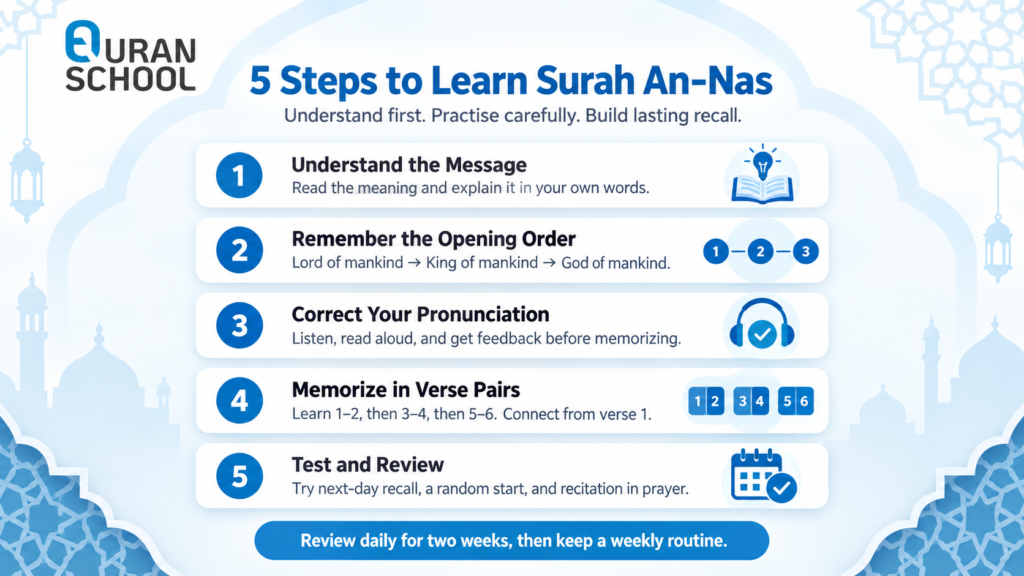
Step 1: Read the Meaning of Surah An-Nas First, before Learning A Word
Do not start with the sound. Start with what the verses actually mean. Surah An-Nas is one clear message, not six separate lines. You ask Allah for protection using three of His names. Then you name the thing you are asking protection from.
Then you learn where it attacks, and who it can come from. That is the whole surah in four moves.
Read the full text and meaning in the table further down this page. Read the English meaning twice. Then close the page and say the message back in your own words, out loud. If you can do that, you are ready for the next step. If you cannot, read it once more.
This takes about five minutes. Those five minutes save you hours later. Your mind holds meaning far longer than it holds sound. A surah you understand sits on a frame. A surah you only heard sits on nothing.
That frame is also what catches you when you forget a word, because the sense of the verse points you to the word that belongs there.
There is a second benefit too. When you know what you are saying, your recitation changes. You stop reading words and start making a request.
Step 2: Learn Allah’s Three Names in the Right Order — Lord, King, God
The first three verses name Allah three times. Many learners treat this as repetition. It is not repetition, and seeing why will lock these verses in place for good.
The order moves in a clear direction, and scholars of tafsir treat that direction as the key to the whole surah.
Read each name below with its meaning, then read the three together as one chain. This is the single most useful memory anchor in Surah An-Nas.
- رب الناس (Rabb an-Nas) — the Lord. He created you. He owns you. He provides for you and cares for you.
- ملك الناس (Malik an-Nas) — the King. He has full power and command over all people. No earthly power sits above Him.
- إله الناس (Ilah an-Nas) — the God. He alone is worthy of worship. Hearts turn to Him in need and in fear.
Now read the chain as one thought. He made me and cares for me. He rules me and commands me. So He alone is my Allah, and He alone is my refuge.
Each name is also a reason to feel safe. The first says He knows your needs. The second says He has the power to act. The third says He is the only one worth asking.
Say the three names in order ten times before you move on. Cover the meanings and say them again. Then try to say the third name without saying the first two. Once the order is automatic, verses one to three are already half learned.
Read also: What the Hadith About Reading Quran With Tajweed Reveals?
Step 3: Fix Your Pronunciation Before You Memorize Surah An-Nas
This is the step most people skip. It is also the most expensive one to skip. Here is why. A mistake you memorize now takes far longer to remove later. Your tongue has to drop an old habit at the same time your memory tries to hold the verse. You end up fighting yourself. It is much easier to learn a sound correctly once than to unlearn it twice.
So do this instead. Find a slow recitation from a trusted reciter. Listen to the full surah three times while your eyes follow the Arabic text. Do not try to memorize anything yet. You are only teaching your ear what correct sounds like.
Then read it back out loud while looking at the text. Look at the words, not at your memory. Do this for two or three short sessions across two days.
Pay special attention to four places. The doubled nūn in al-khannās, an-nās, and al-jinnah needs a nasal sound held for about two counts.
The nūn in min sharri is hidden, not said plainly. The ṣād in ṣudūr is heavy, while every other “s” sound in the surah is light. And the long vowels need their full length — do not cut them short.
If you can work with a teacher, this is the best moment to use one. Self-correction is unreliable at this stage. You cannot hear a sound as wrong when you have never heard it right.
Read Surah An-Nas out loud to a certified teacher at EQuran School Online and find out in ten minutes whether your pronunciation is correct. Explore our Online Quran Classes with Tajweed.

Step 4: Memorize Two Verses At A Time, Then Join Them Together
Six verses split into three neat pairs. Take verses 1–2 first, then verses 3–4, then verses 5–6.
Work on one pair at a time. Read the pair out loud from the text ten times. Then cover the text and say it from memory three times. If you stumble, uncover the text and read it five more times. Do not move on until the pair comes out clean.
Then comes the part that matters most. Add the new pair to the pairs you already know, and recite from verse one every single time. Never practise a pair in isolation after you have learned it. This is called layering, and it is what builds the link between verses.
That link is the real goal. Knowing each verse on its own is not enough for prayer. In prayer you need each verse to pull the next one after it, with no gap. Layering is what creates that pull.
Always recite out loud, not in your head. When you hear your own voice, you catch your own errors. Silent review hides mistakes.
Keep each session short. Fifteen to twenty minutes is plenty. Two short sessions in one day beat one long session every time, because sleep and spacing do part of the work for you.
See Us in Action
Watch a quick snippet from our live, interactive classes below and see how our teachers make learning engaging for all ages!
Start Your Quranic Journey Today
Experience our interactive online classes with a dedicated tutor.
Get Your Free TrialStep 5: Test Yourself The Right Way, Then Keep Reviewing
Reciting the surah right after you learn it proves very little. Your memory is still holding the sound from a minute ago, and that fades fast. Real memorization only shows up when the easy conditions are removed.
So give yourself tests that can actually fail, rather than tests designed to pass. The three below take less than five minutes in total.
- The cold test. Recite the surah the next morning, before you review anything. No warm-up, no peeking, no audio to jog your memory. If it comes out clean when your mind is cold, it is holding.
- The random start. Begin at verse four or verse five, without reciting the earlier verses first. Then try verse three. Many learners can only recite a surah as one long run, from the first word to the last. Break the run, and they freeze. That means the verses are linked in one direction only, and that link breaks fast in prayer.
- The prayer test. Recite Surah An-Nas in a voluntary prayer. Prayer adds pressure, and pressure exposes weak joins. You are standing, you are focused on the meaning, and you cannot stop to check the text.
If all three tests go smoothly, the learning stage is done. If one breaks down, you are not finished yet. You have repeated the surah, but you have not learned it.
The fix is simple. Find the pair of verses where you stopped. Go back to Step 4 and layer that pair again, always starting from verse one. Then test yourself once more the next morning. One extra day usually closes the gap.
Now keep it alive. Recite Surah An-Nas once a day for the next two weeks, then once a week after that. The easiest way to review is to stop treating it as review. Say it in your daily prayers, before you sleep, and in the morning and evening.
Read also: Master Surah Falaq: Easy Step-by-Step Guide
A 5-day plan to learn Surah An-Nas
The five steps tell you what to do. This plan tells you when to do it. It spreads the work across five short sessions, because spacing helps memory far more than long study blocks do.
Fifteen to twenty minutes a day is enough for most learners, and you do not need to sit for longer. Follow the table from Day 1 and resist the urge to rush ahead.
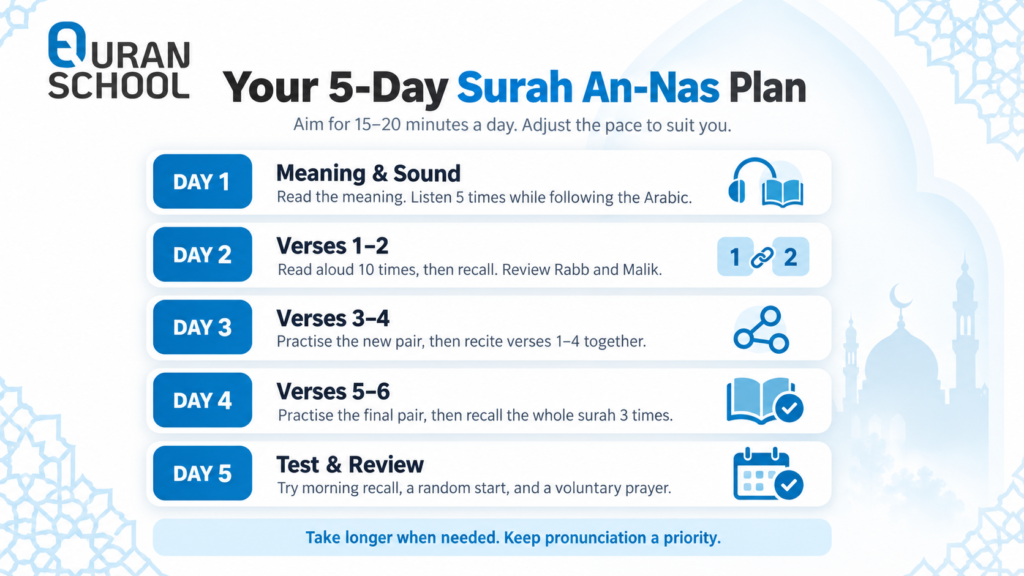
| Day | Focus | What you do |
| Day 1 | Meaning and sound | Read the meaning. Then listen to the surah five times while following the Arabic text. |
| Day 2 | Verses 1–2 | Read them aloud 10 times from the text. Then recite from memory. Review what Rabb and Malik mean. |
| Day 3 | Verses 3–4 | Same method. Then recite verses 1–4 together, from the start. |
| Day 4 | Verses 5–6 | Same method. Then recite the whole surah from memory three times. |
| Day 5 | Review | Do the cold test in the morning. Then the random start. Then recite it in a voluntary prayer. |
Change the pace to fit the learner. A young child often needs the same five stages spread over two weeks, with much shorter sessions. An adult who already reads Arabic script well can often finish in three days.
One thing should never be rushed: Step 3.
Keep the plan somewhere you can see it, and tick off each day as you go. Missing a day is fine — just pick up where you left off instead of starting over. What matters is that the days stay close together, because long gaps undo the work of the days before them.
A plan is easier to follow when someone is following it with you. At eQuran School Online, a certified teacher walks you through this same method, one surah at a time, and checks your progress every week.
Take a look at our Quran Memorization (Hifz) Course — we would love to help you finish what you started here.

Surah An-Nas: Full Text, Transliteration, And Meaning
This is the full text of Surah An-Nas in three columns. The first column gives the Arabic, the second gives the transliteration, and the third gives the meaning in English.
Read the meaning column first, during Step 1, before you memorize anything. Then come back to this table each day of your plan and read the pair of verses you are working on.
Keep the Arabic column in front of you while you recite, even after you think you know the words.
| # | Arabic | Transliteration | Meaning |
| 1 | (قُلْ أَعُوذُ بِرَبِّ النَّاسِ) | Qul aʿūdhu bi-Rabbi n-nās | Say: I seek refuge with the Lord of mankind |
| 2 | (مَلِكِ النَّاسِ) | Maliki n-nās | The King of mankind |
| 3 | (إِلَٰهِ النَّاسِ) | Ilāhi n-nās | The God of mankind |
| 4 | (مِن شَرِّ الْوَسْوَاسِ الْخَنَّاسِ) | Min sharri l-waswāsi l-khannās | From the evil of the whisperer who withdraws |
| 5 | (الَّذِي يُوَسْوِسُ فِي صُدُورِ النَّاسِ) | Alladhī yuwaswisu fī ṣudūri n-nās | Who whispers into the hearts of mankind |
| 6 | (مِنَ الْجِنَّةِ وَالنَّاسِ) | Mina l-jinnati wa n-nās | From among the jinn and mankind |
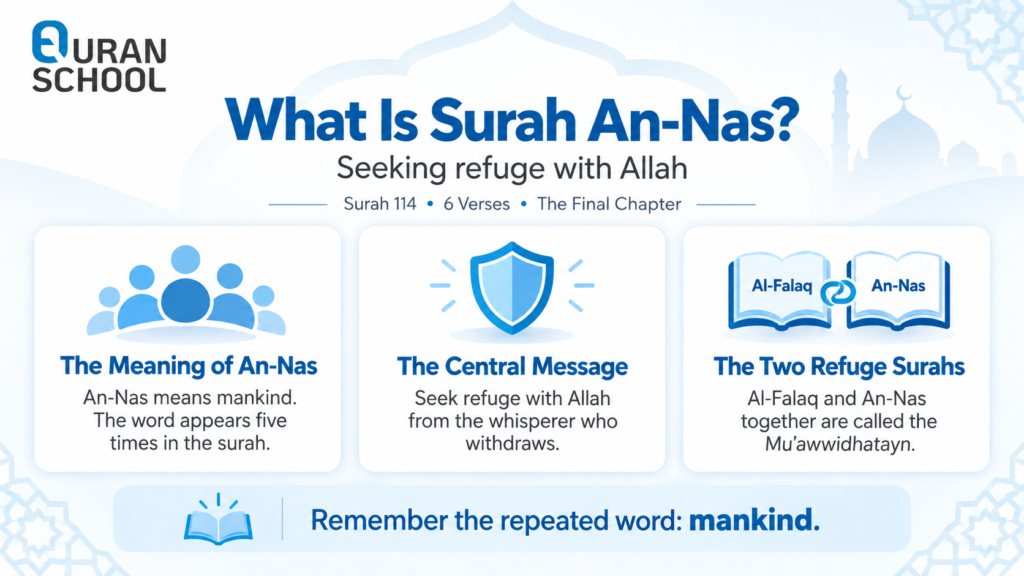
Look at how often the word an-nās appears in the Arabic column — five times in six verses. That repetition is your anchor, because every verse except verse four ends the same way.
Read also: Surah Ikhlas Guide: How to Memorize and Recite
What Is Surah An-Nas?
Surah An-Nas is the 114th and final chapter of the Qur’an. It is a Makkan surah of six short verses in which you seek refuge with Allah from the whisperer who withdraws. It is the last surah in the mushaf, and one of the first that most people learn.
Surah An-Nas At A Glance
Before you memorize a surah, it helps to know the basic facts about it. The table below gives you everything you need in one place: where the surah sits in the Qur’an, how long it is, where it was revealed, and what it is about.
Read it once now, and come back to it if a term confuses you later.
| Chapter number | 114 — the last surah in the Qur’an |
| Number of verses | 6 |
| Place of revelation | Makkah (a Makkan surah) |
| Main theme | Seeking refuge with Allah from whispering |
| Recited with | Surah Al-Falaq (together: the Mu’awwidhatayn) |
| Common uses | Before sleep, morning and evening, and in daily prayers |
Two facts in this table matter more than the rest. Six verses is short enough to learn in a few days, so the length is never the hard part. And a surah you recite before sleep, morning and evening, and in your prayers is one you will say out loud many times a week.
That kind of daily use is the real reason to learn it carefully now. It is also why getting the pronunciation right at this stage is worth the extra day it costs.
Read also: Learn Surah Kausar Easily: Step-by-Step Guide
Why It Is Called Surah An-Nas
The word an-nās means “mankind.” It appears five times across the six verses — more than any other word in the surah. That is where the name comes from.
Look at where those five appear. The word closes verse one, verse two, verse three, verse five, and verse six. Only verse four ends differently, with al-khannās. So five of the six verses land on the same sound.
That pattern is your best memory anchor. Each verse has a shared landing point, and your ear starts to expect it. Once you notice the pattern, the surah stops feeling like six separate lines. It starts to feel like one shape you can hold.
The repetition is not only a memory aid, though. Scholars of tafsir explain it as emphasis and honour. Allah names mankind beside each of His three attributes — Lord of mankind, King of mankind, God of mankind — so each attribute stands complete on its own.
It also ties the surah together from both ends. The protection is asked for mankind, the whispering happens in the hearts of mankind, and the whisperer may come from among mankind itself. The same word opens the request and closes it.
Read also: How to Read and Understand Surah Kausar
The Other Names Of Surah An-Nas
One surah can carry more than one name. This confuses many beginners, especially when a teacher or a book uses a name they have never heard. Surah An-Nas appears under several names in the books of tafsir and hadith, and each name tells you something about the surah.
- Surah An-Nas — the most common name. You will see it in the mushaf, in tafsir books, and in almost every class.
- Surah “Qul a’udhu bi-Rabbin-Nas” — named after its opening words. Naming a surah by its first words is an old and normal practice.
- The second Mu’awwidhah — Mu’awwidhah means “the one that seeks refuge.” Surah Al-Falaq is the first. Surah An-Nas is the second.
- The Mu’awwidhatayn — the name for Al-Falaq and An-Nas together, as a pair. You will hear this one often, because the two are usually recited together.
- The Mu’awwidhat — the name for Al-Falaq, An-Nas, and Al-Ikhlas as a group of three.
All of these point to the same six verses. If you meet one of these names in a book or a class, you are simply meeting Surah An-Nas under a different title. Nothing about the surah changes.
Two of these names are worth remembering in particular. Mu’awwidhatayn is the one you will hear most in daily practice, because Al-Falaq and An-Nas are recited as a pair. Mu’awwidhat is the one that appears in the hadith about reciting before sleep, where Al-Ikhlas joins them.
There is a practical lesson here too. Learning Surah An-Nas is easier when you learn Surah Al-Falaq beside it. They are short, they are paired in the Sunnah, and you will almost always recite them one after the other. Many teachers teach the two together for exactly that reason.
Read also: Learning Surah Al-Lail That Lasts: Proven Techniques for Retention
5 Mistakes That Make Surah An-Nas Harder
Every teacher sees the same errors in beginner recitation, and they repeat across learners of every age. Most of them are not caused by weak memory. They are caused by learning the surah in the wrong order, or by copying a sound that was never checked.
The good news is that each mistake has a simple fix, and catching one early can save you months of correction later. Read through the five below before Day 2 of your plan, not after Day 5.
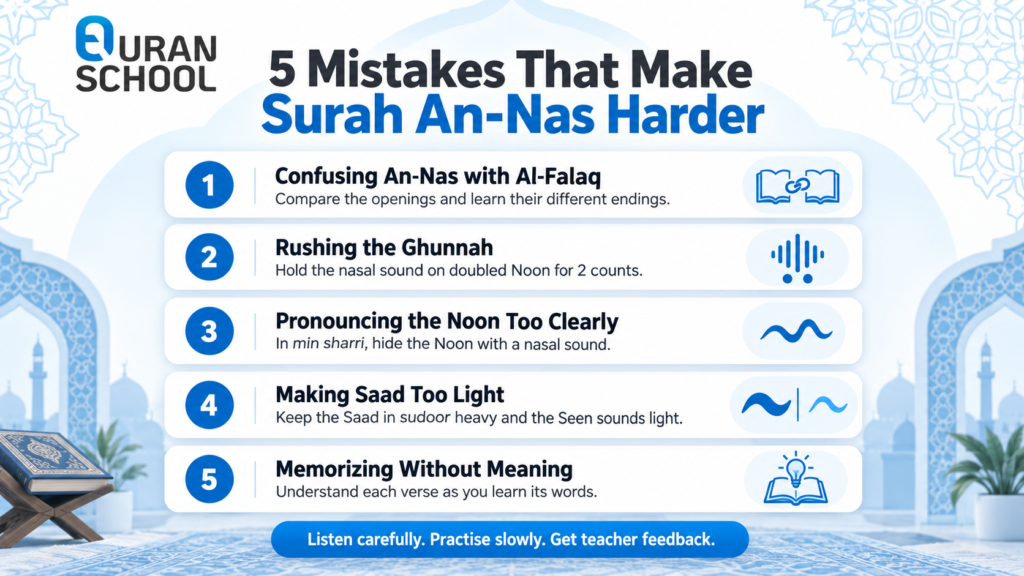
- Mixing it up with Surah Al-Falaq. Both surahs open with Qul aʿūdhu bi-Rabb. Al-Falaq then says al-falaq. An-Nas then says an-nās. Learn the two endings side by side on purpose. Do not hope the difference will sort itself out.
- Dropping the nasal sound on doubled letters. The nūn carries a shaddah in al-khannās, an-nās, and al-jinnah. Each one needs a nasal sound held for about two counts. Rushing this is the most common Tajweed error in the surah.
- Saying min sharri too plainly. The silent nūn in min comes before shīn. So the nūn is hidden with a nasal sound. It is not pronounced clearly.
- Flattening the ṣād in ṣudūr. Every other “s” sound in this surah is a light sīn. You hear it in waswās, khannās, and nās. But ṣudūr uses the heavy ṣād. Say it with a full, round mouth.
- Memorizing with no meaning. Sound-only memorizing is the weakest kind. It often lasts a week. It rarely lasts a year. And it gives you none of the reflection the surah is meant to bring.
You may also like: 10 Benefits of Reading Quran with Tajweed That Every Muslim Should Know
Why Learn Surah An-Nas First
This surah is short. But that is not the main reason to learn it first. It is reported in Sahih al-Bukhari that Aisha (may Allah be pleased with her) described the Prophet ﷺ reciting Surah Al-Ikhlas, Surah Al-Falaq, and Surah An-Nas into his hands each night before sleep, then wiping them over himself.
Narrations in the Sunan collections also record the instruction to recite these surahs in the morning and the evening.
So when you learn Surah An-Nas, you gain something you can use every single day. You can recite it before you sleep, after Fajr, and again in the evening.
You can also recite it in any prayer, since it is short enough to use in every rak’ah. That is why it is often the first or second surah taught to children and new learners.
It is also why correct pronunciation matters so much at this stage. You will carry it for decades. A verse you recite twice a day is a verse you will repeat thousands of times over the years.
If a small error settles in now, it repeats with every one of those recitations. Six verses are a very small price for something you will return to that often.
Read also: One Year Quran Reading Plan: Read the Entire Quran in 1 Year
Experience Our Classes
Don’t just take our word for it—watch real-time recordings of our online classes below to experience our teaching style firsthand.
Start Your Quranic Journey Today
Experience our interactive online classes with a dedicated tutor.
Get Your Free TrialStart Learning Surah An-Nas With A Teacher Who Listens
You can memorize six verses on your own. What you cannot do on your own is confirm that you learned them correctly. Nobody hears their own ghunnah as too short. Nobody notices their own ṣād turning into a sīn. A teacher does — in the first minute.
That matters more than it sounds. Every habit you form in your first surahs follows you into the next hundred. Correct habits compound. So do incorrect ones.
Here is what a class at EQuran School Online gives you:
- Al-Azhar certified tutors. Your teacher is a native Arabic speaker, a Hafiz, and certified by Al-Azhar University — trained to teach non-Arabic speakers from the very first letter.
- One-to-one, never group. Private sessions only, so you get 100% of the focus and every error is caught the moment you make it.
- Female tutors available. A comfortable, private learning space for sisters, with a teacher of your choice.
- Flexible 24/7 scheduling. Our teachers work in shifts across time zones, so you book classes around your week — day or night.
- Affordable plans with no lock-in. Simple monthly billing, family discounts, no hidden fees, and no long-term contract.
- A path beyond An-Nas. Tajweed, memorization (Hifz), Qur’an reading, and an Ijazah program for a connected chain of transmission when you are ready.
- A completely free first session. Meet your tutor, try our teaching style, and decide afterwards. No payment, no card, no commitment.
Start where you already are. Bring the six verses you just learned to your first session, recite them out loud, and let a qualified teacher tell you exactly what to fix. It takes one class to find out whether you learned Surah An-Nas correctly — and one class costs you nothing.
Our Quran Courses
- Quran Recitation Classes
- Weekend Quran Classes
- Quran Reading Classes
- Online Quran Classes for Kids
- Learn Quran Online with Tajweed for Kids and Adults
- Online Quran Learning with Tajweed Course
- Quran Classes for Adults
- Female Quran Classes
- Female Quran Teacher for Ladies
- Learn Quran for Beginners
- Quran Qirat Learning Course
👉 Book your free trial class with eQuran School Online and recite Surah An-Nas with a certified teacher today

Conclusion
Learning Surah An-Nas is not really about repeating it more times. It is about doing things in the right order.
Start with the meaning. Six verses that make sense are far easier to hold than six verses that are only sound. Then learn the three names of Allah in order: Rabb, then Malik, then Ilah. That chain keeps the opening verses in place, and it is the reason people stop confusing this surah with Surah Al-Falaq.
Next, fix your pronunciation before you memorize a single line. This is the step that costs the least now and the most later. Then memorize in pairs and layer each pair onto the one before it, so the verses connect smoothly.
Finally, test yourself in a way that can actually fail: cold recall in the morning, a random starting verse, and a real recitation in prayer.
Follow the five-day plan and most learners hold the surah within a week. More importantly, they still hold it a year later, because the meaning is holding it in place. Then keep it alive with short reviews. A surah recited once a day for two weeks, then once a week after that, rarely slips away.
Remember that this surah is not a task to finish. It is a daily protection you will use before sleep, in the morning, and in the evening, for the rest of your life. Six verses is a small price for something you will return to that often. Give them the extra two days it takes to learn them properly.
One last point worth saying plainly. Self-study can take you a long way with a surah this short. But it cannot tell you whether your ghunnah is right, whether your ṣād is heavy enough, or whether a small error has quietly become a habit.
Frequently Asked Questions
How Long Does It Take To Learn Surah An-Nas?
Most adults learn Surah An-Nas in three to five days, at fifteen to twenty minutes a day. Children usually need one to two weeks with shorter sessions. The main variable is how much time you spend fixing pronunciation before you memorize.
Is Surah An-Nas Easy To Memorize?
Yes. Surah An-Nas is one of the easiest surahs to memorize. It has only six short verses, and the word an-nās repeats five times, which gives each verse a shared anchor. The real difficulty is not memorizing it. It is avoiding confusion with Surah Al-Falaq, which starts the same way.
What Is The Difference Between Surah An-Nas And Surah Al-Falaq?
Surah Al-Falaq is chapter 113 and seeks refuge with the Lord of daybreak from outside harms. Surah An-Nas is chapter 114 and seeks refuge with the Lord of mankind from the inner harm of whispering. Al-Falaq has five verses. An-Nas has six. Together they are called the Mu’awwidhatayn.
How Many Verses Does Surah An-Nas Have?
Surah An-Nas has six verses. It is a Makkan surah and the final chapter in the order of the mushaf.
Can I Learn Surah An-Nas If I Don’t Read Arabic?
Yes. You can start with transliteration and audio, and many learners do. But transliteration cannot show Arabic sounds accurately. Treat it as a short bridge, not a permanent method. Learning the Arabic script alongside your first surahs prevents pronunciation errors from settling in.
Why Is The Word “An-Nas” Repeated Five Times?
Scholars of tafsir explain the repetition as emphasis and honour. Naming mankind next to each divine attribute — Lord, King, God — makes each attribute a complete statement on its own. It also links the request for protection directly to the hearts where the whispering happens.
Sources
Related Articles
Learn Quran











Leave a Reply