 Learn Quran
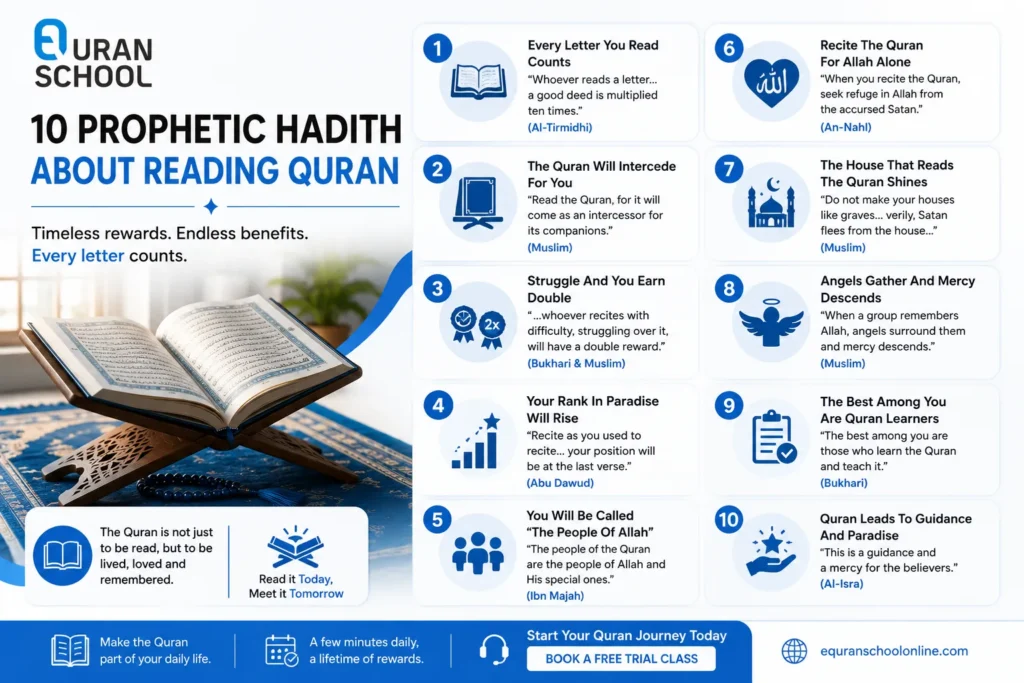
Every letter you read from the Quran earns something specific. Not vaguely. Not approximately. The Prophet Muhammad ﷺ stated the reward in precise numerical terms — and then corrected anyone who might miscount. Across the hadiths he left, reading the Quran comes with rewards tied to intercession, rank in Paradise, the company of angels, and a closeness to Allah that few acts of worship can match.
Yet many Muslims carry a quiet uncertainty: Is my recitation — slow, imperfect, and stumbling — actually doing anything? These ten hadith about reading Quran answer that question directly. One of them specifically doubles the reward for those who struggle.
What follows is an account of the most important authenticated narrations on reading the Quran, drawn from Sahih al-Bukhari, Sahih Muslim, and the major Sunan collections. Each is presented with its source, its meaning, and its practical implication.
1. Every Letter You Read Counts According To The Hadith About Reading Quran
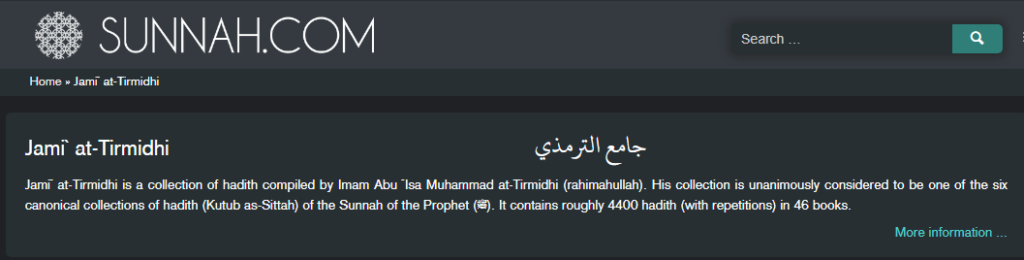
Abdullah ibn Mas’ud (may Allah be pleased with him) reported that the Messenger of Allah ﷺ said: “Whoever reads a letter from the Book of Allah will have a good deed recorded for him, and a good deed is multiplied ten times. I do not say that Alif Lam Mim is one letter — rather, Alif is a letter, Lam is a letter, and Mim is a letter.” — Al-Tirmidhi (authenticated by al-Albani)
The precision is intentional. The Prophet ﷺ anticipated the miscount — treating a word or phrase as a single unit — and corrected it before it could take hold. Each letter is an independent transaction. Three letters yield thirty good deeds. Across the Quran’s 323,000+ letters, a single complete recitation generates millions of recorded deeds.
The benefits of reading Quran become concrete the moment you treat each letter as currency and begin counting forward rather than judging yourself backward.
Start Mastering the Quran from Home Today with Free Trial for your first session
Read also: How Many Good Deeds For Reading The Whole Quran?

2. The Quran Will Intercede For You On The Day Of Judgment
Abu Umama al-Bahili (may Allah be pleased with him) said: “I heard the Messenger of Allah ﷺ say: Read the Quran, for it will come on the Day of Resurrection as an intercessor for its companions.” — Muslim
“Companions” is the operative word. The Arabic ashabihi implies a sustained relationship — not someone who picked up the Quran once, but someone who kept its company over a lifetime. The Quran will recognize that person and argue on their behalf before divine judgment.
Understanding what we learn from the Quran ultimately resolves to this: we are shaping the relationship with the Book that will speak for us when we cannot speak for ourselves.
Join our Noorani Qaida Course and get a free trial

3. Struggling To Read The Quran Comes With Double The Reward
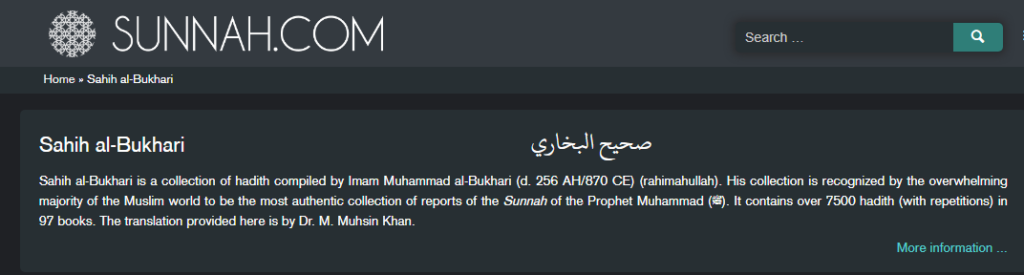
Aisha (may Allah be pleased with her) reported that the Messenger of Allah ﷺ said: “The one who recites the Quran skillfully will be with the noble, obedient scribes. And the one who recites the Quran with difficulty, struggling over it, will have a double reward.” — Al-Bukhari and Muslim
Two groups, two distinct outcomes — both honored. The skilled reader earns fellowship with the angels. The struggling reader earns two rewards: one for the recitation, and one specifically because the effort was hard.
This hadith dismantles the most common excuse for not starting. The Prophet ﷺ did not say “come back when you’re ready.” He assigned extra credit to the difficulty itself. The journey of Quran recitation for beginners is not a waiting room for the real reward — it is the reward, in its own elevated category.
The benefits of Quran recitation are not conditional on fluency. They begin with the first imperfect attempt and are measured there.
Read Also: How to Learn the Quran?

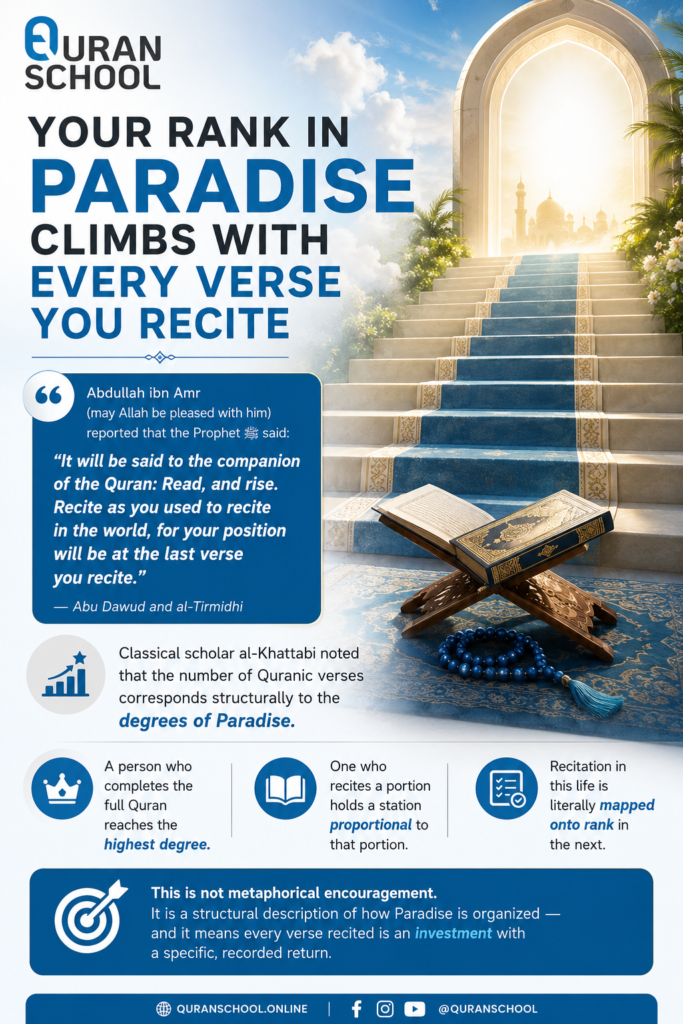
4. Your Rank In Paradise Climbs With Every Verse You Recite
Abdullah ibn Amr (may Allah be pleased with him) reported that the Prophet ﷺ said: “It will be said to the companion of the Quran: Read, and rise. Recite as you used to recite in the world, for your position will be at the last verse you recite.” — Abu Dawud and al-Tirmidhi
Classical scholar al-Khattabi noted that the number of Quranic verses corresponds structurally to the degrees of Paradise. A person who completes the full Quran reaches the highest degree. One who recites a portion holds a station proportional to that portion. Recitation in this life is literally mapped onto rank in the next.
This is not metaphorical encouragement. It is a structural description of how Paradise is organized — and it means every verse recited is an investment with a specific, recorded return.
Read also: Benefits Of Reading Quran At Fajr
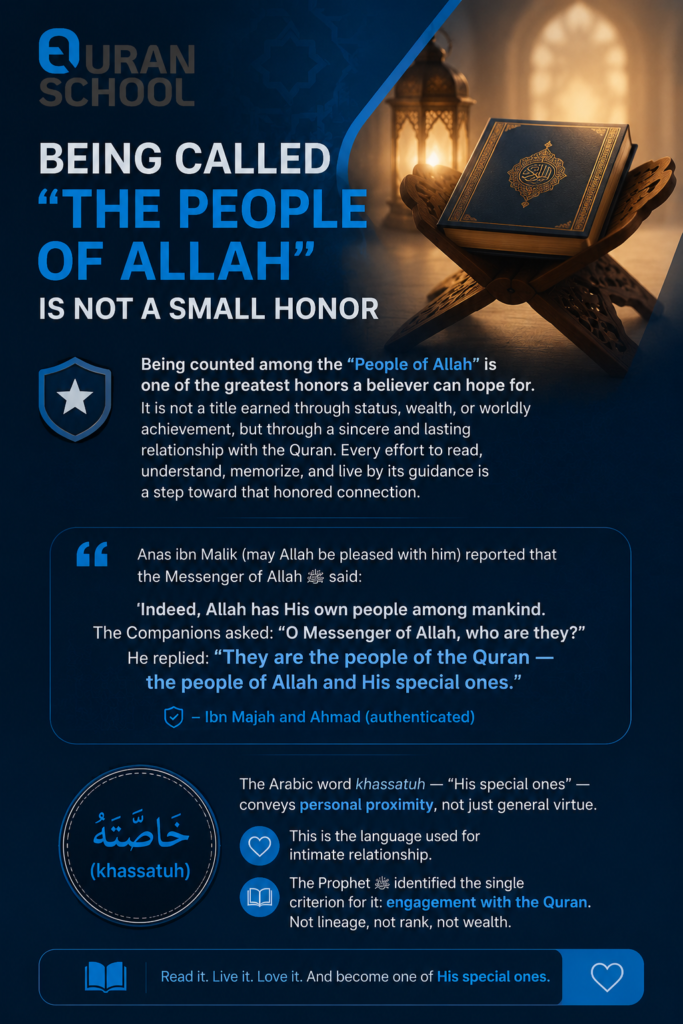
5. Being Called “The People Of Allah” Is Not A Small Honor
Being counted among the “People of Allah” is one of the greatest honors a believer can hope for. It is not a title earned through status, wealth, or worldly achievement, but through a sincere and lasting relationship with the Quran. Every effort to read, understand, memorize, and live by its guidance is a step toward that honored connection.
Anas ibn Malik (may Allah be pleased with him) reported that the Messenger of Allah ﷺ said: “Indeed, Allah has His own people among mankind.” The Companions asked: “O Messenger of Allah, who are they?” He replied: “They are the people of the Quran — the people of Allah and His special ones.” — Ibn Majah and Ahmad (authenticated)
The Arabic word khassatuh — “His special ones” — conveys personal proximity, not just general virtue. This is the language used for intimate relationship. The Prophet ﷺ identified the single criterion for it: engagement with the Quran. Not lineage, not rank, not wealth.
Read also: 9 Hadiths About Reading Quran With Difficulty
Read also: Hadith About Reciting Quran Loudly – A Complete Guide
6. When People Gather To Recite Together, Four Blessings Come Down At Once
Abu Hurairah (may Allah be pleased with him) reported that the Messenger of Allah ﷺ said: “No group gathers in one of the houses of Allah, reciting the Book of Allah and studying it together, except that tranquility descends upon them, mercy covers them, the angels surround them, and Allah mentions them among those with Him.” — Muslim
Four independent outcomes — not one blessing with four descriptions. Tranquility (sakina), mercy (rahma), the presence of angels, and divine remembrance each arrive separately in response to a single act of communal recitation.
The health benefits of reading Quran have been documented in contemporary psychological research on stress, cortisol levels, and mental well-being. This hadith identifies the source: a specific spiritual mechanism, not a placebo effect.
Read also: 9 Hadiths About Reciting Quran Beautifully
Start learn Quran with Tajweed with your first free class

See Us in Action
Watch a quick snippet from our live, interactive classes below and see how our teachers make learning engaging for all ages!
Start Your Quranic Journey Today
Experience our interactive online classes with a dedicated tutor.
Get Your Free Trial7. The Best Person In The Community Is Defined By One Criterion — The Quran
Uthman ibn Affan (may Allah be pleased with him) reported that the Prophet ﷺ said: “The best of you is the one who learns the Quran and teaches it.” — Al-Bukhari
This single-criterion definition of excellence is deliberate. Not the wealthiest, the most eloquent, or the most influential. The one who completes the full loop — learning and then passing it on — holds the highest designation.
The Prophet ﷺ specifically described the commitment to learn the Quran and teach it as a dual practice, not a sequence with a final destination. The teacher who keeps learning, and the learner who begins to teach, both qualify for the title.
The importance of learning and teaching Quran in Islamic tradition reflects this precisely: it is not a pious hobby. It is, by prophetic definition, the mark of the best kind of Muslim.
Book a free trial class at EQuran School and Let the Quran Begin Working for You

8. The Quran Is Either A Witness For You Or Against You
Abu Malik al-Ash’ari (may Allah be pleased with him) reported that the Prophet ﷺ said, “…and the Quran is either a proof for you or against you.” — Muslim
This short statement carries a powerful message. The Quran is not meant to be something we simply own, admire, or leave unopened. It can become a source of guidance and reward when we recite it, reflect on its meaning, and follow its teachings. This is one reason the reward for reading quran hadith and the benefits of reading the quran hadiths are so important for every Muslim to understand.
The hadith also reminds us that our relationship with the Quran has consequences. Every time we make an effort to read, understand, and apply its guidance, we move closer to benefiting from it. But repeatedly neglecting the Quran means missing the guidance and opportunities for reward that Allah has placed in it.
For anyone who has been waiting to begin, the message is simple: do not wait until you feel ready. Open the Quran, take the first step, and build a consistent relationship with it. The sooner you begin, the sooner its guidance can become a witness for you, rather than something you neglected.
Join our Quran Tafsir Course and get a free trial

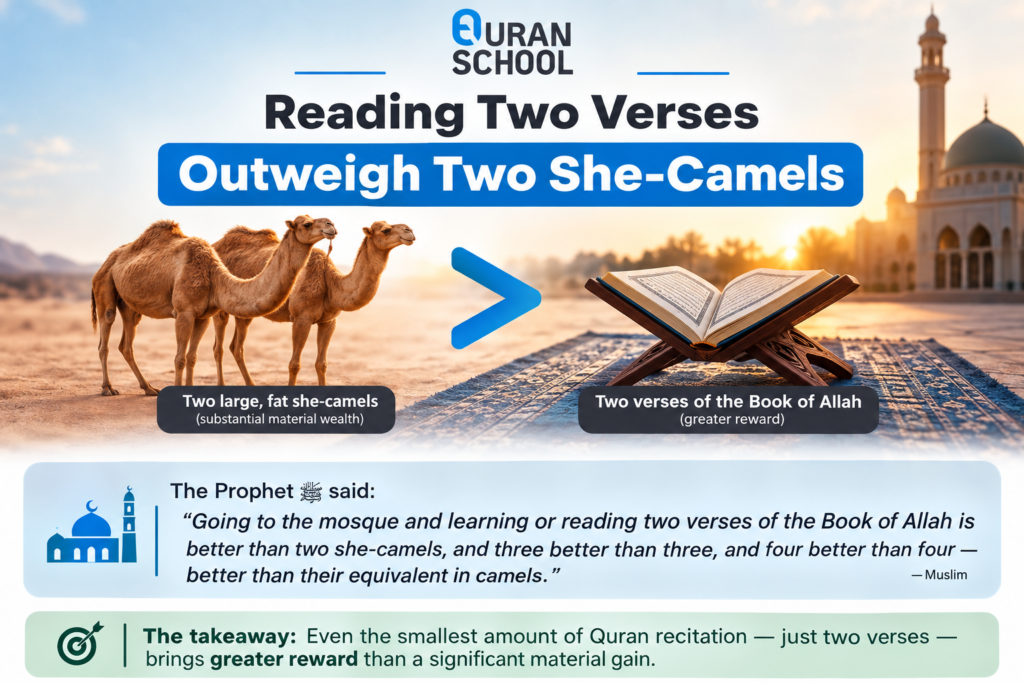
9. Reading Two Verses Outweigh Two She-Camels
Uqba ibn Amir (may Allah be pleased with him) reported that the Prophet ﷺ said:
“Would any of you like to go out every morning and bring home two large, fat she-camels without sin or severing family ties?” They said: “Yes, O Messenger of Allah.” He said: “Going to the mosque and learning or reading two verses of the Book of Allah is better than two she-camels, and three better than three, and four better than four — better than their equivalent in camels.” — Muslim
She-camels represented substantial material wealth in seventh-century Arabia — a significant financial asset by any era’s standard. The Prophet ﷺ used this comparison not for abstract inspiration but to make the opportunity cost of not reciting viscerally clear. The minimum unit of engagement — two verses — already outweighs a considerable worldly gain.
10. Those Devoted To Quran Recitation Receive More Than Those Who Ask Directly
Abu Sa’id al-Khudri (may Allah be pleased with him) reported that the Prophet ﷺ said:
“Whoever is kept busy with the Quran and remembrance of Me from asking Me, I will give him the best of what I give to those who ask. And the superiority of the Word of Allah over all other words is like the superiority of Allah over His creation.” — Al-Tirmidhi (authenticated)
A person so absorbed in recitation that they forget to make explicit requests receives a response calibrated to what Allah knows they need — which is often better than what they would have known to ask for. Recitation is itself a form of appeal, addressed continuously upward.
Opening each session with a dua before starting quran class or personal recitation is a recommended practice in its own right. But this hadith reassures: the recitation that follows is already heard.

How Non-Arabic Speakers Can Build A Consistent Quran Reading Practice?
The rewards of Quran recitation are not limited to those who already understand Arabic. Non-Arabic speakers can begin where they are, learn gradually, and build a consistent relationship with the Quran over time. The key is to understand what the Quran and Sunnah teach about recitation and then turn that guidance into practical, sustainable habits. Check the two points below:
A. What Non-Arabic Speakers Need To Know Before Starting?
The most common friction point is the script. Arabic letters change form depending on their position in a word, carry sounds that don’t map cleanly onto English phonology, and require a specific sequence to approach correctly.
Most learners who try to learn Quran alphabet using standard materials quickly discover those materials were built for children raised in Arabic-speaking homes — children who already hear the sounds constantly in daily life. The assumption doesn’t hold for someone in Birmingham, Chicago, or Melbourne.
EQuran School addressed this gap directly when building their methodology. Rather than adapting existing materials, their instructors developed the proprietary Al-Menhaj Book — authored by Luqman ElKasabany — specifically for non-Arabic speaking adults and children in Western contexts.
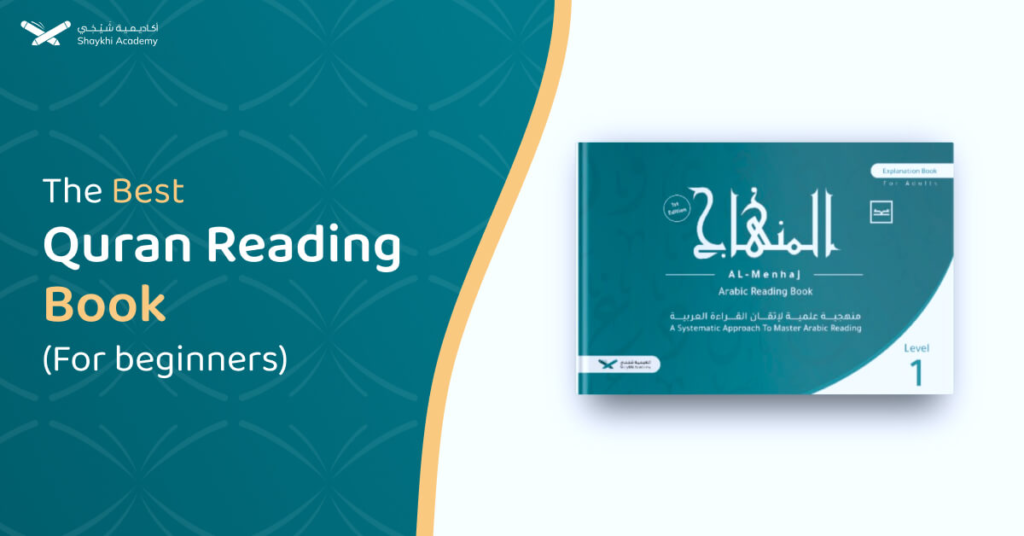
It was built from scratch for learners whose first encounter with Arabic script is through Quran study. The best way to learn Quran online for someone in Toronto or Sydney looks genuinely different from what works for a student raised in an Arabic-speaking household — and this curriculum reflects that difference in every lesson.
B. How To Turn These Hadiths Into A Consistent Practice?
Reading these hadiths produces motivation. Sustaining the practice requires structure.
The hadith on gathering (Hadith 6) suggests that community accountability sustains what solo intention often cannot. Joining an online class, finding a recitation partner, or following a 30 day Quran reading schedule helps most learners maintain consistency better than unstructured solo effort. Completion rates rise sharply when there is a daily target and someone to report to.
Beginning each session with a dua for learning Quran — asking Allah to open the heart to the words and make them hold fast — grounds the practice in intention rather than discipline alone. The habit becomes easier once it carries a clear spiritual framing rather than feeling like a self-improvement project that competes with other priorities.
Read also: 7 Best Online Quran Learning Platforms for Non-Arabic Speakers

Experience Our Classes
Don’t just take our word for it—watch real-time recordings of our online classes below to experience our teaching style firsthand.
Start Your Quranic Journey Today
Experience our interactive online classes with a dedicated tutor.
Get Your Free TrialBuild Lasting Quran Skills With EQuran School And Learn With Confidence
EQuran School serves thousands of active students across North America, Europe, and Australia, with one-to-one instruction by certified teachers who specialize in working with non-Arabic speakers at every level. The curriculum is structured, sessions are flexible around family and work schedules, and teachers are trained to meet each student at their actual starting point — not an assumed one.
For students whose goal is retention, the structured Quran memorization (hifz) course provides a sequenced path from foundational letters through complete Quran memorization, with revision systems built in to prevent the slipping-away the Prophet ﷺ warned about.
Those seeking to understand what they recite will find their footing through the dedicated online Quran tafsir course, which covers the meanings, context, and scholarly interpretation of Quranic verses — so recitation becomes engaged rather than rote.
Those ready to learn quran online from home have access to EQuran School’s full curriculum, delivered via Zoom with certified instructors:
- Online Quran Classes for Kids
- Learn Quran Easily at Home
- Online Arabic and Quran Classes
- Quran Qirat Learning Course
- Online Quran Recitation Classes
- Noorani Qaida Course for Kids
- Weekend Quran Classes
- Zoom Quran Classes
Book a free trial class at EQuran School and experience personalized Quran instruction that adapts to your unique learning needs, Insha’Allah.
Start Your Quranic Journey Today
Experience our interactive online classes with a dedicated tutor.
Get Your Free TrialConclusion
The ten narrations collected here form a coherent system. A letter earns ten deeds. Consistent recitation builds a companion who intercedes. Struggling earns double. A gathering draws down four blessings at once. A lifetime of reading resolves into a station in Paradise measured verse by verse.
This system operates regardless of starting level, native language, or location. The Prophet ﷺ designed his encouragement to reach every Muslim — the skilled reciter, the stumbling beginner, the isolated Muslim in a non-Muslim country, and the person who has been meaning to start for years.
No hadith about reading the Quran sets a minimum standard of fluency. The minimum standard is picking it up. Everything above that baseline earns something — and the hadiths are clear on what, in terms specific enough to build a daily practice around.
Frequently Asked Questions
What is the most widely cited hadith about reading the Quran?
The narration from Abdullah ibn Mas’ud — recorded by al-Tirmidhi — is considered foundational: “Whoever reads a letter from the Book of Allah will have a good deed recorded for him, and a good deed is multiplied ten times.” It establishes the base reward that underlies every other hadith on recitation, and it is the one most commonly referenced in classical Fiqh and educational literature.
Does reading the Quran without understanding still earn reward?
Yes. The hadiths tie the reward to recitation, not comprehension. The hadith of Ibn Mas’ud says “reads a letter” — not “reads and understands a letter.” Learning the meaning of what you recite is separately encouraged through Tafseer study, and it deepens the practice significantly, but it is not a condition for the reward of recitation itself.
Is the double reward for struggling readers confirmed in Sahih hadith?
Yes. The narration from Aisha appears in both Sahih al-Bukhari and Sahih Muslim — the two most rigorously authenticated hadith collections in the Sunni tradition. The classical scholar al-Nawawi clarified in his commentary that the reward for struggling does not exceed that of the skilled reader overall, but that struggling earns a distinct category of its own — one the smooth reader does not receive.
How much Quran should a Muslim aim to read daily?
The Prophet ﷺ recommended completing the Quran within a month — roughly one juz per day — as a balanced default, with a minimum of seven days for those who can sustain a faster pace while maintaining reflection. A structured 30 day quran reading schedule gives most readers a concrete daily target without creating an unsustainable pace, and it makes it easy to track progress and recover from missed days.
What does “companion of the Quran” mean in the intercession hadith?
It refers to a person who maintained a consistent, ongoing relationship with the Quran across their lifetime — returning to it regularly, reciting it as a habit rather than an occasion, and treating it as a living part of their practice. The Arabic sahib (companion) carries the implication of closeness over time, not a single or infrequent encounter.
Can children begin Quran learning online with qualified teachers?
Yes. Free online quran classes for kids are available through EQuran School for children from age four and above, taught by instructors trained in child-appropriate pedagogy. Young learners follow a structured progression through letter recognition, sound production, and connected reading — with methods calibrated to how children actually acquire new scripts rather than adapting adult instruction for younger students.









[…] Read also: 10 Prophetic Hadith About Reading Quran […]
[…] Read also: What Is The Reward For Becoming A Hafiz? […]