 Learn Quran
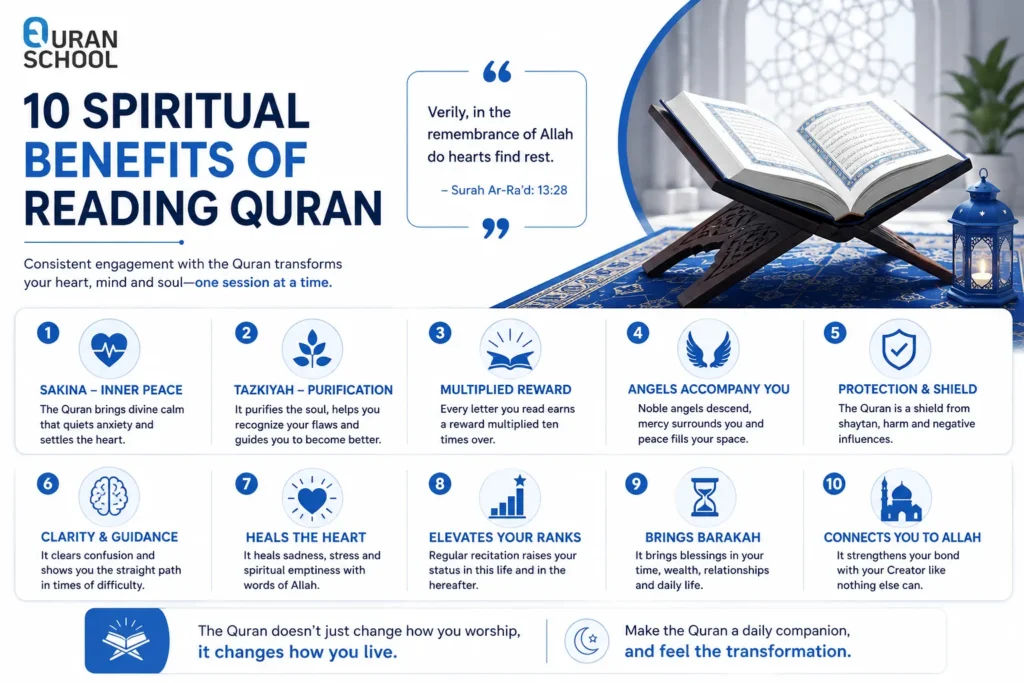
Millions of Muslims open the Quran before the world has had a chance to crowd in — before the notifications, before the noise, before the day takes hold. There is a reason for that instinct. The spiritual benefits of reading Quran are not abstract promises deferred to the afterlife. They reshape the present, stabilize the anxious, heal the grieving, and redirect the lost, one session at a time.
This article unpacks ten of those benefits in specific, evidence-grounded detail — not to give you more reasons to read what you already believe in, but to name precisely what happens when you do, so that every session you sit with the Quran is one you understand, not just one you perform.
Whether you are in the US, UK, Canada, Australia, or anywhere else in the world, the math is the same and the method works: consistent engagement with the Quran produces consistent spiritual growth, regardless of native language, background, or starting point.
Read also: Benefits Of Reading Quran In The Morning
1. Sakina Is One Of The Most Spiritual Benefits Of Reading Quran That Quiets Every Storm
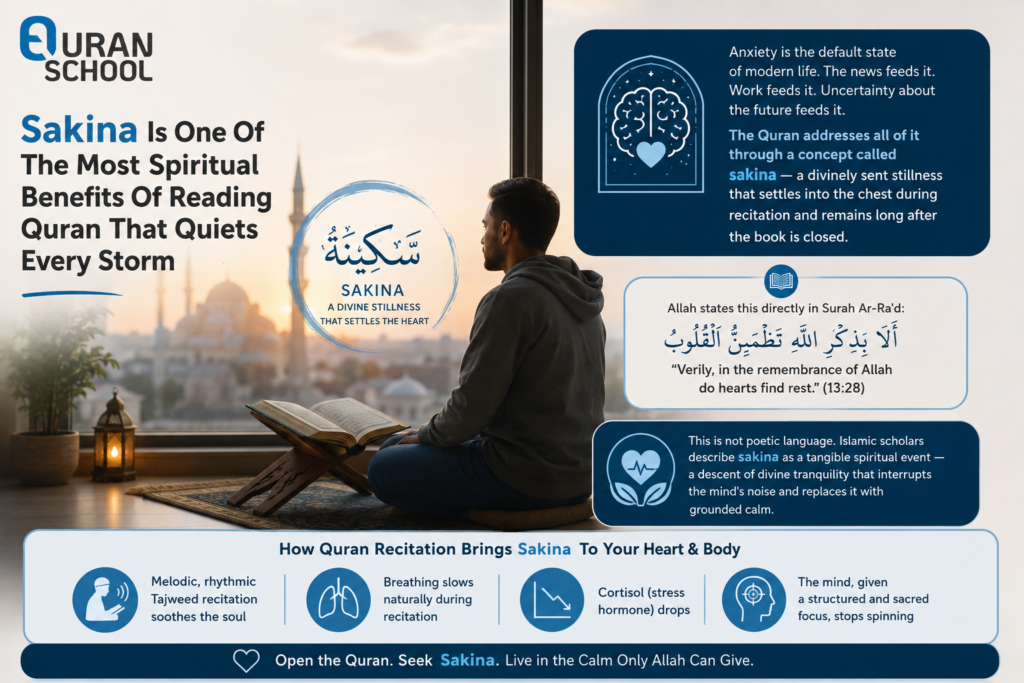
Anxiety is the default state of modern life. The news feeds it. Work feeds it. Uncertainty about the future feeds it. The Quran addresses all of it through a concept called sakina — a divinely sent stillness that settles into the chest during recitation and remains long after the book is closed.
Allah states this directly in Surah Ar-Ra’d:
“Verily, in the remembrance of Allah do hearts find rest.” (13:28)
This is not poetic language. Islamic scholars describe sakina as a tangible spiritual event — a descent of divine tranquility that interrupts the mind’s noise and replaces it with grounded calm. The melodic, rhythmic nature of Tajweed recitation has a documented settling effect on the nervous system: breathing slows, cortisol drops, and the mind, given a structured and sacred focus, stops spinning.
The benefits of Quran recitation extend well beyond the moment of reading. Regular sessions build a kind of emotional baseline — a reference point the heart can return to when the pressures of any given day begin to accumulate.
Read also: Benefits Of Reading Quran At Fajr
2. Tazkiyah Is The Purification The Quran Brings To Your Soul
One of the most underappreciated spiritual benefits of reading Quran is what it reveals about the reader. It does not flatter or lecture. It holds up a clear reflection — and then shows the way forward.
Islamic tradition calls this tazkiya: purification of the soul. The Quran identifies three states of the self: the nafs al-ammara driven by desire and ego, the nafs al-lawwama that catches its own errors and grieves them, and the nafs al-mutma’inna — the soul at peace. Allah draws the stakes plainly in Surah Ash-Shams: “He who purifies it has succeeded; he who corrupts it has failed.” (91:9–10)
In practice, many Muslims find that consistent Quran recitation gradually makes them more aware of their own behavior. After a few weeks, they may begin to notice things they previously overlooked, such as impatience, small acts of dishonesty, or a lack of effort in their spiritual life.
This awareness does not come from feeling judged or criticized. Instead, it develops naturally through regularly reading and reflecting on the Quran and being exposed to its guidance.

3. Each Letter You Read Earns A Reward Ten Times Over
A single page of the Quran contains approximately seven lines, around ten words per line, with each word averaging three to five letters. That is thousands of multiplied rewards from a single page — before any comprehension or reflection is added.
The Prophet ﷺ was precise on this point: “Whoever recites a letter from the Book of Allah will receive one good deed, and that good deed will be multiplied ten times. I do not say Alif-Lam-Meem is one letter; rather, Alif is one letter, Lam is one letter, and Meem is one letter.” (Al-Tirmidhi — Hasan Sahih)
This reward structure carries a crucial implication: fluency is a bonus, not a prerequisite. The Prophet ﷺ also confirmed that the one who reads while struggling earns two rewards — one for the recitation, one for the effort. Every person who opens the Quran with sincerity receives its reward, from the most advanced reciter to the student who stumbles through each line.
Join our Noorani Qaida Course and get a free trial
Read also: Benefits Of Reading Quran In The Morning

4. Noble Angels Accompany You When Read Quran
Among the most moving spiritual benefits of reading Quran is who joins you when you recite. The Prophet ﷺ said: “The one who is proficient with the Quran will be with the noble, dutiful scribes — the angels. And the one who reads while faltering, for whom it is difficult, will have two rewards.” (Bukhari and Muslim)
The unseen dimension of a Quran recitation session is not symbolic. The hadith literature consistently describes angels descending, mercy enveloping, and sakina settling wherever the Quran is recited with attention. The quality of presence in the room shifts.
For anyone standing at the beginning of the journey, this hadith is especially significant. Quran recitation for beginners carries the same divine company as the recitation of a scholar who has completed dozens of khatms. The student who struggles earns more in reward precisely because the effort is honored.
Begin your journey of learning Quran Easily at Home in Our academy

5. The Quran Heals Wounds That Medicine Cannot Heal
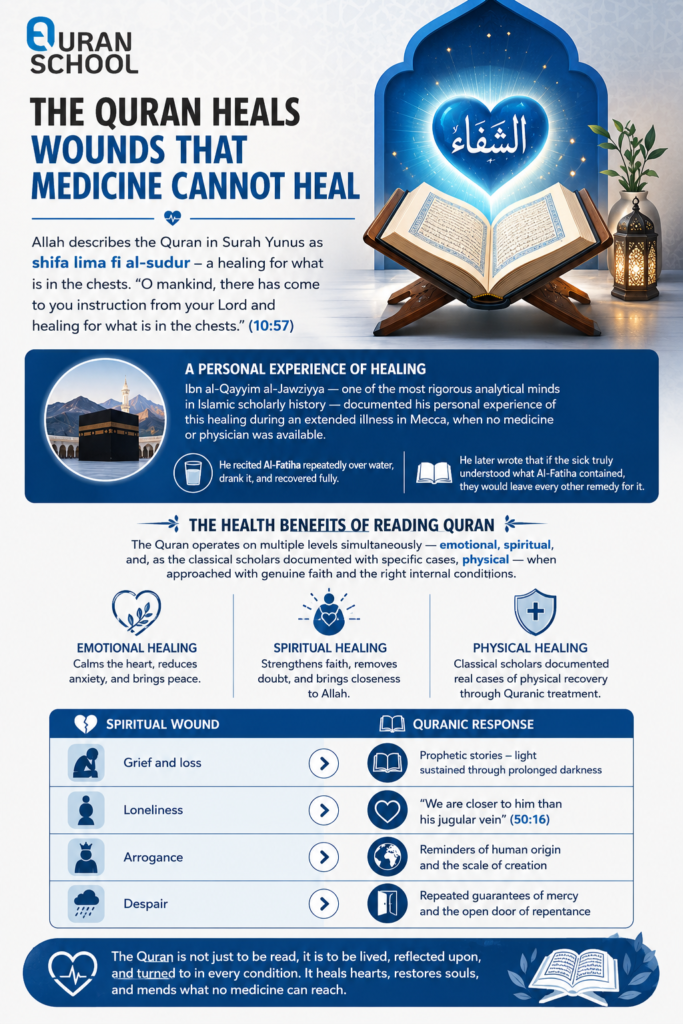
Allah describes the Quran in Surah Yunus as shifa lima fi al-sudur — a healing for what is in the chests. The chest in Quranic language is the seat of emotion, faith, and spiritual life. “O mankind, there has come to you instruction from your Lord and healing for what is in the chests.” (10:57)
Ibn al-Qayyim al-Jawziyya — one of the most rigorous analytical minds in Islamic scholarly history — documented his personal experience of this healing during an extended illness in Mecca, when no medicine or physician was available.
He recited Al-Fatiha repeatedly over water, drank it, and recovered fully. He later wrote that if the sick truly understood what Al-Fatiha contained, they would leave every other remedy for it.
The health benefits of reading Quran operate on multiple levels simultaneously — emotional, spiritual, and, as the classical scholars documented with specific cases, physical — when approached with genuine faith and the right internal conditions.
| Spiritual Wound | Quranic Response |
| Grief and loss | Prophetic stories — light sustained through prolonged darkness |
| Loneliness | “We are closer to him than his jugular vein” (50:16) |
| Arrogance | Reminders of human origin and the scale of creation |
| Despair | Repeated guarantees of mercy and the open door of repentance |
Read also: The Scientific Benefits Of Reading Quran Which Research Now Confirms
6. The Quran Sharpens God-Consciousness And That Changes Every Decision You Make
Taqwa is commonly translated as “fear of God,” but the more precise rendering is spiritual wakefulness — a state in which the weight of your choices becomes visible to you before you make them. Surah Al-Baqarah opens with this description of the Quran’s primary function:“This is the Book about which there is no doubt, a guidance for those conscious of Allah.” (2:2)
Regular Quran reading develops taqwa not by inducing anxiety but by building intentionality. The reader who engages consistently begins living with purpose rather than habit. Ethical shortcuts stop feeling comfortable. Small compromises stop feeling small. This is not legalism — it is the natural effect of sustained proximity to divine speech on human moral perception.
What we learn from the Quran is ultimately how to live wide awake — aware of where you are going and why, rather than drifting through decisions that compound, over years, into an entire life.
Book a free trial class at EQuran School

See Us in Action
Watch a quick snippet from our live, interactive classes below and see how our teachers make learning engaging for all ages!
Start Your Quranic Journey Today
Experience our interactive online classes with a dedicated tutor.
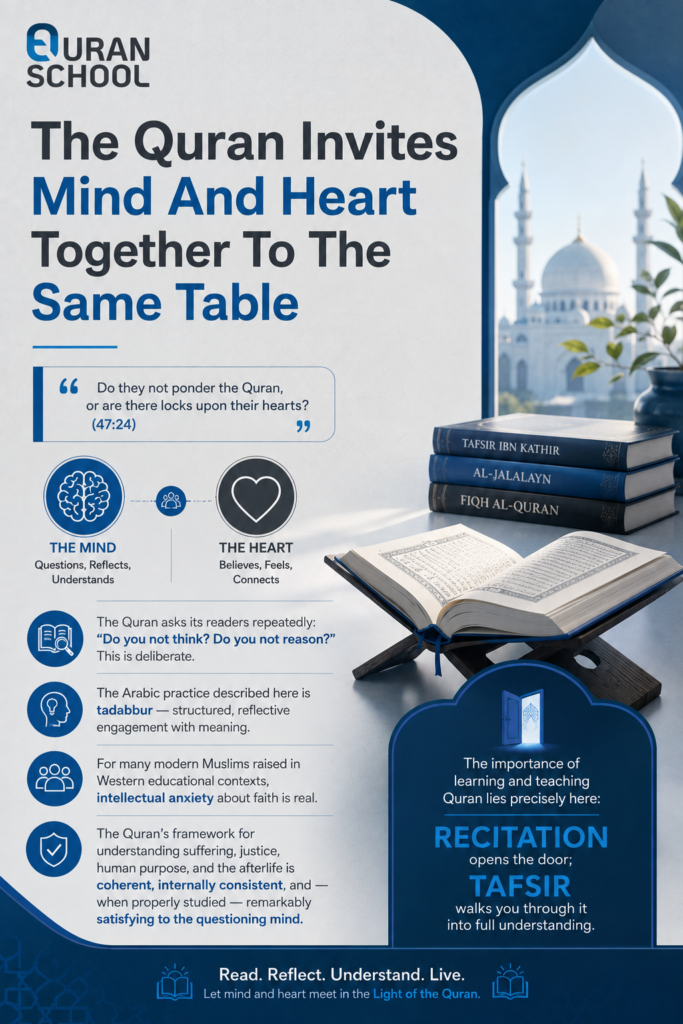
Get Your Free Trial7. The Quran Invites Mind And Heart Together To The Same Table
The Quran asks its readers repeatedly: “Do you not think? Do you not reason?” This is deliberate. Unlike spiritual traditions that ask the intellect to stand down before faith, the Quran invites both to the same table. Surah Muhammad addresses those who let that invitation pass by:“Do they not ponder the Quran, or are there locks upon their hearts?” (47:24)
The Arabic practice described here is tadabbur — structured, reflective engagement with meaning. For many modern Muslims raised in Western educational contexts, intellectual anxiety about faith is real.
The Quran’s framework for understanding suffering, justice, human purpose, and the afterlife is coherent, internally consistent, and — when properly studied — remarkably satisfying to the questioning mind.
The importance of learning and teaching Quran lies precisely here: recitation opens the door; Tafsir walks you through it into full understanding.
Read also: What The Hadith About Reading Quran With Tajweed Reveals?
8. The Quran Intercedes For You On The Day Of Judgment
The Prophet ﷺ made a specific and unforgettable promise about the Quran and the next life: “Recite the Quran, for it will come on the Day of Resurrection as an intercessor for its companions.” (Muslim)
A second hadith narrated by Buraidah describes the Quran meeting its companion when the grave opens — reminding them of the hot afternoons spent in thirst for its sake and the late nights kept awake for it — before presenting them with a crown of honor and ascending with them through the levels of Jannah, ascending further with every verse they knew.
Specific surahs carry documented protective functions alongside this general intercession: Surah Al-Baqarah guards the home and repels spiritual harm, Surah Al-Mulk shields its reciter from the punishment of the grave, and the Mu’awwidhat form a daily fortress recited morning and evening. These are established through authenticated hadith, not tradition.
Read Also: Learn Quran Alphabet
Read also: How Many Good Deeds For Reading The Whole Quran?
9. Blessing Flows Into Every Home Where The Quran Is A Regular Guest
The Quran’s presence changes the atmosphere of a home in ways that are both documented in hadith and experienced in households around the world.
The Prophet ﷺ said: “Do not make your homes like graves — pray in them and recite the Quran in them.” The contrast is intentional. A home without Quran has the spiritual quality of a grave — still, hollow, dark. A home where the Quran is read regularly carries barakah: an increase Allah places in time, in provision, and in the quality of relationships within those walls.
The benefits of reading Quran in Arabic are especially evident in this dimension. Reciting in the original language carries the full weight of the preserved divine speech — the exact words as they were revealed.
For non-Arabic speakers who want to access this benefit in full, learning Quranic Arabic is among the highest-value investments a Muslim can make. The journey is not as long as most people assume when the right curriculum is used.
Start Your Quranic Journey Today
Experience our interactive online classes with a dedicated tutor.
Get Your Free Trial10. The Quran Grows In You A Love For Allah That Rewires How You Treat People
At its core, the Quran is a disclosure — Allah revealing Himself through His names, His attributes, His relationship with creation. Consistent reading does not only inform the intellect about these attributes; it cultivates emotional knowledge of them. Allah describes this mutual relationship in Surah Al-Ma’idah: “He loves them, and they love Him.” (5:54)
As the reader repeatedly encounters Al-Latif (the Subtle), Al-Wadud (the Loving), Al-Hakeem (the Wise) — not as labels but as living realities in narrative, in command, in promise — genuine love develops.
Specific affection. And love for Allah changes everything downstream: it makes generosity natural, forgiveness easier, and service to others feel like the most obvious response to divine generosity. The transformation is behavioral, not merely theological.
Book a Free Trial in Our Online Quran Recitation Classes

How To Build A Quran Reading Practice That Lasts?
Knowing the benefits is one thing. Building the practice that delivers them is another challenge entirely, and the gap between these two is where most good intentions dissolve. The most common failure point is not lack of desire — it is lack of structure. The following few proven principles close that gap.
A. Start Your Quran Practice With A Clear Intention And A Consistent Routine
Reciting a dua before starting Quran class — or any private reading session — transforms the activity from routine into ritual. Seeking refuge with Allah and beginning with Bismillah sets a mental and spiritual context that changes the quality of attention brought to the text.
B. Quality Of Quran Reading Outweighs Volume
Ibn al-Qayyim wrote that one verse read with genuine tadabbur produces more spiritual change than a surah read at speed. A structured 30 day Quran reading schedule — even one that covers only half a page per day — builds compounding momentum that sustained motivation alone cannot.
C. Open Each Session With A Sincere Dua For Learning Quran
This signals commitment and opens the session with a direct act of dependence on Allah’s facilitation — acknowledging that the ability to read and understand is itself a gift.
D. The Pre-Fajr Hours Carry A Distinct Quality For Quran Reading
Surah Al-Muzzammil (73:6) identifies this time specifically as “more conducive to contemplation and more upright in speech.” When the world is quiet and the mind is at its clearest, the Quran lands differently than it does amid the day’s noise.
Read also: The Scientific Benefits Of Reading Quran Which Research Now Confirms
Why EQuran School Is The Right Partner For Every Stage Of The Journey?
The spiritual benefits described in this article are available to every Muslim — but access depends on the ability to read, understand, and engage with the Quran properly. That is precisely where EQuran School steps in.
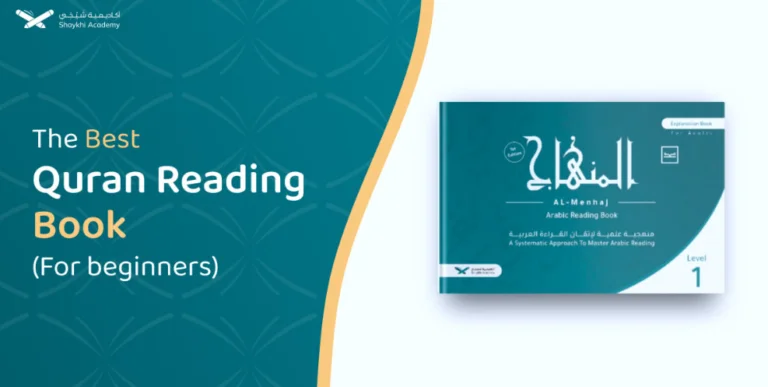
Most online Quran platforms use generic Arabic phonics materials designed for native Arabic children. EQuran School developed the proprietary Al-Menhaj Book — authored by Luqman ElKasabany — specifically for non-Arabic speaking adults and children in Western contexts.
It bridges the gap that generic methods consistently miss, producing faster and more accurate reading for students who arrive with no Arabic background.
Explore Al-Menhaj Book for FREE
For those who want to carry the prophetic instruction forward: the Prophet ﷺ said, “The best among you are those who learn the Quran and teach it.” (Bukhari). Certification pathways and advanced programs are available for students who want to reach that level of service.
Experience Our Classes
Don’t just take our word for it—watch real-time recordings of our online classes below to experience our teaching style firsthand.
Start Your Quranic Journey Today
Experience our interactive online classes with a dedicated tutor.
Get Your Free TrialStart Your Spiritual Journey with E Quran School Today
Transform your understanding and recitation of the Holy Quran from the comfort of your home. At E Quran School, our certified tutors provide personalized, one-on-one guidance tailored to your pace and schedule. Whether you are looking for beginner Quran reading, advanced Tajweed, or Memorization (Hifz) courses, we have a program for you.
Our Quran Courses
- Quran Recitation Classes
- Weekend Quran Classes
- Quran Reading Classes
- Online Quran Classes for Kids
- Learn Quran Online with Tajweed for Kids and Adults
- Online Quran Learning with Tajweed Course
- Quran Classes for Adults
- Female Quran Classes
- Female Quran Teacher for Ladies
- Learn Quran for Beginners
- Quran Qirat Learning Course
EQuran School provides a complete curriculum, including:
- Quran memorization (Hifz) course
- Quran Qirat Learning Course
- Quran Memorization (Hifz) Course
- Online Quran Learning with Tajweed Course
- Quran Tafsir Course
Book a free trial class at EQuran School and experience personalized Quran instruction that adapts to your unique learning needs, Insha’Allah.
Start Your Quranic Journey Today
Experience our interactive online classes with a dedicated tutor.
Get Your Free TrialConclusion
Every benefit named in this article — sakina, tazkiya, taqwa, intercession, healing, barakah — arrives through the same door: consistent presence with the text, an open heart, and the willingness to be changed by what you read.
The Prophet ﷺ said: “Verily, the one who has nothing of the Quran inside him is like a ruined house.” (Al-Tirmidhi). The image is instructive. A ruined house may appear solid from a distance. What it lacks is interior life. The Quran fills what is hollow.
The benefits of reading Quran are not reserved for the fluent, the memorized, or the theologically trained. They reach the struggling beginner reciting her first surah and the seasoned scholar completing his fortieth khatm. The door is always open, and the only requirement to step through it is sincerity.
Frequently Asked Questions
What are the main spiritual benefits of reading Quran daily?
Daily Quran reading delivers sakina (spiritual peace), tazkiya (soul purification), increased taqwa (God-consciousness), and barakah in time and provision. Each letter earns ten good deeds, angels surround every session, and consistent reading positions the Quran as an intercessor on the Day of Judgment. The transformation compounds — the longer the consistency, the deeper the impact on every level of the reader’s life.
Does the Quran help with anxiety and emotional distress?
The Quran directly addresses what classical Islamic scholarship calls askam al-sudur — diseases of the chest — including anxiety, despair, restlessness, and grief. The verse “Verily, in the remembrance of Allah do hearts find rest” (13:28) is not comfort language; it describes a spiritual mechanism.
The rhythm of Tajweed recitation combined with the meanings of specific verses creates conditions that directly counter the patterns of anxiety. Ibn al-Qayyim documented this healing extensively from personal experience and scholarly observation.
Can I receive spiritual benefits from the Quran if I do not understand Arabic?
Yes. Sakina, the company of angels, and the multiplication of rewards are not conditional on comprehension. However, understanding amplifies every benefit significantly. Reading a reliable translation alongside the Arabic text, or enrolling in a Quranic Arabic or Tafsir program, deepens the experience and accelerates spiritual growth considerably.
How much time should I read the Quran each day to notice real change?
Consistency matters more than duration. Five to ten minutes of attentive, unhurried reading daily produces measurable spiritual change over weeks and months.
Classical scholarship consistently emphasizes quality of engagement over word count — one verse read with genuine tadabbur surpasses many pages read without it. The goal is not to finish chapters. It is to be changed by what you read.
What is the best way for a complete beginner to start reading the Quran?
Begin with correct foundations: accurate Arabic letter recognition and pronunciation before attempting memorization or meaning study. A qualified teacher corrects errors that self-study cannot catch.
EQuran School’s beginner program starts with letter sounds, progresses through Tajweed rules, and builds to confident independent reading — all from home, at a pace set by the student and guided by the teacher.
Is there a specific time of day that is best for Quran reading?
The pre-Fajr hours are specifically identified in Surah Al-Muzzammil (73:6) as the time when recitation is “more conducive to contemplation and more upright in speech.” The quiet before dawn, when the mind is clear and distraction minimal, allows the deepest engagement with the text.


Leave a Reply