 Learn Quran

If you want to learn Surah Al-Zalzalah, the order you follow matters more than the hours you put in. Most people start by repeating the words until they stick. Months later, they find out they memorized a mispronunciation — and fixing a habit takes far longer than learning the surah did.
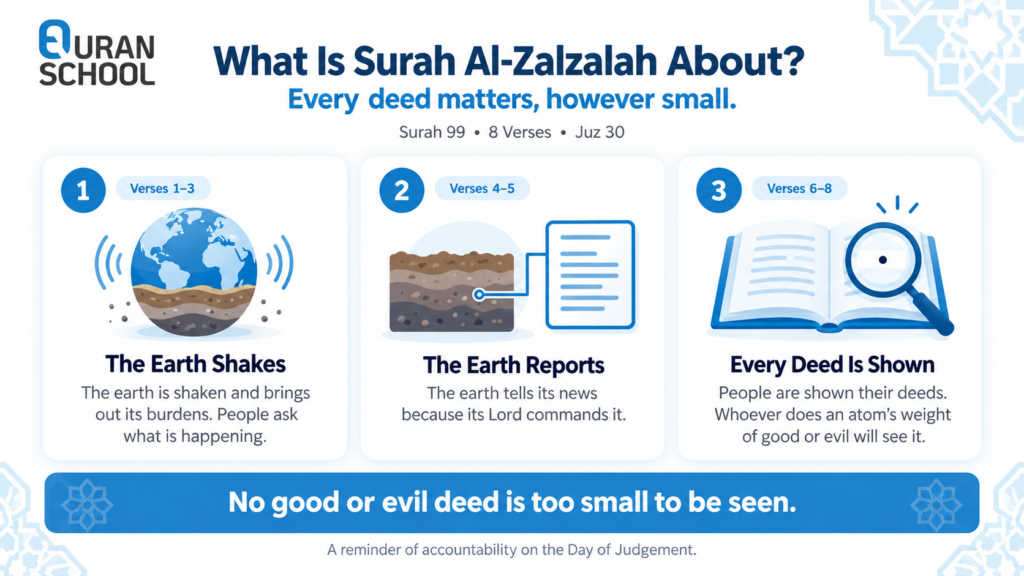
Surah Al-Zalzalah is the 99th chapter of the Quran. It has eight verses and sits in Juz’ 30. It describes the earth’s final shaking on the Day of Judgement, the earth speaking about what happened on it, and every person seeing their own deeds down to the weight of an atom.
The surah is short, so it is one of the first taught to children and new learners. That is also why it is so often learned wrongly. Let’s have a look at the sequence that works.
Step 1: Hear Surah Al-Zalzalah Recited Correctly Before You Read A Word
Play the full surah several times and just listen. Do not read along yet, and do not try to repeat anything.
Choose one reciter and stay with him for the whole surah. Switching between reciters gives your ear several different models, and a beginner cannot yet tell which details are rules and which are personal style.
You are training your ear to hear three things: where each letter comes from in the mouth, how long the elongations are held, and where the reciter pauses.
Play the surah at a slow, teaching pace rather than a fast recitation. Slow recitation separates the letters so you can hear each one clearly. Fast recitation blurs them together and hides exactly what you are trying to learn.
Give this step three or four listens before you move on. That is a few minutes, and it decides how the rest of your learning sounds.
Once the sound is familiar, start reading the text while the audio plays. Let your eyes follow the words your ear already knows. This is the moment the written verse and the correct sound lock together.
Listening first gives your memory a correct model to copy. Reading first gives it your own guesswork to copy.
Reciting correctly is not a technical preference — see what the Sunnah says about reciting with tajweed
Step 2: Learn Two Verses At A Time, Not The Whole Surah At Once
Start with verses 1 and 2 only. Ignore the rest of the surah for now. Say the two verses aloud while looking at the text.
Repeat them until you can say them with your eyes closed. Aloud matters here — silent reading uses your eyes, but recitation uses your tongue, and the tongue is what you will need in prayer.
Then, move to verses 3 and 4. Learn them the same way. Continue in pairs until you have covered all eight verses.
Two verses is the right size for one sitting. One verse is too small, and it leaves you with eight loose pieces that do not join up. Four verses at once is too much, and you end up repeating words without holding any of them.
Pairs solve both problems. You learn the two verses and the join between them in the same effort, so the second verse arrives on its own when you finish the first.
Do not move to the next pair until the current one comes out clean, with no hesitation and no peeking at the text. A shaky pair does not get stronger later. It gets buried under new material and becomes the place where your recitation breaks.
Step 3: After Every New Pair Of Verses, Go Back And Recite From Verse 1
Finish a pair, then start again from the beginning of the surah and recite up to the point you have just reached.
So after verses 3 and 4, recite verses 1 to 4 without stopping. After verses 5 and 6, recite verses 1 to 6. After the last pair, recite the whole surah from start to finish.
Do this from memory, with the text closed. If you look at the page, you are reading, not recalling — and only recall makes the surah stick.
Most learners skip this step because the earlier verses already feel easy. That feeling is the trap. Knowing a verse is not the same as being able to reach it in sequence, and in prayer you always arrive at a verse through the one before it.
Each return to verse 1 does two jobs. It reviews what you already learned, and it builds the chain that carries you from one verse to the next without thinking.
The cost is small: a few extra recitations in each session, maybe two minutes. The benefit is that you never get stuck. Many learners know verses 5 and 6 well on their own, but go blank when they try to reach them from verse 1.
If you stumble at the same joint twice, stop and repeat only those two verses — the end of one and the start of the next — five or six times. Weak joints are almost always where recitation breaks later.
See Us in Action
Watch a quick snippet from our live, interactive classes below and see how our teachers make learning engaging for all ages!
Start Your Quranic Journey Today
Experience our interactive online classes with a dedicated tutor.
Get Your Free TrialStep 4: Understand What Each Verse Means While You Memorize It
Learn what a verse means in the same session you learn its words. Do not leave the meaning for later.
Meaning gives the surah an order you can follow. Without it, you are holding eight strings of sound. With it, you are following one scene from start to finish.
Look at how the surah moves:
- Verse 1 — the earth shakes.
- Verse 2 — it throws out what is inside it.
- Verse 3 — people ask in shock what is happening.
- Verse 4 — the earth reports everything done on it.
- Verse 5 — it speaks because Allah commanded it to.
- Verse 6 — people come forward in groups to see their deeds.
- Verse 7 — an atom’s weight of good is seen.
- Verse 8 — an atom’s weight of evil is seen.
Tell that story in your own words once. Now the verses are not random. Each one answers the one before it.
This also helps when a word slips. You know verse 5 explains why the earth spoke. That clue brings the words back, instead of leaving you stuck.
Meaning matters most at the end. Verses 7 and 8 are the same except for one word: khayran (good) in verse 7, and sharran (evil) in verse 8. Learners who memorize by sound alone mix them up again and again.
More repetition will not fix that. The meaning will. Good comes first, then evil. You do not need deep tafsir yet. A simple, correct meaning for each verse is enough. Study the full explanation later, once the words are secure.
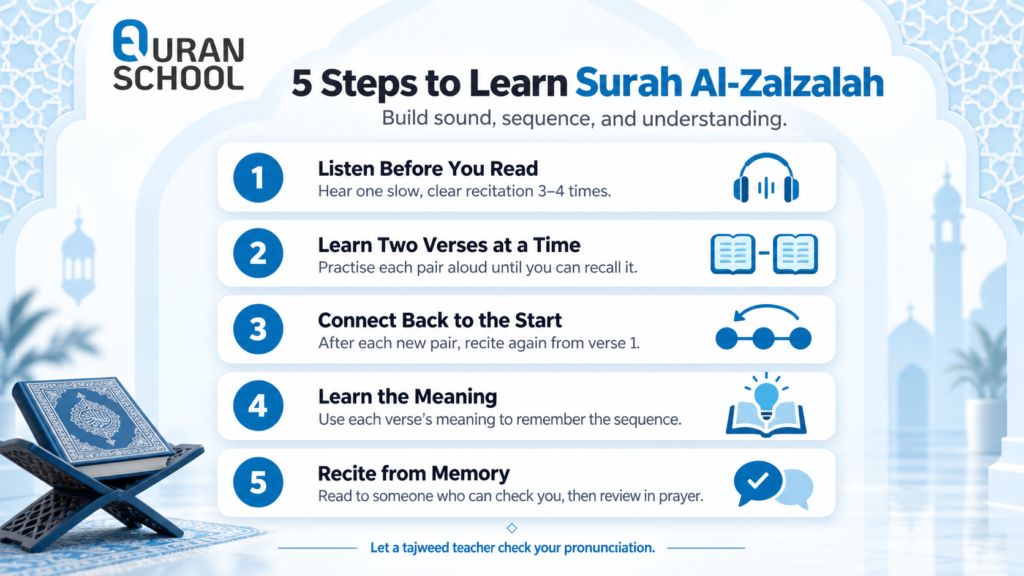
Step 5:Recite The Surah To Someone Who Can Correct You
You have not finished learning a surah until you can recite it out loud, with the text closed, to another person.
Reciting alone feels fine. You skip a word without noticing. You stretch a letter too long. You stop in the wrong place. Nobody tells you, so the mistake stays.
Another listener catches what you cannot hear yourself. Recite to a teacher, a parent, or a study partner. Ask them to stop you the moment something sounds wrong — not at the end, but right away.
The best listener is someone who knows tajweed. A teacher hears a short vowel that should be long, or a letter coming from the wrong place in the mouth. A parent or friend can still catch missed and swapped words, which is most of the problem.
Recite the full surah in one go, without stopping to check the page. If you break down, note where it happened, repeat that part, and start again from verse 1.
Then move the surah into your daily prayers. Use it in Fajr, in Sunnah prayers, in any unit you like.
Prayer is the best review schedule you have. It repeats the surah every day, at set times, in a place where you cannot look at the text.
Give it two weeks of this. After that, the surah stops being something you recall and becomes something you simply have.
A qualified teacher hears the mistakes you cannot hear yourself and corrects them while you recite. Start with a free trial class at eQuran School Online.

The Meaning Of Surah Al-Zalzalah, Verse By Verse
Use this table while you memorize, not after. Each line anchors the verse above and below it. Read the meaning first, then say the verse, so the words arrive with a picture attached.
The transliteration is there to guide your tongue, not to replace the Arabic text — keep the mushaf open beside it. Cover the middle column and try to recall each verse from its meaning alone; that is the fastest way to find which verses are still weak.
| Verse | Transliteration | Meaning |
| 1 | Idhā zulzilat-il-arḍu zilzālahā | When the earth is shaken with its final, violent shaking |
| 2 | Wa akhrajat-il-arḍu athqālahā | And the earth throws out the burdens it has held inside it |
| 3 | Wa qāl-al-insānu mā lahā | And man says, in shock, “What is happening to it?” |
| 4 | Yawma’idhin tuḥaddithu akhbārahā | That Day, the earth will report its news — everything done upon it |
| 5 | Bi’anna rabbaka awḥā lahā | Because your Lord has commanded it to speak |
| 6 | Yawma’idhin yaṣdur-un-nāsu ashtātan liyuraw a’mālahum | That Day, people will come forward in separate groups to be shown their deeds |
| 7 | Faman ya’mal mithqāla dharratin khayran yarah | So whoever does an atom’s weight of good will see it |
| 8 | Wa man ya’mal mithqāla dharratin sharran yarah | And whoever does an atom’s weight of evil will see it |
The surah moves in three parts. The earth shakes and empties itself (verses 1–2). People react, and the earth speaks (verses 3–5). Then people are separated and shown their record (verses 6–8).
Each part leads into the next, so the surah reads as one continuous scene rather than eight separate statements. Hold these three parts in mind and you will always know roughly where you are in the surah, even if a single word escapes you.
Read also: How to Master Surah An-Nas in 5 Simple Steps
Which Tajweed Rules Appear In Surah Al-Zalzalah?
Tajweed is the set of rules that control how each Arabic letter is pronounced when you recite the Quran. Surah Al-Zalzalah contains most of the rules a beginner needs: qalqalah, the rules of the silent nūn and tanwīn, the sun and moon lām, and several elongations.
The surah is short, so it is an efficient text for practising these rules on purpose instead of by accident. The rules below are grouped by family, because that is how they are taught and how they are easiest to remember.
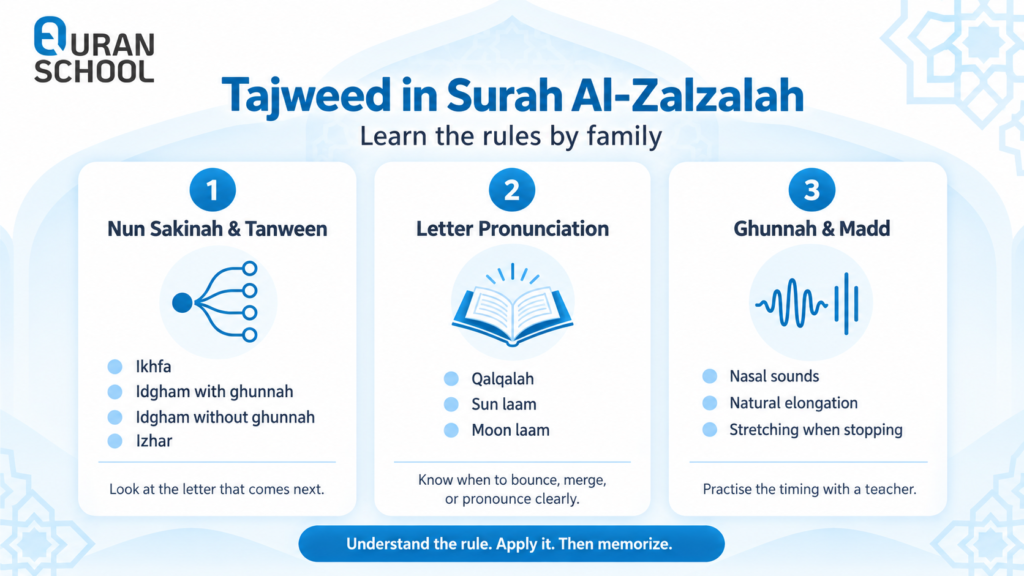
1. Rules of the silent nūn and tanwīn
These four rules decide what happens when a silent nūn sound meets the letter after it. They appear more than any other rule in this surah.
| Rule | Where it occurs | What to do |
| Ikhfā’ ḥaqīqī — الإخفاء الحقيقي | الْإِنسَانُ al-insānu (v.3)؛ ذَرَّةٍ شَرًّا dharratin sharran (v.8) | Hide the nūn sound and hold a nasal sound for two counts |
| Idghām with ghunnah — الإدغام بغُنَّة | يَوْمَئِذٍ يَصْدُرُ (v.6)؛ فَمَن يَعْمَلْ (v.7)؛ خَيْرًا يَرَهُ (v.7)؛ وَمَن يَعْمَلْ (v.8)؛ شَرًّا يَرَهُ (v.8) | Merge into the next letter while holding the nasal sound |
| Idghām without ghunnah — الإدغام بغير غُنَّة | أَشْتَاتًا لِّيُرَوْا ashtātan liyuraw (v.6) | Merge fully, with no nasal sound |
| Iẓhār — الإظهار | ذَرَّةٍ خَيْرًا dharratin khayran (v.7) | Pronounce the nūn sound clearly — no merging, no hiding |
2. Rules that change how a single letter is pronounced
These three rules do not depend on the letter that follows. They belong to the letter itself, and they are fixed wherever that letter appears in this position. Learn them once and you will apply them correctly in every surah, not only in Surah Al-Zalzalah.
| Rule | Where it occurs | What to do |
| Qalqalah (minor) — القلقلة الصغرى | The silent ق in أَثْقَالَهَا athqālahā (v.2) and مِثْقَالَ mithqāla (v.7, v.8) | Give the letter a light bounce, without adding a vowel |
| Moon lām — اللام القمرية | الْأَرْضُ al-arḍu (v.1, v.2) | Pronounce the ل of “al-” clearly |
| Sun lām — اللام الشمسية | النَّاسُ an-nāsu (v.6) | The ل is silent, and the ن is doubled |
3. Rules that control how long a sound is held
These three rules are about timing, not about which letter you say. Each one is measured in counts — a count is roughly the time it takes to lower or raise one finger.
Hold them too short and the recitation sounds rushed; hold them too long and it sounds unnatural, which is why this group is the hardest to judge without a listener.
| Rule | Where it occurs | What to do |
| Ghunnah of a doubled letter — الغُنَّة | بِأَنَّ bi’anna (v.5)؛ النَّاسُ an-nāsu (v.6) | Hold the nasal sound for two counts |
| Madd līn — مد اللين | يَوْمَئِذٍ yawma’idhin (v.4, v.6) | Soften the و smoothly instead of rushing it |
| Madd ‘iwaḍ — مد العِوَض | When you stop on أَشْتَاتًا ashtātan or خَيْرًا khayran | Stretch the ending for two counts |
If all of this is new, learn group 1 first. It covers the largest number of words in the surah, and it is where beginners make the most mistakes. Group 2 is quick to fix once someone points it out. Group 3 is about timing, and it is the hardest to judge on your own.
If any row here is unfamiliar, close that gap before you memorize — not after. A rule learned late has to replace a habit; a rule learned first only has to be applied.
If you want the wider case for learning these rules properly, read the benefits of reading Quran with tajweed.
Five Common Mistakes When Learning Surah Al-Zalzalah
Most people who struggle with this surah are not struggling with memory. They are repeating a small error that nobody corrected early, and it only shows up later — in prayer, or when someone asks them to recite.
The five mistakes below account for almost every case. Each one is easy to avoid at the start and slow to fix afterwards. Read them before your first session, not after your last.
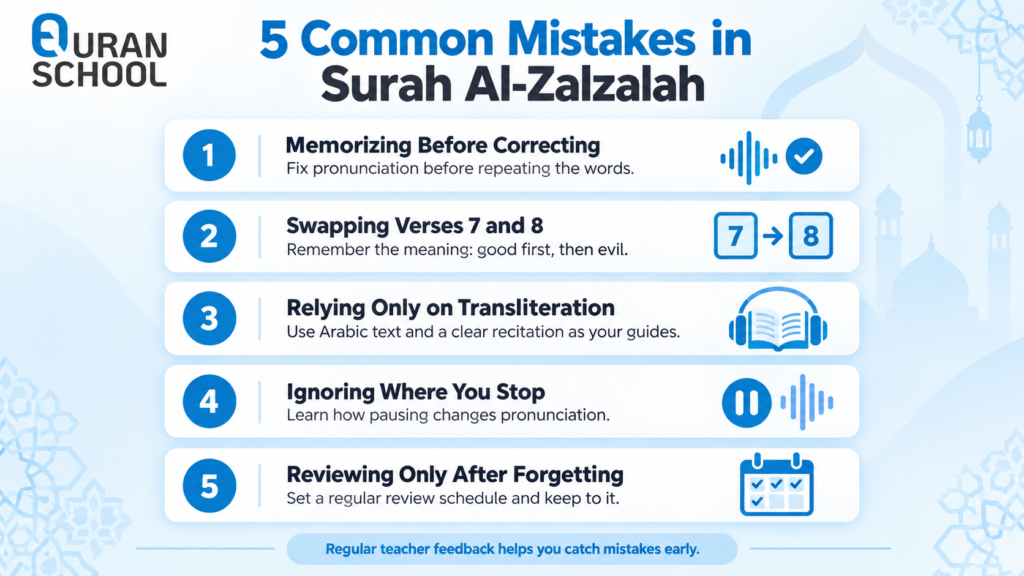
- Memorizing before fixing pronunciation. Every repetition makes the mistake harder to remove. Correct the sounds first.
- Swapping verses 7 and 8. The two verses differ by one word. Anchor them by meaning: good comes first, then evil.
- Learning from transliteration only. English letters cannot show the Arabic ḍād, ẓā’, ḥā’, or ‘ayn. Transliteration is a support, not a source.
- Ignoring where you stop. Stopping changes the pronunciation. Khayran stretches when you pause on it. Many learners sound fluent until they have to pause.
- Reviewing only when you forget. Review on a schedule instead. A surah recited daily for two weeks is far more secure than one revisited by accident.
All five of these disappear when someone qualified is listening. A weekly session with a Quran teacher catches the mistake in the first month, not in the third year. Learn Quran with Tajweed at eQuran School Online.

What Is Surah Al-Zalzalah About?
Surah Al-Zalzalah is about the accounting of every deed, told through the scene of the earth shaking and then speaking. It takes its name from the word zilzāl, which means a violent shaking, in the first verse.
The surah opens on the Day of Judgement. The earth convulses, throws out everything inside it, and then speaks about what people did on its surface. Its testimony is not a summary — it is a full record, given by the ground itself.
The message is direct: nothing is too small to be recorded, and nothing is too small to be seen again.
That is why the surah ends with the weight of an atom. It names the smallest thing a person can imagine, then says that even this is seen. A good word, a small charity, a quiet kindness — all of it counts, and so does the opposite.
It is also why this surah is taught early. It is short enough for a child, yet it carries one of the clearest statements about accountability in the whole Quran.
Surah Al-Zalzalah is the 99th chapter, has 8 verses, and sits in Juz’ 30. Scholars differ on where it was revealed, and the majority classify it as Madani — revealed after the migration to Madinah.
How Long Does It Take To Learn Surah Al-Zalzalah?
Most adults who already read Arabic can memorize Surah Al-Zalzalah in about four sessions of twenty minutes. That means two verses per session, with a review of everything learned so far at the start of each one.
Spread those sessions over four days rather than doing them in one sitting. Sleep is part of memorization, and verses learned across separate days hold far better than verses crammed into one afternoon.
Add time if you are working from transliteration. You will need extra listening and imitation to get the sounds right.
Children do better with shorter sessions repeated more often. Ten minutes daily beats forty minutes twice a week.
Also count the review time after the surah is learned. Memorizing takes days, but making the surah permanent takes about two weeks of daily recitation.
One factor decides your real timeline: whether anyone corrects you while you learn. Self-taught learners move slower because every repetition reinforces whatever they are doing — right or wrong.
You may also like: a one-year Quran reading plan
What Is The Virtue Of Surah Al-Zalzalah?
The strongest report about this surah concerns its ending. Someone once asked the Prophet ﷺ a question, and no verse had been revealed about that particular matter.
He answered by pointing to the ending of this surah: “So whoever does an atom’s weight of good will see it.” He called it al-āyah al-fādhdhah al-jāmi’ah — the one verse that stands alone and covers everything.
This is reported in Sahih al-Bukhari and Sahih Muslim.
The point is simple. This one verse settles the question of accountability for every act, however small. Nothing needs to be added to it, and nothing falls outside it.
A second narration appears in Jāmi’ at-Tirmidhī. It says the surah equals half of the Quran. At-Tirmidhī himself graded that narration gharīb, and scholars differ over how strong it is. Other wordings mention a quarter instead of a half.
This kind of difference is normal in hadith study. Scholars weigh the chain of narrators and the wording before they accept a report, and they do not always reach the same conclusion.
So treat it as a reported virtue that scholars discuss, not as a settled fact. And do not build a practice on a fixed number of recitations.
Read also: Master Surah Lahab: Easy Step-by-Step Guide
Two Beliefs About Surah Al-Zalzalah With No Established Basis
Both of these questions come up constantly. The honest answer to both is the same.
Is There A Specific Du’a To Say After Surah Al-Zalzalah?
No specific supplication is authentically reported from the Prophet ﷺ to be said after reciting Surah Al-Zalzalah.
You will find such du’as circulated online and on social media. They usually come with a promise attached: recite this, then say that, a set number of times, and a specific result follows. None of it goes back to an authentic report.
A Muslim may supplicate with anything good at any time. But tying a fixed du’a, a fixed count, or a promised outcome to this surah has no basis in the Sunnah.
The rule in worship is simple. Acts of worship are taken from what was taught, not from what sounds beautiful or spreads widely.
So recite the surah, reflect on what it says, and ask Allah for whatever you need in your own words. That is the practice, and nothing is missing from it.
If you come across a du’a presented as “the du’a of Surah Al-Zalzalah,” ask where it is reported before you act on it. A teacher can check the source for you in a few minutes.
Does Reciting Surah Al-Zalzalah Harm An Oppressor?
There is no authentic evidence that reciting Surah Al-Zalzalah harms an oppressor or anyone else.
This idea spreads widely online, often with instructions: recite it a set number of times, with a certain intention, against a particular person. Nothing of that is reported from the Prophet ﷺ or his Companions.
The Quran was not given as a tool to direct at people. It was given as guidance, as a reminder, and as a cure for the heart.
Someone who has been wronged is taught to rely on Allah, take lawful steps, and use the supplications that are established — including Surah Al-Falaq and Surah An-Nās for protection.
The supplication of a wronged person is answered, and that is the door the Sunnah points to. If you supplicate against someone who wronged you, stay within the size of the wrong itself, without going further.
So recite Surah Al-Zalzalah for what it actually is: a reminder that every deed is seen and counted. That reminder applies to the one who wronged you — and to you as well.
Read also: Do You Really Have to Learn Tajweed?
How To Teach Surah Al-Zalzalah To Children
Children learn this surah by ear, in small pieces, with immediate correction. Follow these six points.
- Start with sound, not text. Play the surah in the background for a few days until the rhythm is familiar. The child will begin repeating parts of it without being asked.
- Teach half a verse at a time. Say it, then have the child say it back straight away. Correction works best in the same moment as the mistake.
- Keep sessions to five or ten minutes. Short and daily beats long and occasional. Stop while the child is still enjoying it.
- Make the meaning concrete. The earth shakes. The earth speaks. Every small thing is seen. Children hold on to stories, and this surah is a story from start to finish.
- Review everything learned so far, every day. Begin each session from verse 1 and recite up to where the child has reached.
- Move it into prayer early. Once the first four verses are solid, let the child recite them in salah. Prayer turns review into a daily habit.
One more thing: praise the correct recitation, not the speed. A child who finishes the surah in three days with five mistakes has learned less than a child who took two weeks and recites it cleanly.
Experience Our Classes
Don’t just take our word for it—watch real-time recordings of our online classes below to experience our teaching style firsthand.
Start Your Quranic Journey Today
Experience our interactive online classes with a dedicated tutor.
Get Your Free Trial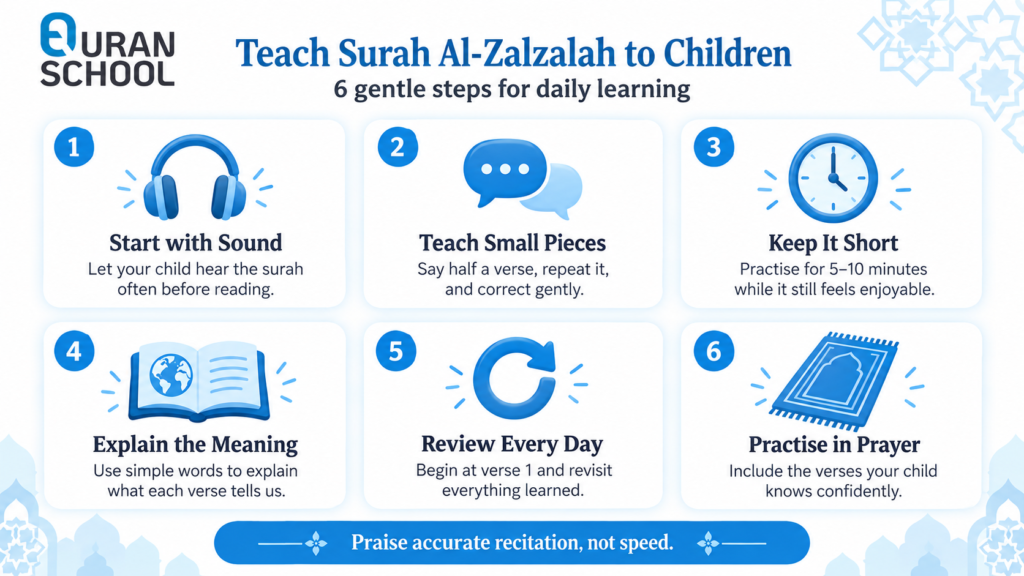
Learn Surah Al-Zalzalah Correctly, With A Teacher Who Hears Every Letter
Surah Al-Zalzalah takes a few sessions to memorize — and years to fix if you memorize it wrongly. The difference is one thing: someone qualified listening while you recite.
At eQuran School Online, you learn with certified Quran teachers in one-to-one online classes built around your level. Your teacher corrects pronunciation from the first session, applies tajweed rules as they appear in the text, and follows a structured memorization and review plan instead of repetition without direction.
If your goal is clean recitation, our Quran classes with tajweed start exactly there. If you want to move surah by surah through the Quran, the Hifz program gives you a memorization and review plan you can actually keep. Classes are scheduled around your time zone, for adults and children alike.

👉 Book your free trial class — recite Surah Al-Zalzalah to a certified teacher and hear exactly what to fix, from the first verse.
Our Quran Courses
- Quran Tafsir Course
- Zoom Quran Classes
- Skype Quran Classes
- Learn Quran Easily at Home
- Al-Azhar Quran Course
- Sunni Online Quran Classes
- Intensive Quran Course
- Online Quran Classes Based in Saudi Arabia
- Quran Teachers
- Noorani Qaida Course
- Noorani Qaida Course for Kids
- Quran Memorization (Hifz) Course
- Hifz Classes for Adults
- Quran Ijazah Program
- Online Arabic and Quran Classes
Conclusion
Learning Surah Al-Zalzalah comes down to sequence. Listen to a skilled reciter. Fix your pronunciation. Memorize in pairs of verses. Connect each pair back to the start. Learn the meaning as you go. Then recite from memory to someone who can correct you.
Eight verses, four sessions, and one habit of daily review.
Nothing in that list is difficult. What makes the difference is doing the steps in order and not skipping the two that feel optional — listening before reading, and reciting to someone who will stop you.
Expect the first two sessions to feel slow. That is the pronunciation work, and it is the part that pays you back later. By the third session, the verses start arriving on their own.
Once the surah is secure, keep it in your daily prayers for two weeks. After that it stops being something you revise and becomes something you simply have.
The same method then carries over. Surah Al-Adiyat, Surah Al-Qari’ah, Surah At-Takathur — the surahs around this one in Juz’ 30 are learned the same way, and each one goes faster than the last.
Frequently Asked Questions
How Many Verses Does Surah Al-Zalzalah Have?
Surah Al-Zalzalah has 8 verses. It is chapter 99 of the Quran and sits in Juz’ 30, the final part of the Quran.
Is Surah Al-Zalzalah Makki Or Madani?
Scholars differ. The majority classify Surah Al-Zalzalah as Madani, revealed after the migration to Madinah. A minority hold that it is Makki.
How Long Does It Take To Memorize Surah Al-Zalzalah?
Most adults who read Arabic can memorize Surah Al-Zalzalah in about four sessions of twenty minutes, at two verses per session with review. Learners using transliteration and young children usually need more, shorter sessions.
Why Is It Called Surah Al-Zalzalah?
The surah is named after the word zilzāl in its first verse, which means a violent shaking or earthquake. It refers to the shaking of the earth on the Day of Judgement.
Can I Learn Surah Al-Zalzalah Without Knowing Arabic?
You can start by listening to a skilled reciter and imitating him. But transliteration cannot represent several Arabic letters. Learning the Arabic script, even at a basic level, is what turns approximation into correct recitation.
Which Tajweed Rules Should I Focus On In Surah Al-Zalzalah?
Focus on qalqalah in the silent ق, ikhfā’ in الْإِنسَانُ, idghām with ghunnah in فَمَن يَعْمَلْ and وَمَن يَعْمَلْ, and the two-count elongations. These cover most of the rules in the surah.










Leave a Reply