 Quran
Quran
There is a moment most Quran learners know well — the pause before a difficult verse, the repeated stumbling over the same letter, the quiet thought that maybe you simply are not cut out for this. If you have been there, the hadith about reading Quran with difficulty was spoken for exactly that moment.
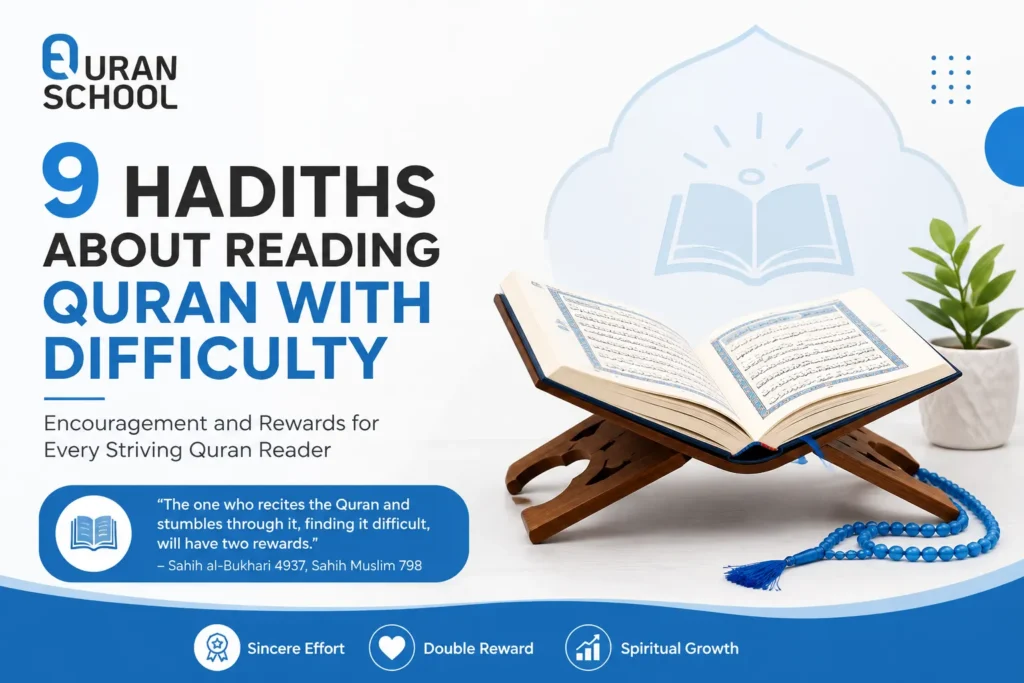
Aisha (may Allah be pleased with her) reported that the Messenger of Allah ﷺ said:“The one who is proficient in the Quran will be with the noble, righteous scribing angels (as-safarah al-kiram al-bararah). The one who recites the Quran and stumbles through it, finding it difficult and burdensome, will have two rewards.“ (Sahih al-Bukhari 4937, Sahih Muslim 798)
This prophetic statement does something few religious texts do so directly: it names the struggle without shame, describes the struggling reader without negative judgment, and attaches to that reader a reward distinct from anything the fluent reader receives.
Understanding this hadith fully reshapes how you approach recitation altogether. This article does that work through eight concrete lessons, each grounded in the hadith itself and in the classical tradition that has interpreted it across centuries.
Start Mastering the Quran from Home Today with Free Trial for your first session

1. Gaining Double Reward Is The First Lesson Of The Hadith About Reading Quran With Difficulty
The Prophet ﷺ used the Arabic dual: two rewards, specifically. Scholars consistently identify the first as the reward for recitation itself — with each Arabic letter earning ten good deeds, as confirmed in the hadith of Ibn Mas’ud (Tirmidhi, sahih by al-Albani). The second reward is exclusively for the difficulty, the patience, and the sustained effort.
The benefits of reading Quran reach every reader, fluent or not. But this second reward is something only the struggling reader can access. It is not a consolation prize — it is a divinely calibrated response to a particular kind of striving that the fluent reader, by definition, cannot replicate.
Learn Noorani Qaida Online and start your free trial Now

Read also: 9 Hadiths About Reciting Quran Beautifully
2. The Key Is Your Sincerity Of Striving In Reading Quran
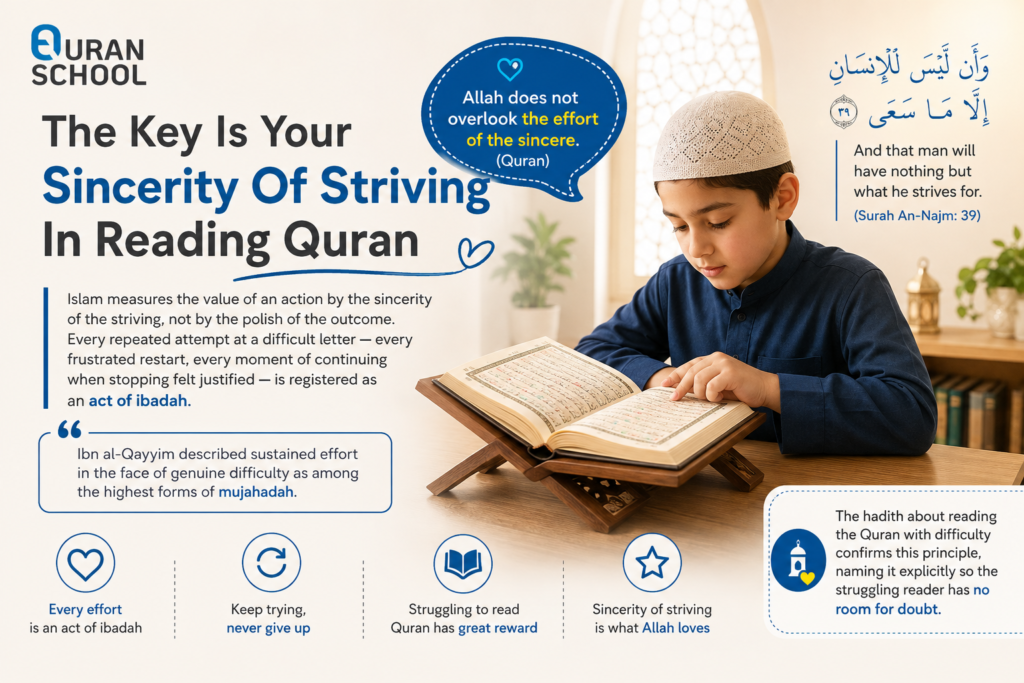
Islam measures the value of an action by the sincerity of the striving, not by the polish of the outcome. Every repeated attempt at a difficult letter — every frustrated restart, every moment of continuing when stopping felt justified — is registered as an act of ibadah. Ibn al-Qayyim described sustained effort in the face of genuine difficulty as among the highest forms of mujahadah.
This is what we learn from the Quran across multiple verses: Allah does not overlook the effort of the sincere. The hadith about reading the Quran with difficulty confirms that same principle for the specific act of recitation, naming it explicitly so the struggling reader has no room for doubt.
3. The Difficulty In The Hadith About Struggling To Read Quran Does Not Mean Spiritual Delay
One of the most damaging misconceptions in Quranic learning is the idea that difficulty signals spiritual distance from Allah. The hadith dismantles this completely. The Prophet ﷺ described the struggling reader without any negative judgment — only the promise of reward.
Sheikh Ibn Baz (may Allah have mercy on him) was asked about a reader who makes errors and struggles, and replied: “He should strive, and he will have a great reward.” Difficulty in recitation is a stage of learning, not a measure of spiritual standing. Understanding the importance of learning and teaching Quran means accepting that both sides of the journey — the learning and the teaching — carry worth at every stage, not only at completion.
Read also: 8 Hadiths About Reading Quran In 3 Days
Don’t Wait to Learn Quran Easily at Home and start with a single click.

4. Allah Does Not Waste A Single Moment Of Your Effort
The hadith functions as a statement of divine accounting: nothing placed into learning the Quran disappears unrewarded. Umar ibn al-Khattab (may Allah be pleased with him) reportedly spent twelve years on Surah al-Baqara before considering his understanding of it complete. That sustained engagement was not failure — it was depth, and every moment of it was counted.
For readers building consistent practice, following a structured 30 day Quran reading schedule creates daily momentum that prevents the discouragement of long gaps between sessions. Small, consistent sessions compound. Every one of them adds to a total that Allah does not lose track of.
Read also: Reward For Reading Quran And The Blessings That Follow
See Us in Action
Watch a quick snippet from our live, interactive classes below and see how our teachers make learning engaging for all ages!
Start Your Quranic Journey Today
Experience our interactive online classes with a dedicated tutor.
Get Your Free Trial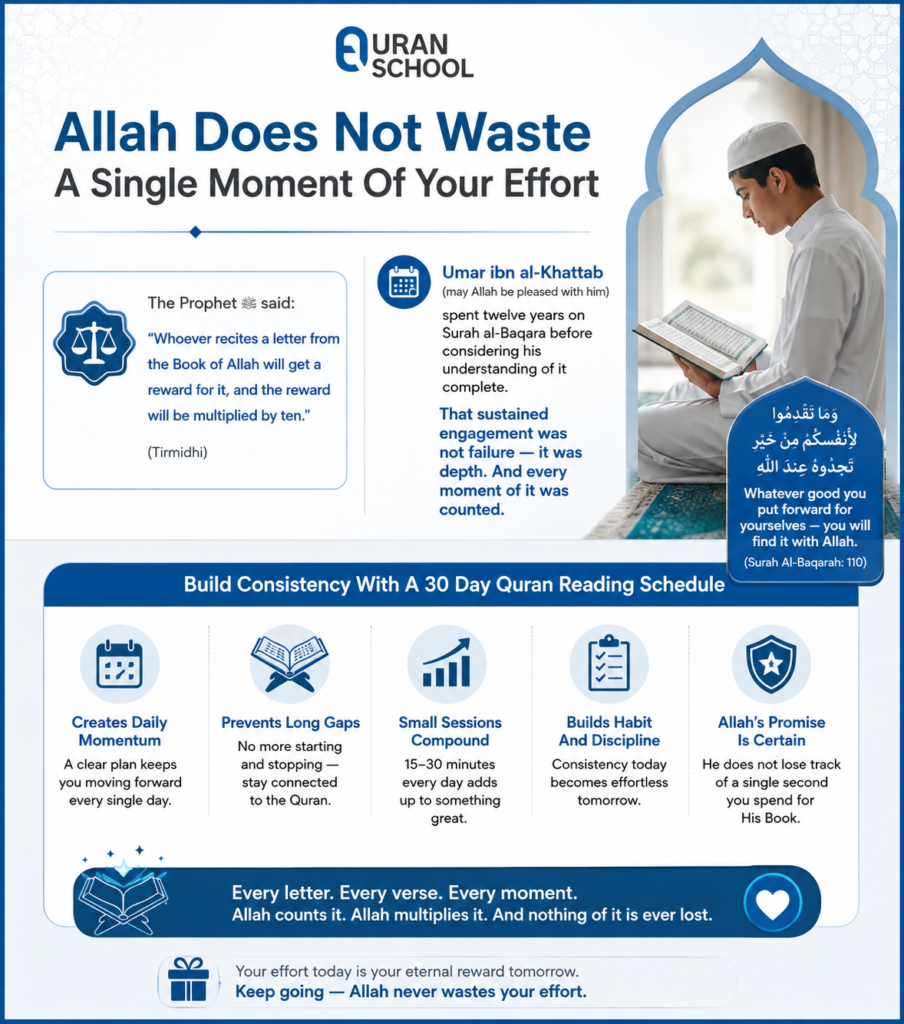
5. The Fluent Reader Holds A Higher Station
Imam al-Nawawi is explicit in his commentary on Sahih Muslim: the double reward for the struggling reader is not equal to the overall reward of the mahir. The proficient reader is described as being with the noble, righteous angels — a companionship that scholars describe as among the highest spiritual ranks promised in hadith literature.
The struggling reader earns two rewards for their specific condition, but the mahir’s station remains greater. This is not discouraging — it is directional. The door to fluency stays open for every reader who keeps working toward it, and the benefits of Quran recitation are real and accumulating at every level of progress.
Understanding this prevents two opposite mistakes: giving up because fluency feels impossible, and becoming complacent because the double reward feels sufficient.
Join The Best Quran Reading Course Online at our EQuran School

6. Seeking A Qualified Teacher Is The Path The Prophet ﷺ Pointed To
The hadith does not say “struggle alone and you will be rewarded.” Sheikh Ibn Baz added to his commentary: “If someone is available to teach him and help him, he should seek assistance from those righteous brothers who have understanding of the Quran.” Seeking instruction is not an admission of defeat — it is the natural next step the prophetic tradition points to.
The Prophet ﷺ himself said: “The best of you are those who learn the Quran and teach it” (Bukhari 4739). The two rewards do not disappear when you accept help. They are joined by the reward of the student who sought knowledge actively and took the path of correction.
Book Your Free Session with One of EQuran School’s Certified Teachers
7. Spiritual Causes Of Difficulty Are Real And Addressable
Imam al-Shafi’i famously complained of poor memorization to his teacher Waki’ ibn al-Jarrah, who replied: “Knowledge is a light, and Allah does not give His light to the disobedient.” This is a practitioner’s observation, repeated by scholars and teachers across generations — not a theoretical claim.
Sin and distraction create a real heaviness that affects recitation. This does not mean every struggle is caused by sin, but it does mean that increasing dhikr, reducing distraction, and seeking forgiveness consistently make a measurable difference.
Teachers of Quran recitation classes regularly observe that students who build spiritual habits alongside pronunciation practice make steadier and faster progress than those who treat recitation as purely technical.
Start A Free Trial For Your Quranic Journey Today

8. Every Letter Still Earns Ten Rewards No Matter How Slowly You Go
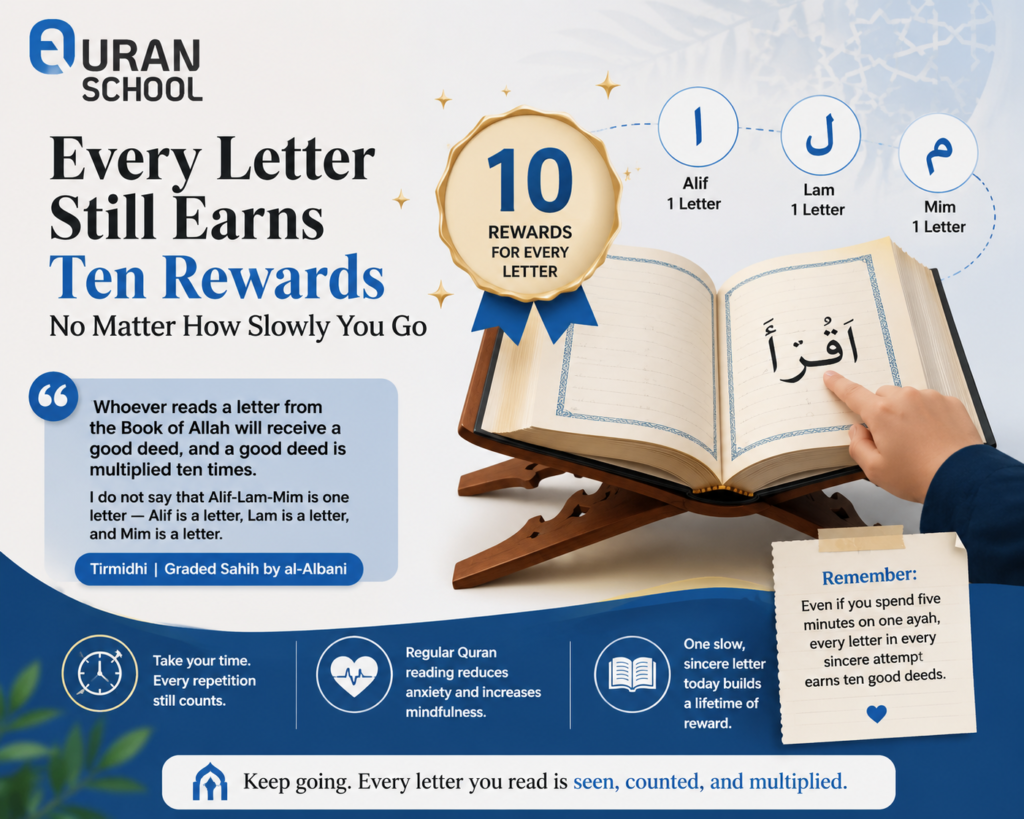
The Prophet ﷺ said: “Whoever reads a letter from the Book of Allah will receive a good deed, and a good deed is multiplied ten times. I do not say that Alif-Lam-Mim is one letter — Alif is a letter, Lam is a letter, and Mim is a letter.” (Tirmidhi, graded sahih by al-Albani)
This hadith runs directly parallel to the hadith about reading the Quran with difficulty. Even if a reader spends five minutes repeating a single ayah — working through corrections, restarting, trying again — every letter in every sincere repetition earns ten good deeds.
The health benefits of reading Quran, including documented reductions in anxiety and heightened mindfulness reported in academic research, are most fully realized through regular practice and regular practice begins one slow, rewarded letter at a time.
9. Why Quranic Arabic Trips Up And What Actually Fixes It?
The difficulty most English-speaking adult learners encounter is not a failure of devotion. At its root, it is a phonological gap: Quranic Arabic contains sounds that simply do not exist in English, French, Urdu, or most other languages. Understanding this gap is the first step to closing it.
A. The Phonological Gap That No Amount Of Willpower Alone Can Bridge
Letters like Ain (ع), Ghayn (غ), Kha (خ), and the emphatic consonants Sad (ص) and Dad (ض) require precise articulator positioning that takes weeks of targeted practice to produce correctly. Neither willpower nor repetition of the wrong sound trains the mouth to produce these letters accurately — only instruction that identifies the exact placement and provides targeted exercises changes the output.
Many adult learners understand the benefits of reading Quran in Arabic deeply — they know that the Quran’s linguistic miracle is inseparable from its Arabic form, and that the rewards of recitation attach to the Arabic letters specifically.
That motivation is real and important. But motivation applied without the correct method produces readers who work hard and still cannot understand why they are not improving.
B. How The Right Method Changes Everything
Most online Quran platforms use generic Arabic phonics materials designed for native Arabic children. EQuran School developed the proprietary Al-Menhaj Book — authored by Luqman ElKasabany — specifically for non-Arabic speaking adults and children in Western contexts.
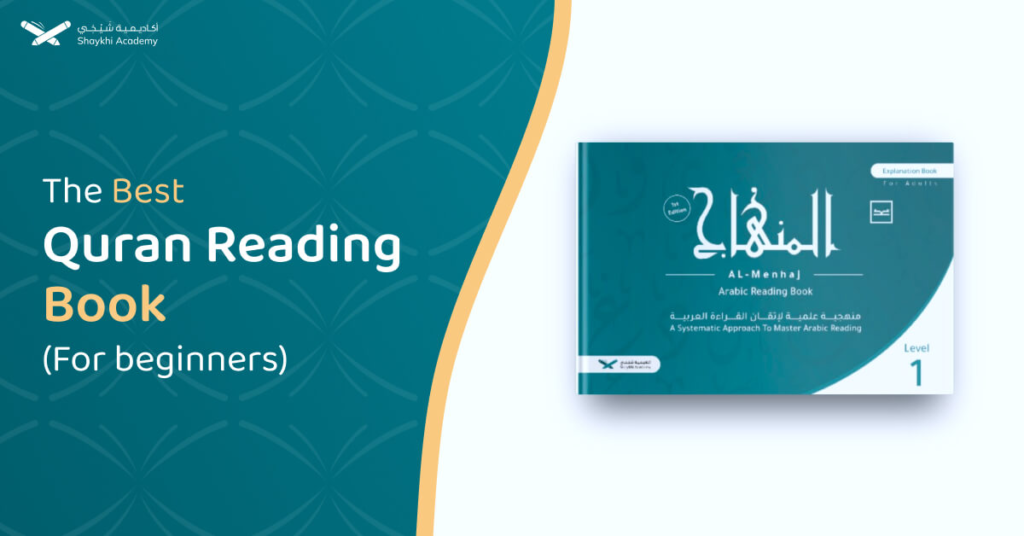
The book sequences letter production and sound recognition in a way that accounts for where an English speaker’s phonology actually starts, dramatically reducing the time required to achieve correct pronunciation.
Before each recitation session, incorporating a dua before starting Quran such as Rabbi zidni ‘ilma (My Lord, increase me in knowledge) — frames each practice session as worship and invites divine assistance into the effort, however difficult it still feels.
10. Equran School Built For Students Who Are Serious About Getting Past The Struggle
EQuran School has guided thousands of adult learners and children from halting, uncertain recitation to correct, confident tilawa. The school’s model rests on three principles: qualified native-speaking teachers, structured progression matched to each student’s current level, and scheduling flexible enough to fit real life.
The best way to learn Quran online is not a library of pre-recorded videos. It is live, one-on-one interaction with a teacher who hears your specific errors in real time and corrects them immediately.
Families searching for online Quran classes for kids will find EQuran School‘s children’s curriculum combines the Noorani Qaida foundation with teacher-guided progression into full Quranic reading — delivered by instructors trained specifically in child pedagogy and patient correction.
Students pursuing deeper engagement with the Quran’s meaning will find that the online Quran Tafsir course connects the words they recite to their scholarly interpretation, turning recitation from repetition into understanding. Those committed to memorization benefit most from joining a class Quran memorization (Hifz) course with daily teacher accountability — because solo memorization without supervision rarely reaches completion.
Experience Our Classes
Don’t just take our word for it—watch real-time recordings of our online classes below to experience our teaching style firsthand.
Start Your Quranic Journey Today
Experience our interactive online classes with a dedicated tutor.
Get Your Free TrialStart Today Where Every Word You Read Counts
The Prophet ﷺ already promised you double reward for your struggle. EQuran School exists to help you turn that struggle into mastery.
Book a free trial class. A certified teacher will assess exactly where you are, identify what specifically needs to change, and show you the clearest path forward. Whether you are starting from zero, returning after years away, or working to correct a recitation you know is not quite right — this is where it changes.
Students can learn Quran online from home through EQuran School‘s complete curriculum, which includes:
- Online Quran Learning with Tajweed Course
- Online Arabic and Quran Classes
- Quran Qirat Learning Course
- Online Quran Recitation Classes
- Noorani Qaida Course for Kids
- Learn Quran Easily at Home
- Weekend Quran Classes
- Zoom Quran Classes
Book a free trial class at E Quran School and Let the Quran Begin Working for You.

Start Your Quranic Journey Today
Experience our interactive online classes with a dedicated tutor.
Get Your Free TrialConclusion
The Prophet ﷺ was precise. This hadith does not offer vague encouragement to anyone who finds anything hard. It names a specific reader — the one who stumbles (yatataa’a) while it is genuinely burdensome (shaaq) — and attaches to that reader a specific, named reward: two, not one.
The eight lessons drawn from this hadith are not abstractions. The fluent reader holds a greater station, and that station is the destination every struggling reader should keep in view. The double reward is already theirs.
Sins and distraction close the flow of recitation, and repentance and spiritual practice open it. Every letter earns ten good deeds regardless of pace. Seeking a qualified teacher is not a step backward — it is the step the prophetic tradition explicitly recommends.
The hadith about struggling to read the Quran does not ask for perfection. It asks for persistence. And it promises — clearly, in authenticated words that have held for fourteen centuries — that persistence in this particular act of worship is never, in Allah’s accounting, wasted.
Frequently Asked Questions
What exactly is the hadith about reading the Quran with difficulty?
The hadith is narrated by Aisha (may Allah be pleased with her), recorded in Sahih al-Bukhari (4937) and Sahih Muslim (798). The Prophet ﷺ said: “The one who is proficient in the Quran will be with the noble, righteous scribing angels. The one who recites the Quran and stumbles through it, finding it difficult and burdensome, will have two rewards.”
Do I earn a reward for reading the Quran even when I make mistakes?
Yes. Scholars including Sheikh Ibn Baz and the Permanent Committee for Islamic Research state clearly that a reader who tries sincerely, exercises care, and seeks correct pronunciation earns reward — specifically two rewards when the difficulty is genuine and sustained.
Does the struggling reader earn more reward than the fluent reader?
No, and scholars are explicit about this. Imam al-Nawawi states in his commentary on Sahih Muslim that the fluent reader’s overall reward is greater, that reader is described as being with the noble angels, a rank not attached to any other category. The struggling reader’s double reward is specific to their condition. This distinction motivates improvement rather than complacency.
Why do I find Quranic Arabic so hard to pronounce?
Quranic Arabic contains consonants and vowel patterns that do not exist in English or most European and South Asian languages. This is a phonological challenge, not a reflection of intelligence or sincerity. With a qualified teacher using materials built for non-native speakers most adult learners reach correct basic pronunciation within weeks of consistent daily practice.
Does reciting slowly still earn the full per-letter reward?
Yes. The Prophet ﷺ confirmed in the hadith of Ibn Mas’ud that each letter earns ten good deeds regardless of pace. Repeating a difficult verse multiple times during practice earns the ten-good-deed reward for each letter in each sincere repetition. Slowness is never penalized in the divine accounting of Quranic recitation — only insincerity would be.
How do I find a qualified teacher to correct my recitation?
Look for schools offering live, one-on-one instruction with certified teachers — not self-paced video libraries. EQuran School provides a free assessment and trial class in which a teacher identifies your specific areas of difficulty and begins targeted correction from the first session.











Leave a Reply