 Quran
Many Muslims carry the Quran in their pocket now, opening it on the train, during a lunch break, or in bed before sleep. That convenience raises a sincere question we hear from students every week: is reading Quran without wudu on phone permissible, or does the screen carry the same rules as a printed Mushaf?
The short answer from respected scholars is clear. Reading Quran without wudu on phone is allowed for anyone free of major impurity, because a phone is not legally a Mushaf. Wudu remains recommended, however, and the reward of recitation stays complete.
What You Will Learn From This Article
- Whether reading Quran without wudu on phone is permissible, and the reasoning scholars give for it
- The difference between reciting the Quran and touching the Mushaf, with evidence from the Quran and Sunnah
- Why a phone screen is not considered a Mushaf in Islamic law
- How the rulings change for janabah and menstruation, with a clear comparison table
- Which etiquette to keep when reciting from a phone, from wudu to notifications and bathroom use
- How to use Quran apps for Tajweed practice and Hifz revision without relying on them alone
Ruling on Reading Quran Without Wudu on Phone According to Scholars
The scholarly ruling on reading Quran without wudu on phone rests on one distinction: reciting the Quran and touching a Mushaf are two separate acts in Islamic law, and each has its own conditions.
Reciting from memory without wudu is permitted by consensus for someone in minor impurity. Scholars disagree only about physically touching the written Mushaf, and the four schools require wudu for that.
Contemporary scholars conclude that a phone does not fall under the Mushaf ruling. Holding the device is allowed even for someone in major impurity, and reading Quran without wudu on phone carries no sin.
Understanding why scholars reach this conclusion protects you from both extremes: needless anxiety and careless disrespect. Students in our Al-Azhar Quran Course study these rulings alongside recitation, so their worship rests on authentic knowledge rather than assumptions.
Book Your Free Trial Today for Al-Azhar Quran Course!

Difference Between Reading Quran From the Mushaf and From a Phone
The difference between reading Quran from the Mushaf and from a phone explains the entire ruling. The Mushaf is a dedicated physical copy of the Quran, while a phone is a multipurpose device that only temporarily displays the text.
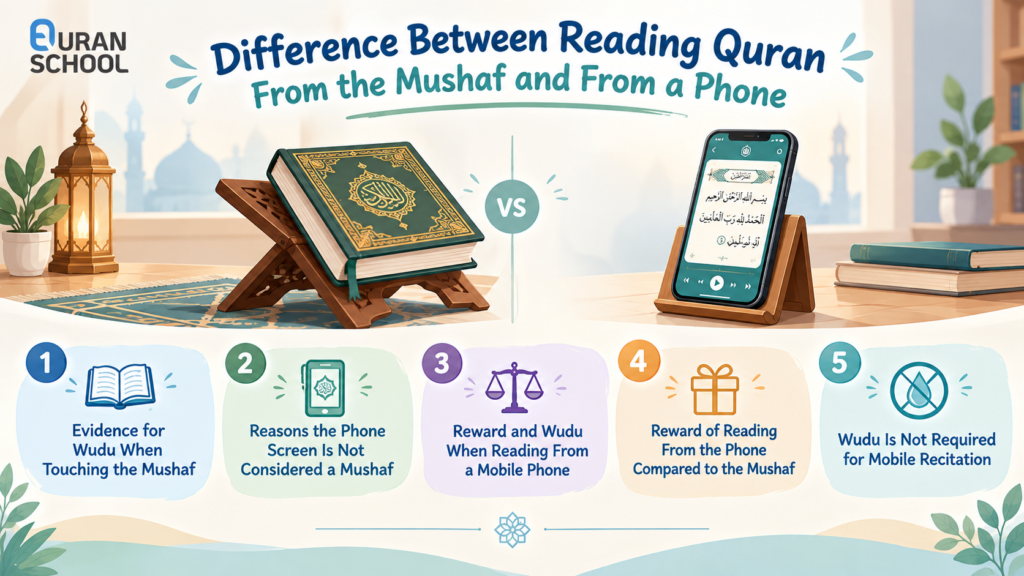
1. Evidence for Wudu When Touching the Mushaf
Evidence for requiring wudu when touching the Mushaf comes primarily from the Sunnah. Scholars also cite the verse in Surah Al-Waqi’ah, even though many classical commentators explain that it refers to the angels:
إِنَّهُ لَقُرْآنٌ كَرِيمٌ فِي كِتَابٍ مَّكْنُونٍ لَّا يَمَسُّهُ إِلَّا الْمُطَهَّرُونَ
Innahu la-Qur’anun kareem, fee kitabim-maknoon, la yamassuhu illal-mutahharoon
“Indeed, it is a noble Qur’an, in a Register well-protected; none touch it except the purified.” (Al-Waqi’ah 56:77–79)
The clearer textual proof is the letter the Prophet ﷺ sent with Amr ibn Hazm to the people of Yemen, which jurists across the schools relied upon:
أَنْ لاَ يَمَسَّ الْقُرْآنَ إِلاَّ طَاهِرٌ
“That no one should touch the Quran except one who is pure.” (Muwatta Malik)
2. Reasons the Phone Screen Is Not Considered a Mushaf
The phone screen is not considered a Mushaf because the Quran does not exist on it in a fixed, written form. Inside the device, the text is stored as electronic signals, not as readable letters on a page.
When you open the app, those signals form an image of the letters on the screen. When you move to another app, the image disappears completely, and nothing of the written text remains on the device’s surface.
The same reasoning applies to audio recordings of the Quran. Scholars therefore permit touching the phone or any recording device, and reading from it, even without purification, because none of these is a Mushaf.
This is the reasoning behind accepting reading Quran without wudu on phone. Plain recitation is fine for someone not in major impurity, while touching a printed Mushaf still requires wudu.
3. Reward and Wudu When Reading the Quran From a Mobile Phone
Reward and wudu are the two concerns people raise most about reading the Quran from a mobile phone. Scholars give a consistent and reassuring answer on both points.
4. Reward of Reading From the Phone Compared to the Mushaf
The reward of reading from the phone is equal to reading from the Mushaf. The belief that phone recitation earns less reward is a common misconception with no basis in the texts.
The purpose of recitation is reading the words of Allah and reflecting on their meanings. Once that purpose is achieved, whether from paper or a screen, the reward is achieved in full, by Allah’s grace.
5. Wudu Is Not Required for Mobile Recitation
Wudu is not required for mobile recitation, because the requirement of purity is tied to holding the noble Mushaf itself, not to the act of reading the words.
When someone reads from a phone, they are not touching the Mushaf. For that reason, reading Quran without wudu on phone does not require ablution, though making wudu remains the more virtuous choice.
See Us in Action
Watch a quick snippet from our live, interactive classes below and see how our teachers make learning engaging for all ages!
Start Your Quranic Journey Today
Experience our interactive online classes with a dedicated tutor.
Get Your Free TrialRead also: Do You Get Reward For Reading Quran On Phone? The Scholarly Answer
Rulings for Major Impurity and Menstruation When Using a Phone for Reading Quran
Rulings for major impurity and menstruation need separate attention, because the phone changes the touching ruling, not the recitation ruling. A person in a state of janabah faces restrictions on reciting itself, whatever the medium.
The majority of scholars prohibit reciting the Quran in a state of janabah, whether from memory, a Mushaf, or a screen. So reading Quran without wudu on phone is allowed, but reading it while in janabah is not, according to the majority.
For menstruating women, scholars differ. The Maliki school permits recitation, especially for teaching, learning, or protecting memorization from being lost, and many contemporary scholars allow reading from a phone on that basis.
| Situation | Reciting From Memory | Touching a Printed Mushaf | Holding a Phone and Reading |
| Minor impurity (no wudu) | Permitted by consensus | Not permitted (four schools) | Permitted |
| Major impurity (janabah) | Not permitted (majority) | Not permitted | Holding permitted; reciting not permitted (majority) |
| Menstruation or postnatal bleeding | Disputed; Malikis permit | Not permitted (majority) | Holding permitted; reciting disputed, many permit |
For a junub person, the remedy is simple: perform ghusl, then recite freely. Listening to recitation and making dhikr remain open in every state, as Aisha (may Allah be pleased with her) described:
كَانَ النَّبِيُّ صلى الله عليه وسلم يَذْكُرُ اللَّهَ عَلَى كُلِّ أَحْيَانِهِ
“The Prophet ﷺ used to remember Allah in all of his states.” (Sahih Muslim)
Sisters often worry about losing their memorized portions during their monthly cycle. Our Female Quran Classes help them plan revision around these days, guided by a certified teacher who understands both the fiqh and the practical challenge.
Book Your Free Trial Today for Female Quran Classes!

Etiquette for Reciting the Quran From a Phone Screen
Etiquette for reciting the Quran from a phone screen matters even when wudu is not required. Permission does not remove the respect owed to Allah’s words, and good manners increase the blessing of your recitation.
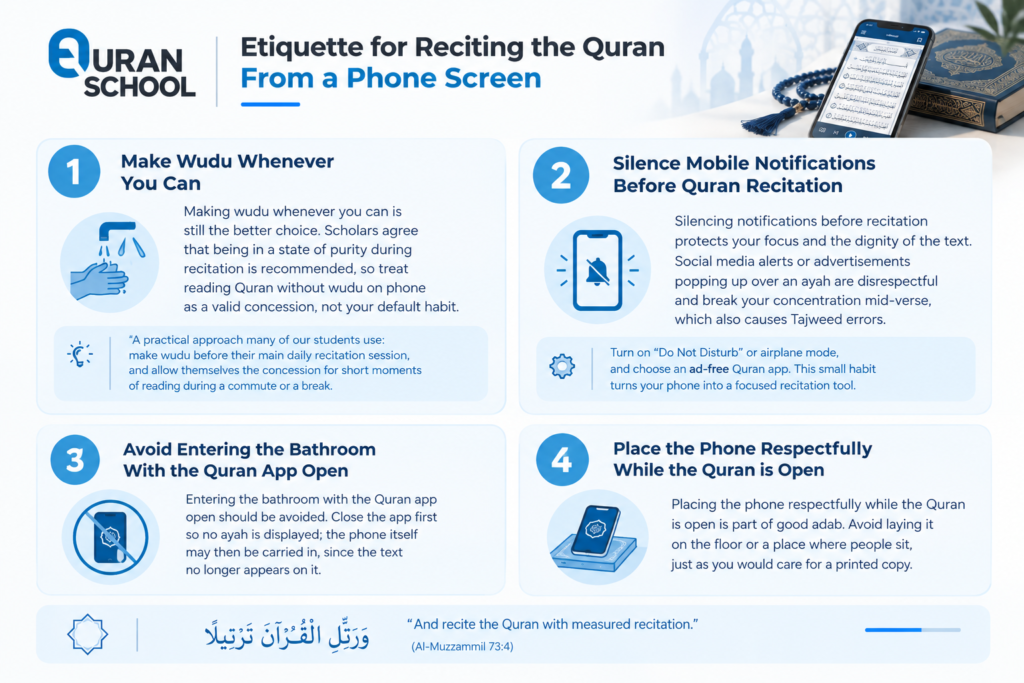
1. Make Wudu Whenever You Can
Making wudu whenever you can is still the better choice. Scholars agree that being in a state of purity during recitation is recommended, so treat reading Quran without wudu on phone as a valid concession, not your default habit.
A practical approach many of our students use: make wudu before their main daily recitation session, and allow themselves the concession for short moments of reading during a commute or a break.
2. Silence Mobile Notifications Before Quran Recitation
Silencing notifications before recitation protects your focus and the dignity of the text. Social media alerts or advertisements popping up over an ayah are disrespectful and break your concentration mid-verse, which also causes Tajweed errors.
Turn on “Do Not Disturb” or airplane mode, and choose an ad-free Quran app. This small habit turns your phone into a focused recitation tool.
3. Avoid Entering the Bathroom With the Quran App Open
Entering the bathroom with the Quran app open should be avoided. Close the app first so no ayah is displayed; the phone itself may then be carried in, since the text no longer appears on it.
3. Place the Phone Respectfully While the Quran is Open
Placing the phone respectfully while the Quran is open is part of good adab. Avoid laying it on the floor or a place where people sit, just as you would care for a printed copy.
Read also: Can I Read Quran Without Wudu? A Clear Guide For Non-Arabic-Speaking Muslims
Practical Tips for Using Phone Quran Apps in Recitation and Hifz
Practical tips for using phone Quran apps in recitation and Hifz come down to choosing the right tools and knowing their limits. A phone is excellent for access, but it cannot replace a qualified teacher.
1. Choose a Reliable App Mushaf Layout
Choosing a reliable Mushaf layout is the first step. Use an app based on the standard 15-line Madinah Mushaf, so your page memory stays consistent with printed copies, and select a color-coded Tajweed edition to see Ghunnah and Madd rules.
Huffaz memorize visually, recalling where each ayah sits on the page. Switching between different layouts confuses that visual memory, so stick with one edition on your phone and at home.
2. Use the Phone for Daily Muraja’ah
Using the phone for daily Muraja’ah is where it truly shines. A working adult can review half a Juz on the commute, which is often the difference between keeping and losing a memorized portion.
Since reading Quran without wudu on phone is permitted, those scattered minutes become revision time. Students in our Quran Memorization (Hifz) Course receive a structured revision plan that fits these short daily windows.
3. Recognize the Limits of Quran Apps
Quran apps have real limits that beginners rarely notice. An app can play a reciter’s audio, but it cannot hear your mistakes, such as confusing ح with ه or making ق sound like ك.
These errors become habits when nobody corrects them. Our Online Quran Learning With Tajweed classes pair your phone practice with an Azhari tutor who corrects every letter in real time over Zoom.
Book Your Free Trial Today for Online Quran Learning With Tajweed!

Start Your Spiritual Journey with E Quran School Today
Transform your understanding and recitation of the Holy Quran from the comfort of your home. At E Quran School, our certified tutors provide personalized, one-on-one guidance tailored to your pace and schedule. Whether you are looking for beginner Quran reading, advanced Tajweed, or Memorization (Hifz) courses, we have a program for you.
Our Quran Courses
- Quran Recitation Classes
- Weekend Quran Classes
- Quran Reading Classes
- Online Quran Classes for Kids
- Online Quran Learning with Tajweed Course
- Quran Classes for Adults
- Female Quran Teacher for Ladies
- Learn Quran for Beginners
- Quran Qirat Learning Course
Book your free trial class today at EQuran School and start reciting with confidence.
Experience Our Classes
Don’t just take our word for it—watch real-time recordings of our online classes below to experience our teaching style firsthand.
Start Your Quranic Journey Today
Experience our interactive online classes with a dedicated tutor.
Get Your Free TrialConclusion
Scholars agree that reading Quran without wudu on phone is permissible for anyone free of major impurity, because the device holds the text only as a temporary display, and the reward of recitation remains complete.
The printed Mushaf keeps its distinct ruling, and touching it still requires wudu. Janabah restricts recitation itself according to the majority, while menstruation remains an area of valid difference among the schools.
Let this concession bring you closer to the Quran rather than more casual with it. Make wudu when you can, silence distractions, and let your phone become a doorway to daily recitation, Insha’Allah.
Frequently Asked Questions About Reading Quran Without Wudu on Phone
Can you read Quran on phone without wudu while lying down?
Yes, you can read Quran on phone without wudu while lying down, since wudu is not required for the phone and Allah praises those who remember Him lying on their sides. Sitting upright remains more respectful.
Can we read Quran without wudu in mobile during periods?
Whether we can read Quran without wudu in mobile during periods is a matter of scholarly difference. The Maliki school and many contemporary scholars permit it, especially for learning or revision, while the majority prohibit recitation.
Is the reward the same when reading Quran without wudu on phone?
The reward for reading Quran without wudu on phone is complete. The goal is reciting and reflecting on Allah’s words, and wudu only adds extra virtue and blessing to that recitation.
Can I touch the Quran on the screen without wudu?
You can touch the Quran on the screen without wudu. The displayed text is a temporary image formed by electronic signals, not a written Mushaf, so swiping or tapping verses carries no prohibition.
Can you read Quran on phone without wudu after using the bathroom?
You can read Quran on phone without wudu after using the bathroom, because relieving oneself causes only minor impurity. Wash properly first, and making a fresh wudu is still the more virtuous option.
Should children make wudu before reading Quran on a tablet?
Children reading Quran on a tablet are not obligated to make wudu, as they are not yet accountable. Teaching them wudu before lessons builds respect early, and our Online Quran Classes for Kids encourage this habit.











[…] Read also: Reading Quran Without Wudu On Phone – The Scholarly Ruling Explained […]
[…] Read also: Reading Quran Without Wudu On Phone – The Scholarly Ruling Explained […]