 Learn Quran

If you want to know how to learn Surah Lail – properly, not just well enough to forget it in a month – the method matters more than the effort.
Surah Al-Lail is 21 short verses, which makes it look like a quick win. It isn’t, and the reason is structural: the surah is built on mirrored pairs of verses that sound almost identical and mean the opposite. Memorize it the usual way, verse after verse, and you will slip between those pairs for years.
Thus, let’s walk together through a method built around that structure: how to split the surah, how to read it correctly, where the predictable mistakes are, and how to keep it once it’s in.

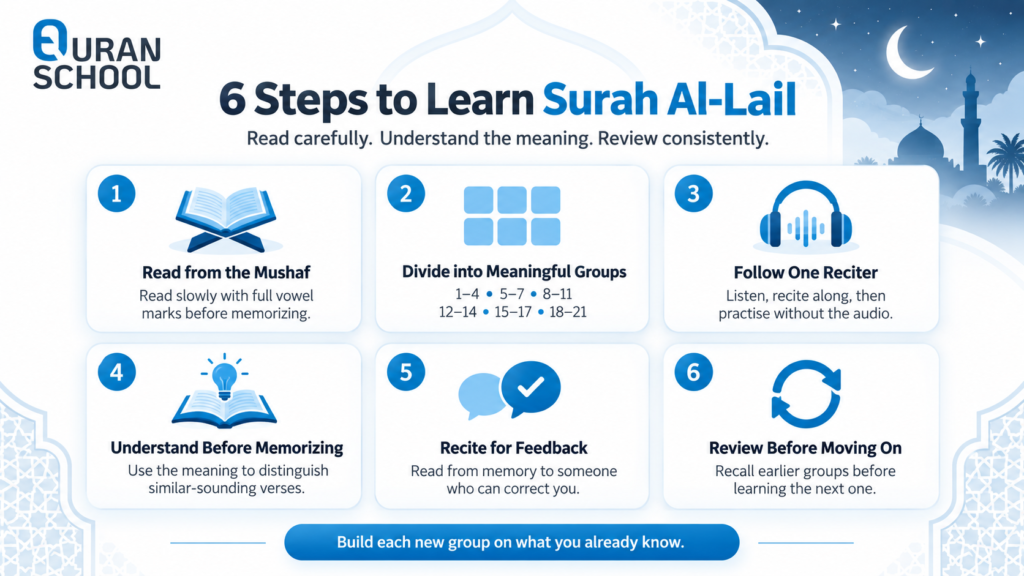
Step 1: Read Surah Al-Lail From The Mushaf Before You Memorize Any Verse
Open a mushaf that shows full vowel marks (tashkeel). Read the whole surah out loud, slowly, four times. Do not try to memorize during this step. That is not what it is for.
You are building a clear picture of the surah in your eyes and your mouth first. Every letter, every vowel, every stop. Point at each word with your finger as you say it. That small habit stops your eyes from guessing a word they already half know.
Here is why this step is worth the time. A wrong vowel learned in week one is very hard to remove in month three.
Once your tongue has said a word wrong two hundred times, that is the version it defaults to. And in Arabic, a wrong vowel does not just sound wrong. It can change the meaning of the word.
If you cannot yet read Arabic with vowel marks, start there before you start Hifz. Reading first, memorizing second, is slower for two weeks and much faster after that. A few weeks with a teacher on reading alone will save you months of fixing the same mistakes later.
Step 2: Split Surah Al-Lail Into Groups Of Three Verses
Do not take the surah as one piece. Break it along the blocks above.
Your groups are: verses 1–4, then 5–7, then 8–11, then 12–14, then 15–17, then 18–21. Write today’s group at the top of a page or a phone note before you start, so you know exactly where you stop. A clear finish line is half the reason people keep going.
Three verses is the right size for two reasons. It is short enough to finish in one sitting, so you end each day with a win instead of a half-memorized mess. And it is long enough to hold a complete idea. One sitting here means about 10 to 15 minutes, not an hour.
That second reason is the important one. Your memory holds meaning far better than it holds sound. When a group of verses says one whole thing, your mind has something to hold on to. When you cut a thought in half to fit a verse count, you throw that help away.
So say the group as one flowing piece from the first repetition, instead of drilling it word by word and joining the words later.
Follow the meaning, not the number. And if a group is fighting you, cut it to two verses for that day rather than pushing through and half-learning all three.
The same splitting method works for longer surahs too — our guide on how to learn Quran by heart walks through it for a full Hifz plan
Step 3: Play One Reciter Of Surah Al-Lail On Repeat Until The Verses Sound Familiar
Pick one reciter in the Hafs ‘an ‘Asim recitation. Stay with that same reciter until you finish the whole surah. Choose someone who recites slowly and clearly, in the style called murattal, not a fast recitation. You need to hear where each letter starts and stops, and speed hides that.
Do not switch reciters in the middle. Different reciters pause in slightly different places and stretch some sounds differently. Your ear hears that as doubt, and doubt is exactly what you do not want while a verse is still settling in.
Now use the recording in two ways. First, listen without working. Play your three-verse group on repeat while you are driving, cooking, or walking. You are not studying. You are letting the sound become familiar.
Most Quran apps let you loop a set range of verses, so set it to your group and leave it running. Aim to hear the group at least twenty times before you try to say it from memory.
Second, listen and join in. Play the group and recite along with the reciter, out loud, five or six times. Then pause the recording and recite the same group alone.
Then check yourself against the recording again. Use headphones for this part, because small details like the nasal sound in ghunnah are easy to miss through a phone speaker.
Step 4: Learn What The Verses Mean Before You Memorize Them
Do not memorize sounds you do not understand. It works, but it is slow, and it falls apart fast.
Before you memorize verses 5 to 11, learn this much: one person gives, fears Allah, and believes in the best reward, and Allah makes the easy path easy for him. The other person holds back, feels he does not need Allah, and denies the reward, and Allah leaves him to the hard path.
Ask yourself one question at every verse in this block: who is this verse talking about? If you can answer that, you will never put the wrong ending on the wrong verse.
Once you know which person belongs to which verse, you stop mixing them up. You are no longer pulling a sound out of memory. You are pulling a meaning that has a sound attached to it.
You do not need deep tafsir for this. A plain, verse-by-verse meaning is enough. Spend five minutes on it before each new group. Use one translation, not three, so you are not comparing wordings when you should be memorizing.
It also helps to learn the few key words that keep coming back in this surah, such as al-husnaa, al-yusraa, and al-‘usraa, because once you know them the verses stop sounding alike. If you are teaching a child, tell it as a story about two people instead of explaining word by word.
Most people who struggle with Hifz are not struggling with memory. They are memorizing sounds in a language they do not speak, which removes the one thing memory leans on most.
That is exactly how online Quran memorization classes at EQuran School Online are run: meaning first, then memorizing, then correction.

Step 5: Recite From Memory To Someone Who Can Correct You
This is the step that turns “I know it” into “I have it.” In Hifz circles this step has a name: tasmee’, which simply means reciting to a listener.
Close the mushaf. Recite your group from memory to a teacher or a study partner who is following along in the text.
Ask them to stop you the moment you slip. Tell them clearly that you want every mistake called out, even the small ones. Many people correct softly to be kind, and that kindness costs you months.
Do not skip this because you feel ready. You cannot hear your own mistakes. That is not a discipline problem or a focus problem. It is simply how reciting works: your brain hears what it meant to say, not what your mouth said.
The mistakes you cannot hear are the ones that stay. Every day you recite a verse wrong without correction, that wrong version gets stronger. When you do slip, do not start the whole group again from the top.
Fix that one verse, say it correctly three times, then carry on from where you stopped. Count a group as finished only when you can recite it three times in a row with no correction.
If you have no teacher yet, record yourself on your phone and play it back while reading the mushaf. That catches some errors. It will not catch Tajweed errors, so treat it as a temporary fix, not a plan.
This is the real limit of studying alone, and we cover where that line sits in can I learn Quran by myself
See Us in Action
Watch a quick snippet from our live, interactive classes below and see how our teachers make learning engaging for all ages!
Start Your Quranic Journey Today
Experience our interactive online classes with a dedicated tutor.
Get Your Free TrialStep 6: Review Everything You Memorized Of Surah Al-Lail Before Adding New Verses
Never start a new group until you have recited every group before it from memory.
Day 3 is not “memorize verses 8 to 11.” Day 3 is “recite verses 1 to 7 from memory, then memorize 8 to 11.” The review comes first, every single day, with no exceptions.
So each session has two halves. The first half is old verses. The second half is new verses. If you only have ten minutes today, spend them all on the first half and skip the new group. Losing a day of progress costs you nothing. Losing verses you already earned costs you a week.
Start the review with yesterday’s group, because that is the one closest to slipping. Then recite everything from verse 1 up to where you stopped. By day 5 or 6 this takes only two or three minutes, since the surah is short and the earlier verses are already settling.
Watch for the groups that keep failing. If the same verse trips you three days in a row, that verse is not memorized, it is guessed. Stop, go back to the mushaf, read it slowly ten times while looking at it, then close the mushaf and try again.
Fixing one weak verse today is much easier than fixing it after it has been wrong for a month.
This feels slow. It is the opposite. Memorizing new verses while the old ones fade means you finish the surah and own none of it. You will have reached verse 21 and lost verse 4, which is not finishing at all.
What is Surah Al-Lail?
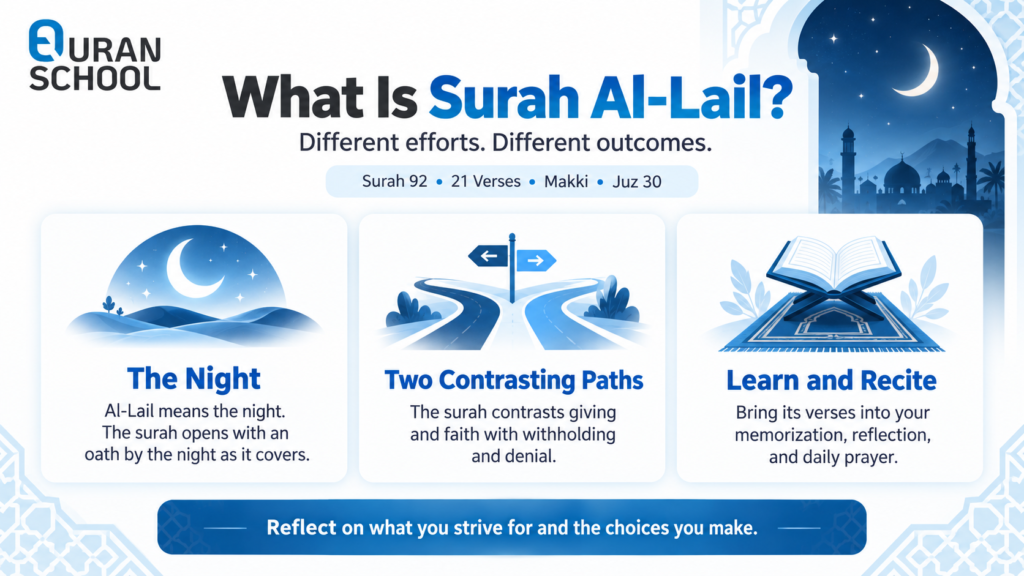
Surah Al-Lail is the 92nd surah of the Qur’an. It is a Makki surah with 21 verses. You will find it in Juz ‘Amma, the thirtieth part of the Qur’an.
The name Al-Lail means “the night.” The surah is named after its first word, because it opens with an oath: “By the night as it covers.” Naming a surah after a word near its start is a common pattern in the Qur’an.
| Fact | Detail |
| Name | Surah Al-Lail (The Night) |
| Order in the mushaf | 92 |
| Number of verses | 21 |
| Type | Makki, revealed before the migration to Madinah |
| Juz | Juz ‘Amma, the 30th part |
| Revealed after | Surah Al-A’la |
| Surah before it | Surah Ash-Shams |
| Surah after it | Surah Ad-Duha |
| Main theme | People’s efforts differ, and so do their outcomes |
Its main subject is simple. People do not all work for the same thing, so they do not all end up in the same place. One person gives and fears Allah. Another holds back and turns away. The surah sets them side by side and shows where each one ends up.
The surah sits right after Surah Ash-Shams, and the link between them is close. Surah Ash-Shams ends by saying that whoever purifies his soul succeeds and whoever corrupts it fails.
Surah Al-Lail then explains what that actually looks like in a person’s life: giving, fearing Allah, and believing, against holding back, feeling no need for Allah, and denying. Reading the two surahs together makes both of them clearer.
One more feature is worth knowing. The word “Allah” does not appear anywhere in Surah Al-Lail, even though the whole surah is about Him. He speaks in it as “We” and as “your Lord.”
It was revealed after Surah Al-A’la, early in the Makkan period.
Most scholars of tafsir, including Ibn Kathir, say the verses about the God-fearing giver were revealed about Abu Bakr As-Siddiq (may Allah be pleased with him). He spent his wealth to free believers who were being harmed in Makkah.
The lesson is not limited to him, though. Scholars take the ruling from the general wording, so the surah speaks to every reader.
Sahih Muslim reports from Jabir ibn Samurah that the Prophet ﷺ used to recite Wal-layli idha yaghsha in the Dhuhr prayer.
Why Surah Al-Lail Is Easier Than It Looks
The surah is built on opposites. Night and day. Male and female. Giving and holding back. Ease and hardship. The most wretched and the most God-fearing.
Scholars of Arabic call this tibaq, or contrast. For someone memorizing, it is free structure. Your mind already stores opposites in pairs, so every pair you notice is one less thing to memorize on its own.
| Block | Verses | What it covers |
| The oath | 1–4 | Night, day, and creation — ending with “your efforts are diverse” |
| The first path | 5–7 | The one who gives, fears Allah, and believes in the best reward |
| The second path | 8–11 | The one who holds back, feels no need for Allah, and denies |
| Guidance and outcome | 12–21 | Allah’s guidance, the warning of the Fire, and who is saved from it |
Read the table once before you memorize anything, then again at the end of each day. It takes thirty seconds, and it keeps the whole shape of the surah in front of you while you work on small pieces of it.
Learn the blocks, not the verse numbers. If you know there are four parts and what each part does, you can find your place again when you blank. If you only memorized 21 loose verses, you have nothing to find your place with.
Read also: How to Memorize and Recite Surah Al-Zalzalah Accurately
How To Read Surah Al-Lail Correctly
Reading Surah Al-Lail correctly means saying each letter from its proper place and applying the rules of Tajweed as they were passed down, most commonly in the Hafs ‘an ‘Asim recitation.
These are the rules that actually appear in this surah, and where to find them.
| Tajweed rule | Where it appears | What to do | The common mistake |
| Natural madd (elongation) | وَمَا خَلَقَ (verse 3) | Stretch the maa for two counts | Cutting it to one count, or stretching it to four |
| Idgham with ghunnah | مِنْ نِعْمَةٍ (verse 19) | Merge the noon sakinah into the next noon with a nasal sound | Saying both noons separately |
| Ikhfa (concealment) | نِعْمَةٍ تُجْزَى (verse 19), نَارًا تَلَظَّى (verse 14) | Hide the tanween before the taa with a light nasal sound | Pronouncing the tanween fully and clearly |
| Light raa (tarqeeq) | وَالنَّهَارِ (verse 2) | Say the raa thin, because it carries a kasrah | Saying every raa heavy |
| Heavy raa (tafkheem) | فَسَنُيَسِّرُهُ (verses 7 and 10) | Say the raa full and heavy, because it carries a dammah | Flattening it to match the light raa |
| Shaddah (doubled letter) | فَسَنُيَسِّرُهُ (verses 7 and 10), وَسَيُجَنَّبُهَا (verse 17) | Hold the doubled letter for two counts | Dropping it when reciting quickly |
| Stopping (waqf) | End of every verse | Stop at verse endings, and never break a word in half | Running verse 6 into verse 7, or verse 9 into verse 10 |
That last row is not only a Tajweed rule. The pause at the end of verses 6 and 9 is what keeps the two paths separate in your memory. Rush it and you will merge them.
Do not try to learn all seven rules in one sitting either, because that is how people end up applying none of them. Take only the rules that appear in the group you are memorizing today, and leave the rest until you reach them.
And remember that Tajweed is learned by ear, not from a table, so use this as a checklist for what to ask your teacher about, not as a replacement for one.
If you are wondering why these rules matter beyond correctness, see the benefits of reading Quran with Tajweed.
The Four Places Where Memorizers Of Surah Al-Lail Slip
These are not general warnings. They are the exact weak points of this surah. Every one of them comes from the same cause: the surah repeats a shape and changes one word inside it.
That is a beautiful feature of the Qur’an’s style, and it is also the reason a memorizer slips. Read all four before you start memorizing, so you meet them expecting them instead of being caught by them.
1. Verses 6 and 9 end with the same word
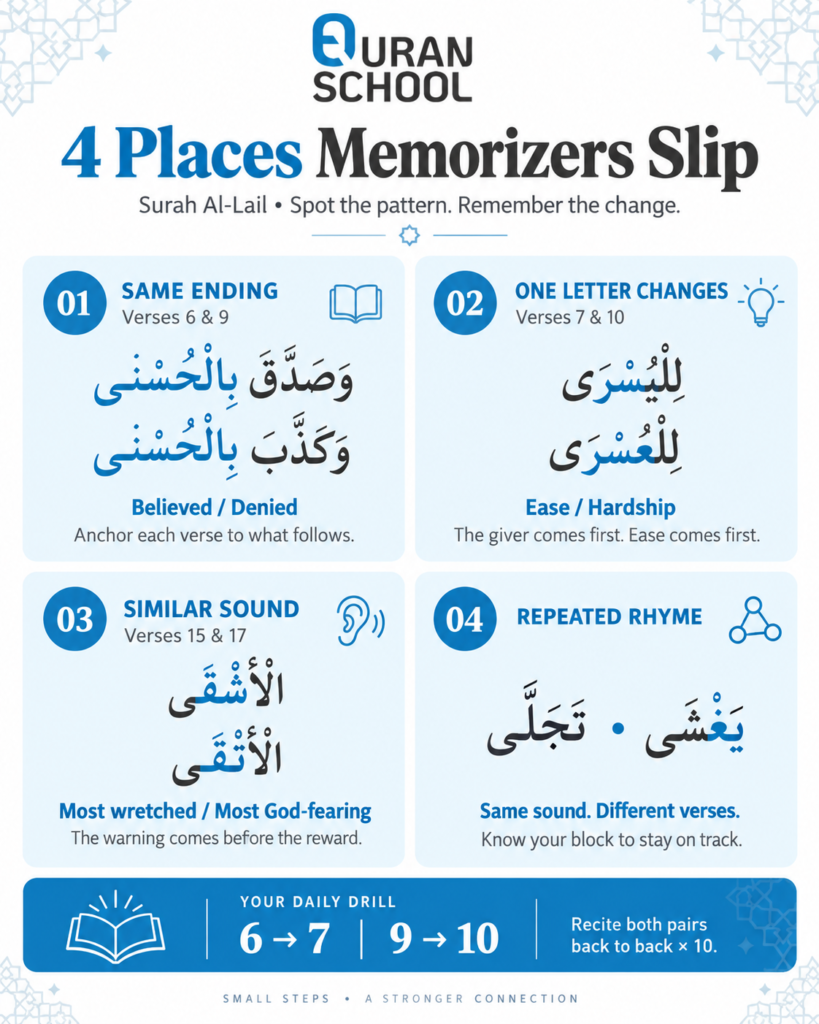
Wa saddaqa bil-husnaa (وَصَدَّقَ بِالْحُسْنَى) means “and believed in the best reward.” Wa kadhdhaba bil-husnaa (وَكَذَّبَ بِالْحُسْنَى) means “and denied the best reward.” One affirms. One denies. Both end the same way. This is where most people jump from verse 6 straight into verse 10.
2. Verses 7 and 10 start the same way
Fasanuyassiruhu lil-yusraa (فَسَنُيَسِّرُهُ لِلْيُسْرَى) and fasanuyassiruhu lil-‘usraa (فَسَنُيَسِّرُهُ لِلْعُسْرَى) differ by one letter. Fix it with a rule you can repeat: the giver comes first, and ease comes first.
3. Al-Ashqaa and Al-Atqaa sound almost identical
Al-Ashqaa (الْأَشْقَى, verse 15) is the most wretched. Al-Atqaa (الْأَتْقَى, verse 17) is the most God-fearing. Fix it with another rule: in this last block, the warning comes before the reward.
4. Nearly every verse ends on the same rhyme
Yaghshaa, tajallaa, wal-unthaa, lashattaa. Almost all 21 verses close on the same sound. That rhyme is exactly what lets your memory drift from one verse into another without noticing. The block structure is the fix. When you know which block you are in, the rhyme stops being a trap.
Drill these four on purpose. Do not wait to make the mistake. Recite verse 6 then 7, then verse 9 then 10, back to back, ten times, on the day you memorize them.
Read also: Learning Surah Lahab Made Easy: Complete Guide
What Surah Al-Lail Means
The surah moves in four steps. Each one sets up the next. Nothing in it is placed at random, and that is exactly why it is memorable. Once you can say what each step does, you can rebuild the whole surah from its shape alone.
Read the four parts below in order, and read them as one argument rather than four separate summaries.
The Setup: An Oath in Opposites (Verses 1-4)
Allah swears by the night that covers, the day that reveals, and the creation of male and female. Three pairs of opposites, one after the other.
Then comes the answer to the oath: your efforts are not the same. The opposites in creation are there to prepare you for the opposite in people.
The First Path: Ease Through Giving (Verses 5-7)
He gives. He fears Allah. He believes in the best reward.
So Allah makes the easy path easy for him. Good action leads to more good action, and the road opens in front of him.
The Second Path: Hardship Through Withholding (Verses 8-11)
He holds back. He feels no need for Allah. He denies the reward.
So Allah leaves him to the hard path. And the block closes with a warning about the wealth he held on to: it will not save him when he falls.
The Resolution: Guidance and Outcome (Verses 12-21)
Allah settles the matter. Guidance is upon Him. This world and the next belong to Him. Nobody can say they were left without direction.
The surah ends with a promise to the first person: “And he is going to be satisfied.”
Why this matters for memorizing
Notice what the four steps do together. The oath sets up a question. The two people answer it. The last block shows where each answer leads.
When that shape is clear in your mind, the verses stop being a list you recall. They become an argument you follow. That is the difference between memorizing that lasts and memorizing that fades.
Read also: Time to Learn Tajweed: What to Expect
A 7-Day Plan For Surah Al-Lail
Here is what the six steps look like across one week. Each day has two jobs: recite what you already know from memory, then add a small new group. The review always comes first.
This is a plan, not a promise. Your pace depends on your Arabic reading level, your past Hifz, and how steadily you review. Treat the table as a shape to follow, not a deadline to beat.
| Day | Review first | Then memorize | Extra focus |
| Day 1 | — | Verses 1–4 | Read the whole surah from the mushaf four times before you start |
| Day 2 | Verses 1–4 | Verses 5–7 | Learn the meaning of both paths |
| Day 3 | Verses 1–7 | Verses 8–11 | Drill the verse 6 and verse 9 confusion |
| Day 4 | Verses 1–11 | Verses 12–14 | Watch the doubled letters and the stops |
| Day 5 | Verses 1–14 | Verses 15–17 | Separate Al-Ashqaa from Al-Atqaa |
| Day 6 | Verses 1–17 | Verses 18–21 | Recite the last block slowly, without rushing the endings |
| Day 7 | The full surah | — | Recite all 21 verses from memory three times, to someone following the mushaf |
Fifteen to twenty focused minutes a day is enough. Two hours once a week is not. Memory settles through repetition spread across days, not through one long session.
If a day slips, do not restart the plan. Repeat the last day you completed, then carry on from there. And if a group is fighting you, stay on it for two days instead of pushing ahead with verses you only half know.

Read also: How Long Does It Take To Learn The Quran?
How To Keep Surah Al-Lail After You Memorize It
Memorizing is the easy half. Most people who say they forgot a surah never built review into their week.
The best review costs you no extra time at all, because it happens inside something you already do. Recite Surah Al-Lail in your daily prayers. The Prophet ﷺ recited it in prayer, so you are following his practice and holding on to the surah at the same time.
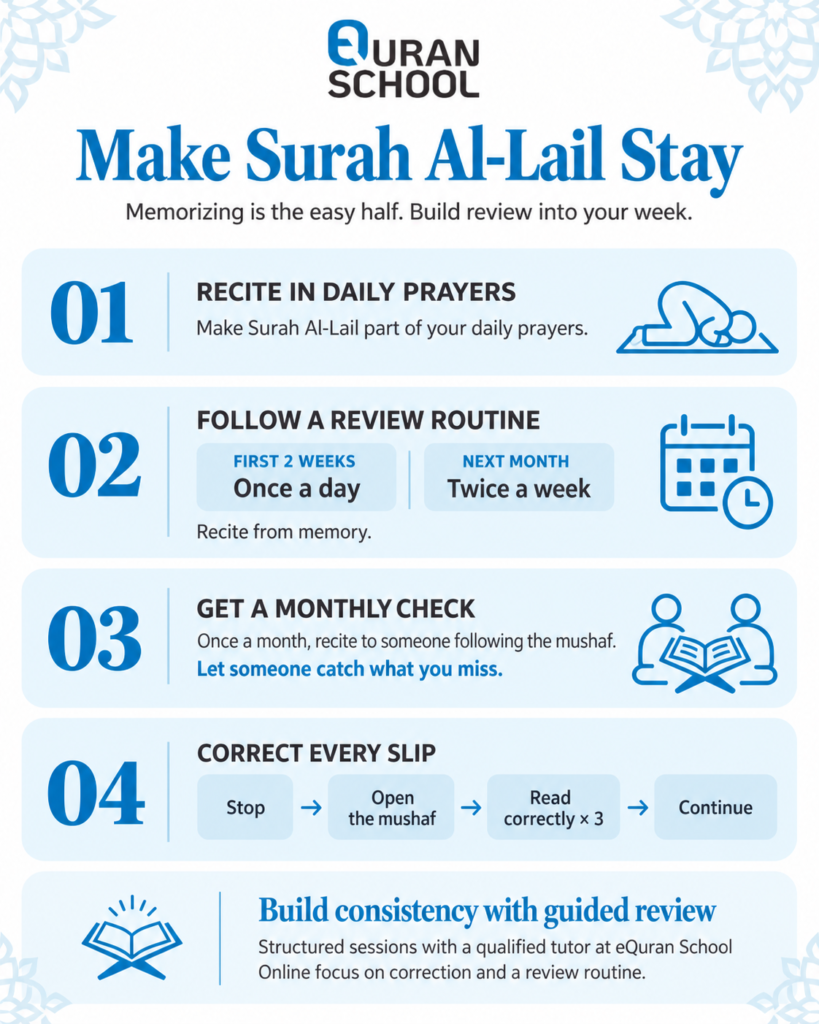
Beyond prayer, keep a simple schedule. Recite the surah from memory once a day for the first two weeks, then twice a week for the next month. That is only a minute or two each time, and it is what carries the surah from fresh to fixed.
Once a month, recite it out loud to someone who is following the mushaf. Reviewing on your own keeps your mistakes; it does not catch them, because you still cannot hear what your own mouth is doing. One listener a month is enough to stop small errors from settling in.
And never let a slip pass. When you stumble, stop, open the mushaf, read that verse correctly three times, then carry on from there. A mistake you walk past today is a mistake you will be repeating next year.
Slipping after a few weeks is a routine problem, not a memory problem. Learn Quran Online with Tajweed for Kids and Adults Course at EQuran School Online gives you both missing pieces — live correction and a set review plan. Book a free trial class to try it.

One Correction Worth Making About Surah Al-Nail
You will find content online that gives Surah Al-Lail a fixed number of repetitions. Recite it seven times for provision.
Recite it a set number of times to have a need met. You will also see it tied to removing a particular problem, always with a number attached.
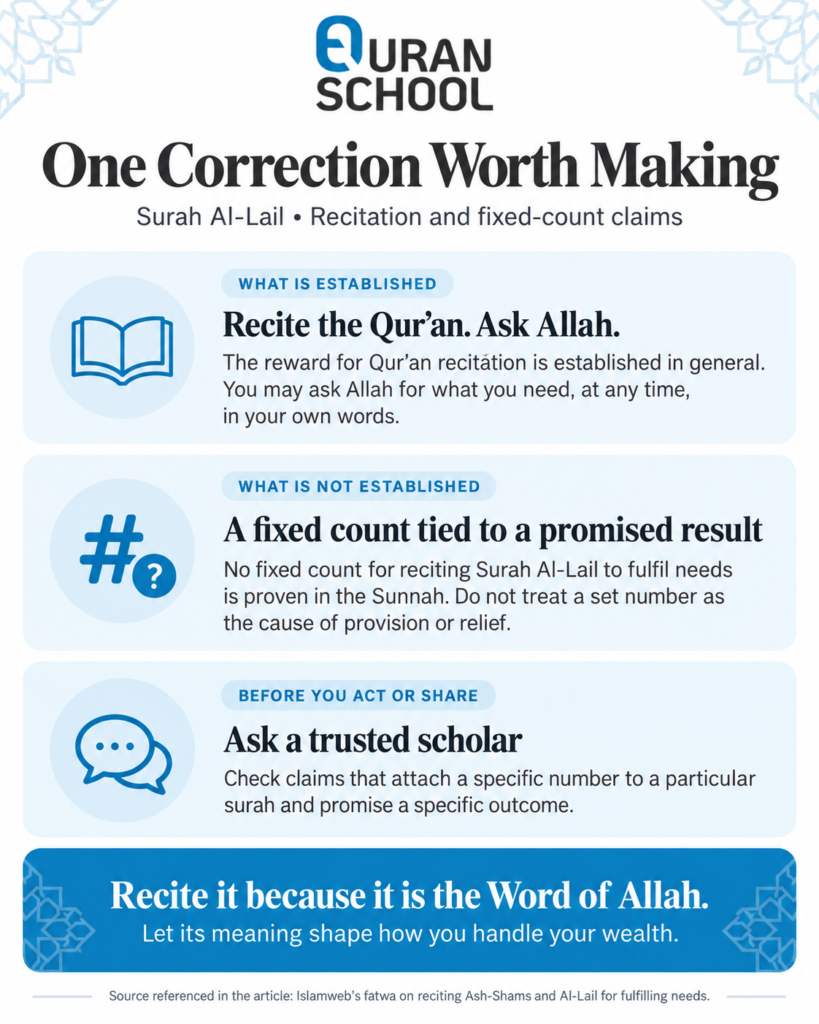
According to Islamweb’s fatwa on reciting Surat Ash-Shams and Al-Lail for fulfilling needs, no such fixed count is proven in the Sunnah. Setting a number or a format that was not passed down from the Prophet ﷺ is not an established practice.
This does not mean that reciting the Qur’an and asking Allah are not good. The reward for reciting the Qur’an is established in general, and you may ask Allah for whatever you need, at any time, in your own words.
What is not established is fixing a count to one surah and then treating that count as the thing that brings the result. If you come across a claim like this, ask a trusted scholar before you act on it, and before you pass it on to someone else.
Recite Surah Al-Lail because the Prophet ﷺ recited it in prayer. Recite it because its meaning shapes how you handle your wealth. Recite it because it is the Word of Allah. That is enough reason on its own.
Experience Our Classes
Don’t just take our word for it-watch real-time recordings of our online classes below to experience our teaching style firsthand.
Start Your Quranic Journey Today
Experience our interactive online classes with a dedicated tutor.
Get Your Free TrialLearn Surah Al-Lail With A Teacher Who Hears What You Cannot
Studying alone can get you to recitation. It rarely gets you to accuracy, because the mistakes that matter are the ones you cannot hear in your own voice. A teacher hears them in the first minute.
EQuran School Online offers one-to-one online Quran classes in Tajweed, recitation, and Hifz, for children and adults. Here is what that means in practice.
One student, one teacher. No group class, no waiting your turn. Every minute of the session is your recitation being listened to and corrected.
- Qualified tutors with Ijazah in the Hafs ‘an ‘Asim recitation: You are copying a correct model from day one, instead of fixing habits later.
- Meaning taught alongside memorizing: Your tutor explains what each verse says before you memorize it, which is what stops verses like 6 and 9 from blurring together.
- A review plan set for you: You are not left guessing what to revise. Your tutor tracks what you have memorized and tells you what to recite each week, so the surahs behind you stay solid while new ones are added.
- Flexible scheduling across time zones, with female tutors available for sisters and children: Classes fit around school, work, and family, not the other way round.
- A free trial class, so you can test the teaching before you commit.
Our Quran Courses
- Quran Tafsir Course
- Zoom Quran Classes
- Skype Quran Classes
- Learn Quran Easily at Home
- Al-Azhar Quran Course
- Sunni Online Quran Classes
- Intensive Quran Course
- Online Quran Classes Based in Saudi Arabia
- Quran Teachers
- Noorani Qaida Course
- Noorani Qaida Course for Kids
- Quran Memorization (Hifz) Course
- Hifz Classes for Adults
- Quran Ijazah Program
- Online Arabic and Quran Classes
Book your free trial class and start Surah Al-Lail with a qualified tutor this week.

Conclusion
Learning Surah Al-Lail is a structure problem before it is a memory problem. The surah is short, but it is built on mirrored verses, and that is what defeats people who memorize it line by line.
So work with the structure instead of against it. Split the surah into its four blocks. Learn the meaning of the two paths before you memorize the verses about them.
*Drill the four confusion points on purpose, on the day you reach them, rather than waiting to be caught out by them later. Then build review into your daily prayers, where it costs you no extra time at all.
None of this asks for more hours. It asks for the same twenty minutes, spent in a better order. Reading correctly comes before memorizing. Meaning comes before repetition. Review comes before new verses. That order is the whole method.
Start today with verses 1 to 4 and nothing more. Tomorrow, recite those four from memory before you add anything new. Keep that pattern for a week and the surah will be yours.
Do that, and Surah Al-Lail stays with you, ready in every prayer. Skip it, and you will be relearning the same 21 verses next year.
Frequently Asked Questions
How Long Does It Take To Memorize Surah Al-Lail?
Most learners memorize Surah Al-Lail in about a week using a three-verse-a-day plan with 15 to 20 focused minutes daily. Your pace depends on your Arabic reading level and your past memorizing experience. Keeping it needs review well past that first week.
How Many Verses Are In Surah Al-Lail?
Surah Al-Lail has 21 verses. It is the 92nd surah in the mushaf. It is a Makki surah, and it sits in Juz ‘Amma, the thirtieth part of the Qur’an.
Is There A Set Number Of Times To Recite Surah Al-Lail For Provision?
No fixed number of repetitions for Surah Al-Lail is proven in the Sunnah. According to Islamweb, setting a count for reciting a surah to have a need met, when that count was not passed down from the Prophet ﷺ, is not an established practice.
Can I Memorize Surah Al-Lail Without Knowing Arabic?
Yes, but it is much harder and it fades faster, because you lose meaning as a memory anchor. Learn the meaning of each verse block alongside the memorizing. That is what stops you slipping between the surah’s mirrored verses.
Why Was Surah Al-Lail Revealed?
Most scholars of tafsir say the verses about the God-fearing man who gives his wealth to purify himself were revealed about Abu Bakr As-Siddiq (may Allah be pleased with him), for spending his wealth to free believers who were being harmed in Makkah.
The lesson applies to everyone, since rulings are taken from the general wording, not the specific event.
What Is Surah Al-Lail About?
Surah Al-Lail is about how people’s efforts differ, and how their outcomes differ with them. It sets the one who gives, fears Allah, and believes in the best reward against the one who holds back, feels no need for Allah, and denies it.
Sources
Related Articles
Learn Quran











Leave a Reply