 Learn Quran
One night, the Prophet Muhammad ﷺ stopped in the dark outside a companion’s home. He stood still, listening. When he spoke about it the following morning, his words “You have been given a flute from the flutes of David” became one of the most celebrated statements in the history of Quranic recitation.
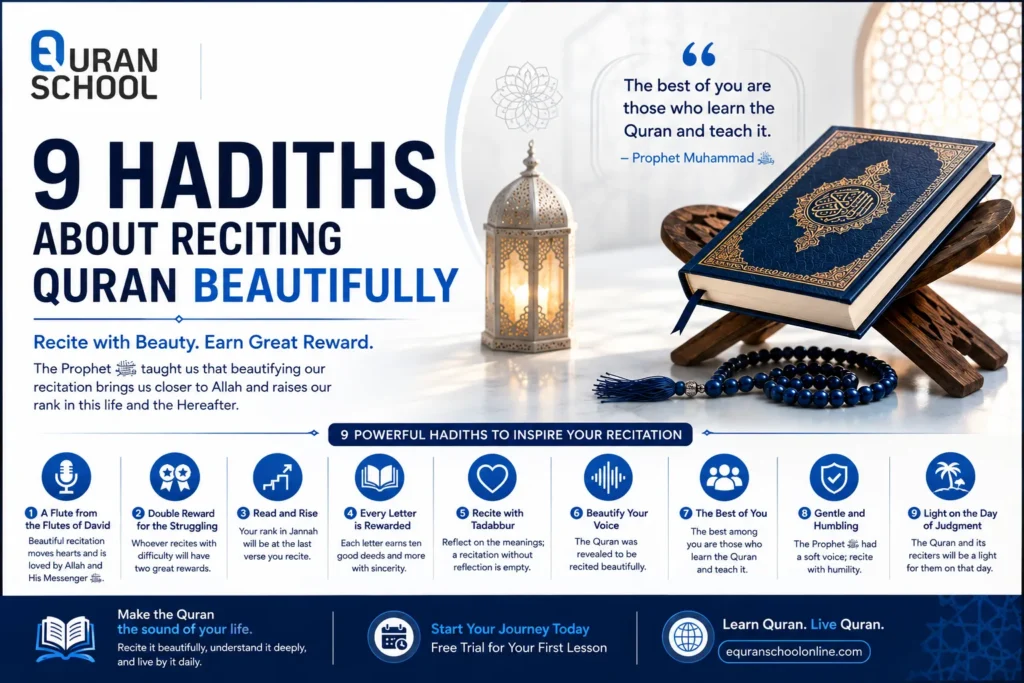
The hadith about reciting Quran beautifully are not minor footnotes in prophetic teaching; they form a coherent, compelling vision of how the Word of God should be carried in the human voice — and what that voice earns in return.
This article gathers the nine most significant of those narrations, explains what scholars understood them to mean across fourteen centuries, and shows you the practical difference they can make in how you open the Quran tomorrow morning.
Reserve your free trial lesson for Quran Reading Classes

1. “You Have Been Given A Flute From The Flutes Of David” — The Prophet’s Hadith About Reciting Quran Beautifully
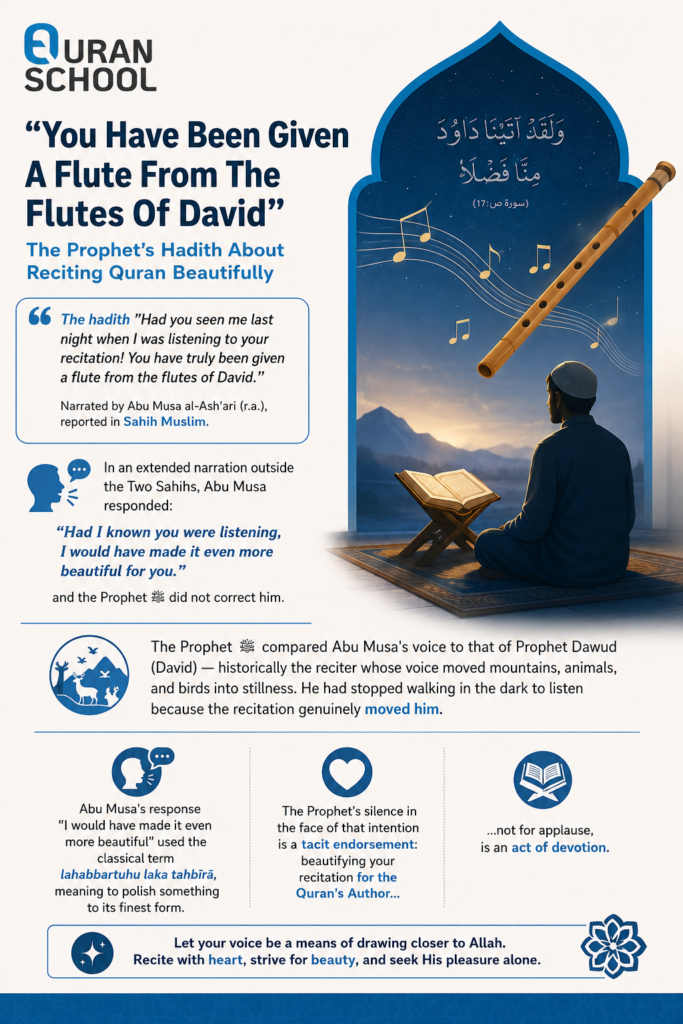
The hadith “Had you seen me last night when I was listening to your recitation! You have truly been given a flute from the flutes of David.” Narrated by Abu Musa al-Ash’ari (r.a.), reported in Sahih Muslim.
In an extended narration outside the Two Sahihs, Abu Musa responded: “Had I known you were listening, I would have made it even more beautiful for you.” and the Prophet ﷺ did not correct him.
The Prophet ﷺ compared Abu Musa’s voice to that of Prophet Dawud (David) historically the reciter whose voice moved mountains, animals, and birds into stillness. He had stopped walking in the dark to listen because the recitation genuinely moved him.
Abu Musa’s response “I would have made it even more beautiful” used the classical term laḥabbartuhu laka taḥbīrā, meaning to polish something to its finest form. The Prophet’s silence in the face of that intention is a tacit endorsement: beautifying your recitation for the Quran’s Author, not for applause, is an act of devotion.
Read also: 8 Hadiths About Reading Quran In 3 Days
2. The One Who Struggles Gets Double The Reward And That Is Where Beautiful Recitation Begins
The hadith “The one who recites the Quran proficiently will be with the noble, righteous scribes. And the one who recites the Quran with difficulty, stammering through it, will have a double reward.” Narrated by ‘A’isha (r.a.), reported in Sahih Muslim.
The Prophet ﷺ opened his teaching on recitation not with a standard that excludes but with a mercy that includes. Mastery earns a lofty station — companionship with angels. Struggle earns two rewards. This is not a consolation prize; it is a structural feature of how this Sunnah operates. Honest, effortful difficulty carries more weight than ease passively received.
This hadith is where the journey of Quran recitation for beginners rightly starts — with the assurance that imperfect recitation, when sincere and sustained, is a doubly rewarded act. The door into this practice is wider than most people assume.
Begin Learning Quran For Beginners Online Today at EQuran School

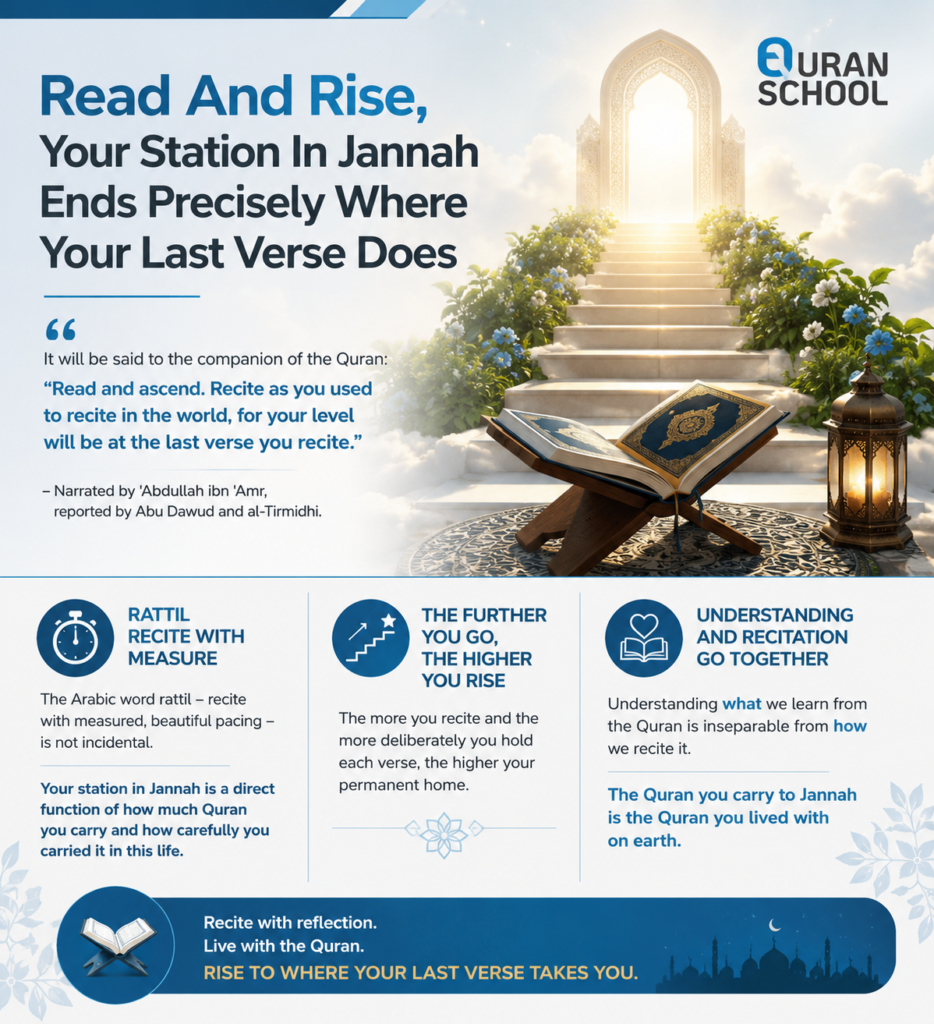
3. Read And Rise, Your Station In Jannah Ends Precisely Where Your Last Verse Does
The hadith “It will be said to the companion of the Quran: Read and ascend. Recite as you used to recite in the world, for your level will be at the last verse you recite.” Narrated by ‘Abdullah ibn ‘Amr, reported by Abu Dawud and al-Tirmidhi.
The Arabic word embedded here, rattil, recites with measured, beautiful pacing, is not incidental. Your station in Jannah is a direct function of how much Quran you carry and how carefully you carried it in this life. The further you go, and the more deliberately you held each verse, the higher your permanent home.
Understanding what we learn from the Quran is inseparable, in this narration, from how we recite it. A person who rushes through the same surah each morning learns something different from the person who recites it slowly, voice open, meaning absorbed. The Quran you carry to Jannah is the Quran you lived with on earth.
Read also: Reward For Reading Quran And The Blessings That Follow
4. Every Letter Earns Ten Rewards
The hadith “Whoever recites a letter of the Book of Allah will have one good deed recorded for him, and that good deed will be multiplied by ten. I do not say that Alif Lam Mim is one letter — rather, Alif is a letter, Lam is a letter, and Mim is a letter.” Narrated by ‘Abdullah ibn Mas’ud, reported by al-Tirmidhi.
The Prophet ﷺ broke Alif Lam Mim into three separate letters, each with its own reward — a detail that makes even a brief recitation session a dense accumulation of goodness. Classical scholars note that the baseline reward described here increases further with sincerity, correct makhraj (articulation), and tadabbur (contemplation) during the session.
The health benefits of reading Quran are increasingly documented in academic research — reduced cortisol, lower anxiety markers, measurable shifts in stress response, and improved sleep patterns in regular readers. These findings align with what scholars described centuries ago: engaged, voiced Quran reading produces a specific quality of stillness in the body and mind that passive reading does not replicate.
Join the Best Quran Qirat Learning Course Online with the first session free

5. God Listens Intently To The Beautiful-Voiced Reciter
The hadith “Allah listens more intently to a man who recites the Quran beautifully and aloud than the owner of a singing girl listens to his singer.” Narrated by Fadalah ibn ‘Ubayd, reported by Ibn Majah and authenticated by Ibn Hibban.
The comparison is striking by design. The Prophet ﷺ used an image his audience immediately recognized — the undivided attention a person gives to something they deeply love — and applied it to how God receives a beautiful Quranic recitation.
The Arabic word adhina (listens) here denotes attentive, approving, pleased reception, understood in a manner befitting God’s majesty without any resemblance to human hearing.
The benefits of reading Quran are commonly framed in terms of personal reward. This hadith adds a relational dimension that changes the texture of every session: your recitation is heard, attended to, and received. That is a different kind of motivation for improving how you sound.
Book a free trial class at E Quran School
See Us in Action
Watch a quick snippet from our live, interactive classes below and see how our teachers make learning engaging for all ages!
Start Your Quranic Journey Today
Experience our interactive online classes with a dedicated tutor.
Get Your Free Trial
6. The Best Quranic Voice Is The One That Makes Every Listener Feel The Reciter Genuinely Fears God
The hadith “The best voice among people for reciting the Quran is the one that, when you hear him recite, you think he fears Allah.” Narrated by Jabir ibn ‘Abdillah, reported by Ibn Majah and authenticated by al-Albani.
This narration sets the aesthetic standard from the inside out. The most beautiful voice is not the most technically trained or the most naturally gifted, it is the one through which genuine khushoo’ (awe and humility) is audible.
A measured pause at a verse about accountability, a softening at a verse of mercy, a breath held at a verse of warning, these are not theatrical choices. They are what a present, fearing heart sounds like when it reads.
Ibn al-Qayyim wrote that reading the Quran with tadabbur places its practitioner in an entirely different spiritual register from those around them. The voice is simply the outward sound of an inward state. Those who want to recite with that depth often find that an online Quran Tafsir course permanently changes the quality of every session they sit down to recite.
Book Your Free Session with One of EQuran School’s Certified Teachers
7. “He Is Not One Of Us Who Does Not Recite The Quran Melodiously” A Prophetic Line That Left No Room For Passivity
The hadith “He is not one of us who does not recite the Quran melodiously.” Narrated by Abu Hurairah and Abu Lubaba, reported by al-Bukhari, Muslim, and Abu Dawud.
The phrase “not one of us” is a strong prophetic formulation — a signal to take serious note, not a literal statement of exclusion from the faith. It communicates that melodious, careful recitation is a defining characteristic of the Muslim’s relationship with the Quran. It is a Sunnah, not an optional extra for those with good voices.
Scholars who have explored the importance of learning and teaching Quran consistently cite this narration when establishing that the Quran is not meant to be passively consumed; it is meant to be actively voiced, trained, improved upon, and transmitted.
If you work through EQuran School‘s live courses, the instructor’s ear becomes a constant measure of how close your recitation comes to what this hadith describes.
Book a Free Trial in Our Online Quran Recitation Classes

8. “Beautify The Quran With Your Voices” One Of The Clearest Imperatives In The Entire Prophetic Tradition
The hadith “Beautify the Quran with your voices, for a beautiful voice adds beauty to the Quran.” Narrated by al-Bara’ ibn ‘Azib, reported by Abu Dawud and al-Nasa’i, authenticated by Ibn Khuzaymah and Ibn Hibban.
Zayyinu l-Qur’āna bi-aṣwātikum — the grammar is imperative. A command to every Muslim who opens the Quran, not to those with natural talent alone. An accompanying narration closes the door on the excuse of limited ability: when asked what someone with a poor voice should do, the answer was simply, “Improve it as much as you can.”
Consistency is what turns this command into a daily reality. A 30 day Quran reading schedule pairs daily tilawah with focused voice work, transforming scattered sessions into a discipline — and giving you the repetition that voice improvement actually requires.
Start learn Quran with Tajweed with your first free class

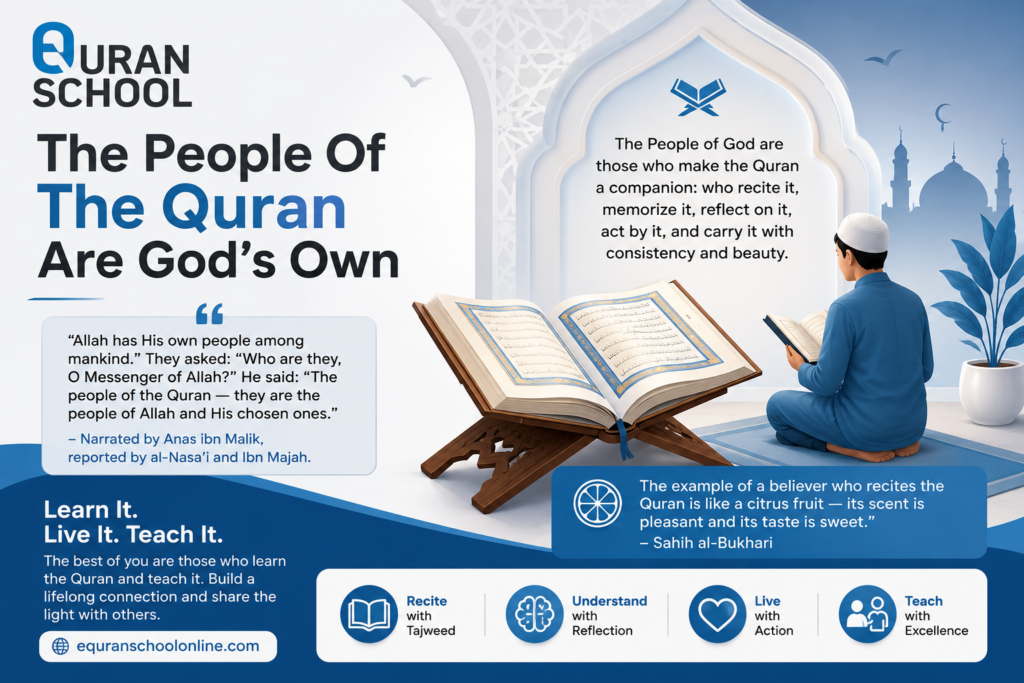
9. The People Of The Quran Are God’s Own
The hadith “Allah has His own people among mankind.” They asked: “Who are they, O Messenger of Allah?” He said: “The people of the Quran — they are the people of Allah and His chosen ones.” Narrated by Anas ibn Malik, reported by al-Nasa’i and Ibn Majah.
The title Ahl Allah — the People of God — is the highest relational designation in this narration. It belongs to those who make the Quran a companion: who recite it, memorize it, reflect on it, act by it, and carry it with consistency and beauty.
The Prophet ﷺ also said: “The example of a believer who recites the Quran is like a citrus fruit — its scent is pleasant and its taste is sweet.” (Sahih al-Bukhari). The fragrance and the taste are both present — an inner connection to meaning and an outward voice that honors the words.
To learn the Quran and teach it, the instruction from the famous narration, “The best of you are those who learn the Quran and teach it”, requires both a living personal practice and access to qualified teachers who hold the authentic chain of transmission.
The Etiquette Of Beautiful Recitation
The nine hadiths above generated a centuries-long scholarly conversation about exactly where beautification becomes distortion. That conversation resolves into three practical principles on which all four major legal schools — Shafi’i, Hanbali, Maliki, and Hanafi — reached substantial agreement.
Imam al-Nawawi stated that scholars unanimously recommended beautifying the voice for Quranic recitation. The disagreements concern degree and style, not the recommendation itself.
A. What Every Reciter Is Actively Encouraged To Do?
Reciting with the best voice you can produce, projecting it with audibility, slowing at meaningful points, and allowing genuine emotion to be audible, all of this falls squarely within what the hadiths prescribe.
Articulating letters from their correct points (makharij al-huroof) and applying tajweed rules is both a linguistic obligation and an act of reverence toward the Quran’s precision.
Reading the Quran in Arabic is the foundation on which all of this rests. The benefits of reading Quran in Arabic include direct access to the sound patterns, prosodic rhythms, and lexical precision that no translation can preserve intact.
Beginning each session with a dua before starting Quran — a short supplication that centers the intention — opens the recitation with the kind of conscious presence these hadiths are ultimately pointing toward.
Begin memorizing the Quran today and your first session is free

B. Stretching Letters And Adding Sounds Disagree With Scholars Curriculum
Stretching letters beyond their correct measure, adding sounds not found in the original Arabic, or modeling the delivery on entertainment music — all of these cross a line scholars drew clearly.
The practical criterion: does this beautification serve the listener’s understanding and awe, or has the voice itself become the object of admiration? The former is worship. The latter is performance.
The luhun (melodic styles) that prophetic narrations discourage are those that pull attention away from the meaning and toward the sound — a distortion that works against the very purpose these hadiths are trying to achieve.
C. A Lesson In Intention From Abu Musa Himself
When Abu Musa said “I would have made it even more beautiful for you,” he expressed something scholars noted carefully: the intention to honor the listener of the Quran — and ultimately its Author — through careful voice work is an intention that purifies the act entirely. The motive separates beautification from vanity.
For families with young children beginning this journey, simple anchors like a dua for learning Quran build the right intention into the habit from day one, framing Quranic study as worship before it ever becomes routine.
Experience Our Classes
Don’t just take our word for it—watch real-time recordings of our online classes below to experience our teaching style firsthand.
Start Your Quranic Journey Today
Experience our interactive online classes with a dedicated tutor.
Get Your Free TrialEQuran School: Where These Hadiths Become a Living Practice — Not Just a Reading List
EQuran School was built on the conviction that every Muslim, wherever they live, deserves access to that quality of instruction. Students come from across North America, Europe, Australia, and beyond. The school’s approach is the same for all of them: live, personal instruction grounded in the authentic chain of transmission that links today’s reciters to the Prophet ﷺ himself.
EQuran School developed the proprietary Al-Menhaj Book — authored by Luqman ElKasabany — specifically for non-Arabic speaking adults and children in Western contexts.
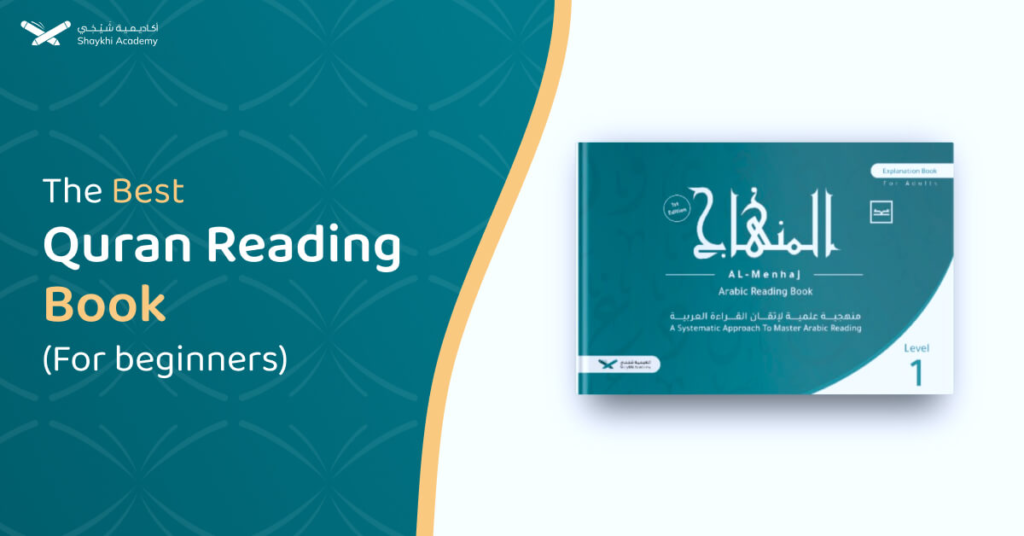
The book walks students from the Arabic alphabet through correct articulation and tajweed rules in a sequence tested with thousands of learners. It eliminates the guesswork that makes self-study so slow and the errors that self-study so reliably leaves in place for years.
For families with young children, online Quran classes for kids at EQuran School use age-appropriate pacing, certified instructors, and engagement techniques proven to hold young attention while building correct foundations early.
EQuran School offers a full curriculum:
- Online Quran Learning with Tajweed Course
- Noorani Qaida Course for Kids
- Female Quran Classes
- Intensive Quran Course
- Quran Tafsir Course
- Online Arabic and Quran Classes
- Weekend Quran Classes
- Zoom Quran Classes
- Learn Quran Easily at Home
Book a free trial class at E Quran School and experience personalized Quran instruction that adapts to your unique learning needs, Insha’Allah.
Start Your Quranic Journey Today
Experience our interactive online classes with a dedicated tutor.
Get Your Free TrialConclusion
The nine hadiths in this article make one consistent argument across different occasions, companions, and contexts: the way you recite the Quran matters. Not because God needs a beautiful voice, but because the voice is the gate through which meaning enters the heart. When you slow down, open your chest, and recite with presence, the words stop being text and become experience.
The Prophet ﷺ modeled this. He praised it in his Companions. He corrected those who rushed. He commanded: “Beautify the Quran with your voices.” And he left a tradition in which every Muslim — the struggling beginner and the devoted hafiz alike — is invited to bring their best voice to the best words ever spoken.
The benefits of reading Quran are not automatic. They deepen with intention, with knowledge, with tajweed, and with the consistency that comes from having a structure, a teacher, and a plan. Whether you are just beginning or returning to a practice that has grown quiet, the door is exactly where the Prophet ﷺ said it was — open to anyone willing to enter.
If you are ready to learn Quran online from home with certified instructors who apply these prophetic standards in every session, EQuran School offers the teachers, the curriculum, and the accountability to make that commitment real.
Frequently Asked Questions
What is the most important hadith about reciting the Quran beautifully?
Scholars most frequently cite the narration reported by Abu Hurairah in Sahih al-Bukhari and Sahih Muslim: “Allah does not listen to anything as He listens to a Prophet with a beautiful voice who recites the Quran aloud with melody.” This hadith establishes that God attends to beautiful Quranic recitation in a way that exceeds all other forms of listening.
Does a person need a naturally beautiful voice to fulfill these hadiths?
No. The Prophet ﷺ addressed this directly. When a companion asked what someone with a poor voice should do, the answer was: “Let him improve it as much as he can.” The hadith about the struggling reciter receiving double reward confirms this: sincere effort in the face of difficulty carries its own elevated reward. The obligation is directed at effort and intention, not at natural ability.
What exactly does “singing” the Quran (taghanni) mean in Islamic law?
Taghanni in the prophetic context means beautifying the voice, projecting it with audibility and measured pace, and reciting with a tone that conveys awe and submission. It does not mean adding musical instruments, entertainment-style melodies, or theatrical techniques to Quranic verses.
Is reciting the Quran loudly recommended or discouraged?
Both are appropriate in different contexts. The Prophet ﷺ praised audible, melodious recitation and himself recited beautifully and aloud on recorded occasions. The condition scholars consistently cite is that loud recitation must not disturb others who are praying, remembering God, or sleeping. The Prophet ﷺ addressed this exact situation: “Each of you is conversing privately with his Lord, so do not disturb one another with your recitation.
How can a non-Arabic speaker improve their Quran recitation?
The most effective path is systematic: begin with correct letter articulation (makharij al-huroof), move to the rules of tajweed, then work on voice quality and measured pacing with a teacher who can hear and correct you in real time.
Programs designed specifically for non-Arabic speakers, like those built around the Al-Menhaj Book methodology, compress this progression significantly and eliminate errors that self-study leaves in place for years.
At what age should children begin learning to recite the Quran correctly?
Most scholars and Quranic educators recommend starting between the ages of four and seven. Children who learn correct pronunciation before the age of seven rarely develop the stubborn articulation errors that adult learners must later unlearn at significant effort.
Related Articles
Learn Quran









Leave a Reply