 Quran

How to become a hafiz? A question asked by every parent who hears a child recite a full Juz from memory, and every adult who wishes they had started earlier. The answer is encouraging, because thousands of non-Arabic speakers have done it, Insha’Allah.
Becoming a hafiz rests on four pillars: fluent reading with Tajweed, a single Mushaf, a realistic daily target, and a revision system that outweighs new memorization. Most students finish in three to seven years, and this plan for how to become a Hafiz-e-Quran follows the order Azhari teachers use in class.
1. Master Fluent Quran Reading with Tajweed Before Memorizing
Fluent Quran reading with correct Tajweed is the first thing every Hifz teacher checks before assigning a single new page. A student who still sounds out words letter by letter will memorize mistakes along with the verses.
Fixing a memorized mistake takes far longer than avoiding it, because the wrong sound has already been repeated dozens of times. Teachers often spend weeks undoing one misplaced Harakah in a well-known Surah.
For non-Arabic speakers, the usual trouble spots are ح versus ه, ع versus أ, ق versus ك, and heavy letters such as ص and ط read as light. These sounds must be stable before memorization begins.
Allah commands careful, measured recitation:
وَرَتِّلِ الْقُرْآنَ تَرْتِيلًا
Wa rattilil-Qur’ana tartila
“And recite the Qur’an with measured recitation.” (Al-Muzzammil 73:4)
If your reading is still slow, the Noorani Qaida Course at EQuran School usually takes adults from the alphabet to fluent reading in three to six months.
Book Your Free Trial Today for the Noorani Qaida Course!

Simple Reading Test Before Starting Hifz
A simple reading test before starting Hifz is to open any random page of the Mushaf and read it aloud. If you read at a steady pace with no more than two or three errors, you are ready.
Read also: How To Learn Quran With Tajweed? – A Complete Guide
2. Choose One Mushaf and a Qualified Hifz Quran Teacher
Choosing one Mushaf and keeping it for your entire Hifz is a decision many self-taught students overlook. Visual memory plays a large role, because you remember where each verse sits on the page.
We recommend the 15-line Madinah Mushaf. Each page ends at the end of a verse, and each Juz covers about 20 pages, which makes planning, tracking, and testing far easier for both student and teacher.
A qualified Hifz Quran teacher is just as essential. The Quran was passed down orally from teacher to student, and only a trained listener catches subtle errors in Madd lengths, Ghunnah, and similar-sounding verses known as Mutashabihat.
3. Set a Daily Quran Memorization Target Based on Age and Schedule
A daily Quran memorization target should match the student’s age, attention span, and available time, not a number borrowed from someone else’s success story. The table below reflects what we see work with real students.
| Student profile | Daily new memorization | Total daily study time |
| Children aged 5 to 7 | 2 to 4 lines | 30 to 45 minutes |
| Children aged 8 to 12 | 5 to 8 lines | 60 to 90 minutes |
| Teenagers | Half to one page | 90 to 120 minutes |
| Working adults | 3 to 7 lines | 45 to 60 minutes |
| Full-time adult students | 1 to 2 pages | 3 to 4 hours |
Consistency matters more than volume. Five lines a day, five days a week, add up to over four Juz in one year, which beats a full page daily that collapses after two months.
Renew your intention regularly as well. Students who memorize for the sake of Allah, rather than to impress others, tend to stay steady when progress feels slow.
Experience Our Classes
Don’t just take our word for it—watch real-time recordings of our online classes below to experience our teaching style firsthand.
Start Your Quranic Journey Today
Experience our interactive online classes with a dedicated tutor.
Get Your Free Trial4. Start Quran Hifz with Juz Amma and the Short Surahs
Starting Hifz with Juz Amma gives beginners early wins, because the short Surahs build confidence and are already recited daily in Salah. Many students know several of them before formally beginning.
Allah has promised that this effort is within reach:
وَلَقَدْ يَسَّرْنَا الْقُرْآنَ لِلذِّكْرِ فَهَلْ مِن مُّدَّكِرٍ
Wa laqad yassarnal-Qur’ana lidh-dhikri fahal min muddakir
“And We have certainly made the Qur’an easy for remembrance, so is there any who will remember?” (Al-Qamar 54:17)
Most teachers then move to Juz 29 and Juz 28 before returning to Al-Baqarah. Starting from Al-Baqarah is also valid, but the reverse order suits children and busy adults better.
5. Memorize Each New Quran Page with a Proven Repetition Method
Memorizing each new page works best with a fixed method repeated every day, ideally right after Fajr when the mind is fresh. Random, unstructured repetition is the main reason students forget quickly.
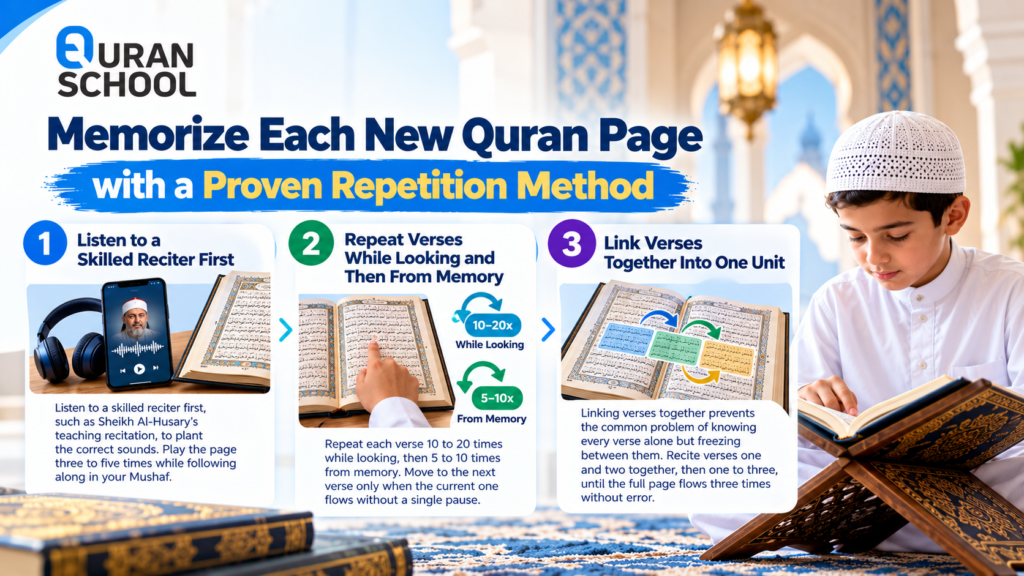
A. Listen to a Skilled Quran Reciter First
Listening to a skilled reciter first, such as Sheikh Al-Husary’s teaching recitation, plants the correct sounds before you read. Play the page three to five times while following along in your Mushaf.
B. Repeat Verses While Looking and Then From Memory
Repeat each verse 10 to 20 times while looking, then 5 to 10 times from memory. Move to the next verse only when the current one flows without a single pause.
C. Link Verses Together Into One Unit
Linking verses together prevents the common problem of knowing every verse alone but freezing between them. Recite verses one and two together, then one to three, until the full page flows three times without error.
Read also: Word by Word Quran Reading and Recitation Teachers and Tutors
6. Build a Daily Quran Revision System for Recent and Older Portions
A daily Quran revision system is what separates students who finish Hifz from those who memorize and then lose it. The Prophet ﷺ warned about how quickly the Quran slips away:
“Keep on reciting the Quran, for by Him in Whose Hand my soul is, it escapes faster than camels escape from their tying ropes.” (Sahih al-Bukhari 5033)
Experienced teachers keep revision time at least double the time spent on new memorization. A practical ratio is 1 to 2 in the first year, rising to 1 to 3 after five Juz.
Recent Revision of the Last 20 Pages
Recent revision covers the last 20 pages you memorized, recited from memory every day. These pages are the most fragile because they have not yet settled into long-term memory.
Older Revision Rotated Across the Week
Older revision rotates through everything memorized before those 20 pages, aiming to cover it all every one to two weeks. A student with ten Juz typically reviews one Juz daily, often within Sunnah and night prayers.
7. Recite to Your Quran Teacher for Correction and Weekly Testing
Reciting to your Quran teacher several times a week turns memorization into accurate memorization. Your teacher hears the new page, part of your recent revision, and a random older portion in every session.
Weekly testing should start from random points, not just the beginning of a Surah. Being asked to continue from the middle of a page exposes weak links that ordinary recitation hides.
Keep a small notebook of Mutashabihat, the verses that look almost identical. Writing down how they differ, and where each appears, saves months of confusion later.
This is exactly how the Quran Memorization (Hifz) Course at EQuran School runs. Our Azhari tutors use Active Correction, stopping every mistake in real time so errors never get the chance to settle in.
Book Your Free Trial Today for Quran Memorization (Hifz) Course!
8. Complete the Full Quran and Consolidate It Before Ijazah
Completing the full Quran is a huge milestone, but consolidating it is what truly makes someone a hafiz. Most teachers require a consolidation period of six to twelve months after finishing.
During consolidation, no new pages are added. The student revises one to three Juz daily and recites the entire Quran to the teacher in long sittings, until any page can be recalled confidently.
Students who want a sanad, an unbroken chain back to the Prophet ﷺ, can continue to the Quran Ijazah Program, where certified teachers test the full recitation from memory with complete Tajweed precision.
Book Your Free Trial Today for the Quran Ijazah Program!
Common Hifz Mistakes That Slow Down Students Who Do Not Speak Arabic
Common Hifz mistakes usually come from rushing rather than from lack of ability. The most damaging one is adding new pages faster than revision can protect them, which creates a growing pile of weak memorization.
Switching between Mushafs or apps breaks visual memory. Students who memorize from a phone screen and revise from a printed copy often lose their sense of where verses begin and end.
Memorizing without a teacher is another costly mistake. Students who rely only on transliteration or audio frequently lock in wrong vowels, merged letters, or shortened Madd that take months to correct.
Weekend cramming also fails. Two hours on Saturday cannot replace twenty minutes every day, because memory strengthens through spaced repetition, not occasional long sessions.
Realistic Hifz Timelines by Age for Anyone Learning How to Become a Hafiz
Realistic Hifz timelines depend mainly on daily consistency, not on age or intelligence. The estimates below assume five study days per week and do not include the consolidation period.
| Student profile | Daily new portion | Estimated completion |
| Children aged 8 to 12 | Half a page | 4 to 5 years |
| Teenagers | One page | 2 to 3 years |
| Working adults | 5 lines | 6 to 8 years |
| Full-time intensive students | 2 pages | 1 to 1.5 years |
When working adults ask how to become hafiz e Quran alongside a full-time job, the answer is usually smaller daily portions and stronger revision. Our Hifz Classes for Adults are built around early morning and late evening slots for exactly this reason.
Book Your Free Trial Today for Quran Classes for Adults!
Start Your Quranic Journey Today
Experience our interactive online classes with a dedicated tutor.
Get Your Free TrialRead also: How Long Does It Take To Memorize The Quran And Become A Hafiz?
Start Your Spiritual Journey with E Quran School Today
Transform your understanding and recitation of the Holy Quran from the comfort of your home. At E Quran School, our certified tutors provide personalized, one-on-one guidance tailored to your pace and schedule. Whether you are looking for beginner Quran reading, advanced Tajweed, or Memorization (Hifz) courses, we have a program for you.
Our Quran Courses
- Quran Recitation Classes
- Weekend Quran Classes
- Quran Reading Classes
- Online Quran Classes for Kids
- Learn Quran Online with Tajweed for Kids and Adults
- Online Quran Learning with Tajweed Course
- Quran Classes for Adults
- Female Quran Classes
- Female Quran Teacher for Ladies
- Learn Quran for Beginners
- Quran Qirat Learning Course
Book your free trial class today at EQuran School and take your first step toward Hifz, Insha’Allah.
Start Your Quranic Journey Today
Experience our interactive online classes with a dedicated tutor.
Get Your Free TrialConclusion
Strong Hifz begins long before the first memorized page, with fluent reading, correct Makharij, and a single Mushaf. Skipping these foundations is the most common reason non-Arabic speakers struggle later and lose motivation.
Knowing how to become a hafiz really means respecting the balance between new memorization and revision. Small daily portions, a 1 to 2 revision ratio, and regular recitation to a teacher keep the Quran firmly protected.
Whether you are a parent planning for your child or an adult starting late, the timeline is realistic, Insha’Allah. Steady effort, a qualified teacher, and sincere intention will carry you to the final page.
Frequently Asked Questions About Becoming a Hafiz
Can an adult learn how to become a hafiz after 30?
Yes, an adult can learn how to become a hafiz after 30. Adults often memorize more slowly than children but understand better, stay more disciplined, and retain well with consistent daily revision and a qualified teacher.
What is the best age to start learning how to become Hafiz e Quran?
The best age to start Hifz is usually between 7 and 10, once a child reads fluently and can focus for 30 minutes. However, any age is suitable when reading is correct and commitment is steady.
How to become Hafiz e Quran without understanding Arabic?
Becoming Hafiz e Quran without understanding Arabic is common, as most huffaz worldwide are non-Arabs. Learning basic meanings of each page alongside memorization strengthens retention and makes recitation in Salah far more meaningful.
How many hours a day should a Hifz student study?
A Hifz student should study one to two hours daily, split between new memorization and revision. Children need shorter sessions, while full-time students may study three to four hours with breaks between them.
Is it possible to complete Hifz through online classes?
Completing Hifz through online classes is entirely possible with one-on-one sessions. A qualified teacher hears every verse clearly over video, corrects mistakes instantly, and tests revision just as effectively as in a traditional classroom.
What should a hafiz do after forgetting parts of the Quran?
A hafiz who forgets parts of the Quran should return to daily revision immediately, starting with the weakest Juz. Reciting to a teacher again and reading those portions in night prayers helps restore them quickly.









[…] Read also: How To Become A Hafiz? 8 Simple Steps […]
[…] Read also: How To Become A Hafiz? 8 Simple Steps […]