 Learn Quran
Few questions in Islamic practice occupy as comfortable a place in the “it depends” category as the question of voice during recitation. Raise your voice and you might disturb a worshipper nearby; stay too quiet and you risk missing the full spiritual weight of the act itself.
The hadith about reciting Quran loudly — there are several, and they appear to pull in different directions — represents one of the most practically important bodies of narrations a Muslim can study and apply.
This article brings together the most reliable narrations on the topic, the classical scholarly framework that reconciles them, and the practical rules that help every Muslim make the right call depending on their situation.
What you’ll learn in this article:
- The two most important hadiths about loud recitation and what they mean when read together.
- The exact scholarly threshold for what counts as valid recitation.
- When raising your voice is the more virtuous act — and when silence becomes the better choice.
- The three narrations that guarantee reward for every articulated letter.
- How to build a structured, correct recitation practice from wherever you are starting.
Book a FREE Trial Class for Your Child in Our Noorani Qaida Course for Kids

The Hadith About Reciting Quran Loudly Reveals the Prophetic Guidance
The Islamic tradition does not leave the question of recitation volume to personal preference. The Prophet ﷺ addressed it across multiple authentic narrations, and the scholars who followed built a coherent, applicable framework from those narrations — one that is precise enough to guide every situation a Muslim encounters, from a quiet room at home to a mosque full of worshippers.
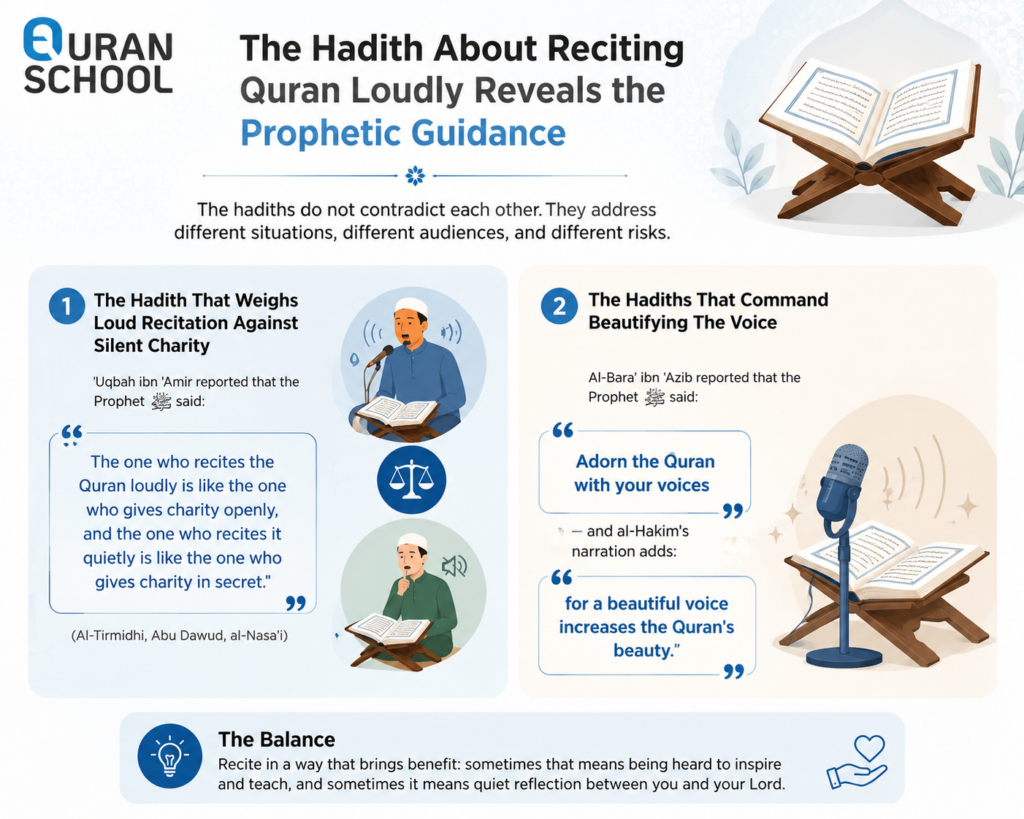
The key to understanding this topic is recognising that the hadiths do not contradict each other. They address different situations, different audiences, and different risks. Once that is clear, the apparent tension disappears.
1. The Hadith That Weighs Loud Recitation Against Silent Charity
Since secret charity is considered more virtuous in Islamic law — further from the desire to be seen and praised — the following hadith appears to favour silent recitation; ‘Uqbah ibn ‘Amir reported that the Prophet ﷺ said:
“The one who recites the Quran loudly is like the one who gives charity openly, and the one who recites it quietly is like the one who gives charity in secret.” (Al-Tirmidhi, Abu Dawud, al-Nasa’i)
Imam al-Nawawi‘s synthesis, which became the authoritative position across the major schools, resolved the apparent difficulty: quiet recitation is better specifically when the person fears showing off, or when raising the voice would disturb worshippers, students, or sleepers nearby.
In every other case, reciting aloud carries greater reward, because the effort is greater, the heart becomes more alert, and the benefit reaches beyond the reciter alone. Understanding the benefits of Quran recitation begins here: the scale does not tip automatically toward silence or toward sound. It tips toward whichever choice is more sincere, more useful, and least likely to impose on others.
2. The Hadiths That Command Beautifying The Voice
The second stream of narrations actively encourages vocal, melodious recitation. Al-Bara’ ibn ‘Azib reported that the Prophet ﷺ said: “Adorn the Quran with your voices” — and al-Hakim’s narration adds: “for a beautiful voice increases the Quran’s beauty.”
Abu Hurayrah reported what may be the most frequently cited hadith on this topic, agreed upon by al-Bukhari and Muslim: “Allah has not given permission for anything as He has given permission to a Prophet with a beautiful voice who recites the Quran aloud.”
The word “permission” here is understood by scholars as attentive listening — Allah’s attention to the raised, beautified voice of a Prophet reciting His Book surpasses His attention to anything else. This is an open invitation, through the example of the Prophets, to raise the voice as an act of worship.
Jabir ibn ‘Abdillah also reported: “Among the best of people in reciting the Quran are those whom, when you hear them reading, you assume they fear Allah.” (Ibn Majah). The voice, in other words, should carry the weight of what is being said.
Read also: 10 Prophetic Hadith About Reading Quran
Reading The Room — When Volume Is A Virtue In Quran Recitation And When It Crosses The Line
The governing principle of the entire topic is found in a single narration from Abu Sa’id al-Khudri. The Prophet ﷺ was in i’tikaf in the mosque when he heard his companions reciting aloud. He pulled back the curtain and said:
“Know that every one of you is in private conversation with his Lord. So do not disturb each other, and do not raise your voices over one another in recitation.” (Abu Dawud, with a sound chain)
This narration sets the boundary with precision: loud recitation is your right and your privilege — until it becomes a burden on someone else’s right to worship in peace.
1. Four Situations Where Quran Reciting Aloud Is Recommended
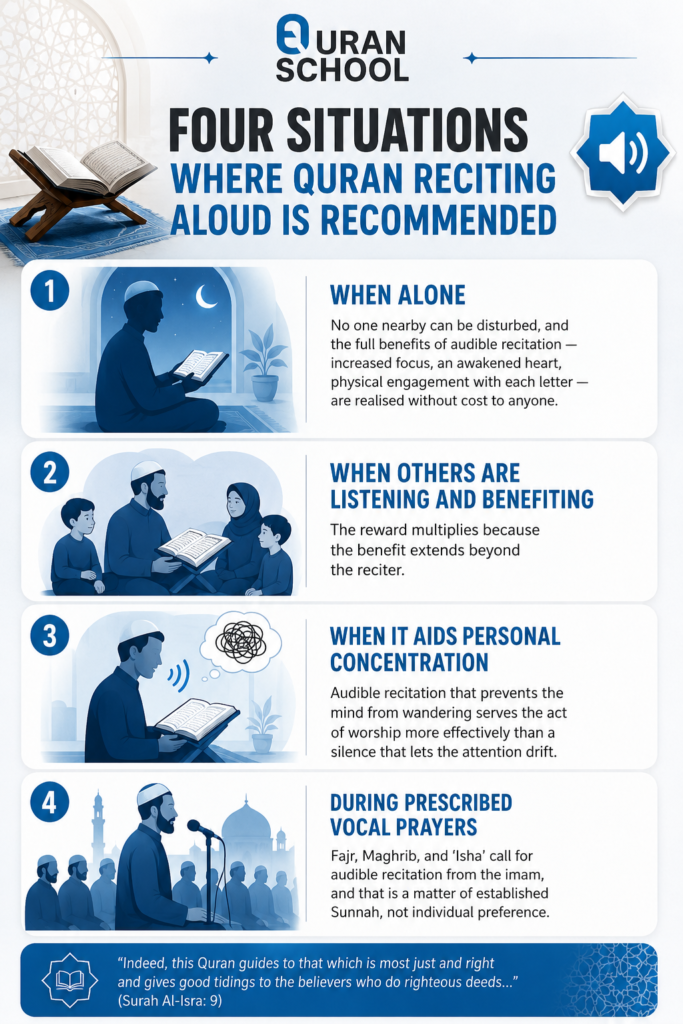
Classical scholars converged on four conditions under which raising the voice is preferred or strongly recommended:
- When alone: no one nearby can be disturbed, and the full benefits of audible recitation — increased focus, an awakened heart, physical engagement with each letter — are realised without cost to anyone.
- When others are listening and benefiting: the reward multiplies because the benefit extends beyond the reciter.
- When it aids personal concentration: audible recitation that prevents the mind from wandering serves the act of worship more effectively than a silence that lets the attention drift.
- During prescribed vocal prayers: Fajr, Maghrib, and ‘Isha’ call for audible recitation from the imam, and that is a matter of established Sunnah, not individual preference.
2. When Reciting In Silence Becomes The More Honourable Choice
There are equally clear situations where silence is the right — and in some cases obligatory — choice:
- When worshippers are praying in the same space and loud recitation would confuse their own reading
- When people are sleeping or resting nearby and a raised voice would disturb them
- When the person honestly fears that reciting aloud is feeding self-admiration
- During voluntary daytime prayers, where the classical position holds that recitation is quiet by nature
The scholar Ibn Sirin captured the daytime threshold in one practical line: “In daytime recitation — let yourself hear.” That is the minimum: your own ears catching the sound of your own voice. Anything beyond that requires an honest question about whether it is helping or intruding.
One distinction rarely made explicit: reciting correctly in Arabic — with the proper articulation of every letter — is where the benefits of reading Quran in Arabic are truly realised. Correct pronunciation and appropriate volume work together, not separately.
Book Your FREE Trial Lesson in Our Quan Classes for Adults
Read also: 10 Prophetic Hadith About Reading Quran
See Us in Action
Watch a quick snippet from our live, interactive classes below and see how our teachers make learning engaging for all ages!
Start Your Quranic Journey Today
Experience our interactive online classes with a dedicated tutor.
Get Your Free TrialThe Letter That Most People Miss — What “Reciting Quietly” Actually Requires
If the Quran passes through the mind only — as a memory, a visualisation, or a silent mental reading — without producing any audible sound, that is not recitation. It is a form of reflection, valuable in its own right, but a different act entirely.
The Prophet ﷺ promised reward for every letter: “Whoever reads one letter from the Book of Allah has one good deed to his name, and that good deed is worth ten like it. I do not say that Alif-Lam-Mim is one letter — rather Alif is a letter, Lam is a letter, and Mim is a letter.” (Al-Tirmidhi).
During Ramadan, many Muslims sit with an open Mushaf and let the text pass before their eyes, assuming they are completing a recitation. Scholars across the major schools are consistent: if the tongue and lips are still, the reward of recitation has not been earned.
The reward of gazing at the Mushaf exists and carries its own virtue — it simply is not the same thing as reading it. This is part of what we learn from the Quran as a comprehensive practice: form is not incidental to worship. The method matters.
Reserve your free trial lesson for Quran Reading Classes

Three Hadiths That Promise Reward for Every Letter You Recite
The narrations about the reward for Quran recitation are among the most motivating in the entire hadith corpus. Three in particular address distinct dimensions of reward — every Muslim who recites regularly should hold all three in mind.
Together, these three hadiths form a complete picture: every letter is rewarded, the extent of that reward is multiplied, and even struggling with recitation earns double what effortless reading would receive.
1. A Good Deed Multiplied Ten Times For Every Single Letter
Ibn Mas’ud reported that the Prophet ﷺ said: “Whoever reads one letter from the Book of Allah receives one good deed, and that good deed is multiplied ten times.” (Al-Tirmidhi). A single short verse carries hundreds of individually counted rewards. The arithmetic of recitation is more generous than most people ever stop to calculate.
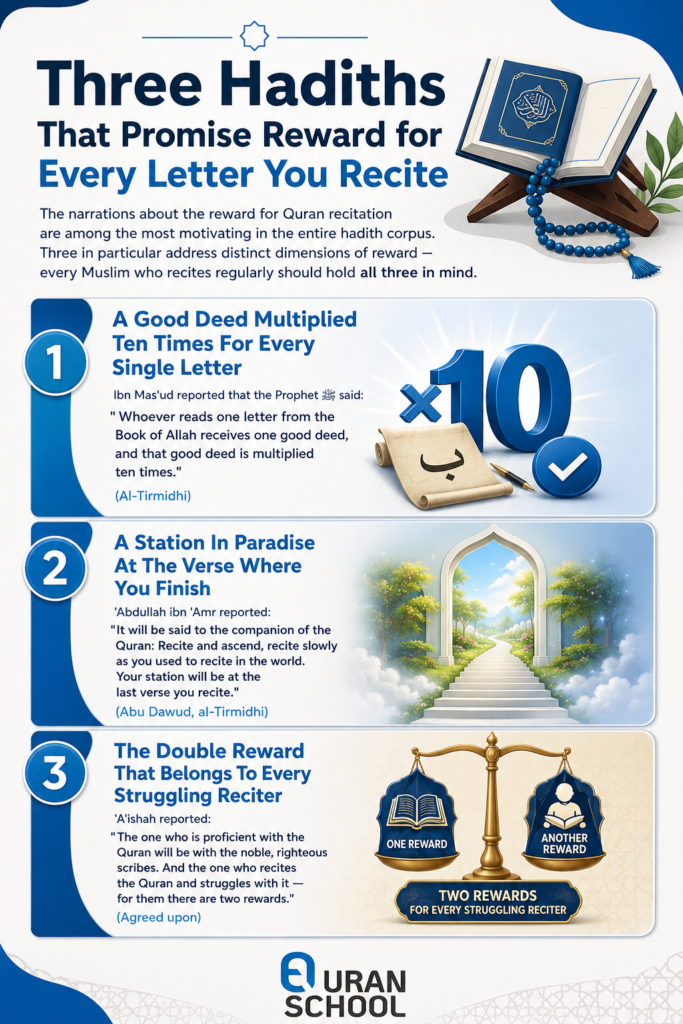
2. A Station In Paradise At The Verse Where You Finish
‘Abdullah ibn ‘Amr reported: “It will be said to the companion of the Quran: Recite and ascend, recite slowly as you used to recite in the world. Your station will be at the last verse you recite.” (Abu Dawud, al-Tirmidhi).
This hadith links consistent recitation and memorisation to elevation in Paradise — a station determined entirely by how much a person engaged with the Book during this life.
3. The Double Reward That Belongs To Every Struggling Reciter Of Quran
The person who stumbles, corrects, and pushes through earns more than the one for whom recitation comes naturally. Difficulty is not a signal to stop; it is confirmation that the effort is being counted separately.
‘A’ishah reported: “The one who is proficient with the Quran will be with the noble, righteous scribes. And the one who recites the Quran and struggles with it — for them there are two rewards.” (Agreed upon).
Whether you are in the US, UK, Canada, Australia, or anywhere else in the world, the math is the same and the method works: every articulated letter earns a deed, every deed is multiplied ten times, and every moment of struggle earns a bonus reward on top.
Consistent recitation, particularly when done with deliberate sound and genuine reflection, has been associated with reduced stress levels, improved attentional capacity, and a measurable increase in the kind of calm that follows focused worship.
Start learn Quran with Tajweed with your first free class

The Etiquette The Scholars Preserved Around Every Quran Recitation Session
Performing wudu before recitation is recommended because the Quran is the highest form of remembrance. Choosing a clean, quiet space — the mosque where possible — establishes the right frame. Sitting facing the qibla, with composure and unhurried intention, mirrors how the Companions approached the act.
Reciting the ta’awwudh — seeking refuge from Shaytan — before every session is explicitly recommended. And when passing a verse that mentions Paradise, the Sunnah is to pause and ask Allah for it; when passing one that mentions the Fire, to pause and seek refuge.
Before sitting with the Quran, many scholars and students make it their practice to recite a dua before starting Quran — an act that orients the heart and marks the session as conscious worship rather than mechanical reading.
Similarly, making a dua for learning Quran free of error and distraction was a practice the Companions observed; they regularly asked Allah to make the Book easy on their tongues and deep in their understanding.
Experience Our Classes
Don’t just take our word for it—watch real-time recordings of our online classes below to experience our teaching style firsthand.
Start Your Quranic Journey Today
Experience our interactive online classes with a dedicated tutor.
Get Your Free TrialStart Your Quran Journey With Teachers Who Have A Proven Track Record
EQuran School was built specifically for Muslims in Western countries who want expert Quran education that meets their real situation — schedule, language background, and starting point included.
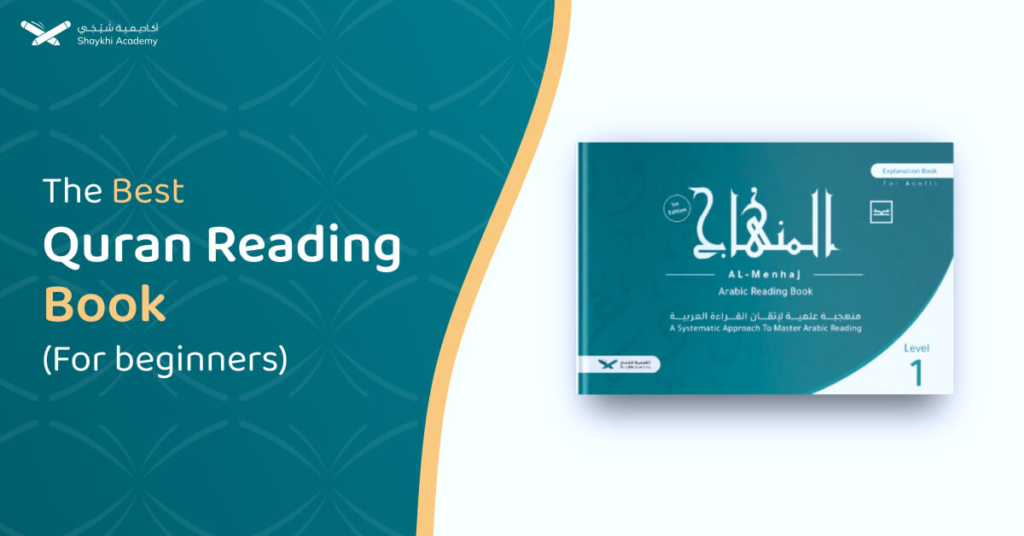
Most online Quran platforms use generic Arabic phonics materials designed for native Arabic children. EQuran School developed the proprietary Al-Menhaj Book — authored by Luqman ElKasabany — specifically for non-Arabic speaking adults and children in Western contexts.
The outcomes are measurable: thousands of students who arrived with no Arabic reading ability and left with tajweed-correct recitation, confident enough to lead prayers. The best way to learn Quran online is not found by comparing the number of platforms available.
For parents researching online Quran classes for kids, EQuran School runs dedicated programmes for children taught by instructors specifically trained to keep young learners engaged, progressing, and building real recitation skills rather than surface-level familiarity.
EQuran School offers a full path — from the very first Arabic letter to advanced memorisation and scholarly engagement:
- Quran Memorization (Hifz) Course
- Quran Tafsir Course
- Online Arabic and Quran Classes
- Quran Qirat Learning Course
- Online Quran Recitation Classes
- Noorani Qaida Course
- Online Quran Classes for Kids
- Learn Quran Easily at Home
- Weekend Quran Classes
- Zoom Quran Classes
Book a free trial class at E Quran School and experience personalized Quran instruction that adapts to your unique learning needs, Insha’Allah.
Start Your Quranic Journey Today
Experience our interactive online classes with a dedicated tutor.
Get Your Free TrialConclusion
The hadiths about reciting Quran loudly are not in conflict — they are completing each other. The Prophet ﷺ praised beautiful audible recitation, instructed companions during i’tikaf to lower their voices to protect one another’s worship, and guaranteed double reward to every reciter who finds the task difficult. These three truths hold together without contradiction.
The benefits of reading Quran — spiritual, psychological, and in terms of accumulated reward — are fully accessible to anyone willing to recite correctly and consistently. If you have been reciting in near-silence, it may be time to hear yourself more clearly. If you have been reciting loudly without thought for those nearby, it may be time to lower the voice and raise the intention.
For those ready to build something structured and lasting — correct pronunciation, consistent practice, and qualified guidance — EQuran School offers the curriculum to make it possible. Learn the Quran and teach it is not simply a motivational line from hadith; it is a community obligation with a clear starting point. Begin with one session, one teacher, and one correctly articulated letter.
Frequently Asked Questions
Is it better to recite the Quran loudly or silently?
Neither is categorically better in all situations. The Prophet ﷺ established through multiple narrations that silent recitation is preferred when there is a genuine risk of showing off, or when a raised voice would disturb worshippers, sleepers, or students nearby.
What is the minimum requirement for Quran recitation to be valid?
The lips and tongue must move, and the person must be able to hear their own voice — that is the minimum threshold established by the majority of scholars. Passing the Quran through the mind without producing any audible sound is not counted as recitation, even though it carries a separate reward as an act of reflection.
Is there a reward for someone who struggles with Quran recitation?
The person who struggles earns double the reward of the one who finds recitation effortless. The Prophet ﷺ confirmed this in the hadith narrated by ‘A’ishah in both al-Bukhari and Muslim. The effort and hardship involved in difficult recitation count as an additional act of worship on top of the recitation itself.
How should a complete beginner approach Quran recitation?
Begin with the Arabic letters and their correct pronunciation before attempting connected recitation. A structured Quran recitation for beginners’ programme — covering the articulation points, basic tajweed rules, and the proper etiquette of recitation — builds a far stronger foundation than attempting to read the full text from the start.
Can I build a consistent Quran recitation habit without formal classes?
Structure helps significantly. Many students find that following a 30 day quran reading schedule gives the routine enough shape to become a genuine daily practice — one backed by the kind of discipline the Companions themselves maintained. Combining that structure with live teacher sessions accelerates progress and corrects pronunciation mistakes before they become embedded habits.
Does reciting the Quran loudly in a mosque disturb other worshippers?
It can — and the Prophet ﷺ addressed this directly. The narration from Abu Sa’id al-Khudri makes the principle explicit: in a space where others are praying or reciting, raising the voice beyond the level that serves your own recitation and begins to impose on theirs is actively discouraged. The practical guidance is to lower the voice until it benefits you without becoming a burden on anyone else in the room.










Leave a Reply