 Quran
Quran
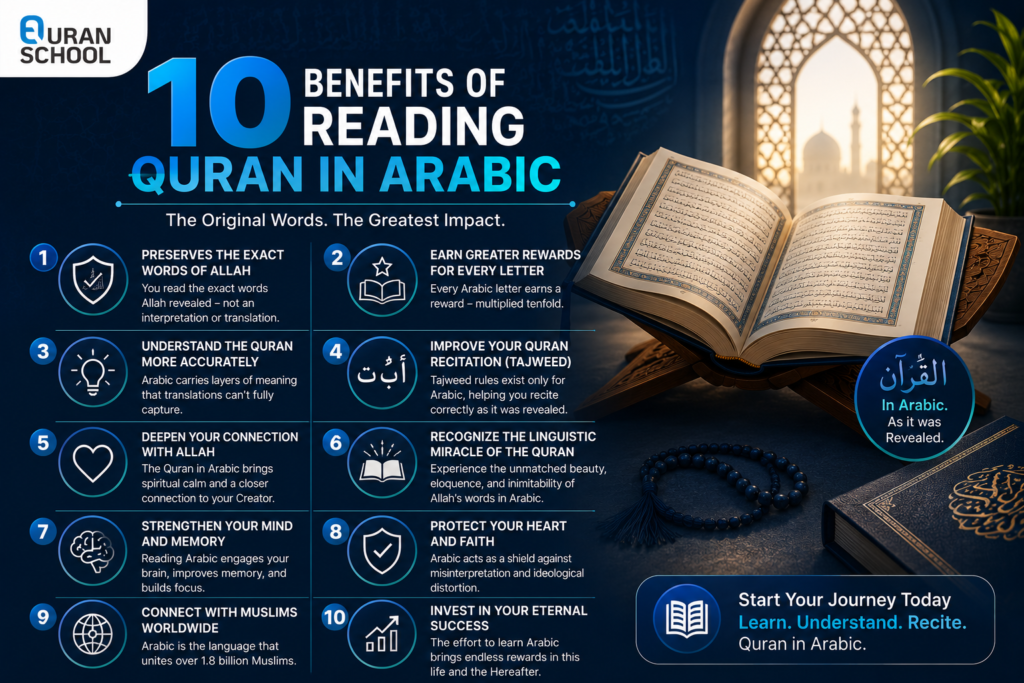
Millions of Muslims around the world read the Quran daily — in English, Urdu, French, Indonesian, and dozens of other languages. But there is something uniquely powerful about returning to the original Arabic text.
Whether you are a fluent Arabic speaker, a complete beginner, or someone still working through a Noorani Qaida Course, reading the Quran in Arabic carries benefits that no translation can fully replicate.
This article explores ten benefits of reading Quran in Arabic in depth, grounded in Islamic scholarship and the linguistic reality of Arabic itself.
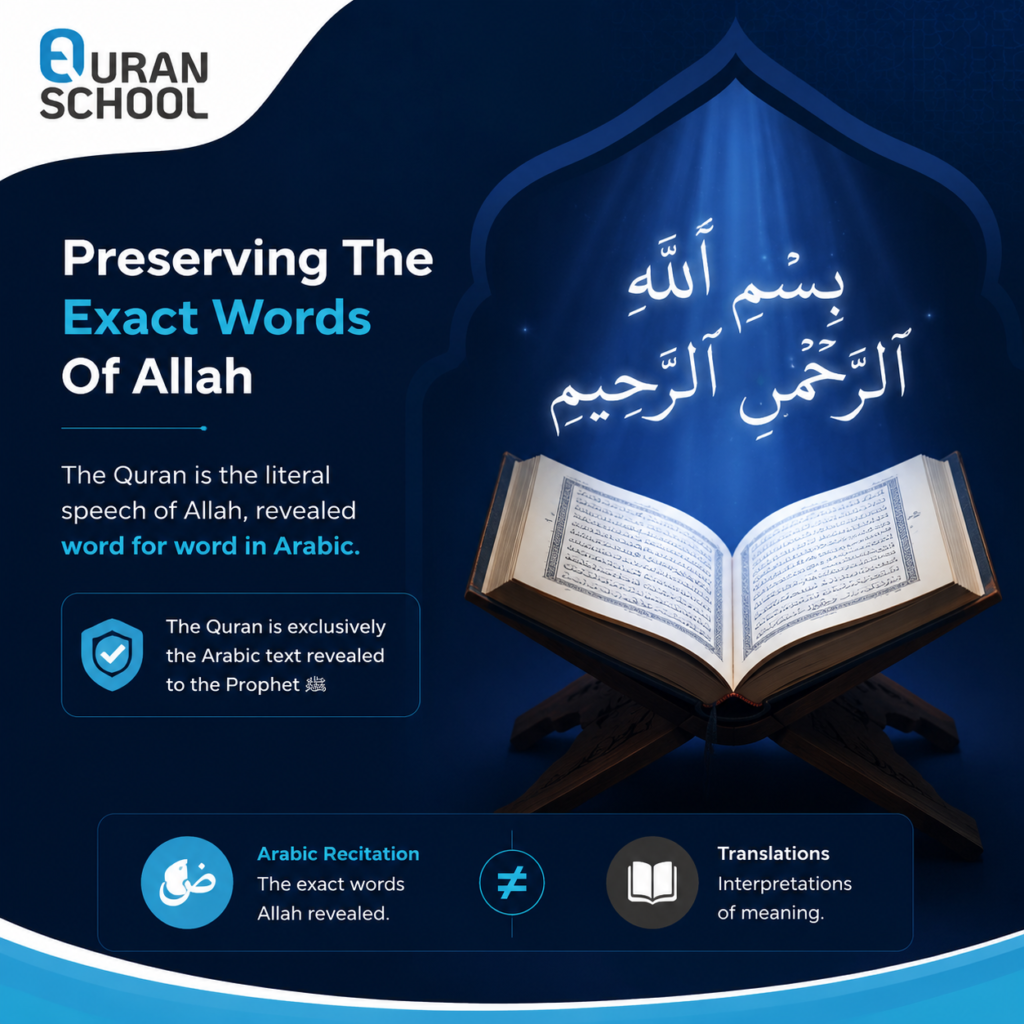
1. Preserving The Exact Words Of Allah as One of The Benefits of Reading Quran in Arabic
The Quran is the literal speech of Allah, revealed word for word in Arabic. Every translation — no matter how careful or scholarly — is an interpretation of meaning, not the Quran itself.
Islamic scholars across all four major schools of jurisprudence agree on this point: translations carry the meaning, but the Quran is exclusively the Arabic text revealed to the Prophet Muhammad ﷺ. When you read “Bismillah ir-Rahman ir-Raheem,” you are reciting the precise letters Allah chose.
When you read “In the name of God, the Most Gracious, the Most Merciful,” you are reading a human attempt to approximate those letters — and approximation is not preservation.
Imam ibn Kathir noted that Allah chose Arabic for this final scripture because it is the most eloquent, expansive, and capable of conveying meanings that reside in the human soul. Preserving those words means reading them as they were revealed — not as they were later translated.
2. Earning Greater Rewards For Every Arabic Letter
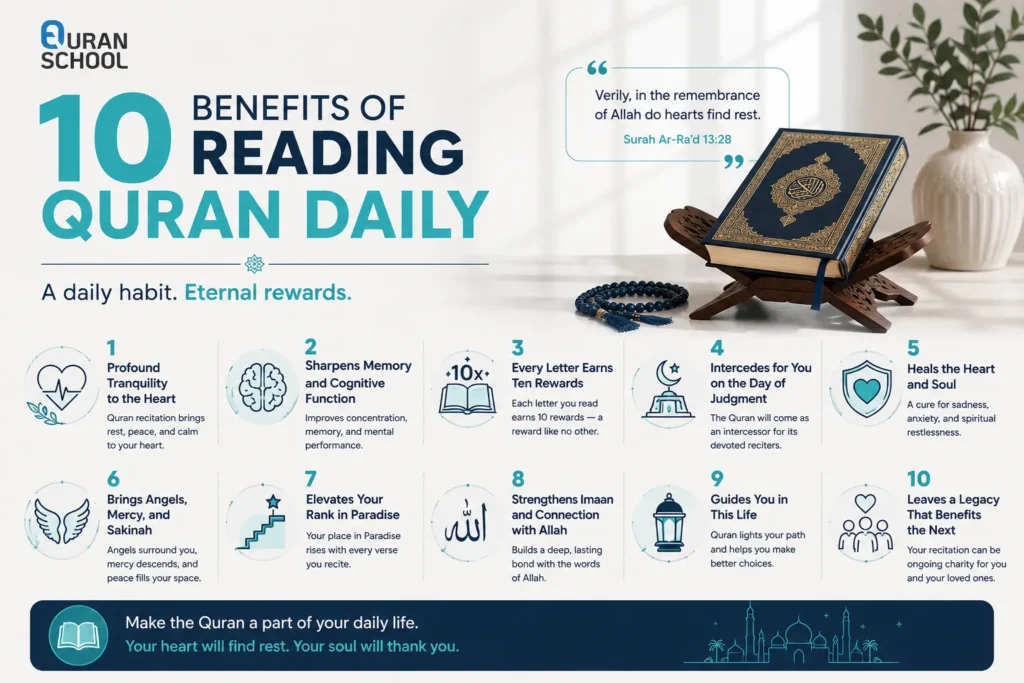
Reading the Quran in Arabic earns specific, quantified rewards that do not apply to reading a translation.
The Prophet ﷺ said: “Whoever reads a letter of the Book of Allah will receive a reward, and the reward is multiplied by ten. I do not say that ‘Alif Lam Meem’ is one letter; rather Alif is a letter, Lam is a letter, and Meem is a letter.” (Tirmidhi, authenticated as sound)
This means reading a single verse earns rewards counted by individual Arabic letters — not words, not sentences. Surah Al-Baqarah alone contains over 25,000 letters. The arithmetic of reward here is staggering.
The Al-Menhaj Book methodology developed by Luqman ElKasabany at E Quran School provides systematic letter-by-letter instruction. This approach ensures you understand letter connections before attempting full words.
Read also: Quran Learning Journey

3. Understanding the Quran More Accurately
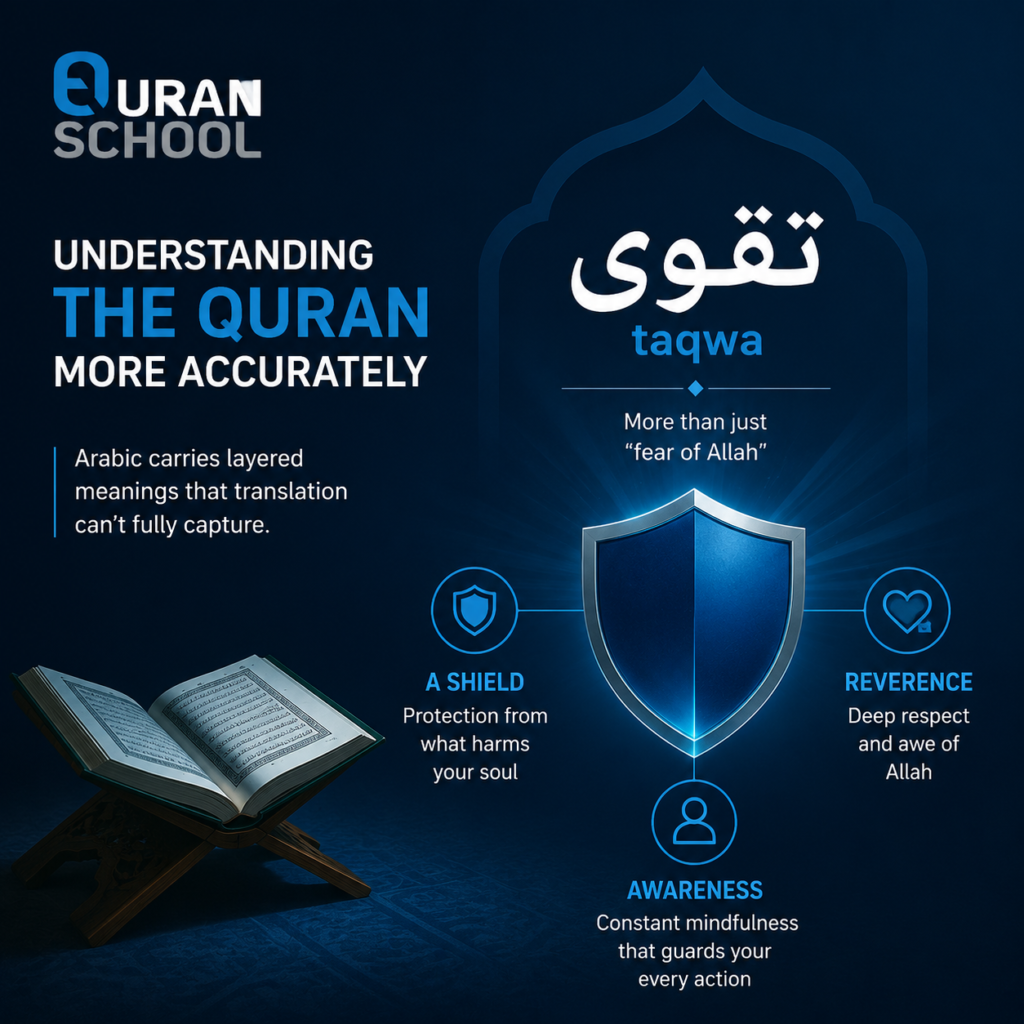
Arabic is not simply a vehicle for Quranic meaning — it is inseparably intertwined with it. Certain Arabic words and grammatical structures carry layered meanings that collapse into a single flat word when translated.
Take the word “taqwa” — often translated as “fear of Allah” or “piety.” In Arabic, it carries the simultaneous sense of a shield, a protective awareness, a reverence that guards. No English word holds all three dimensions at once.
Or consider “rabb” — translated as “Lord” but meaning the One who nurtures, sustains, develops, and has complete ownership. A translation forces a choice; Arabic holds everything together.
Understanding the Quran more accurately, then, requires engaging with its Arabic — even partially. Students in Basic Quranic Arabic Grammar classes or Learn Quran Easily at Home programs frequently report that even minimal Arabic knowledge transforms how they experience familiar verses.
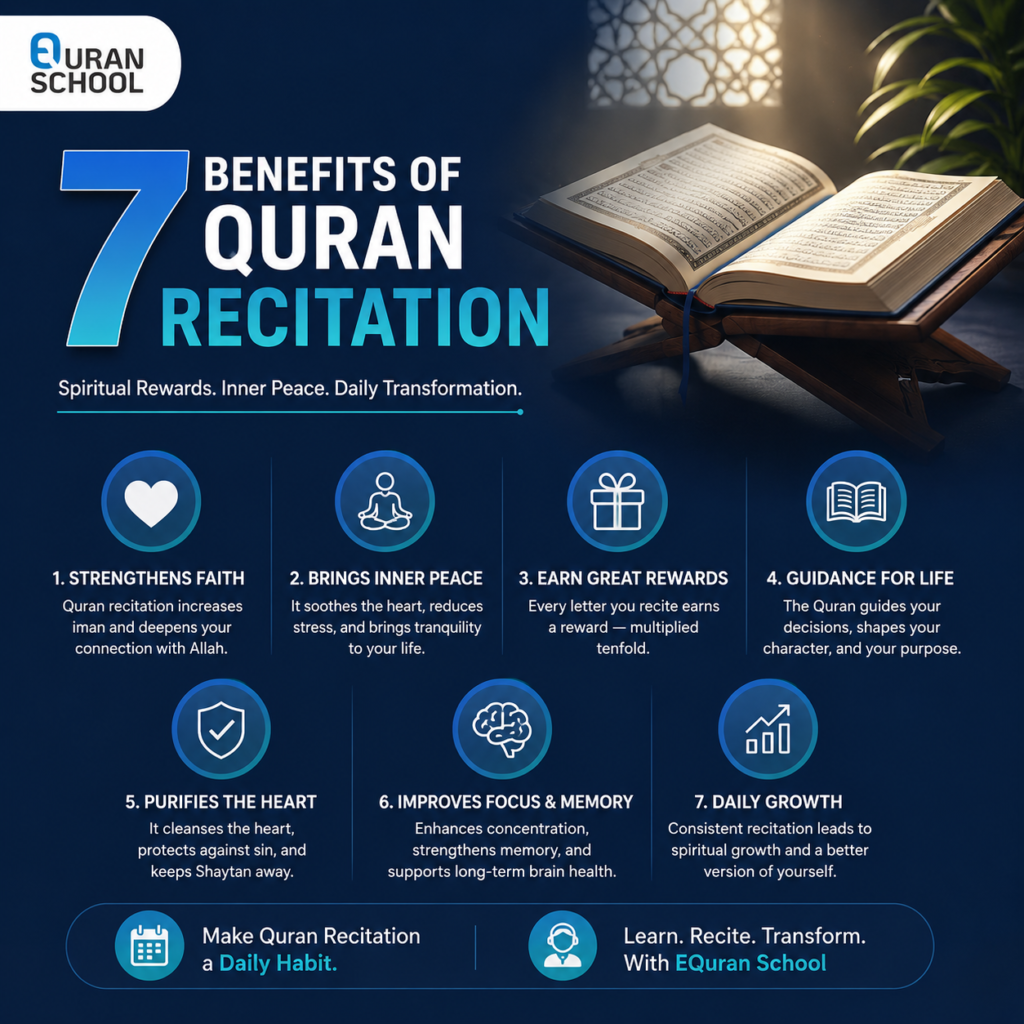
Read also: 7 Benefits of Quran Recitation – A Complete Guide
4. Improving Your Quran Recitation (Tajweed)
Tajweed — the rules governing the correct pronunciation and recitation of the Quran — only exists in relation to the Arabic text. There is no Tajweed for reading an English translation.
The rules of Tajweed govern elongation (madd), nasalization (ghunnah), assimilation (idgham), and the precise articulation points of each Arabic letter. These rules are directly embedded in how the Quran was revealed and transmitted orally from the Prophet ﷺ through an unbroken chain of reciters (isnad) to the present day.
Reading the Quran in Arabic is, therefore, the only way to recite it properly — which is itself an act of preserving the revelation.
An Online Quran Recitation Classes program under a certified teacher — ideally through a Quran Ijazah Program where the teacher holds an unbroken chain to the Prophet ﷺ — is the proper channel for learning this.
Begin memorizing the Quran today—your first session is free

See Us in Action
Watch a quick snippet from our live, interactive classes below and see how our teachers make learning engaging for all ages!
Start Your Quranic Journey Today
Experience our interactive online classes with a dedicated tutor.
Get Your Free TrialRead also: Quran Reading Apps: A Complete Guide for Muslims Worldwide
5. Deepening Your Connection With Allah
The experience of reciting the Quran in Arabic — even when you do not understand every word — produces a spiritual quality that differs from reading a translation. This is documented both in the Quran itself and in the reports of scholars and practitioners across fourteen centuries.
The Quran describes itself as a book whose recitation causes “hearts to find rest” (Ar-Ra’d:28) and “skins to shiver” of those who fear their Lord (Az-Zumar:23). These effects are described in relation to the Quran itself — the Arabic text.
Ibn Taymiyyah observed that habitual use of Arabic affects the intellect, character, and religious practice, because the language carries within it the orientation of those who received the revelation directly.
Master Arabic Language Today and start a free trial

Read also: Quran Reading Apps: A Complete Guide for Muslims Worldwide
6. Recognizing The Linguistic Miracle Of The Quran
The Quran’s inimitability (i’jaz) is not a theological claim alone — it is a linguistic reality that non-Muslim scholars of Arabic have acknowledged. The challenge (tahhaddi) issued in the Quran — to produce even ten verses like it — remains unmet fourteen centuries later.
Arabic’s linguistic properties make this miracle possible. The source materials here document that Arabic roots are predominantly three-letter, allowing maximum expressiveness with minimum letters. Surat al-Fatiha — 31 Arabic words — requires 70 English words in translation.
The German Orientalist Nöldeke wrote that the Quran’s classical Arabic is rich not only in vocabulary but in grammatical forms, in a way that still astonishes those who encounter it.
Read also: The Best Way to Learn Quran Online

7. Avoiding Misinterpretation Caused by Translation
Translations differ from each other, and sometimes significantly. Compare ten English translations of a single verse and you will find ten variations in word choice, emphasis, and implication. This is not a failure of translators — it is the inherent limit of the translation task.
Arabic grammar allows for multiple simultaneously valid meanings within a single phrase. Translators must choose one; Arabic holds all of them.
Ibn Taymiyyah made this point explicitly: the scholar of Islamic jurisprudence must master Arabic because the Quran and Sunnah are the sources of legislation, and their precise meanings — the meanings that determine legal rulings — can only be accessed through Arabic grammar and vocabulary.
This is why programs like an Al-Azhar Quran Course, with its centuries-long tradition of Arabic Quranic education, place Arabic language learning at the center of Quranic study rather than treating it as an optional add-on.
8. Enhancing Focus and Reflection During Recitation (Tadabbur)
Tadabbur — deep, sustained reflection on the meanings of the Quran — is an act explicitly commanded in the Quran itself: “Do they not reflect upon the Quran?” (An-Nisa:82). The quality of tadabbur is directly affected by how you engage with the text.
Al-Farabi described Arabic as a language where meaning is inseparably tied to sound and structure — where the form of a word contributes to its meaning in a way that cannot be separated from it.
Engaging with the Arabic text means engaging with that complete package: sound, rhythm, form, and meaning together. This integration is what enables tadabbur at its deepest level.
An Intensive Quran Course that combines Arabic reading with reflection training gives students tools for this kind of engagement that a translation-only approach cannot provide.
Book Your Free Session with One of EQuran School’s Certified Teachers
9. Supporting More Effective Quran Memorization
The Quran has been memorized in Arabic by millions of Muslims across every generation since its revelation — a phenomenon without parallel in any other religious tradition. This mass memorization is only possible because Arabic’s phonological and structural properties make the Quran memorizable in ways that translation cannot replicate.
Arabic’s root-based system means that words from the same root share recognizable patterns. Its rhythmic structure — governed by the science of ‘Arud (prosody), which scholars note is unique to Arabic among Semitic languages — gives Quranic verses a cadence that aids retention.
Attempting to memorize a translation instead of the Arabic text also means memorizing a human interpretation — which may change with the next edition, the next translator, or the next scholarly revision. The Arabic text has been transmitted letter-perfect for over fourteen centuries.
Book a free trial class at E Quran School

10. Connecting With The Global Muslim Ummah
Over 1.8 billion Muslims worldwide recite the same Arabic text in their five daily prayers, across every country and in every language. A Muslim in Lagos recites Surah Al-Fatiha with the same letters as a Muslim in London, Karachi, Jakarta, or Cairo.
This unity is not symbolic — it is functional. Muslims from the USA, Canada, the UK, Australia, and every other country stand in the same rows at Hajj, reciting the same talbiyah in the same language.
They pray in the same Arabic in every mosque on earth. A Muslim who learns Arabic finds that the Ummah becomes immediately more accessible: the Friday khutbah, Islamic scholarship, classical texts, and fellow Muslims who do not share your native language all become more reachable.
Experience Our Classes
Don’t just take our word for it—watch real-time recordings of our online classes below to experience our teaching style firsthand.
Start Reading the Quran in Arabic Today
Reading the Quran in Arabic is not reserved for Arabs or scholars. Millions of non-Arab Muslims — from the USA, the UK, Canada, Australia, and across the world — have learned to read, recite, and even memorize the Quran in Arabic, and they report that this single step transformed their relationship with the text.
EQuran School offers a complete path, whether you are starting from the alphabet with a Noorani Qaida Course, developing your recitation through Online Quran Recitation Classes, working toward certification through a Quran Ijazah Program, or committing to full memorization through a Quran Memorization (Hifz) Course.
Expert teachers are available online, making it possible to Learn Quran Easily at Home — wherever you are in the world.
E Quran School provides complete curriculum including:
- Quran Reading Classes
- Online Quran Learning with Tajweed Course
- Quran Tafsir Course
- Zoom Quran Classes
- Online Arabic and Quran Classes
- Quran Qirat Learning Course
- Quran for Beginners Course
Book a free trial class at E Quran School and follow a personalized Quran learning plan created to help you succeed, Insha’Allah.
Start Your Quranic Journey Today
Experience our interactive online classes with a dedicated tutor.
Get Your Free TrialConclusion
The benefits of reading the Quran in Arabic span the spiritual, linguistic, cognitive, and communal. Reading in Arabic preserves the exact divine words, earns rewards counted by the letter, reveals meanings that translation cannot carry, enables correct Tajweed and effective memorization, deepens focus during reflection, and connects you to every Muslim who has ever recited the same text.
These are not arguments for avoiding translations — translations have real value, especially when learning. They are arguments for making the Arabic text itself central to your relationship with the Quran. That relationship, built on the language in which the Quran was revealed, is one of the most rewarding commitments a Muslim can make.
Frequently Asked Questions
Does reading the Quran in Arabic earn more reward than reading a translation?
Yes. The reward of ten good deeds per letter, as mentioned in the authentic hadith narrated by ibn Mas’ud (Tirmidhi), applies specifically to reciting the Arabic letters of the Quran — not to reading a translation.
Can non-Arabic speakers still benefit from reading the Quran in Arabic?
Yes, and they receive extra reward for the effort. The Prophet ﷺ stated that the one who struggles with the Quran due to difficulty has two rewards — one for the recitation and one for the effort.
Is a translation of the Quran considered the Quran?
No. According to the consensus of Islamic scholars across all major schools of jurisprudence, a translation is a rendering of the Quran’s meanings, not the Quran itself. The Quran is defined as the Arabic words revealed to the Prophet Muhammad ﷺ.
How long does it take to learn to read the Quran in Arabic?
Most students with consistent instruction can read basic Quranic Arabic within three to six months using a Noorani Qaida Course. Reading with correct Tajweed takes longer and requires practice under a qualified teacher.
Does learning Arabic for Quran memorization really make memorization easier?
Yes. Arabic’s root-based word structure, consistent grammar patterns, and the Quran’s inherent rhythmic and phonological design all make the Arabic text significantly more memorizable than any translation. This is why the Quran has been preserved through oral memorization across fourteen centuries.
Do I need to understand Arabic to benefit from reading the Quran in Arabic?
No. Even reading the Arabic text without full comprehension earns the letter-by-letter reward and preserves the integrity of the recitation. However, learning even basic Quranic Arabic significantly enhances both understanding and tadabbur (reflection).


Leave a Reply