 Quran
Quran
Every Ramadan, millions of Muslims around the world set the same goal — complete the entire Quran before Eid. Most start strong. Many fall behind by the second week. The difference is almost never willpower. It is almost always the absence of a clear, realistic Ramadan Quran reading chart tied to the rhythms of daily life.
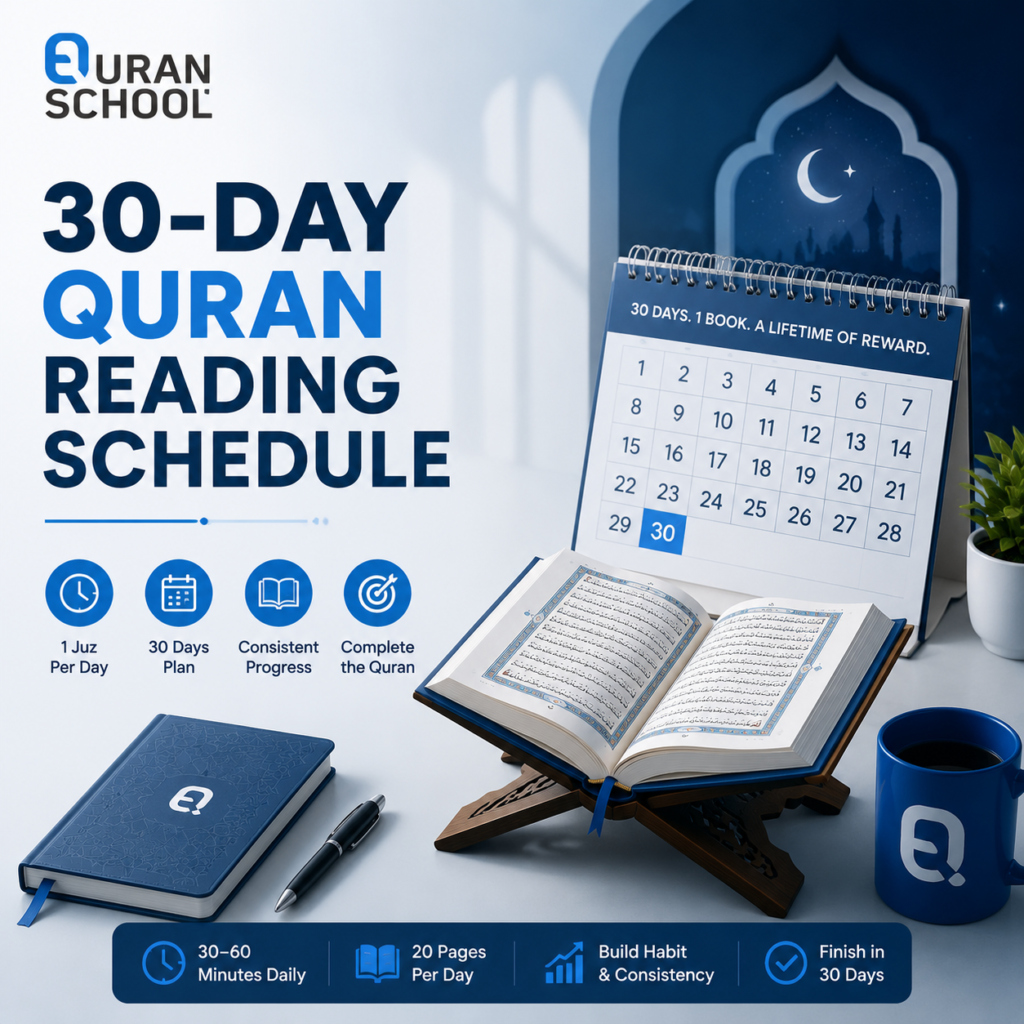
The Quran has exactly 604 pages, divided into 30 equal Juz’ (parts) of 20 pages each. Ramadan has 29 or 30 days. The math lines up perfectly — one Juz’ per day, four pages after each of the five daily prayers, and you finish the entire Quran by the last night of the month.
This guide gives you the exact charts, page breakdowns, and timing strategies you need — whether you are aiming for one completion, two, or a focused sprint through the last ten nights. It also addresses the questions most people only think about after they have already fallen behind.
What You’ll Learn in This Article
- How many pages to read per day to finish the Quran in Ramadan
- A clear Ramadan Quran reading schedule broken down by prayer time
- Charts for one completion, two completions, and the last ten nights
- The best times of day to read Quran during Ramadan
- Common mistakes that break consistency — and how to avoid them
- Answers to the most-asked questions about Quran reading during Ramadan
Ready to start your journey with Quran, Book your free trial lesson today
Why Ramadan Is the Month of the Quran
The connection between Ramadan and the Quran is not a cultural tradition — it is established in the Quran itself. Allah says: “The month of Ramadan in which the Quran was revealed, a guidance for mankind” (Al-Baqarah: 185). The Prophet Muhammad ﷺ received the first revelation in this month, and every year thereafter Jibreel (عليه السلام) would review the entire Quran with him through Ramadan’s nights.
This is why the practice of completing the Quran in Ramadan is not simply a personal achievement goal. It is a continuation of a practice rooted in the Prophet’s own tradition — mudarasa, the mutual review of the Quran — that the companions and scholars preserved across every generation.
For Muslims in the USA, Canada, UK, Europe, and Australia who may not have access to a local Quran circle or masjid Tarawih program with a full Khatm schedule, having your own personal reading chart becomes even more important. It is the structure that connects you to this tradition regardless of where you are.
How Many Pages of Quran Should You Read Per Day to Finish in Ramadan?
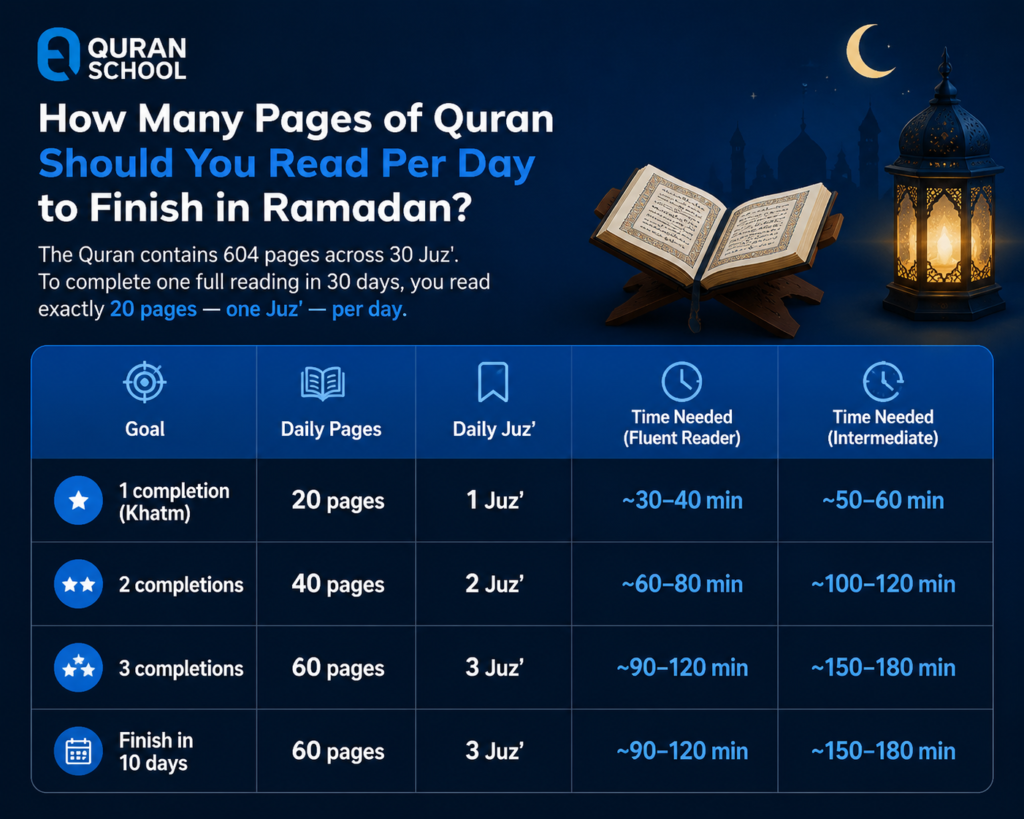
The Quran contains 604 pages across 30 Juz’. To complete one full reading in 30 days, you read exactly 20 pages — one Juz’ — per day.
| Goal | Daily Pages | Daily Juz’ | Time Needed (Fluent Reader) | Time Needed (Intermediate) |
| 1 completion (Khatm) | 20 pages | 1 Juz’ | ~30–40 min | ~50–60 min |
| 2 completions | 40 pages | 2 Juz’ | ~60–80 min | ~100–120 min |
| 3 completions | 60 pages | 3 Juz’ | ~90–120 min | ~150–180 min |
| Finish in 10 days | 60 pages | 3 Juz’ | ~90–120 min | ~150–180 min |
The most common mistake is treating 20 pages as a single sitting. Split across five prayers — 4 pages each — those 20 pages take just 6–12 minutes per prayer session, depending on your reading speed. That is less time than most people spend checking their phone between Fajr and sunrise.
Read also: Daily Quran Reading Plan and Schedule – Complete Guide
The Ramadan Quran Reading Chart: Three Schedules for Every Level
The most effective Ramadan Quran reading schedule ties your daily pages directly to the five prayers. This removes the need to remember to read — prayer time becomes reading time automatically.
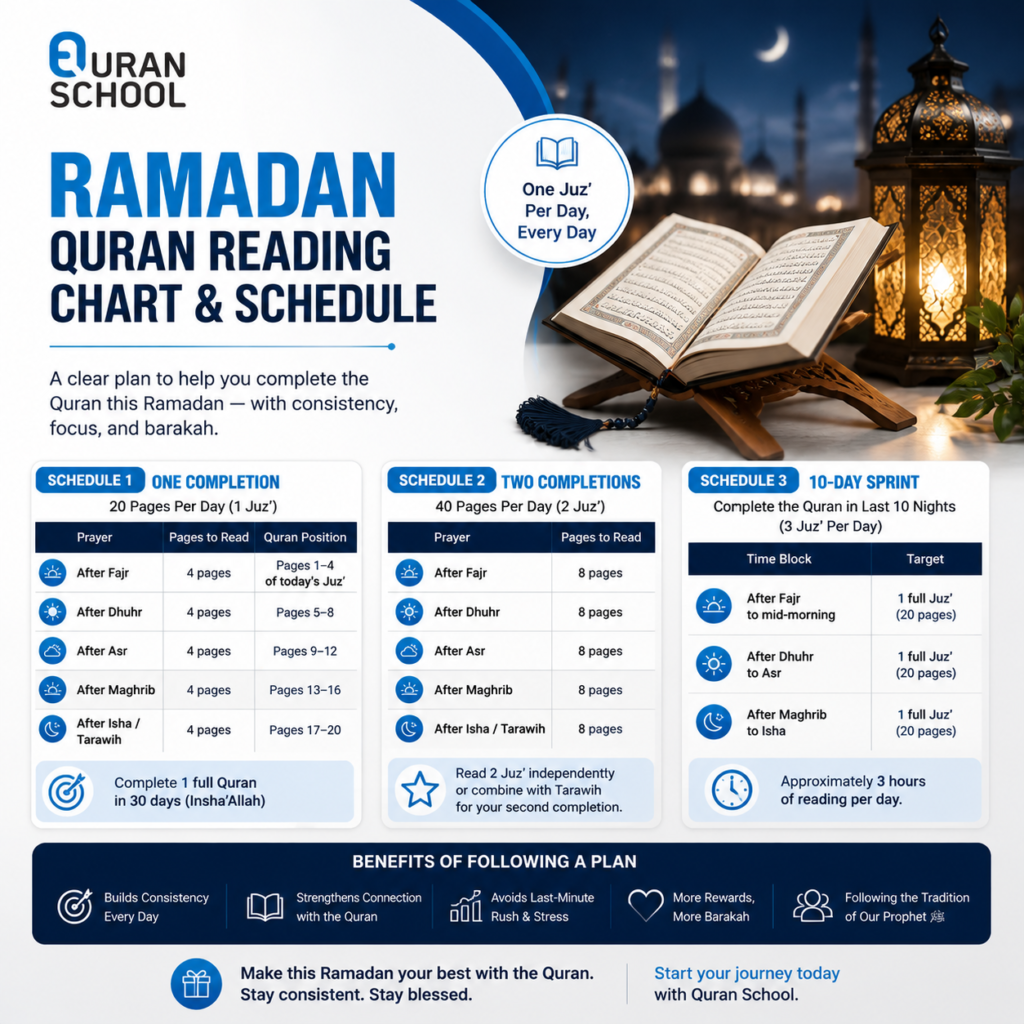
Schedule 1: One Completion (20 Pages Per Day)
Read 4 pages after each of the five daily prayers. This is the baseline Khatm schedule, suitable for all levels, and the one endorsed by scholars and Islamic institutions worldwide as the most sustainable approach.
| Prayer | Pages to Read | Quran Position |
| After Fajr | 4 pages | Pages 1–4 of today’s Juz’ |
| After Dhuhr | 4 pages | Pages 5–8 |
| After Asr | 4 pages | Pages 9–12 |
| After Maghrib | 4 pages | Pages 13–16 |
| After Isha / Tarawih | 4 pages | Pages 17–20 |
Tying reading to prayer removes the decision of when to read. When you finish each prayer, you open the Quran. After 30 days, you have completed it entirely — without a single marathon session.
Schedule 2: Two Completions (40 Pages Per Day)
Tying reading to prayer removes the decision of when to read. When you finish each prayer, you open the Quran. After 30 days, you have completed it entirely — without a single marathon session.
| Prayer | Pages to Read |
| After Fajr | 8 pages |
| After Dhuhr | 8 pages |
| After Asr | 8 pages |
| After Maghrib | 8 pages |
| After Isha / Tarawih | 8 pages |
A practical variation many working adults use: read one Juz’ independently across the day’s prayers, then rely on Tarawih — where the imam typically completes the Quran over 30 nights — as your second completion through attentive, focused listening. This counts as a full second engagement with the Quran when done with genuine presence.
Read also: Interactive Quran Learning With Top Methods and Ways

Schedule 3: Complete the Quran in 10 Days (Last Ten Nights Sprint)
This schedule is designed for the last ten nights of Ramadan — the most spiritually intense period of the year, which includes Laylat Al-Qadr. Read 3 Juz’ per day, structured around the day’s natural divisions.
| Time Block | Target |
| After Fajr to mid-morning | 1 full Juz’ (20 pages) |
| After Dhuhr to Asr | 1 full Juz’ (20 pages) |
| After Maghrib to Isha | 1 full Juz’ (20 pages) |
Egypt’s Dar Al-Iftaa has officially endorsed this as a manageable target, noting that one Juz’ takes approximately one hour for most consistent readers. The 10-day schedule demands roughly three hours of reading per day — distributed across three sessions, not consecutive. Many people already spend more than three hours daily on their phones without noticing.
Read also: Dua for Learning Quran
See Us in Action
Watch a quick snippet from our live, interactive classes below and see how our teachers make learning engaging for all ages!
Start Your Quranic Journey Today
Experience our interactive online classes with a dedicated tutor.
Get Your Free TrialRead also: Quran Reading Plan for Beginners: A Step-by-Step Guide
The Best Times to Read Quran During Ramadan
Not all reading windows in Ramadan are equal. Certain times combine spiritual merit with practical advantages — quieter conditions, a clearer mind, or a heart that is naturally more receptive.
After Fajr is the most consistently productive slot for most readers. The mind is rested, external noise is minimal, and beginning the day with the Quran creates momentum that carries through the afternoon. Scholars across multiple schools of thought consistently identify the post-Fajr period as among the most blessed times for any act of worship.
Before Iftar carries unique spiritual weight. Hunger and anticipation create a state of genuine humility, and classical scholars note that both du’a and recitation at this time carry heightened sincerity. Even five to ten pages in the final minutes before the adhan is a powerful use of this window.
After Tarawih — in the quiet after the congregation disperses — offers uninterrupted evening time that many people find easier to protect than daytime slots. If you are praying Tarawih at home or in a local masjid, this is a natural moment to continue with your personal pages before sleep.
The last third of the night (Suhoor time) is cited in multiple hadith as a time of divine proximity and answered du’a. For those who wake for Suhoor, even 10–15 minutes of recitation here adds a consistent daily session that compounds significantly over the month. The Quran itself notes the special quality of night recitation: “Indeed, the hours of the night are more impactful and more suitable for words” (Al-Muzzammil: 6).
The practical principle: your best reading time is the slot you can actually protect from interruption. Choose one, fix it, and treat it as non-negotiable.
Avoid Falling Behind on Your Ramadan Quran Reading Schedule
Most people who fall behind do so by the end of the first week — not because Ramadan became harder, but because their schedule was designed around ideal conditions rather than real ones.
Do not plan for perfect days of reading Quran:
If your schedule requires total silence, an empty house, and unlimited time, it will fail on day three. Build your plan around the minimum you can guarantee — the four pages after Fajr that you will read before anyone else wakes up.
Never try to compensate for an entire missed day in one session:
If you miss one prayer’s worth of reading, add an extra half-page to each remaining session that day. Trying to read two Juz’ in one sitting to catch up typically leads to fatigue and abandonment within days.
Separate the Quran reading habit from your emotional state:
Waiting until you “feel spiritually ready” to read is the main reason sessions get skipped. The Quran has historically been read through illness, travel, fatigue, and grief — the habit must be stronger than the feeling.
Use a physical tracker to record your progress:
Mark off each session on a simple chart — either a printed grid or a notes-app checklist. Seeing your completion progress across 30 days creates a genuine psychological incentive that good intentions alone do not provide. This is not a modern productivity trick; it is why Ramadan Quran journals have existed for centuries.
Do not compare your pace of reading Quran with others:
A person reading 4 pages slowly and attentively after each prayer is practicing Quran reading during Ramadan at its fullest. A person racing through 10 pages without awareness is running a different exercise entirely.
Reading Quickly Or Reflecting on the Meaning? It Depends on Your Goal
A question that comes up every Ramadan — and rarely gets a direct answer — is whether it is better to read quickly to complete the Quran or to slow down and reflect on the meaning.
The honest answer is that this is a false choice, and the classical scholars resolved it practically rather than theoretically.
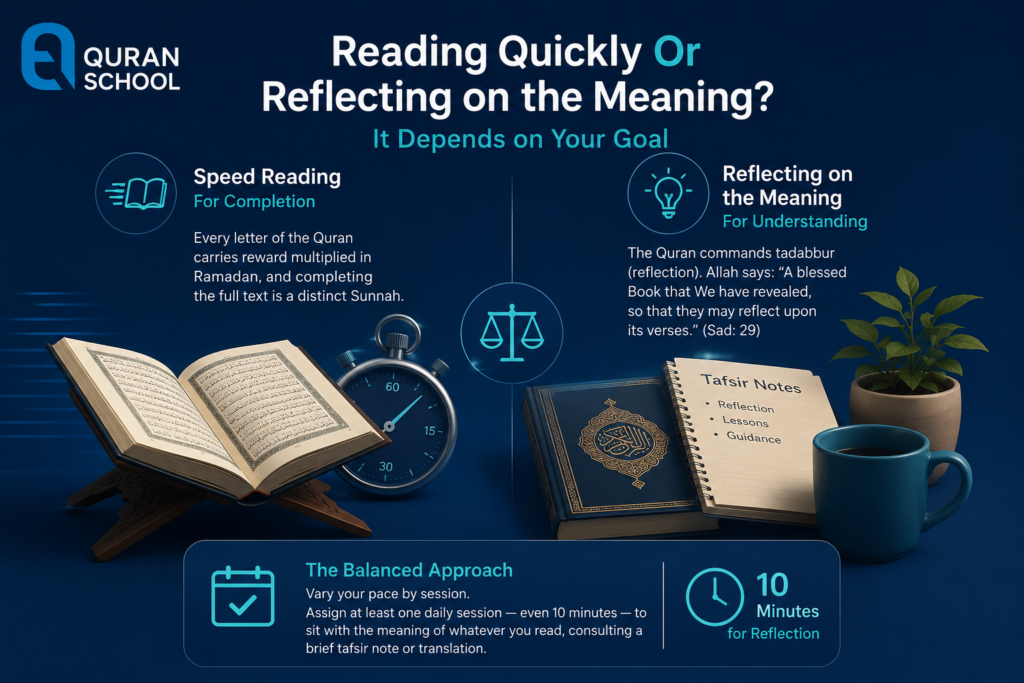
Recitation (tilawa) and reflection (tadabbur) are two distinct forms of worship with different purposes. Allah commands tadabbur explicitly: “A blessed Book that We have revealed, so that they may reflect upon its verses” (Sad: 29). At the same time, Ibn Mas’ud narrated that the Prophet ﷺ said every letter of the Quran carries a multiplied reward — which applies to recitation regardless of pace.
The approach used by the pious predecessors was to vary deliberately: some sessions for completion, others for sitting with a passage. Imam Ahmad ibn Hanbal is reported to have completed the Quran in Ramadan while also maintaining a separate daily tafsir session of a few verses. These were not competing activities — they served different needs of the same relationship with the Book.
A practical framework that works for most readers: treat your prayer-linked sessions as recitation sessions, and set aside one brief daily slot — 10 to 15 minutes, perhaps at Suhoor or before sleep — to reread a short passage from what you covered that day with a simple translation or brief tafsir note. This is enough to create genuine understanding without disrupting your completion schedule.
Experience Our Classes
Don’t just take our word for it—watch real-time recordings of our online classes below to experience our teaching style firsthand.
Start Your Quranic Journey Today
Experience our interactive online classes with a dedicated tutor.
Get Your Free TrialStart Ramadan with Expert Quran Guidance — Join EQuran School
Whether you are working toward your first Khatm or strengthening your recitation before Ramadan begins, EQuran School connects you with qualified, ijazah-certified instructors who teach online — live, one-to-one, from wherever you are in the USA, Canada, UK, Europe, or Australia.
Our students enter Ramadan prepared: confident in their recitation, clear on their schedule, and supported by a Quran teacher who knows their level and their pace. No commute, no fixed classroom time — just structured, expert guidance that fits your life.
E Quran School provides complete curriculum including:
- Online Arabic and Quran Classes
- Quran Qirat Learning Course
- Quran Memorization (Hifz) Course
- Noorani Qaida Course
- Online Quran Learning with Tajweed Course
- Quran Tafsir Course
Book a free trial class at E Quran School and experience personalized Quran instruction that adapts to your unique learning needs, Insha’Allah.

Start Your Quranic Journey Today
Experience our interactive online classes with a dedicated tutor.
Get Your Free TrialConclusion
A Ramadan Quran reading chart works when it is built around what you can realistically do every day — not around what you hope a perfect day will allow. The formula is simple: 20 pages per day, 4 pages after each prayer, one Juz’ completed every 24 hours, one full Quran by the end of the month. Add sessions or compress the timeline from there based on your goal.
Recitation and reflection are not competing priorities — the wisest approach builds in both, treating prayer-time sessions as your completion engine and carving out a brief daily slot for meaning. A consistent four pages after each prayer, held through the whole month, will always produce more than an ambitious plan abandoned in the second week.
Make the Quran your daily companion this Ramadan — not your end-of-month sprint.
Frequently Asked Questions
How long does it take to read one Juz’ of the Quran?
Reading one Juz’ (20 pages) takes approximately 30–40 minutes for a fluent reader and 50–60 minutes for an intermediate reader. Beginners may take up to 90 minutes for one Juz’, which is still fully achievable when divided across five prayer sessions throughout the day.
Can I complete the Quran twice in Ramadan?
Yes. To complete two Khatms in 30 days, read 8 pages after each prayer instead of 4. A practical alternative many working adults use: read one completion independently during the day and treat attentive listening through Tarawih — with a present heart and focused attention — as a second engagement with the full Quran.
Is it permissible to read the Quran from a phone during Ramadan?
Yes. The majority of Islamic scholars permit Quran recitation from a phone or app, and the reward is the same as reading from a printed Mushaf. If you are commuting, at work, or simply find a phone more convenient for maintaining your between-prayer sessions, using it is both valid and encouraged.
What should I do if I fall behind on my Ramadan Quran reading chart?
Do not try to recover an entire missed Juz’ in one session. Add 1–2 extra pages to your remaining prayer sessions that day. If you miss a full day, add a short additional session — after Tarawih or at Suhoor — over the following two or three days rather than attempting a large catch-up that risks discouraging you entirely.
Does reading the Quran during Tarawih count toward my personal Khatm?
Listening to the Quran in Tarawih with full presence and attention is an independent act of worship with its own great reward. It is typically counted as a separate listening completion — not a substitution for personal recitation — though scholars note that an attentive listener hopes to receive reward equivalent to the reciter.
Should I read the Quran with or without translation during Ramadan?
Reading with a translation or brief tafsir note in a separate daily session deepens understanding without slowing your completion pace. Keep recitation sessions as recitation — focused on completing your daily pages — and use a short 10–15 minute reflection slot to revisit what you have read with meaning. Both practices strengthen your relationship with the Quran in different ways.










Leave a Reply