 Quran
What is the reward for becoming a hafiz? Every parent who hears a child recite Surah Al-Mulk from memory senses the answer, and so does every adult who finishes a first Juz. This effort carries a weight beyond any school certificate, and knowing its reward from authentic hadith turns that feeling into clear, lasting motivation.
Authentic hadith promise the hafiz a rising rank in Paradise, the company of noble angels, priority in leading prayer, and honor among Muslims. These rewards depend on sincerity, acting on the Quran, correct recitation, and steady revision. Some popular narrations also need careful verification.
A. Authentic Hadith Answering What the Reward for Becoming a Hafiz
The authentic hadith about the reward for becoming a hafiz focus first on the Hereafter. They describe a rank in Paradise tied to the verses you carry, and a place beside the angels who honor revelation.
Allah describes the Quran as something preserved inside the hearts of believers, which explains why carrying it in memory is treated as a distinct honor:
بَلْ هُوَ آيَاتٌ بَيِّنَاتٌ فِي صُدُورِ الَّذِينَ أُوتُوا الْعِلْمَ
Bal huwa ayatun bayyinatun fi sudooril-ladheena ootul-‘ilm
“Rather, it is distinct verses [preserved] within the breasts of those who have been given knowledge.
Because these rewards grow with every verse memorized correctly, students in the Quran Memorization (Hifz) Course at EQuran School build each portion with an Azhari tutor who checks Tajweed before adding any new page.
Book Your Free Trial Today for Quran Memorization (Hifz) Course!
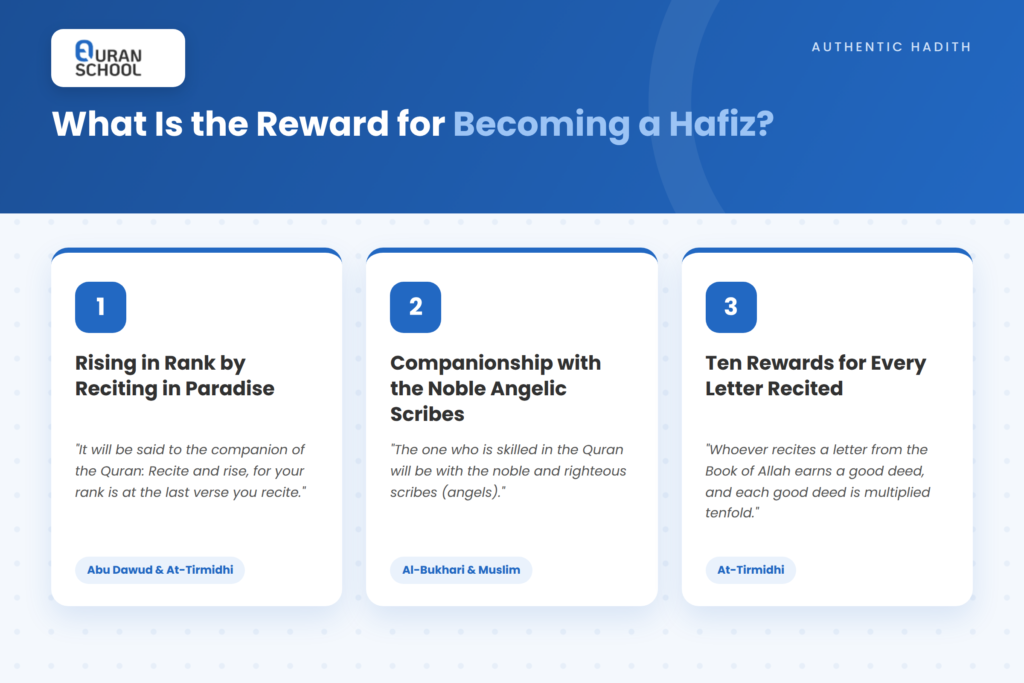
1. Higher Ranks in Paradise for Every Verse the Hafiz Recites
Rising in rank through recitation is the best-known reward for the hafiz. The Prophet ﷺ said:
“يُقَالُ لِصَاحِبِ الْقُرْآنِ: اقْرَأْ وَارْتَقِ وَرَتِّلْ كَمَا كُنْتَ تُرَتِّلُ فِي الدُّنْيَا، فَإِنَّ مَنْزِلَتَكَ عِنْدَ آخِرِ آيَةٍ تَقْرَؤُهَا”
“It will be said to the companion of the Quran: Recite and rise, and recite as you used to recite in the world, for your rank is at the last verse you recite.”
Classical commentators, including al-Khattabi, mentioned that the levels of Paradise are said to match the number of Quran verses, roughly 6,236 in the common count. The more verses a person carries and recites, the higher they climb.
Notice the phrase “as you used to recite in the world.” Experienced teachers stress this detail because recitation in Paradise mirrors the recitation practiced here. Careful Tajweed and regular revision are therefore part of the reward itself.
2. Company of the Noble Angels for the Skilled Reciter
Companionship with the noble angels is promised to the one skilled in the Quran. The Prophet ﷺ said:
“الماهر بالقرآن مع السفرة الكرام البررة”
“The one who is skilled in the Quran will be with the noble and righteous scribes.”
The Arabic word used here, mahir, means fluent and proficient, not simply someone who memorized words. A hafiz with weak Makharij is encouraged to keep refining pronunciation until recitation flows smoothly and accurately.
3. Ten Rewards for Every Quran Letter the Hafiz Recites
Ten rewards for every letter belong to every reciter, but the hafiz benefits most. The Prophet ﷺ said:
“مَنْ قَرَأَ حَرْفًا مِنْ كِتَابِ اللَّهِ فَلَهُ بِهِ حَسَنَةٌ، وَالْحَسَنَةُ بِعَشْرِ أَمْثَالِهَا”
“Whoever recites a letter from the Book of Allah receives a good deed, and a good deed is multiplied tenfold.”
A single Juz contains roughly ten thousand letters. A hafiz who revises one Juz daily during prayer, commuting, or night prayer accumulates reward that someone limited to reading from the mushaf rarely reaches.
Read also: 10 Prophetic Hadith About Reading Quran
B. Worldly Rewards and Honors Given to the Hafiz
The rewards of the hafiz begin in this worldly life, long before the Day of Judgment. They appear as leadership in worship, respect within the community, and a status the Prophet ﷺ openly praised.
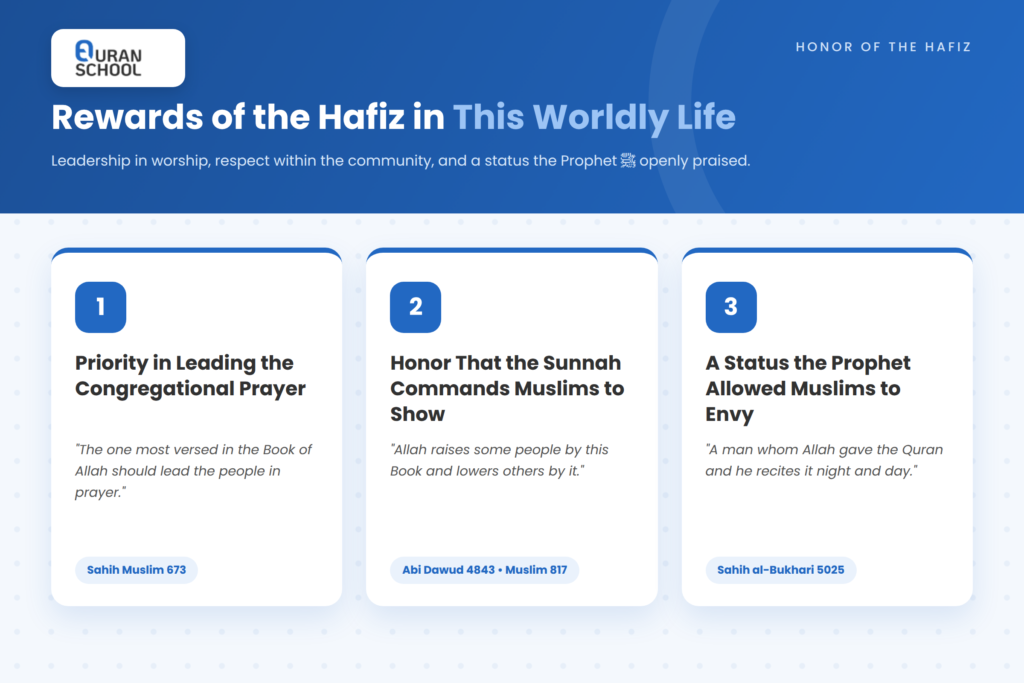
1. Priority of the Hafiz in Leading Congregational Prayer
Priority in leading the congregational prayer goes to the person most versed in the Quran. The Prophet ﷺ said:
“يَؤُمُّ الْقَوْمَ أَقْرَؤُهُمْ لِكِتَابِ اللَّهِ”
“The one most versed in the Book of Allah should lead the people in prayer.”
This is why many mosques in the USA, UK, and Australia ask teenage huffaz to lead Taraweeh. Their age matters less than the Quran they carry, a practical honor visible every Ramadan.
2. Respect for the Hafiz as Part of Glorifying Allah
Honoring the bearer of the Quran is described as part of glorifying Allah. The Prophet ﷺ included
“…وَحَامِلِ الْقُرْآنِ غَيْرِ الْغَالِي فِيهِ وَلَا الْجَافِي عَنْهُ…”
“the bearer of the Quran who neither exaggerates in it nor neglects it” among those whose honor glorifies Allah.
Umar ibn al-Khattab once learned that his governor of Makkah had appointed a freed slave as deputy. When told the man had memorized the Quran, Umar quoted the Prophet ﷺ:
“إِنَّ اللَّهَ يَرْفَعُ بِهَذَا الْكِتَابِ أَقْوَامًا وَيَضَعُ بِهِ آخَرِينَ”
“Allah raises some people by this Book and lowers others by it.”
3. Permissible Envy of the Hafiz Who Recites Day and Night
The status of the hafiz is one of only two the Prophet ﷺ allowed Muslims to envy:
“رَجُلٌ آتَاهُ اللَّهُ الْقُرْآنَ فَهُوَ يَقُومُ بِهِ آنَاءَ اللَّيْلِ وَآنَاءَ النَّهَارِ”
“A man whom Allah gave the Quran and he recites it night and day.”
This honor continues even after death. After Uhud, the Prophet ﷺ buried martyrs two to a grave and asked which of them knew more Quran, placing that person first. (Sahih al-Bukhari 1343)
See Us in Action
Watch a quick snippet from our live, interactive classes below and see how our teachers make learning engaging for all ages!
Start Your Quranic Journey Today
Experience our interactive online classes with a dedicated tutor.
Get Your Free TrialC. Continuous Reward for Parents Who Raise a Hafiz
The reward for parents who raise a hafiz rests on firm evidence about continuous charity. The Prophet ﷺ taught that deeds end at death except three, including
“أَوْ وَلَدٍ صَالِحٍ يَدْعُو لَهُ”
“a righteous child who prays for him.”
A child who memorizes the Quran recites it in every prayer for decades, teaches others, and makes du’a for the parents who arranged those lessons. Each of these, Insha’Allah, returns reward to the parents’ record.
A narration from Buraydah recorded in Musnad Ahmad mentions parents being clothed in garments beyond anything in this world because their child learned the Quran. Several scholars considered its chain acceptable.
Realistic planning helps parents reach this goal. A child typically finishes the Noorani Qaida in six to nine months, then memorizes half a page daily, completing Hifz in three to five years with consistent revision.
Many families in Canada and Europe begin with the Noorani Qaida Course for Kids, where a patient teacher keeps young students motivated through short, focused daily sessions.
Book Your Free Trial Today for the Noorani Qaida Course!
Read also: 9 Hadiths About Memorizing Quran And The Rewards Promised To The Hafiz
Weak Narrations About Hafiz Rewards and Their Authentic Alternatives
Popular narrations about the hafiz circulate widely online, yet some carry weak chains. Distinguishing authentic evidence from weak reports protects your intention and keeps your motivation grounded in what the Prophet ﷺ actually said.
The famous crown narration, describing parents crowned with light brighter than the sun, appears in Sunan Abi Dawud 1453. Hadith scholars, including al-Albani, graded its chain weak because of a narrator named Zabban ibn Fa’id.
The narration about a hafiz interceding for ten relatives destined for Hellfire appears in Jami at-Tirmidhi 2905. Imam at-Tirmidhi himself noted its weakness, since the narrator Hafs ibn Sulayman is considered weak.
Intercession itself is still authentically promised. The Prophet ﷺ said:
“اقْرَءُوا الْقُرْآنَ، فَإِنَّهُ يَأْتِي يَوْمَ الْقِيَامَةِ شَفِيعًا لِأَصْحَابِهِ”
“Recite the Quran, for it will come on the Day of Resurrection as an intercessor for its companions.”
| Reward | Source | Grading |
| Recite and rise in Paradise | Abu Dawud 1464, Tirmidhi 2914 | Hasan sahih |
| Company of the noble angelic scribes | Bukhari 4937, Muslim 798 | Sahih |
| Ten rewards for every letter | Tirmidhi 2910 | Hasan sahih |
| The Quran intercedes for its companion | Muslim 804 | Sahih |
| Parents crowned with light | Abu Dawud 1453 | Weak chain |
| Intercession for ten relatives | Tirmidhi 2905 | Weak |
Three Conditions That Complete the Reward of Hifz
The reward of Hifz is complete only when certain conditions are met. Memorization alone does not guarantee these virtues; Al-Azhar teachers repeatedly stress sincerity, action, and correct recitation as essential foundations.
1. Sincerity of Intention in Memorization
Sincerity of intention in memorization is the first condition. Among the first judged on the Day of Resurrection is a man who
“تَعَلَّمَ الْعِلْمَ وَقَرَأَ الْقُرْآنَ لِيُقَالَ: هُوَ قَارِئٌ”
“learned knowledge and recited the Quran so it would be said he is a reciter.”
Renewing intention before each class helps, especially for children who receive praise at competitions. Parents can gently remind them that the audience that matters most is Allah alone.
2. Acting Upon the Verses You Memorize
Acting upon memorized verses separates the true companion of the Quran from someone who stores text. The Prophet ﷺ said:
“وَالْقُرْآنُ حُجَّةٌ لَكَ أَوْ عَلَيْكَ”
“The Quran is a proof for you or against you.”
Studying the meanings of each portion you memorize makes action possible. A student who understands Surah Al-Hujurat, for example, is far more likely to avoid backbiting than one who only recites it.
3. Correct Recitation with Proper Tajweed
Correct recitation with proper Tajweed preserves the meaning of what is memorized. Non-Arabic speakers commonly confuse ح with ه, ع with أ, and ق with ك, which can change meanings entirely.
In Surah Al-Ikhlas, a light ك instead of a deep ق in “Qul” is a frequent error. Memorizing mistakes is costly because fixing a verse locked in memory takes far longer than learning it correctly.
Students who join Online Quran Learning With Tajweed before or alongside Hifz receive live correction of every letter, so memorized verses settle in the heart exactly as they were revealed.
Book Your Free Trial Today for Online Quran Learning With Tajweed!
Read also: What The Hadith About Reading Quran With Tajweed Reveals?
Daily Muraja’ah Schedule to Retain Quran Memorization
A Muraja’ah routine protects the Hafiz reward from slipping away. The Prophet ﷺ warned:
“تَعَاهَدُوا الْقُرْآنَ، فَوَالَّذِي نَفْسِي بِيَدِهِ لَهُوَ أَشَدُّ تَفَصِّيًا مِنَ الْإِبِلِ فِي عُقُلِهَا”
“Keep refreshing the Quran, for it escapes faster than camels from their ropes.”
The Prophet ﷺ advised Abdullah ibn Amr to complete the Quran monthly, then allowed weekly completion without going faster. (Sahih al-Bukhari 5052) Many teachers use this as a practical revision benchmark.
| Student stage | New memorization | Recent review | Older revision |
| Child mid-Hifz | Half page daily | Last 5 pages | Quarter Juz |
| Adult mid-Hifz | One page daily | Last 10 pages | Half Juz |
| Completed hafiz | None | Prayer recitation | 1 to 4 Juz daily |
A useful rule is keeping revision at least five times larger than new memorization. Students who break this ratio usually finish Hifz with weak early chapters and spend months rebuilding them.
Read also: How Long Does It Take To Memorize The Quran And Become A Hafiz?
Double Reward for Students Who Struggle While Memorizing
The reward of effort begins before a student completes Hifz. The Prophet ﷺ said that one who recites with difficulty, stumbling through the verses, “receives two rewards.” (Sahih al-Bukhari 4937)
Allah has also promised that the Quran is genuinely easy to remember for anyone who sincerely tries:
وَلَقَدْ يَسَّرْنَا الْقُرْآنَ لِلذِّكْرِ فَهَلْ مِن مُّدَّكِرٍ
“And We have certainly made the Qur’an easy for remembrance, so is there any who will remember?”
Adult students often memorize more slowly than children but understand meanings faster, which strengthens retention. A working professional with one focused page daily can realistically complete Hifz in two to three years.
For busy professionals and parents, Hifz Classes for Adults offer early-morning or late-evening sessions, so memorization fits around work instead of competing with it.
Book Your Free Trial Today for Quran Classes for Adults!
Experience Our Classes
Don’t just take our word for it—watch real-time recordings of our online classes below to experience our teaching style firsthand.
Start Your Quranic Journey Today
Experience our interactive online classes with a dedicated tutor.
Get Your Free TrialStart Your Spiritual Journey with E Quran School Today
Transform your understanding and recitation of the Holy Quran from the comfort of your home. At E Quran School, our certified tutors provide personalized, one-on-one guidance tailored to your pace and schedule. Whether you are looking for beginner Quran reading, advanced Tajweed, or Memorization (Hifz) courses, we have a program for you.
Our Quran Courses
- Quran Tafsir Course
- Zoom Quran Classes
- Skype Quran Classes
- Learn Quran Easily at Home
- Al-Azhar Quran Course
- Intensive Quran Course
- Online Quran Classes Based in Saudi Arabia
- Quran Memorization (Hifz) Course
- Hifz Classes for Adults
- Quran Ijazah Program
Book your free trial class today at EQuran School and start carrying the Quran in your heart.

Start Your Quranic Journey Today
Experience our interactive online classes with a dedicated tutor.
Get Your Free TrialConclusion
So, what is the reward for becoming a hafiz? Authentic hadith promise a rising rank in Paradise, the company of noble angels, ten rewards per letter, and honor in this life through leading prayer and community respect.
Popular narrations about crowns and interceding for ten relatives carry weak chains. Parents still earn lasting reward through a righteous child who recites, prays, and makes du’a for them long after they are gone.
The reward stays complete through sincerity, acting on the verses, correct Tajweed, and steady Muraja’ah. Whether you begin at seven or at fifty, every page memorized today moves you closer to that final verse.
Frequently Asked Questions About the Reward for Becoming a Hafiz
What is the reward for becoming a hafiz in Paradise?
The reward for becoming a hafiz in Paradise is being told to recite and rise, reaching a rank at the last verse recited, with companionship of the noble angels for those skilled in recitation.
Do the parents of a hafiz really receive a crown?
The parents of a hafiz are promised a crown in a narration from Sunan Abi Dawud, but its chain is weak. Their reward remains certain through the principle of continuous charity from a righteous child.
Can a hafiz intercede for ten family members?
The narration saying a hafiz can intercede for ten family members is graded weak by hadith scholars. Authentic hadith confirm instead that the Quran itself will intercede for its companions on Judgment Day.
Is the reward for becoming a hafiz lost if I forget some verses?
The reward for becoming a hafiz is not erased by forgetting caused by weakness or illness, according to many scholars. Forgetting through neglect is blameworthy, so returning quickly to Muraja’ah is the safest response.
Is it too late to memorize the Quran as an adult?
It is never too late to memorize the Quran as an adult. One focused page daily completes Hifz in roughly two to three years, and every stumbling effort earns a double reward.
Does a woman receive the same reward for becoming a hafiz?
A woman receives the same reward for becoming a hafiz as a man, since these hadith address every companion of the Quran. Many sisters memorize comfortably from home through Female Quran Classes with experienced female teachers.









Leave a Reply