 Quran

Every Ramadan, a young boy or girl somewhere stands behind the imam and recites an entire Juz from memory without opening a mushaf. Parents watching often ask the same quiet question: who is a Hafiz, and could my own child one day carry that honored title?
A Hafiz is a Muslim who has memorized all 114 surahs and 30 Juz of the Quran and recites them accurately with Tajweed. Millions hold this title today; no official registry counts them, and the path remains open to non-Arabic speakers of any age.
What Will You Learn in This Article?
- The meaning of Hafiz, Hafiza, and Huffaz, and the Arabic root behind the title
- The requirements teachers check before granting the title Hafiz
- Hafiz statistics worldwide, including the countries with the most Hafiz
- How country rankings change between total numbers and population share
- Realistic Hifz timelines and revision ratios for children and working adults
Who Is a Hafiz in Islam and the Meaning Behind the Title?
In Islam, a Hafiz is a Muslim who has memorized the entire Quran by heart and can recite it from memory with correct Tajweed. The meaning behind the title is earned through years of daily memorization and revision under a qualified teacher.
So what is a hafiz in Islam beyond the dictionary definition? A Hafiz is a guardian of revelation. The Quran was transmitted orally before it was compiled in writing, and huffaz remain a living chain in that preservation.
Allah describes this preservation directly:
“بَلْ هُوَ آيَاتٌ بَيِّنَاتٌ فِي صُدُورِ الَّذِينَ أُوتُوا الْعِلْمَ”
“Bal huwa ayatun bayyinatun fi sudooril-ladheena ootul-‘ilm”
“Rather, the Qur’an is distinct verses [preserved] within the breasts of those who have been given knowledge.” (Al-‘Ankabut 29:49)
At EQuran School, students in our Quran Memorization (Hifz) Course begin exactly where this verse points: placing the Quran in the heart, one carefully corrected page at a time, with Azhari tutors checking every word as it is learned.
Book Your Free Trial Today for Quran Memorization (Hifz) Course!
Hafiz Meaning in English and the Arabic Root
The Hafiz meaning in English is “guardian,” “preserver,” or “one who memorizes.” The word comes from the Arabic root ح ف ظ (ḥa-fa-ẓa), which carries the sense of protecting something so carefully that nothing is lost.
This is why Al-Hafiz is also one of the names of Allah, meaning The Preserver. A human memorizer shares a small portion of that meaning by protecting the words of the Quran inside the heart.
The Terms Hafiz and Hafiza and the Plural Huffaz
The term Hafiz refers to a male memorizer, while Hafiza (also written Hafidha) refers to a female memorizer. The plural form is Huffaz or Huffadh, and South Asian communities often use the formal title Hafiz-e-Quran.
The spelling Hafidh is actually closer to the original Arabic letter ظ. Many non-Arab students pronounce it as a plain Z, yet the correct sound requires the tongue tip between the teeth with a heavy, full-mouth quality.
What are the Requirements a Student Must Meet Before Being Called a Hafiz?
The requirements for being called a Hafiz go far beyond reaching the last page of Surah An-Nas. A teacher grants the title only when memorization is complete, accurate, stable, and recited with sound Tajweed from any starting point.
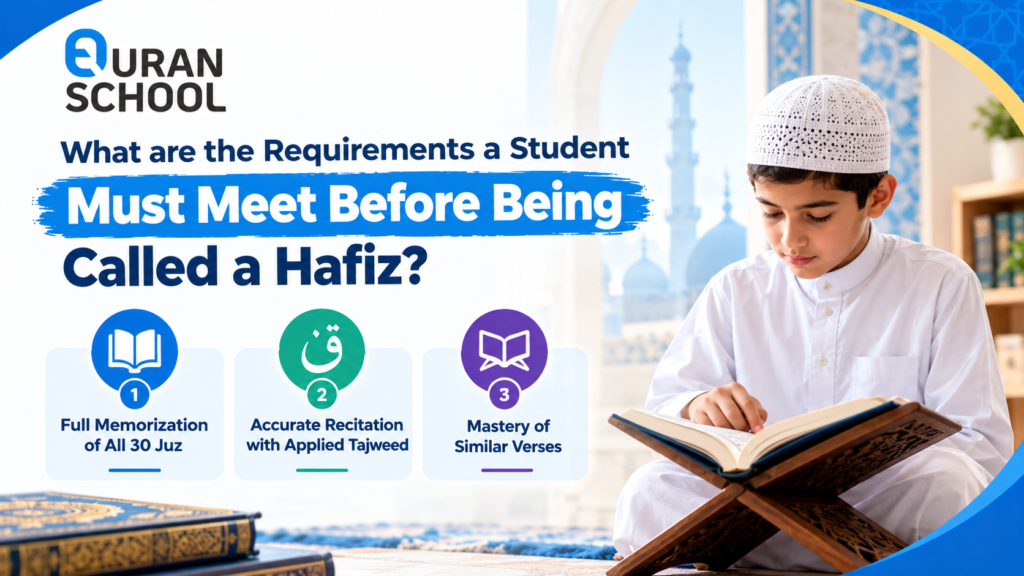
1. Full Memorization of All 30 Juz
Full memorization means holding all 604 pages of the standard Madani mushaf, which contains 6,236 verses in the Hafs count. Partial memorizers of several Juz are praised and rewarded, but the title Hafiz traditionally refers to complete memorization.
2. Accurate Recitation with Applied Tajweed
Accurate recitation is non-negotiable. A student who memorizes quickly but merges ح into ه, or reads ق like ك, is memorizing mistakes. Correcting these errors after Hifz is far harder than preventing them early.
3. Mastery of Similar Verses
Similar verses, called mutashabihat, are where many memorizers stumble. The story of Musa (peace be upon him) appears in several surahs with small wording differences, and experienced teachers drill these passages side by side until students never confuse them.
Hafiz Compared with Qari and Ijazah Holder
Hafiz, Qari, and Ijazah Holder: These three titles are often confused, yet each describes a different achievement. The table below clarifies what each title actually requires.
| Title | What It Means | Requires Full Memorization? |
| Hafiz / Hafiza | Has memorized the entire Quran | Yes |
| Qari | Skilled reciter with mastered Tajweed and one or more Qira’at | Not always |
| Ijazah holder | Certified by a teacher with a connected chain (sanad) to the Prophet ﷺ | Depends on the Ijazah type |
Virtues and Rank of a Hafiz in the Quran and Sunnah
The virtues of a Hafiz are mentioned clearly in authentic Sunnah, and the rank they describe is tied to how much of the Quran a person carries and lives by.
The Prophet ﷺ said:
«يُقالُ لصاحبِ القرآن: اقرأْ وارتقِ ورتِّلْ كما كنتَ ترتِّلُ في الدنيا، فإنَّ منزلَك عند آخرِ آيةٍ تقرؤها»
“It will be said to the companion of the Quran: Recite and rise in status, recite as you used to recite in the world, for your position will be at the last verse you recite.” (Sunan Abi Dawud 1464)
For non-Arabic speakers who find memorization difficult, there is real comfort in another narration. The Prophet ﷺ taught that:
«مَثَلُ الذي يقرأُ القرآنَ وهو حافظٌ له مع السَّفَرةِ الكرامِ البَرَرة، ومَثَلُ الذي يقرأُ وهو يتعاهدُه وهو عليه شديدٌ فله أجران»
“The one skilled in the Quran will be with the noble, righteous scribes, while the one who struggles with it receives a double reward.” (Sahih al-Bukhari 4937)
Allah also promises that the effort itself has been made easy:
وَلَقَدْ يَسَّرْنَا الْقُرْآنَ لِلذِّكْرِ فَهَلْ مِن مُّدَّكِرٍ
Wa laqad yassarnal-Qur’ana lidh-dhikri fahal min muddakir
“And We have certainly made the Qur’an easy for remembrance, so is there any who will remember?” (Al-Qamar 54:17)
Read also: What Is The Reward For Becoming A Hafiz?
Hafiz Statistics Worldwide and the Challenge of Counting Huffaz
Hafiz statistics worldwide are estimates rather than official counts. No single global registry of Hafiz exists, since Qur’anic schools operate through local mosques, private madrassas, online academies, and home circles.
Anyone researching how many Hafiz Quran in the world exist will find wildly different answers. One compilation of country figures and scholarly estimates places living Hafiz at over three million, suggesting the true figure may reach four to five million because several large countries lack consolidated data.
At the other extreme, some online academies claim the global number exceeds 200 million, while admitting no verified registry captures every memorizer. That figure would mean roughly one in every ten Muslims is a complete Hafiz.
From a teacher’s perspective, the lower estimates are far more realistic. Completion rates in Hifz circles are modest, and large figures often appear to merge complete huffaz with students who memorized several Juz but never finished.
See Us in Action
Watch a quick snippet from our live, interactive classes below and see how our teachers make learning engaging for all ages!
Start Your Quranic Journey Today
Experience our interactive online classes with a dedicated tutor.
Get Your Free TrialNumber of Hafiz by Country and the Countries with the Most Hafiz
The number of Hafiz by country is best understood through national madrasa boards and official religious bodies. These reported figures show which countries with the most Hafiz have built strong, organized memorization systems.
Pakistan is widely regarded as having the highest number of Quran memorizers, with Wafaq-ul-Madaris data suggesting over one million Hafiz graduates and roughly 80,000 new memorizers each year.
Morocco’s official figure of Quran memorizers has been reported at 1,628,054, with 68% coming from villages and rural areas, supported by more than 30,000 memorization centers. Egypt is estimated at around 1.5 million Huffaz, anchored by Al-Azhar.
| Country | Reported Estimate | Main Driver |
| Pakistan | 1 million+ graduates, ~80,000 per year | National madrasa boards |
| Morocco | ~1.6 million (official report) | Rural Quranic schools |
| Egypt | ~1.5 million | Al-Azhar institutes and kuttab |
| Turkey | Target of ~840,000 | Diyanet Hafizlik programs |
| Nigeria | No consolidated figure | Traditional Tsangaya schools |
| Indonesia | No consolidated figure | Pesantren tahfidz network |
Treat these numbers as reported estimates, not census data. Methods differ between countries, and some count graduates of madrasa programs while others count anyone who memorized the full Quran at any point.
Ranking of Quran Memorizing Countries by Population Share
The Ranking of Quran-Memorizing Countries changes completely depending on whether you measure total numbers or memorizers per population. Large countries lead in totals, while smaller nations often lead in population share.
Libya and Somalia are frequently placed at the top when memorizers are measured as a percentage of the total population. Nigeria, particularly Kano state, also claims one of the highest densities of Huffaz globally.
Mauritania deserves special mention. Its traditional mahdara schools still use wooden tablets (alwah), where students write each portion by hand, recite it hundreds of times, then wash the tablet before writing the next portion.
What is the Growth of Hafiz Numbers Over the Years?
The growth of Hafiz numbers over the years tells a remarkable story. In the earliest era, huffaz were few enough that their loss became a turning point in Islamic history.
When many reciters were killed at the Battle of Yamamah, Umar (may Allah be pleased with him) urged Abu Bakr to compile the Quran in written form.
Modern growth is driven by state programs and organized institutions. Turkish officials have announced a target of making one percent of the population, around 840,000 people, full memorizers.
Online learning is now the newest driver. Muslims in London, Toronto, Houston, and Sydney can memorize with qualified teachers without living near a large mosque, which shifts the Number of Hafiz by Country toward Western nations.
Sisters have benefited most from this shift. Many women who could not attend mosque circles now complete Hifz at home, and our Female Quran Classes pair them with a Female Quran Teacher for Ladies who understands their schedules and family responsibilities.
Book Your Free Trial Today for Female Quran Classes!
How to Become a Hafiz as a Muslim Living Outside the Arab World?
Becoming a Hafiz outside the Arab world is entirely achievable when the learning order is correct. Students must read fluently with Tajweed first, because memorizing from shaky reading locks pronunciation errors into long-term memory.
1. Make a Realistic Hifz Timeline by Daily Portion
Realistic timelines depend on the daily new portion, not on talent alone. The table assumes six memorization days per week with consistent revision.
| Daily New Memorization | Approximate Time to Complete |
| 5 lines | 5 to 6 years |
| Half page | 3.5 to 4 years |
| 1 page | About 2 years |
| 2 pages (intensive) | About 1 year |
Children usually start full Hifz around ages 7 to 9, after finishing the Noorani Qaida. Working adults often succeed best with five to seven lines daily, since smaller portions leave enough time for strong revision.
2. Revision Ratio That Keeps Memorization Stable
Revision, or Muraja’ah, should take more time than new memorization. Most experienced teachers recommend revising the previous 20 pages daily and cycling through older Juz weekly, so nothing memorized six months ago quietly disappears.
For busy professionals, our Hifz Classes for Adults are built around this balance. Short daily sessions with live correction keep both new memorization and revision moving, even during demanding work weeks, Insha’Allah.
Book Your Free Trial Today for Quran Classes for Adults!
Start Your Quranic Journey Today
Experience our interactive online classes with a dedicated tutor.
Get Your Free TrialRead also: How to Become A Hafiz? 8 Simple Steps
Start Your Spiritual Journey with E Quran School Today
Transform your understanding and recitation of the Holy Quran from the comfort of your home. At E Quran School, our certified tutors provide personalized, one-on-one guidance tailored to your pace and schedule. Whether you are looking for beginner Quran reading, advanced Tajweed, or Memorization (Hifz) courses, we have a program for you.
Our Quran Courses
- Quran Recitation Classes
- Weekend Quran Classes
- Quran Reading Classes
- Online Quran Classes for Kids
- Learn Quran Online with Tajweed for Kids and Adults
- Online Quran Learning with Tajweed Course
- Quran Classes for Adults
- Female Quran Classes
- Female Quran Teacher for Ladies
- Learn Quran for Beginners
- Quran Qirat Learning Course
Book your free trial class today at EQuran School and take your first step toward carrying the Quran in your heart.
Start Your Quranic Journey Today
Experience our interactive online classes with a dedicated tutor.
Get Your Free TrialConclusion
Who is a Hafiz? A Muslim who carries the entire Quran in the heart, recites it with correct Tajweed, and protects it through lifelong revision. The title is earned through discipline, sincerity, and a teacher’s careful correction.
The Hafiz meaning in English, guardian or preserver, captures the responsibility well. Memorizers continue a chain of oral transmission that began with the Companions and has never been broken in fourteen centuries.
Hafiz statistics worldwide remain estimates, yet the growth of Hafiz numbers over the years is undeniable. Whatever the Ranking of Quran-Memorizing Countries shows, every new Hafiz, Alhamdulillah, strengthens that chain for the next generation.
Frequently Asked Questions About Who Is a Hafiz
What Is a Hafiz and How Is It Different from a Qari?
A Hafiz is someone who has memorized the entire Quran, while a Qari is a skilled reciter with mastered Tajweed. A Qari may not be a Hafiz, and a Hafiz may not have studied the Qira’at.
What Is a Hafiz in Islam Expected to Do After Completing Hifz?
A Hafiz in Islam is expected to keep revising daily, act upon the Quran, and protect it from being forgotten. Many continue toward Ijazah, lead Taraweeh prayers, or begin teaching others what they memorized.
How Many Hafiz Quran in the World Are There Today?
No official count exists for how many Hafiz Quran there are in the world. Compiled country estimates suggest at least three million, while far higher claims usually merge partial memorizers with complete huffaz.
Which Are the Countries with the Most Hafiz Today?
The countries with the most Hafiz by reported totals include Pakistan, Morocco, and Egypt. Measured by population share, Libya, Somalia, and Mauritania are frequently described as leading nations in Quran memorization.
Can an Adult Who Does Not Speak Arabic Become a Hafiz?
Yes, an adult who does not speak Arabic can become a Hafiz. A Hafiz is defined by memorization and accuracy, not nationality. With fluent reading, a steady daily portion, and strong revision, adults complete Hifz regularly.
Is the Hafiz Title Lost If a Person Forgets Parts of the Quran?
A Hafiz who forgets parts of the Quran should restore them through serious revision immediately. Scholars warn strongly against neglecting memorization, so the title carries an ongoing responsibility rather than a one-time certificate.









Leave a Reply