 Quran
Quran
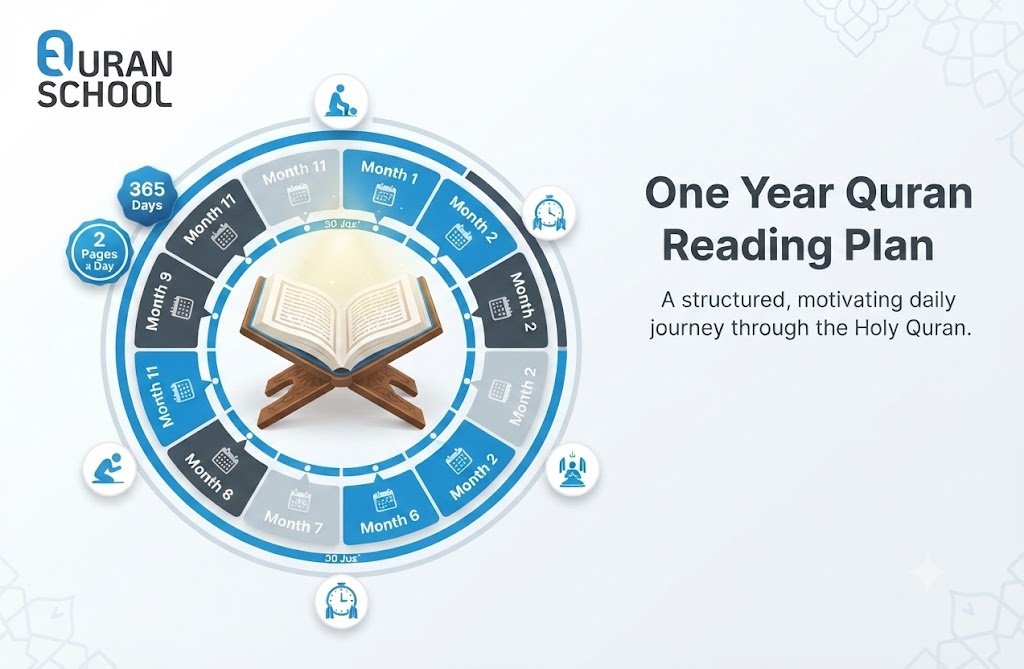
Most Muslims want to read the Quran in a year. Most don’t finish. Not because the goal is too hard — but because the plan they started with gave them no way to recover when life interrupted, no realistic time estimate, and no structure that fits a working day.
This guide gives you a complete one year Quran reading plan built around how much time you actually have, a practical daily split that uses the five prayers as anchors, and a recovery method for the days when things go wrong.
Whether you are in the US, UK, Canada, Australia, or anywhere else in the world, the math is the same and the method works.
What You’ll Learn in This Article
- Exactly how many pages to read each day to finish the Quran in one year
- A flexible 365-day plan for three different daily time budgets
- Monthly milestones so you know you are on track
- The Prayer-Anchor Method: how to split your daily reading across five prayers
- How to recover when you miss days — without abandoning the plan
- The most common mistakes that derail readers and how to avoid them
- The best apps and tools to support your one year plan
Pages Per Day In One Year Quran Reading Plan
The Quran contains 604 pages across 30 Juz’, with each Juz’ consisting of exactly 20 pages. To complete the Quran in one year — 365 days — you need to read approximately 1.65 pages per day, which rounds practically to 2 pages per day with a built-in buffer for missed days.
The simplest and most widely used framework is one Juz’ per day for 30 days, repeated 12 times across the year. But that requires 20 pages daily — a target only fluent readers can sustain comfortably.
For most readers, especially those balancing work and family, reading 4 pages after each of the five daily prayers is the more realistic path to the same destination.
Read also: The Best Free online Quran classes for kids
The One Year Quran Reading Plan By Reading Level
Your daily reading target determines how much time you actually need. Use this table to match your level to a realistic daily commitment:
| Reader Level | Pages per Day | Time per Day | Completion |
| Beginner | 2–4 pages | 20–35 minutes | 12 months |
| Intermediate | 5–10 pages | 20–30 minutes | 12 months (with surplus) |
| Fluent | 20 pages (1 Juz’) | 30–40 minutes | 12 months (standard Khatm) |
Beginners reading 2 pages daily need approximately 4–8 minutes per sitting — less time than most people spend on their phone after Fajr. The barrier is not time; it is the absence of a fixed daily trigger.
Read also: 7 Best Online Quran Learning Platforms for Non-Arabic Speakers
A Flexible One Year Quran Reading Plan for Busy Readers
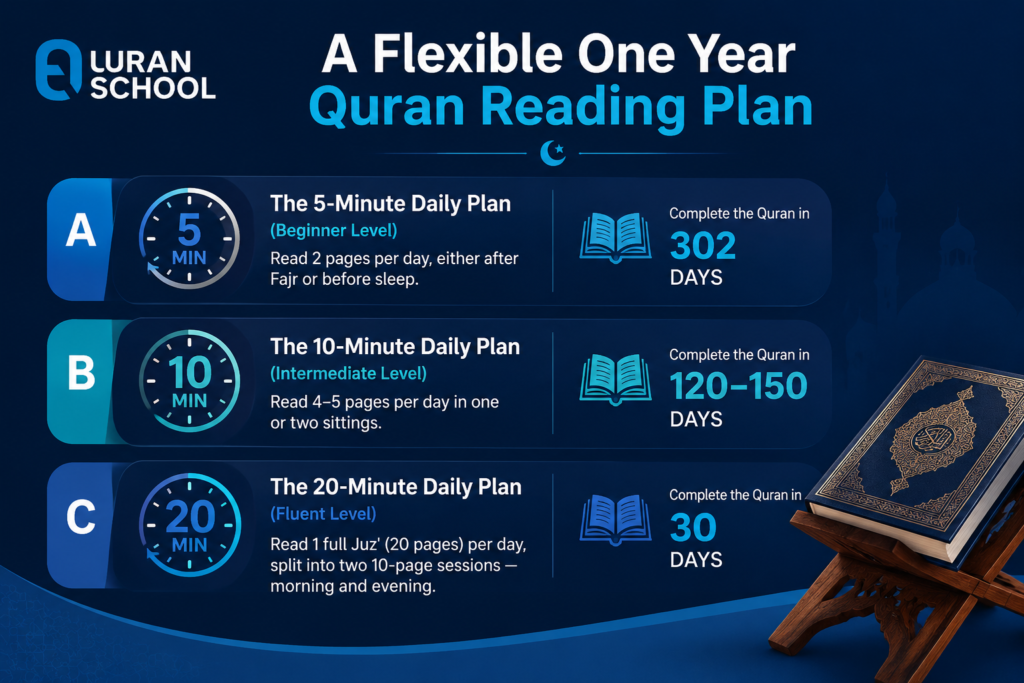
A one year Quran reading plan fails when it demands the same thing from every reader. The plan below comes in three versions based on how many minutes per day you can realistically give — not how much you think you should give:
A. The 5-Minute Daily Plan (Beginner Level)
Read 2 pages per day, either after Fajr or before sleep. At this pace, you complete the Quran in 302 days — with 63 days of buffer for missed readings built into a 365-day year. This is the entry-level plan for readers still building fluency or those returning to a regular reading habit after a long gap.
Students enrolled in a Quran for Beginners Course or working through the Noorani Qaida Course will find this pace very manageable alongside their lessons.
B. The 10-Minute Daily Plan (Intermediate Level)
Read 4–5 pages per day in one or two sittings. This completes the Quran in 120–150 days, meaning two to three full readings in one year. For readers at this level, pairing the reading with listening to a reciter while commuting — on the London Tube, during a drive in Toronto, or on the Sydney train — reinforces pronunciation and deepens retention.
Students taking Online Quran Recitation Classes will see a direct connection between their lesson work and this daily practice.
Read also: 8 Benefits of Reading Quran
C. The 20-Minute Daily Plan (Fluent Level)
Read 1 full Juz’ (20 pages) per day, split into two 10-page sessions — morning and evening. Attempting all 20 pages in one sitting before the habit is established leads to fatigue and dropout.
Two sessions of 10 pages each is observably easier to sustain and maintain recitation quality across the full year. Readers who want to learn Quran easily at home consistently report that this split-session approach is what made the difference between finishing and stopping.
Monthly Quran Reading Milestones
Tracking monthly progress anchors the plan to something concrete and removes the anxiety of not knowing whether you are on pace.
What to Complete Each Month on the One Year Plan
| Month | Pages Completed | Juz’ Completed | Milestone |
| Month 1 | 60 pages | Juz’ 1–3 | Al-Baqarah through Al-Imran |
| Month 3 | 180 pages | Juz’ 1–9 | Approximately one-third complete |
| Month 6 | 360 pages | Juz’ 1–18 | Halfway point — Surah Al-Muminun |
| Month 9 | 504 pages | Juz’ 1–25 | Three-quarters complete |
| Month 12 | 604 pages | All 30 Juz’ | Full Khatm al-Quran |
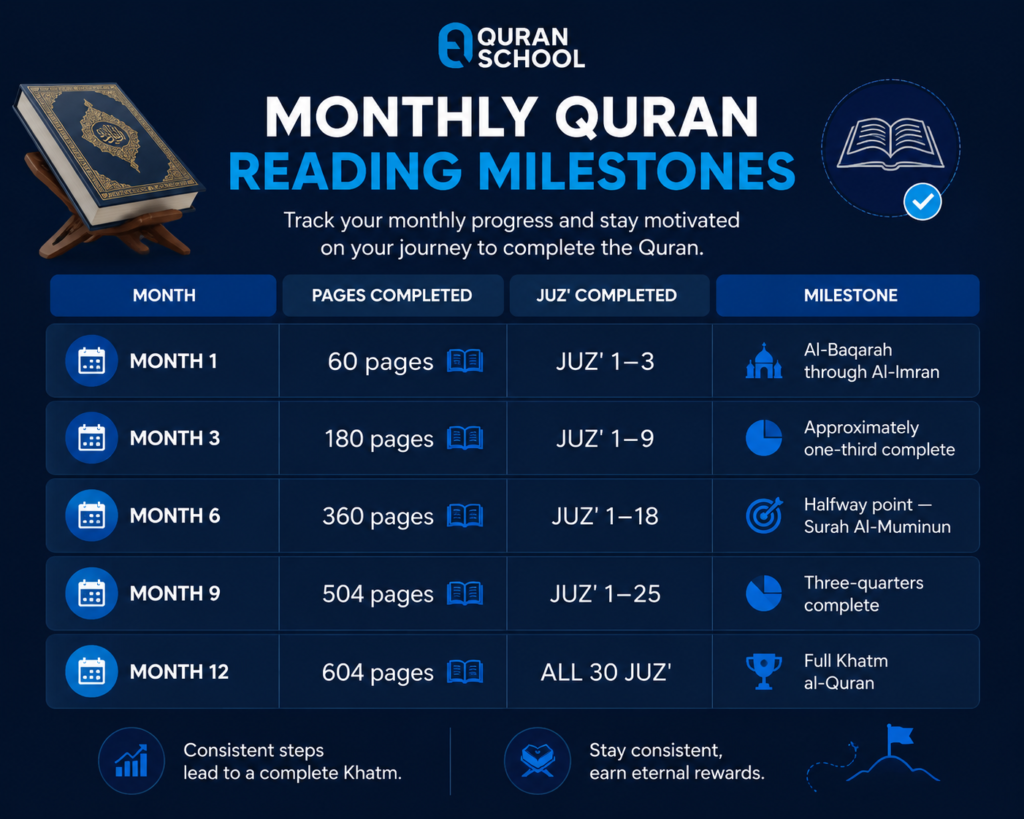
The six-month mark — reaching Juz’ 18 around Surah Al-Muminun — is the most important checkpoint in the plan. Readers who have maintained consistent reading to this point nearly always finish.
Readers who are significantly behind at month six need to adjust their daily target upward or move to the Prayer-Anchor Method immediately.
If you want structured guidance alongside your reading, EQuran School’s Online Arabic and Quran Classes provide 1-on-1 live instruction with certified teachers across all time zones — supporting students in the US, UK, Canada, Australia, and beyond with flexible scheduling and real-time progress tracking.
Start A Free Trial For Your Quranic Journey Today

Read also: 10 Health Benefits of Reading Quran Confirm By Science
Steps To Stay Consistent With Your One Year Quran Reading Plan
Consistency is a system, not a character trait. The readers who complete their one year Quran reading plan are not more disciplined — they built fewer decision points into each day.
A. Fix the Time, Not Just the Target
Assign your reading to a specific daily trigger — immediately after Fajr, during your lunch break, or in the ten minutes before Maghrib. The Prophet (ﷺ) said: “The most beloved deeds to Allah are those done consistently, even if they are small.” A fixed trigger removes the daily negotiation about when to read.
B. Habit Stacking for Quran Reading
Attach the reading to something you already do reliably. If you always make tea after Fajr, read two pages while it brews. If you commute by train or bus, listen to a reciter and follow along in the Mushaf. This is not a workaround — it is how durable habits form in practice.
Read also:
C. Use an Accountability Partner
Reading and tracking your daily progress with one other person — a spouse, sibling, or friend in a WhatsApp group — increases follow-through significantly. Knowing that someone else is tracking the same pages on the same day makes skipping feel like a joint decision rather than a private one.
This mirrors the principle behind structured study groups used in Quran Memorization (Hifz) Course programs worldwide.
D. Track Your Progress Visually
Mark each completed Juz’ on a printed tracker or inside your Quran app. The visual record of streaks and completions is more motivating than reminders alone. When you can see 14 Juz’ marked off, stopping at 15 becomes genuinely harder than continuing.
Book a FREE Trial Class for Your Child in our courses in EQuran School

The Recovery Rule to Get Back on Track After Missing Days
Missing days is not the problem. The problem is the absence of a recovery plan. Most people who abandon their one year Quran reading plan do not stop because of one bad week — they stop because they had no rule for what to do after it.
The Recovery Rule for this plan is straightforward: never try to catch up all at once. If you missed three days and owe six pages, do not add those six pages on top of today’s target.
Instead, add one extra page per day for the next six days. This prevents the catch-up spiral — the pattern where a large make-up session feels overwhelming, gets skipped, and the gap widens until quitting feels easier than continuing.
Common Mistakes That Prevent People From Completing the Quran in One Year
Many people fail to complete the Quran in one year because they set unrealistic goals, read without a consistent schedule, rush through recitation instead of focusing on Tajweed, or give up after missing a few days. The key to success is setting achievable targets, following a fixed daily routine, reciting with proper pronunciation, and getting back on track whenever interruptions occur.
A. Setting an Unrealistic Starting Target
Beginning with 1 Juz’ per day (20 pages) when your current reading pace is 4 pages per day is not ambition — it is a setup for burnout within three weeks.
Start with half your goal, sustain it for two weeks, then increase gradually. This gradual approach is the same principle applied in any well-structured Intensive Quran Course: build the habit before you build the load.
B. Reading Without a Fixed Routine
Reading “when I find time” means reading when the easiest option is already taken. Without a fixed slot, the reading competes with every other claim on your attention and loses most days.
Reserve your free trial lesson for Quran Reading Classes

C. Trying to Speed-Read Through the Quran
Reading at an artificially fast pace to hit page targets produces completion without Tajweed accuracy or any connection to the text. The goal of a one year Quran reading plan is recitation with correct pronunciation — not a race.
Slowing down slightly and applying basic Tajweed rules costs two extra minutes per sitting and produces an entirely different reading experience.
D. Skipping Several Days Without a Recovery Plan
The gap itself is not the danger. The danger is treating the gap as proof you cannot finish. Apply the Recovery Rule and continue from where you are.
Tools and Apps That Make a One Year Quran Reading Plan Easier
The right tool removes friction. The wrong one adds a new habit you have to maintain on top of the reading habit itself. These recommendations are based on which features directly support a structured yearly plan.
A. Quran Apps with Genuine Planning Features
Quran Majeed and Muslim Pro both offer daily reading trackers, Juz’ completion markers, customizable reminders, and audio recitation from major reciters including Sheikh Mishary Rashid Al-Afasy and Sheikh Abdul Rahman Al-Sudais.
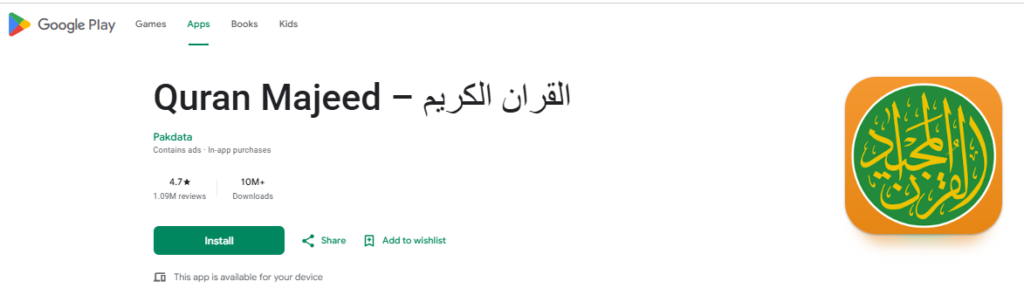
Ayah (آية) is particularly useful for students tracking a daily wird because it displays your daily target on the home screen and marks completion against a yearly goal.
B. The Madinah Mushaf for Printed Reading
If you prefer reading from a physical Mushaf, the Madinah Mushaf (the King Fahd edition widely distributed in the US, UK, and Australia) is formatted so that each Juz’ begins on a right-hand page and each page contains exactly 15 lines — making it straightforward to track your position within any daily target.
Readers who find screen reading too distracting consistently report better focus with this edition.
Read also: The Best Free Online Quran Classes for Adults
C. A Proprietary Curriculum Built for Non-Arabic Speakers
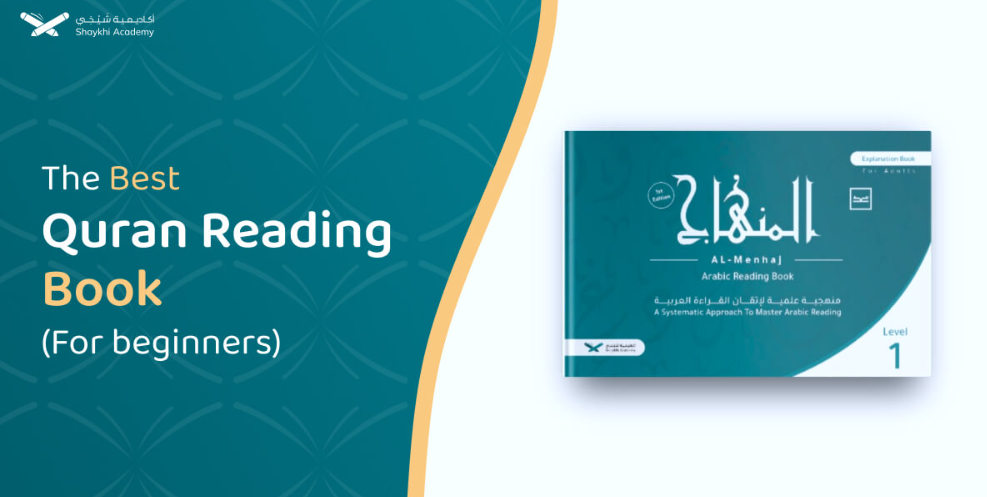
Most online Quran platforms use generic Arabic phonics materials designed for native Arabic children. E Quran School developed the proprietary Al-Menhaj Book — authored by Luqman ElKasabany — specifically for non-Arabic speaking adults and children in Western contexts.
The Al-Menhaj Book is structured around phonetic clarity and graduated difficulty, making it significantly more accessible for Western children than traditional Egyptian or Gulf-style primers.
Which EQuran School Course Fits Where You Are Right Now
Not every reader starting a one year plan is at the same point. EQuran School offers structured courses taught by Al-Azhar University graduates holding Ijazah certification, serving students across the US, UK, Canada, and Australia through flexible online scheduling.
If you are starting from the Arabic alphabet, the Noorani Qaida Course builds the letter recognition and pronunciation foundation needed before you can read fluently. If you can read but want to correct your pronunciation before committing to a full year of recitation, the Online Quran Recitation Classes focus exactly on Makharij accuracy and Tajweed application.
Readers who want to combine Arabic language instruction with Quranic reading can take Online Arabic and Quran Classes that develop both skills simultaneously.
E Quran School provides complete curriculum including:
- Weekend Quran Classes
- Online Quran Learning with Tajweed Course
- Quran Tafsir Course
- Quran Qirat Learning Course
- Noorani Qaida Course for Kids
- Quran Ijazah Program
Book a free trial class at E Quran School and experience personalized Quran instruction that adapts to your unique learning needs, Insha’Allah.
Conclusion
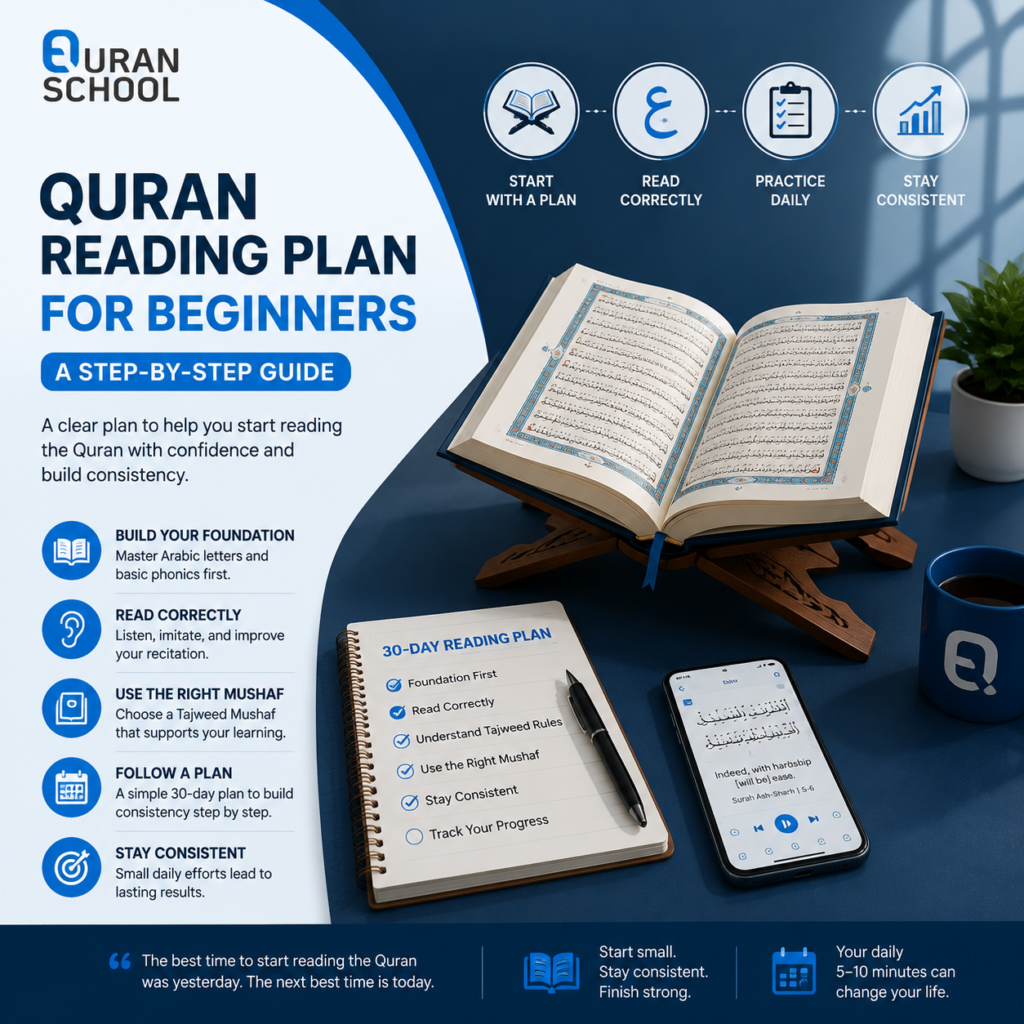
A one year Quran reading plan comes down to three decisions: how many pages per day you can realistically sustain, when in your day the reading will happen, and what you will do when you miss days.
The math is not complicated — the Quran is 604 pages, and two pages daily with a 63-day buffer means you do not need to be perfect. You need to be consistent. The Prayer-Anchor Method — four pages after each of the five daily prayers — remains the most practical daily structure for readers in full-time work or family life.
The Recovery Rule removes the most common reason people quit. Tracking your progress against monthly milestones confirms the plan is working before the year ends. Begin today. The best time to start a one year Quran reading plan is the day you decide to finish one.
Frequently Asked Questions
How many pages of the Quran should I read per day to finish in one year?
Reading 2 pages per day completes the Quran in approximately 302 days, giving you a 63-day buffer in a 365-day year. For a tighter pace with no buffer, read 1 Juz’ (20 pages) per day — this finishes the Quran in 30 days and produces 12 complete readings across a full year.
How long does it take to read 2 pages of the Quran each day?
Two pages take approximately 4–8 minutes for an intermediate reader and 8–12 minutes for a beginner. At that rate, completing a one year Quran reading plan requires less than 10 minutes daily — a realistic target for almost any schedule.
What is the best time to read the Quran daily for consistency?
The most effective fixed times are immediately after Fajr prayer and the ten minutes before or after Maghrib. These moments are already separated from competing activities by the structure of the prayer itself, making them easier to protect than self-scheduled reading windows.
What should I do if I miss several days of my Quran reading plan?
Apply the Recovery Rule: add one extra page per day for the number of pages missed, spread across upcoming days. Do not attempt to read all missed pages in a single session — this creates a catch-up burden that typically leads to abandoning the plan entirely.









Leave a Reply