 Learn Quran
Teaching children the Quran requires more than good intentions—it demands the right tools carefully matched to a child’s developmental stage, attention span, and learning style. The earlier the foundation is laid with structured, engaging resources, the more naturally Quranic recitation and memorization become part of a child’s identity.
The best Quran learning tools for kids combine interactive technology, proven pedagogical methods, and age-appropriate engagement to build skills that last a lifetime. From digital apps and physical books to live online instruction, today’s parents have access to a rich variety of resources.
1. Noorani Qaida Books and Illustrated Beginner Texts
The Noorani Qaida remains the most trusted foundational tool for young learners beginning their Quranic education. Specifically designed for non-Arabic speakers, it introduces Arabic letters, letter forms, and pronunciation rules in a structured, progressive sequence.
Illustrated versions with colorful images hold young children’s attention while associating letter shapes with familiar visuals. This visual-cognitive pairing accelerates letter recognition significantly compared to plain text formats.
For structured, expert-guided instruction through Noorani Qaida, E Quran School offers a dedicated Noorani Qaida Course for Kids with certified Qari instructors who specialize in teaching non-Arabic-speaking children using age-appropriate pacing and encouragement.
Book a FREE Trial Class for Your Child in Our Noorani Qaida Course for Kids
The Al-Menhaj Book for Foundational Arabic Reading
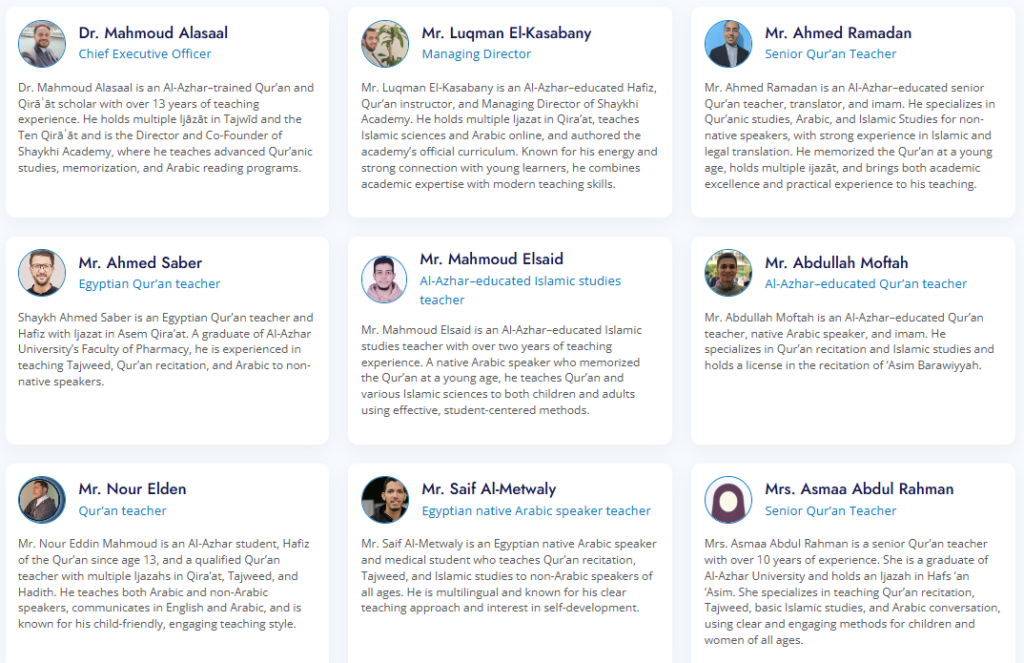
The Al-Menhaj Book, developed by Luqman ElKasabany and the E Quran School administration, is a proprietary curriculum specifically designed for non-Arabic speakers. It guides learners from the Arabic alphabet through full Quranic reading fluency using a uniquely structured progression that avoids the confusion common in traditional texts.
Explore Al-Menhaj Book for FREE
Its lesson sequencing is deliberate and cumulative, ensuring each new concept builds directly on previously mastered skills—an approach that supports long-term retention for young learners.
2. Interactive Quran Learning Apps for Kids
Digital apps have become among the most effective Quran learning tools for kids in modern households. The best apps integrate audio recitation, letter tracing, and short-Surah memorization within gamified environments that maintain children’s focus.
Apps like Quran Companion, Memorize Quran, and Tarteel AI use spaced repetition algorithms to reinforce memorized verses at scientifically optimized intervals. This mimics the traditional Hifz review cycle but in a child-friendly digital format.
Key Features to Look for in a Quran App for Kids
| Feature | Purpose | Why It Matters for Kids |
| Audio by certified Qaris | Correct Tajweed modeling | Children imitate what they hear |
| Letter tracing / writing | Arabic letter recognition | Builds reading readiness |
| Spaced repetition | Memorization retention | Prevents forgetting between lessons |
| Progress tracking | Motivation and accountability | Encourages consistent practice |
| Short Surah focus | Age-appropriate goals | Builds confidence quickly |
Parents should verify that any app used features recitations by certified Huffaz or Qaris, as children naturally absorb pronunciation patterns from audio they hear repeatedly.
Book Your Kid a Free Session with One of EQuran School’s Certified Teachers
3. Quran Flashcards and Memorization Cards for Children
Physical Quran flashcards bridge the gap between digital stimulation and hands-on tactile learning. Cards featuring individual Ayat with transliteration on one side and meanings on the reverse strengthen both memorization and comprehension simultaneously.
For younger children aged 4–7, Surah-specific card sets covering Juz Amma are particularly effective. Short Surahs like Al-Fatiha, Al-Ikhlas, Al-Falaq, and An-Nas can be memorized systematically using a simple three-card-per-session approach.
Allah ﷻ emphasized the accessibility of the Quran for those who sincerely engage with it:
وَلَقَدْ يَسَّرْنَا ٱلْقُرْءَانَ لِلذِّكْرِ فَهَلْ مِن مُّدَّكِرٍ
Wa laqad yassarnal-Qur’ana lidh-dhikri fahal min muddakir
“And We have certainly made the Quran easy for remembrance, so is there any who will remember?” (Al-Qamar 54:17)
Flashcards used consistently in short daily sessions of 10–15 minutes produce measurable memorization results within weeks for children as young as five.
4. Quran Coloring Books and Activity Workbooks for Young Learners
Quran-themed coloring books and activity workbooks engage children’s creativity while embedding Quranic content. These tools are especially valuable for ages 4–8, where kinesthetic and visual learning dominate.
High-quality activity workbooks combine Arabic letter writing practice, dot-to-dot letter formation, simple word matching, and illustrated Surah stories. This multi-sensory approach creates stronger neural associations with Quranic content.
When selecting workbooks, prioritize those that align with the Noorani Qaida sequence so that the child’s classroom learning and at-home activity reinforce the same material simultaneously.
Start Your Quran Learning Journey Today
Book your free trial class and begin learning Quran with expert teachers from the comfort of your home.
Book Your Free Trial5. Online Quran Classes for Kids with Live Instructors
Among all Quran learning tools for kids, live one-on-one instruction remains irreplaceable. Automated tools cannot correct mispronunciation in real time, respond to a child’s confusion, or adapt pacing to emotional states—only a qualified human teacher can.
The Prophet ﷺ highlighted the special status of those who learn and teach the Quran:
The Messenger of Allah ﷺ said: “The best of you are those who learn the Quran and teach it.” (Sahih Bukhari 5027)
Live instruction through platforms like E Quran School ensures that Tajweed rules are applied correctly from the very first lesson—preventing bad habits that become increasingly difficult to correct as children grow older.
E Quran School’s Online Quran Classes for Kids connect children with certified Huffaz and Tajweed-qualified instructors who specialize in teaching non-Arabic-speaking students. Lessons are structured around each child’s current level, learning pace, and memorization goals.
Book Your Child in a FREE Trial Class
6. Quran Listening Stations and Audio Tools for Children
Passive Quran listening is an underutilized but highly effective tool for children’s memorization. Young children absorb language through repetitive audio exposure long before they can consciously process it—the same neurological mechanism that helps toddlers acquire their native language.
Setting up a dedicated Quran listening station at home—a small Bluetooth speaker or child-safe MP3 player loaded with recitations by certified Qaris—creates an immersive Quranic environment during playtime, mealtimes, or before sleep.
Recommended Recitation Styles for Children’s Audio Tools
| Recitation Style | Recommended Qari | Best Use for Children |
| Murattal (slow, clear) | Sheikh Mahmoud Khalil Al-Husary | Learning and memorization |
| Mujawwad (melodious) | Sheikh Abdul Basit Abd us-Samad | Building love for Quranic sound |
| Tarteel (measured pace) | Sheikh Mishary Al-Afasy | Daily listening and repetition |
Murattal-style recitations—slow, clear, and rule-precise—are most appropriate for children actively memorizing, as the deliberate pace allows the ear to isolate individual words and sounds.
7. Quran Memorization Boards and Visual Tracking Charts
Visual progress tools create powerful motivational structures for children. A physical Quran memorization chart displayed in a child’s room or study area turns abstract memorization goals into visible, tangible achievements.
Effective memorization boards divide Juz Amma into individual Surahs, with sticker or stamp systems marking completed memorization.
For older children pursuing structured Hifz, charts tracking full Juz completion provide a clear roadmap from beginning to Khatm.
The visual reinforcement of seeing progress accumulate motivates children to continue even during difficult periods of revision.
Parents should celebrate each milestone vocally—Alhamdulillah—to connect achievement with spiritual gratitude.
8. Tajweed Rule Posters and Arabic Letter Charts for Classroom and Home
Tajweed rule posters and Arabic alphabet charts serve as constant visual references that reinforce classroom learning between formal lessons. Displayed at a child’s eye level, these tools normalize Arabic script as part of the child’s everyday visual environment.
Quality Tajweed posters for children should cover the core rules in simplified, color-coded formats: Ikhfa (concealment), Idgham (merging), Iqlab (conversion), and Izhaar (clear pronunciation) are the four Noon Sakinah and Tanwin rules every child should encounter visually before they encounter them formally in instruction.
For children advancing beyond basic recitation, E Quran School’s Online Quran Learning with Tajweed Course provides structured rule-by-rule instruction under certified Qari teachers, ensuring that poster-level familiarity translates into applied recitation skill.
Get a FREE Trial of our Quran with Tajweed Classes for Kids and Adults
9. Quran Stories and Tafsir Books Adapted for Children
Age-appropriate Tafsir and Quranic story books build children’s relationship with Quranic meaning alongside their recitation practice. Understanding even simple meanings of memorized Surahs dramatically strengthens retention and emotional connection.
Books adapting stories of the Prophets from Quranic accounts—such as the story of Prophet Yunus (AS) connected to Surah Al-Anbiya or Surah As-Saffat—give children narrative anchors for the Arabic text they are memorizing.
10. Structured Hifz Programs Designed Specifically for Children
A structured Hifz program is the most comprehensive of all Quran learning tools for kids who are serious about full memorization. The program methodology must be age-appropriate, with shorter daily lesson targets, frequent review cycles, and strong parental involvement.
For non-Arabic-speaking children, the standard approach at institutions like E Quran School begins with mastery of Juz Amma before advancing to Juz 29, then progressing toward the full Quran from Juz 1. This sequencing builds early confidence through shorter, achievable Surahs.
A Sample Weekly Hifz Schedule for Children Aged 8–12
| Day | Activity | Duration |
| Saturday | New memorization (3–5 Ayat) | 20 minutes |
| Sunday | Review previous week’s lesson | 15 minutes |
| Monday | New memorization (3–5 Ayat) | 20 minutes |
| Tuesday | Cumulative review (last 2 weeks) | 20 minutes |
| Wednesday | New memorization (3–5 Ayat) | 20 minutes |
| Thursday | Full week review with teacher | 25 minutes |
| Friday | Listening day + light revision | 15 minutes |
Consistent short sessions outperform infrequent long sessions for children. The brain’s consolidation process requires regular, spaced engagement to move Quranic text from short-term into long-term memory.
Start Your Quran Learning Journey Today
Book your free trial class and begin learning Quran with expert teachers from the comfort of your home.
Book Your Free TrialBeginning Your Child’s Quran Learning at E Quran School
Every child deserves a Quran education built on correct foundations, expert guidance, and genuine care. E Quran School offers exactly that.
- Certified Huffaz and Qaris specialized in teaching non-Arabic-speaking children
- Structured programs: Noorani Qaida Course for Kids, Online Quran Classes for Kids, Quran Memorization (Hifz) Course, Learn Quran Online with Tajweed for Kids and Adults
- Proprietary Al-Menhaj Book curriculum for foundational reading
- One-on-one live sessions with flexible scheduling
- Free trial lesson—no commitment required
Book your child’s free trial today at E Quran School and let a qualified teacher guide the first step.
E Quran School provides complete curriculum including:
- Quran Memorization (Hifz) Course
- Online Quran Learning with Tajweed Course
- Quran Tafsir Course
- Online Arabic and Quran Classes
- Quran Qirat Learning Course
- Online Quran Recitation Classes
- Noorani Qaida Course
- Noorani Qaida Course for Kids
- Online Quran Classes for Kids
Conclusion
The right combination of Quran learning tools for kids—from Noorani Qaida books and interactive apps to live online instruction—creates a rich, multi-layered learning environment. No single tool is sufficient; the most effective approach layers multiple resources around a structured curriculum.
Live instruction remains the foundation that all other tools support. Apps, flashcards, audio stations, and visual charts are most powerful when they reinforce what a qualified teacher has already introduced, corrected, and contextualized in a real lesson.
Insha’Allah, with consistent daily practice, expert guidance, and a home environment that normalizes Quranic engagement, every child can build a strong, lasting relationship with the Book of Allah ﷻ—one Ayah at a time.


Leave a Reply