 Learn Quran

How long does it take to learn Tajweed? For most learners, there is no single answer. You may understand the basic Tajweed rules within a few months, but applying them naturally and consistently while reciting the Quran usually takes longer.
Your starting level, Arabic reading ability, pronunciation, lesson frequency, daily practice, and access to correction all affect your progress.
A complete beginner who is still learning Arabic letters will naturally need more time than someone who already reads the Quran fluently. Knowing that a Tajweed rule exists is very different from recognizing it instantly in an ayah and applying it correctly without stopping to think.
Structured guidance, such as the Quran with Tajweed course at E Quran School, can shorten this gap by giving you consistent correction from lesson to lesson.

This guide answers how long does it take to learn Tajweed, explains what affects the learning timeline, and shows you how to make steady progress without rushing your recitation.
What You Will Learn
- A realistic, stage-by-stage timeline for learning Tajweed, instead of a single fixed number of weeks.
- The difference between knowing a Tajweed rule, recognizing it, and applying it while reciting.
- The factors that speed up or slow down your progress, including practice frequency and access to a teacher.
- What real progress in three months, six months, and beyond typically looks like.
- Practical daily habits and a sample six-month study plan you can adapt to your own pace.
How Long Does It Take to Learn Tajweed?
For a beginner, a reasonable foundation in Tajweed may take several months of consistent study, while becoming confident in applying the rules throughout Quran recitation can take considerably longer. The exact timeline depends heavily on what “learning Tajweed” means for you.
If your goal is simply to understand the names and basic concepts of common rules, progress can be relatively quick. If your goal is to recite accurately with correct makharij, sifaat, madd lengths, ghunnah, stopping, and starting — applied consistently — you will need much more practical training.
Complete beginners may also need an introductory stage before formal Tajweed study. Someone who cannot yet recognize Arabic letters or read words with harakat should first build basic Quran reading skills, which is exactly where dedicated Arabic reading classes can help before Tajweed rules are introduced.
Trying to memorize dozens of Tajweed rules before being able to read comfortably often creates unnecessary confusion.
A Useful Way to Think About the Timeline
There is an important distinction between finishing a Tajweed syllabus and being able to recite the Quran with Tajweed confidently. Completing a course may mean that you understand the major rules, recognize their categories, and know when they should be applied.
Practical recitation, however, requires those rules to become increasingly natural so that you can maintain correct Makharij, Madd, Ghunnah, and other pronunciation details without stopping to analyze every word.
This practical stage usually takes longer because Tajweed is a skill developed through regular listening, repetition, recitation, and correction. The more frequently you read aloud and receive feedback, the easier it becomes to identify recurring mistakes and replace them with stronger recitation habits.
Over time, rules that initially required deliberate concentration can begin to appear more naturally during longer Quran passages.

- First stage: Build accurate Arabic reading and letter pronunciation.
- Second stage: Learn the essential Tajweed rules.
- Third stage: Apply each rule to real Quranic examples.
- Fourth stage: Recite longer passages while receiving correction.
- Final ongoing stage: Improve consistency, fluency, and finer details.
What Does It Actually Mean to “Learn Tajweed”?
Before asking how long does it take to learn Tajweed, it is important to define what you mean by “learn.” Tajweed is not simply a collection of rules that can be memorized from a textbook or explained during a lesson.
A student may understand the definitions of Idgham, Ikhfa, Iqlab, Qalqalah, Madd, and Ghunnah perfectly on paper while still making noticeable mistakes when those same rules appear during continuous Quran recitation.
Practical Tajweed requires both your ears and tongue to become trained over time. Your ear needs to recognize subtle differences between similar Arabic sounds, while your tongue must learn to produce each letter from its correct Makhraj (articulation point) with the appropriate characteristics.
You also need to develop control over vowel lengths, Ghunnah, heavy and light letters, stopping and starting, and other recitation details. These physical and listening skills usually develop through repeated exposure, imitation, correction, and consistent practice rather than through theory alone.
Another important stage is learning to identify Tajweed rules directly inside Quranic text and apply them while continuing to recite naturally.
At first, you may need to pause and consciously identify a rule before applying it. With regular practice, however, recognition can become faster and the correct pronunciation begins to feel more automatic.
Read also: 10 Prophetic Hadith About Reading Quran

Knowing the Rules of learning Tajweed
The first stage of learning Tajweed is developing a clear understanding of what the major rules mean, when they occur, and how they affect Quran recitation.
This includes subjects such as Noon Sakinah and Tanween, Meem Sakinah, Madd, Qalqalah, Ghunnah, heavy and light letters, as well as the basic principles of Waqf and Ibtida (stopping and starting). At this stage, the learner is primarily building theoretical knowledge and becoming familiar with the terminology used by Tajweed teachers.
However, memorizing definitions should not be the final goal. Each new rule should be connected immediately to real examples from the Quran so that you understand how it sounds and appears in actual recitation.
For example, after studying Ikhfa, locate several Quranic examples, listen to a qualified reciter pronounce them, and compare those examples with cases of Idhhar or Idgham. This makes the theory much easier to retain and prepares you for the next stage.
See Us in Action
Watch a quick snippet from our live, interactive classes below and see how our teachers make learning engaging for all ages!
Start Your Quranic Journey Today
Experience our interactive online classes with a dedicated tutor.
Get Your Free TrialRecognizing the Rules
The next level is being able to identify Tajweed rules directly inside an ayah without waiting for a teacher to point them out. Instead of remembering the definition of a rule only when you are asked about it, you begin noticing its trigger letters and conditions naturally while reading from the Mushaf.
At first, this recognition may require deliberate thought. You might stop at a Noon Sakinah, examine the following letter, and then decide whether the rule is Idhhar, Idgham, Iqlab, or Ikhfa. With repeated Quran reading and practice, however, this process gradually becomes faster.
The goal is to reach a point where seeing the relevant letters immediately reminds you of the correct Tajweed application, allowing you to prepare your pronunciation before reaching the word.
Applying the Rules Correctly
This is often the stage that requires the most practice and teacher correction. Your mind may already know exactly what should happen, but your mouth still needs to reproduce it consistently during continuous recitation.
Correct Makharij, Madd timing, Ghunnah, Tafkheem and Tarqeeq, Qalqalah, and other letter characteristics involve physical habits that usually cannot be developed through theoretical study alone.
For example, knowing that a Ghunnah should be maintained for the appropriate duration is different from producing it naturally while reciting an entire ayah. Likewise, understanding the Makhraj of ق does not automatically mean your tongue will consistently produce it correctly every time it appears.
Repeated listening, slow practice, and immediate correction help close the gap between knowing what the rule requires and actually performing it correctly.
Over time, the aim is for these rules to become increasingly natural rather than requiring conscious analysis at every word.
You may initially need to think, “There is Ikhfa here” or deliberately count a Madd, but regular practice trains your ears and speech until many of these applications become more automatic.
Start learn Quran with Tajweed with your first free class

A Realistic Tajweed Learning Timeline
Although every learner progresses at a different pace, dividing Tajweed into clear learning stages gives you a much more realistic picture than promising complete mastery within an exact number of weeks or months.
Your progress will depend on your starting level, Arabic reading ability, pronunciation, consistency, access to a teacher, and how much focused practice you can maintain each week.
These stages should not be treated as completely separate boxes. In practice, they often overlap and reinforce one another.
You should continue practicing Makharij while studying Noon Sakinah and Tanween, for example, and continue reviewing earlier Tajweed rules while learning new ones. Progress in Tajweed is cumulative: each new skill is added to the pronunciation and recitation habits you have already developed.
Read also: Master Quran with Tajweed: Complete Guide

Stage 1: Arabic Reading and Basic Pronunciation
For a complete beginner, the first priority is becoming comfortable with Arabic letters and basic Quran reading. You need to recognize each letter in its isolated and connected forms and understand how letters join together to create words.
At the same time, begin learning essential reading signs such as Fatha, Kasra, Damma, Sukoon, Shaddah, and Tanween so that you can read simple Quranic words without constantly guessing their pronunciation.
This foundation is extremely important because Tajweed rules cannot compensate for consistently incorrect letter pronunciation.
Before worrying about advanced Madd categories or detailed rules of Idgham, you need enough control over the Arabic alphabet to pronounce the words themselves accurately. Spending additional time here can make every later stage of Tajweed easier.
Reserve your free trial lesson for Quran Reading Classes

Stage 2: Makharij and Sifaat
Once you can read basic Arabic words, greater attention can be given to Makharij, the articulation points from which Arabic letters are produced, and Sifaat, the characteristics that give each letter its distinctive quality.
Together, these two subjects help you move from approximately producing an Arabic sound to pronouncing it with greater accuracy.
This stage can require considerable practice because some Quranic sounds may not exist in the learner’s first language. Letters produced from deeper areas of the throat or requiring particular tongue positions can initially feel unnatural.
Simply knowing intellectually where the tongue should be positioned does not guarantee that the sound will immediately come out correctly.
Stage 3: Essential Tajweed Rules
Once your basic reading and pronunciation are reasonably stable, you can begin working systematically through the essential practical Tajweed rules.
These include Noon Sakinah and Tanween, Izhar, Idgham, Iqlab, Ikhfa, Meem Sakinah, Ghunnah, Qalqalah, Madd, Tafkheem and Tarqeeq, the rules of Laam and Raa, and Waqf and Ibtida.
Avoid trying to memorize every rule and exception simultaneously. Study one group at a time, understand what triggers the rule, and immediately locate several examples in actual Quranic verses. Listen to those examples from a reliable reciter and practice them aloud until you can both recognize and apply the rule.

Stage 4: Guided Quran Recitation
At this stage, a large part of your improvement comes from application and correction rather than learning additional terminology.
You begin spending more time reciting complete passages to a qualified teacher, receiving feedback, repeating difficult words, and identifying patterns in the mistakes you make regularly.
You may discover that your theoretical knowledge is stronger than your practical application. Perhaps you understand Madd perfectly but shorten it unconsciously when reading quickly.
You may know the correct Makhraj of a particular letter when practicing it alone but lose that articulation point when the same letter appears in a difficult word or fast-moving ayah.
These weaknesses are normal and are precisely why guided recitation is so important. A teacher can identify errors you may not notice yourself and ask you to repeat the relevant word or passage immediately.
Through this process, theoretical Tajweed gradually becomes practical Tajweed that you can maintain during real Quran recitation.
Stage 5: Fluency and Consistency
The final long-term goal is to reach a level where the essential Tajweed rules are applied consistently without constantly interrupting the natural flow of your recitation.
Instead of stopping at every word to remember whether a rule is Ikhfa or Idgham, you begin recognizing the pattern and producing the appropriate sound more naturally.
This does not mean that reaching this stage makes your recitation permanently perfect or that you will never make another mistake. Even experienced learners continue reviewing, reciting to teachers, and correcting weaknesses.
Rather, it means that the correct pronunciation and Tajweed habits have become sufficiently established that they require less conscious effort during ordinary recitation.

START YOUR QURANIC JOURNEY TODAY
Move through these stages with a dedicated tutor who corrects your recitation in real time in our Tajweed course.
What Factors Determine How Long It Takes to Learn Tajweed?
When someone asks how long does it take to learn Tajweed, the answer depends on much more than age, intelligence, or natural ability. Tajweed combines theoretical understanding with listening skills, pronunciation, muscle memory, and repeated Quran recitation.
Your starting level, consistency, quality of instruction, and the amount of focused practice you complete between lessons can all significantly affect your progress.
Two students can begin learning Tajweed on exactly the same day and reach very different levels six months later. One may attend a lesson once a week but rarely practice between classes, while another spends 15–20 focused minutes each day reviewing previous corrections, listening to accurate recitation, and practicing aloud.
Even if both students receive the same instruction, their timelines will naturally be different because Tajweed improves through repeated application rather than lessons alone.
1. Your Quran Reading Level Affects Tajweed Progress
If you already read Quranic Arabic comfortably, recognize connected letters quickly, and understand the basic vowel marks, you can usually begin concentrating on Tajweed application much sooner.
Your lessons can focus directly on Makharij, Sifaat, Madd, Ghunnah, and other recitation rules instead of spending substantial time decoding individual words.
A complete beginner may first need to learn the Arabic alphabet, connected letter forms, Fatha, Kasra, Damma, Sukoon, Shaddah, and Tanween, as well as basic word reading. This additional foundation naturally extends the overall learning timeline, but skipping it usually creates greater difficulties later.

2. Pronunciation Affects Your Tajweed Learning Time
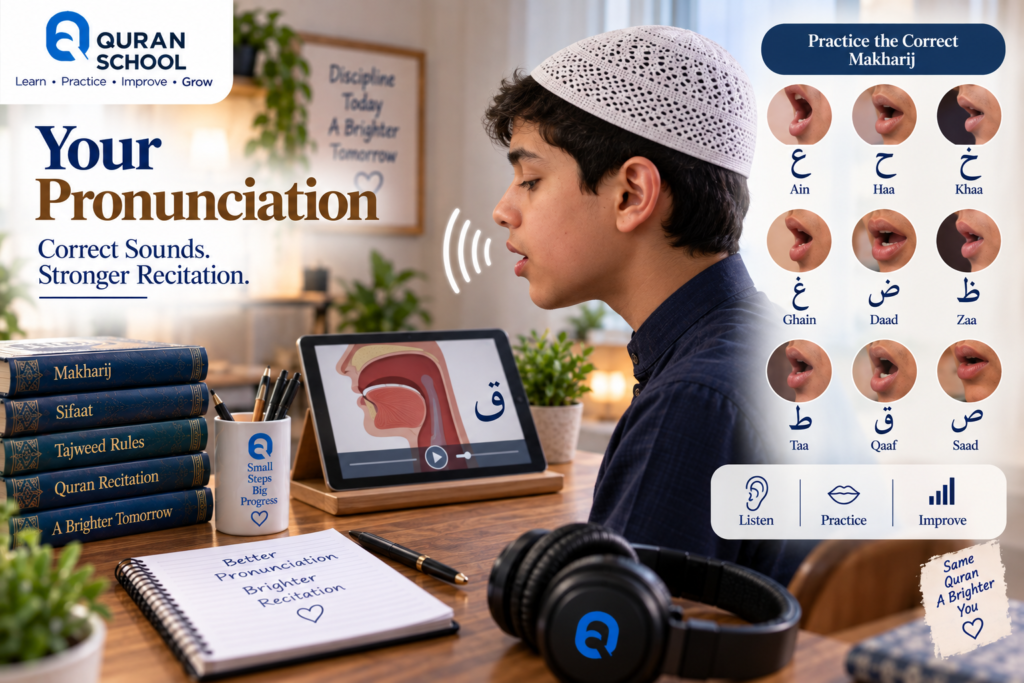
Your existing pronunciation habits can also have a major effect on your Tajweed timeline. Learners whose native language contains sounds similar to Quranic Arabic may find certain Makharij easier, while others may need considerably more practice with unfamiliar letters such as ع, ح, خ, غ, ض, ظ, ط, ق, and ص.
Knowing where a letter should originate is only the first step. Your tongue, lips, and throat must learn to reproduce that position consistently when the letter appears inside complete words and fast-moving Quranic passages.
A learner may pronounce ق correctly during an isolated exercise but unintentionally weaken or change it during continuous recitation.
Pronunciation therefore improves through repeated listening, careful imitation, slow practice, and direct correction.
The more unfamiliar the Arabic sound system is to you, the more time you may need at this stage—and that extra practice is valuable because correct letters form the foundation for everything that follows.
3. Study Frequency Affects Tajweed Progress
Consistency usually matters more than occasional intensive study. A student who practices Tajweed for 15–20 minutes almost every day is repeatedly training the same listening and speech habits, making it easier for new skills to remain active between lessons.
By contrast, completing one long practice session and then leaving several days without recitation can make progress less consistent. You may spend part of every new session simply recovering skills that had begun to weaken instead of building on what you previously learned.
A practical routine does not need to take hours. Short sessions can include listening to a few ayahs, practicing one Tajweed rule, reviewing teacher corrections, and reciting a short passage aloud.
Frequent, focused repetition is particularly useful because Tajweed involves physical speech habits that develop gradually through regular use.
Begin Learning Quran For Beginners Online Today at EQuran School

4. Teacher Can Speed Up Tajweed Learning
Independent Tajweed study can be extremely useful for understanding terminology, reviewing rules, watching demonstrations, and listening to correct Quran recitation.
However, recordings and books have one important limitation: they cannot listen to your individual recitation and tell you exactly what you are doing incorrectly.
A qualified Quran teacher can identify subtle errors involving Makharij, Sifaat, Madd length, Ghunnah, Tafkheem and Tarqeeq, or Waqf and Ibtida. More importantly, the teacher can correct the mistake immediately and ask you to repeat the word or ayah until the difference becomes clearer.
This direct feedback can make your practice considerably more efficient. Instead of repeating an incorrect pronunciation for weeks without realizing it, you discover the problem early and know exactly what needs attention during your independent practice between lessons.
Read Also: Quran recitation for beginners
5. Why Practice Quality Matters in Learning Tajweed
Simply increasing the number of repetitions does not automatically produce better Tajweed. If you pronounce a word incorrectly fifty times without correction, you may actually strengthen the wrong speech habit and make it more difficult to change later.
High-quality practice is slow, attentive, and targeted. When you discover a difficult letter or Tajweed rule, isolate the relevant word or phrase, listen to an accurate model, repeat it carefully, and then return it to the complete ayah.
If a teacher has corrected a particular mistake, make that correction one of the priorities in your next practice session.
Ten careful repetitions in which you actively monitor pronunciation can therefore be more valuable than dozens of rushed repetitions. The aim is not to accumulate practice time but to make sure that the habit you are reinforcing is the correct one.
6. Your Tajweed Goal Affects Learning Time
Finally, your answer to how long does it take to learn Tajweed depends heavily on what level you are trying to reach. Someone who wants to apply essential Tajweed rules confidently during everyday Quran recitation has a very different target from a student pursuing advanced recitation mastery.
A beginner may primarily want to correct Makharij, understand common Tajweed rules, and recite short Surahs accurately.
An advanced learner may be working on subtle pronunciation details, consistent application throughout long passages, advanced stopping and starting, or preparing to recite the complete Quran to an authorized teacher.
Students working toward Ijazah, including those following a structured Hifz and Ijazah program, should expect a longer and more demanding learning process because the required level of precision and consistency is considerably higher.
In general, the more advanced your goal becomes, the more sustained practice, teacher supervision, revision, and direct recitation you will need before reaching it.

Start Your Quranic Journey Today
Experience our interactive online classes with a dedicated tutor.
Can You Learn Tajweed in 3 Months?
Yes, You can make substantial progress in Tajweed within three months, especially if you already read Arabic comfortably, have reasonably good pronunciation, and follow a consistent study routine.
During this period, many learners can become familiar with major Tajweed rules such as Noon Sakinah and Tanween, Meem Sakinah, Ghunnah, Qalqalah, and basic Madd, while beginning to recognize and apply them in selected Quranic passages.
However, three months should not automatically be considered enough to “master Tajweed.” Understanding a rule during a lesson is much faster than developing the ability to apply it correctly and consistently during continuous recitation.
Your ears need time to recognize subtle pronunciation differences, while your tongue needs repeated practice before correct Makharij, vowel lengths, Ghunnah, and other characteristics begin to feel natural.
If you are starting from zero, part of those three months may need to be devoted to strengthening Arabic letter recognition, connected forms, Harakat, basic reading fluency, and Makharij.
Read Also: benefits of reading Quran in Arabic

Can I Learn Tajweed in 6 Months?
Yes, Six months of structured learning can give many students a much stronger Tajweed foundation, particularly when they study with a teacher and practice between lessons.
By this stage, a learner may have covered most of the essential beginner and intermediate rules and spent substantial time applying them during recitation. More importantly, repeated teacher feedback may begin correcting habits that were difficult to notice at the beginning.
However, six months still does not guarantee the same result for everyone. A complete beginner studying twice a week and an advanced Quran reader practicing daily will naturally reach different levels.
Instead of measuring six months only by the number of topics completed, ask whether your recitation has actually changed.
Start learn Quran with Tajweed with your first free class

START YOUR QURANIC JOURNEY TODAY
Whether you are aiming for confident daily recitation or a full Ijazah, a dedicated tutor keeps your pace realistic and your corrections consistent.
Common Mistakes That Make Tajweed Take Longer to Learn
Sometimes the answer to how long does it take to learn Tajweed depends less on the difficulty of Tajweed itself and more on the habits that are slowing the student down.
Inconsistent practice, weak foundations, rushing through lessons, or repeatedly practicing without correction can turn a manageable learning process into a much longer one.
One of the most common problems is collecting information without doing enough actual recitation. A learner may watch dozens of Tajweed videos, memorize the definitions of Idgham, Ikhfa, Iqlab, and Qalqalah, and recognize rules on a worksheet while still struggling to apply them when reading an ayah aloud.
Tajweed is an applied skill, so theoretical knowledge needs to be followed by listening, repetition, recitation, and feedback.
Another common mistake is rushing toward advanced rules before correcting basic pronunciation. If Makharij remains weak, learning additional terminology will not automatically solve the problem.
A student may understand a complicated Tajweed rule correctly while continuing to substitute similar letters or pronounce them from the wrong articulation points. Strengthening these foundations first makes later Tajweed study considerably more productive.

Experience Our Classes
Don’t just take our word for it—watch real-time recordings of our online classes below to experience our teaching style firsthand.
Start Your Quranic Journey Today
Experience our interactive online classes with a dedicated tutor.
Get Your Free TrialLearn Tajweed With Guided, Consistent Correction
A realistic Tajweed timeline still depends heavily on receiving the right kind of feedback at the right time. With E Quran School, students can learn through live, one-on-one Tajweed classes where a qualified tutor listens carefully to their actual Quran recitation, identifies pronunciation and Tajweed mistakes, and provides immediate correction.
Instead of following the same fixed schedule for every learner, lessons can be adjusted according to your current reading level, difficult Makharij, recurring mistakes, and overall progress.
Book a free trial class at E Quran School and experience personalized Quran instruction that adapts to your unique learning needs, Insha’Allah.
Our Quran Courses
- Quran Recitation Classes
- Weekend Quran Classes
- Quran Reading Classes
- Online Quran Classes for Kids
- Learn Quran Online with Tajweed for Kids and Adults
- Online Quran Learning with Tajweed Course
- Quran Classes for Adults
- Female Quran Classes
- Female Quran Teacher for Ladies
- Learn Quran for Beginners
- Quran Qirat Learning Course

START YOUR QURANIC JOURNEY TODAY
Experience our interactive online classes with a dedicated tutor.
Conclusion
So, how long does it take to learn Tajweed? For many learners, building a reasonable foundation can take around three to six months of consistent study, particularly when lessons are supported by regular practice between classes. During this period, you can become familiar with the major Tajweed rules, strengthen Makharij and pronunciation, and begin recognizing those rules while reading the Quran.
However, understanding the foundations is different from being able to apply them naturally in every recitation.
Developing confident and consistent practical Tajweed usually takes longer. Applying correct Makharij, Madd, Ghunnah, Qalqalah, Tafkheem and Tarqeeq, and appropriate stopping and starting across longer passages may require a year or more of continued recitation and correction.
Even after reaching a strong level, finer details can continue to improve for years. Your personal timeline will depend on your starting Quran reading level, existing pronunciation, frequency and quality of practice, and whether a qualified teacher is regularly listening to and correcting your recitation.
Rather than chasing a fixed number of weeks or comparing your progress with another student, focus on moving steadily through the appropriate stages: accurate Arabic reading and Makharij first, essential Tajweed rules next, practical application through guided recitation, and finally greater fluency and consistency.
Each stage supports the next, so spending additional time correcting a weak foundation is often more valuable than rushing toward advanced material.
Frequently Asked Questions
How long does it take to learn Tajweed as a complete beginner?
A complete beginner usually needs several extra months to build Arabic reading and letter pronunciation before Tajweed rules can be applied effectively.
Once reading is comfortable, learning the essential rules typically takes another three to six months of consistent study. Full confidence in application generally takes a year or more.
Can adults learn Tajweed as easily as children?
Adults can learn Tajweed effectively, though they may need more deliberate practice to retrain pronunciation habits formed by their native language. Children often adapt to new sounds more quickly, but consistent adult learners with good correction can still reach strong recitation skills.
Do I need to memorize the Quran to learn Tajweed?
No, Tajweed and Hifz (memorization) are separate skills, though they support each other. You can learn and apply Tajweed rules while reading from the mushaf without memorizing any passage.
Is online Tajweed learning as effective as in-person classes?
Online Tajweed learning can be just as effective when it is live and one-on-one, since a tutor can still hear your recitation in real time and correct mistakes immediately. The key factor is direct, personal correction rather than the physical location of the lesson.
What is the difference between learning Tajweed rules and reciting with Tajweed?
Learning Tajweed rules means understanding definitions and when each rule applies, while reciting with Tajweed means applying those rules naturally and consistently during actual recitation.
Most learners understand the rules before they can apply them fluently, and the gap between the two is closed through guided practice.
How do I know which Tajweed mistakes to focus on first?
Focus first on mistakes that repeat across many different passages, such as a consistently mispronounced letter or a rule you regularly skip. A teacher who hears you recite regularly is best placed to identify which errors are most frequent and most important to correct early.
Related Articles
Learn Quran











Leave a Reply