 Learn Quran

Learning the Quran as a non-Arabic speaker takes more than motivation—it demands a structured path, consistent practice, and a qualified teacher who understands your unique challenges. The quality of your method directly shapes the quality of your recitation, memorization, and connection with Allah’s words.
The best way to learn Quran online combines expert-led instruction, a proven curriculum, and disciplined daily habits. Starting with foundational Arabic phonetics, progressing through Tajweed, and eventually advancing into Hifz or Tafsir—each phase builds meaningfully on the last.
1. A Structured Learning Plan Is the Foundation of Online Quran Education
Without structure, online learning easily becomes inconsistent and unproductive. A well-designed curriculum ensures you progress logically—from foundational Arabic phonetics through fluent Quranic recitation—without skipping essential stages that affect long-term retention.
The structured approach addresses one of the most common failures in self-directed online Quran learning: inconsistency. Students who follow a clear weekly plan with measurable milestones retain knowledge significantly longer than those studying without direction.
At E Quran School, our Quran Reading Classes and Online Quran Learning with Tajweed Course are built on exactly this structured principle. Each session follows a defined progression, ensuring students never move forward before mastering what came before.
Reserve your free trial lesson for Quran Reading Classes

2. Learning Quran Online for Beginners Requires the Right Starting Point
The biggest mistake beginners make is attempting to read Quran directly without first mastering Arabic phonetics. For non-Arabic speakers especially, this creates deeply rooted pronunciation errors that become extremely difficult to correct later.
The Al-Menhaj Book Methodology for Absolute Beginners
E Quran School’s exclusive Al-Menhaj Book—developed by experienced Quran teacher Luqman ElKasabany—offers a systematic approach specifically designed for non-Arabic speaking adults. It begins with individual Arabic letter recognition and progresses through vowel combinations, sukoon rules, and connected letter reading.
Unlike generic Arabic primers, the Al-Menhaj Book is calibrated specifically for Quranic Arabic pronunciation. It introduces makharij (articulation points) from the very first lessons, ensuring that foundational phonetics are embedded correctly from the start.
Explore Al-Menhaj Book for FREE
The Al-Menhaj Methodology Builds Reading Confidence Progressively
The Al-Menhaj Book follows a carefully sequenced progression: isolated letter recognition, then connected letter forms, then short vowels (Harakat), then long vowels (Madd), then sukoon, then tanween. Each stage is mastered before advancing.
This sequence mirrors classical Arabic literacy instruction, ensuring students develop authentic reading fluency rather than memorizing sounds superficially. Students typically complete foundational letter mastery within four to eight weeks with consistent daily practice.
Shots Videos from Our Courses
Start Your Quranic Journey Today
Experience our interactive online classes with a dedicated tutor.
Get Your Free Trial3. Build Your Tajweed Foundation Through Qualified Instruction
Tajweed is not optional decoration—it is an obligation. The scholars of Tajweed have ruled that applying Tajweed rules while reciting the Quran is a collective obligation (Fard Kifayah) at the academic level and an individual obligation (Fard Ayn) during personal recitation.
Allah Himself commands precise, measured recitation. The instruction is clear and direct in the Quran itself:
وَرَتِّلِ ٱلْقُرْءَانَ تَرْتِيلًا
Wa rattilil-Qur’aana tarteelaa
“And recite the Quran with measured recitation.” (Al-Muzzammil 73:4)
The Core Tajweed Rules Every Student Must Internalize First
| Tajweed Rule | Definition | Common Error by Non-Arabic Speakers |
| Noon Saakinah & Tanween | Rules for ن with sukoon or double vowels | Applying Izhar when Idgham is required |
| Meem Saakinah | Rules for م with sukoon | Missing Ikhfaa Shafawi before ب |
| Madd (Elongation) | Stretching vowel sounds 2–6 counts | Under-elongating Madd Muttasil |
| Qalqalah | Echo sound on ق ط ب ج د | Applying Qalqalah on unqualified letters |
| Waqf & Ibtidaa | Rules of stopping and starting | Stopping at grammatically incorrect places |
Mastering these five areas eliminates the majority of recitation errors that non-Arabic speakers make. Your teacher should focus intensively on these before introducing advanced rules.
Working with qualified Quran tutors at E Quran School through the Online Quran Learning with Tajweed Course provides the individualized attention needed to correct articulation errors in real time, with flexible scheduling available 24/7.
Start learn Quran with Tajweed with your first free class

4. Select a Qualified Online Quran Teacher Carefully
The chain of Quranic transmission (Isnad) has been unbroken since the Prophet ﷺ. Learning Quran from an unqualified teacher risks perpetuating errors through generations—a serious responsibility that students often overlook when choosing online platforms.
The Prophet ﷺ emphasized learning Quran from those who have mastered it. As recorded in authentic hadith: “Take the Quran from four: from Abdullah ibn Masud, Salim, Muadh ibn Jabal, and Ubayy ibn Kaab.” (Sahih al-Bukhari)
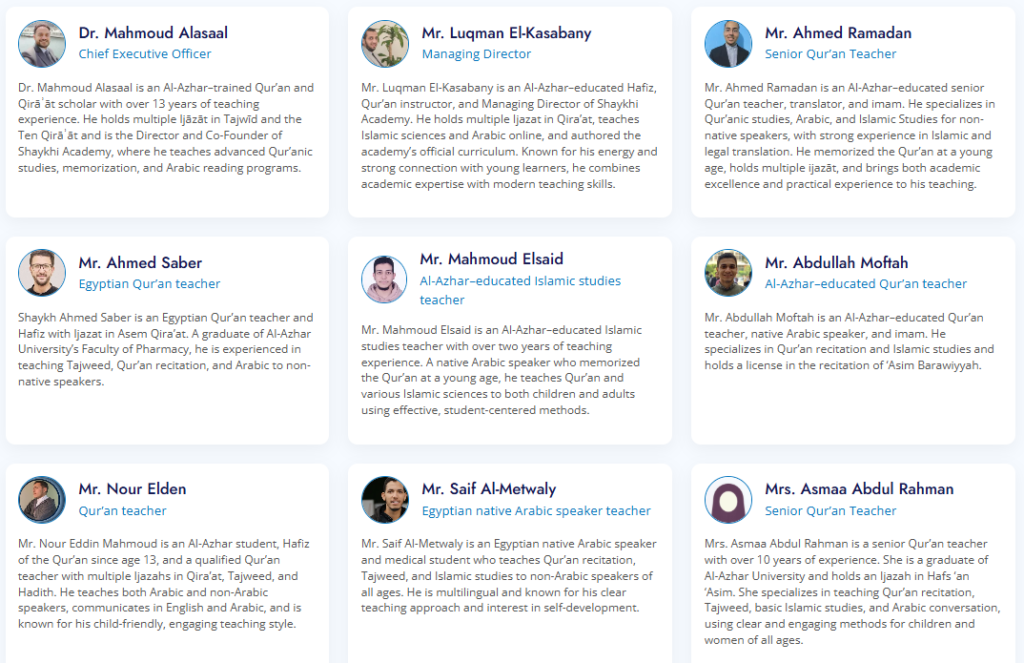
This narration establishes a principle: qualified teachers, not just enthusiastic ones, transmit the Quran properly. When evaluating an online Quran teacher, verify their Ijazah (chain of authorization), teaching experience with non-Arabic speakers specifically, and their ability to identify and correct your particular pronunciation errors.
Key Criteria for Choosing Your Online Quran Instructor
Your teacher should hold a recognized Ijazah in the recitation you are studying (commonly Hafs ‘an Asim). They should demonstrate patience with non-native speakers, maintain structured lesson plans, and provide corrective feedback with specific technical explanations rather than vague encouragement.
Certified Huffaz and Qaris at E Quran School carry verified credentials and bring extensive experience teaching students from Western backgrounds. Their 1-on-1 instruction model means your specific errors receive dedicated attention every session.
Book Your Free Session with One of EQuran School’s Certified Teachers
5. Establish a Daily Quran Learning Schedule That Produces Real Results
Consistency outperforms intensity. A student who practices 20 focused minutes daily progresses faster than one who studies two hours on weekends. The brain consolidates new phonetic patterns and memorized content during sleep cycles, making daily repetition neurologically essential.
A Practical Weekly Schedule for Online Quran Learners
| Day | Focus Area | Duration |
| Saturday | New lesson: letters/Tajweed rules | 30 minutes |
| Sunday | Drill and review previous lesson | 20 minutes |
| Monday | Recitation practice with teacher | 30 minutes |
| Tuesday | Self-review and correction | 20 minutes |
| Wednesday | New Ayat or rule introduction | 30 minutes |
| Thursday | Full week review | 25 minutes |
| Friday | Light recitation, Surah review | 15 minutes |
This schedule builds approximately three to four hours of weekly engagement without overwhelming a working professional or parent. Adjust session length based on your current stage—beginners often need shorter but more frequent sessions.
6. Progress From Reading Fluency to Quran Recitation Mastery
Once Arabic letter recognition and foundational Tajweed are established, the focus shifts to recitation fluency—reading Quranic text smoothly with correct rules applied automatically, not consciously. This transition requires significant repetition of short Surahs before advancing to longer passages.
Our Quran Recitation Classes at E Quran School focus on perfecting this transition phase, combining Tajweed precision with melodious delivery under the guidance of certified Qaris who understand exactly where non-Arabic speakers typically stall.
Book a Free Trial in Our Online Quran Recitation Classes

Short Surahs That Build Recitation Confidence Efficiently
Begin with Juz Amma (the 30th Juz). The shorter Surahs—from Al-Fatiha through An-Nas—appear repeatedly in daily prayers (Salah), meaning every prayer reinforces your learning. Mastering this Juz first creates an immediate, tangible benefit you feel five times daily.
Each Surah in Juz Amma presents distinct Tajweed challenges. Surah Al-Alaq introduces Madd Lazim. Surah Al-Qadr requires careful Idgham. Surah Al-Zilzalah demands precise Qalqalah application. A qualified teacher guides you through each specifically.
7. Understand Quranic Meanings to Deepen Your Connection and Retention
Reciting words you do not understand creates a surface-level relationship with the Quran. Research on memory retention consistently shows that meaningful content is retained significantly longer than abstract sounds. Understanding basic Tafsir of what you recite transforms Quran learning entirely.
How Tafsir Knowledge Strengthens Memorization and Recitation
When you understand that Surah Al-Fatiha is a conversation between you and Allah—confirmed in the hadith of Muslim:
“I have divided prayer between Myself and My servant into two halves” (Sahih Muslim)—every recitation of it transforms from routine to profound.
This meaning-based engagement also reduces memorization time. Students who study brief Tafsir before memorizing a passage demonstrate stronger retention after 30 days compared to those who memorize sounds alone, according to observations from experienced Hifz instructors.
Start Your Quranic Journey Today
Experience our interactive online classes with a dedicated tutor.
Get Your Free Trial8. Begin Quran Memorization Using Proven Hifz Techniques
Hifz (Quran memorization) is a structured discipline with specific methodologies refined over centuries of Islamic scholarship. Randomly reading and re-reading verses is not a Hifz method—it is wishful learning. Effective memorization requires a defined new-lesson system paired with a disciplined review protocol.
The Three-Phase Daily Hifz System Used by Expert Huffaz
Phase 1: New Lesson (Al-Jadeed) Memorize a small, fixed portion daily—typically five to ten Ayat for adults. Repetition count: minimum 20 repetitions before testing yourself without looking.
Phase 2: Recent Review (Al-Qareeb) Review the past seven days’ memorized portions. This combats the rapid decay curve that affects new memorization most aggressively within the first week.
Phase 3: Old Review (Al-Baeed) Cycle through previously memorized Juz systematically. Without this, older sections fade while new sections are added—a common reason students plateau or regress.
Read Also: Dua for Learning Quran
Common Hifz Mistakes That Slow Down Non-Arabic Speakers
| Mistake | Why It Happens | Correct Approach |
| Memorizing too much too fast | Enthusiasm without discipline | Fixed daily limit, strictly maintained |
| Skipping review sessions | Focusing only on new content | Review is non-negotiable—same priority as new lesson |
| Memorizing silently | Quran is an oral tradition | Always memorize aloud, never in silence |
| Not connecting similar Ayat | Confusion between adjacent passages | Mark and drill similar-sounding passages separately |
| Inconsistent daily timing | Variable scheduling | Memorize at the same time each day for habit formation |
At E Quran School, our Quran Memorization (Hifz) Course with certified Huffaz helps students master structured memorization through personalized 1-on-1 sessions tailored to individual learning pace and schedule.
Begin memorizing the Quran today—your first session is free

Read Also: Dua Before Starting Quran Class
9. Use Technology as a Supplement, Not a Substitute for a Teacher
Quran apps, audio recordings, and online resources are valuable supplementary tools. However, they cannot replace a live, qualified teacher who hears your recitation and corrects your specific errors in real time. Technology supports; it does not teach Tajweed.
Use recorded recitations by famous Qaris—Sheikh Mishary Rashid Al-Afasy, Sheikh Abdul Basit Abdul Samad, or Sheikh Mahmoud Khalil Al-Husary—to train your ear and internalize correct pronunciation patterns between teacher-supervised sessions.
Avoid relying solely on auto-generated Tajweed apps for self-assessment. These tools lack the nuance to identify subtle Makhraj errors, improper Ghunnah duration, or incorrect Sifaat application that a qualified human teacher detects immediately.
Read Also: The Best Online Quran Classes for Non-Arabic Speakers
Our Students Reviews
Start Your Quranic Journey Today
Experience our interactive online classes with a dedicated tutor.
Get Your Free TrialRead Also: The Best Online Quran Course
Starting Your Quran Learning Path with Expert Guidance at E Quran School
The best way to learn Quran online is through structured progression, qualified instruction, and daily consistency—exactly what E Quran School is built to provide.
✦ Certified Huffaz and Qaris with extensive international teaching experience
✦ Personalized 1-on-1 sessions tailored to your individual pace and goals
✦ Flexible 24/7 scheduling for students across all time zones
✦ Proprietary Al-Menhaj Book methodology for non-Arabic speaking beginners
✦ Complete curriculum from absolute beginner through advanced Qira’at
E Quran School provides complete curriculum including:
- Quran Memorization (Hifz) Course
- Online Quran Learning with Tajweed Course
- Quran Tafsir Course
- Online Arabic and Quran Classes
- Quran Qirat Learning Course
- Online Quran Recitation Classes
- Noorani Qaida Course
Book a free trial class at E Quran School and experience personalized Quran instruction that adapts to your unique learning needs, Insha’Allah.

Conclusion
The best way to learn Quran online begins with solid Arabic letter recognition, advances through proper Tajweed application, and deepens through Tafsir understanding. Each stage requires a qualified teacher, not just digital resources, to ensure accurate transmission.
Daily consistency—even in short sessions—produces faster results than sporadic intensive study. Combining structured Hifz methodology with regular review cycles ensures memorized content becomes permanent, not temporary.
Whether your goal is foundational reading, Tajweed mastery, Hifz completion, or exploring different Qira’at styles, the path is clear. Qualified guidance, authentic methods, and sincere intention form the foundation of every successful Quran student—Alhamdulillah.











Leave a Reply