 Learn Quran
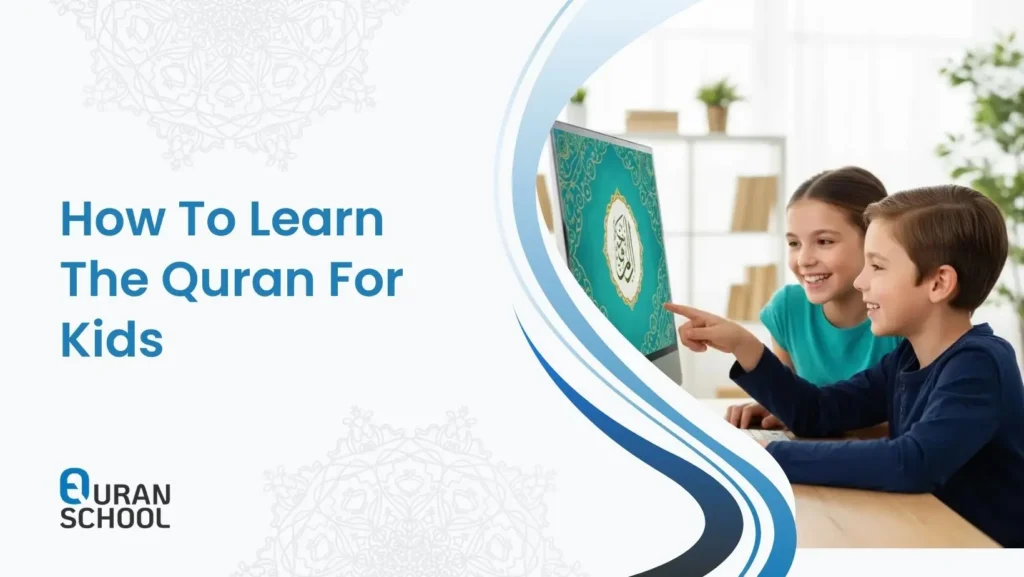
To Learn the Quran for Kids you need to encourage kids to love the Quran by sharing its stories and benefits, making learning enjoyable through rewards and relatable explanations. Simplify Tajweed rules, use interactive methods like role-playing, and follow Prophetic teaching approaches for meaningful Quranic understanding.
Are you interested in how to learn the Quran for kids? Do you want to provide a better experience for your children or students, driven by the sense of responsibility for this vital task?
This guide offers parents and Quran tutors practical steps to help understand how to approach Quran learning for kids. It draws from the teachings of the Quran and Prophetic traditions, ensuring a reliable and authentic method for teaching the Quran and handling children.
The article includes examples of young companions who embodied these successful methods and features a section with tips for teaching Quranic reading to non-native Arabic speakers. It concludes with a set of FAQs commonly raised about the Quranic learning journey for kids. Keep reading for deeper insights!
How To Learn The Quran For Kids?
Learning the Quran for kids is a noble journey that requires patience and consciousness to bear its fruits in this life and the hereafter. Below are practical steps for parents and Quran tutors to help guide kids on an effective Quranic journey:
1. Let the Kids Love the Quran
Love is the first motivation for kids in learning the Quran or any other action. To help kids love their Creator and His Book, the Quran, and achieve the best results, you should:
A. Allah’s Attributes
Let kids understand Allah’s direct influence on their lives by discussing His blessings and relating any favor in their lives to Allah Almighty, emphasizing that parents or benefactors are only means.
B. Quran as a Valuable Message
Explain that our Merciful and All-Knowing Creator sent us a valuable message to ease our temporary life on earth. Encourage kids to reflect on this by treating important messages from loved ones with similar importance.
C. Discover Treasures of the Quran
Highlight the values and benefits gained from the Quran, such as guidance, answers to existential questions, and protection from grief and anxiety.
To maximize the benefit of this method, help kids imagine situations where these meanings are vital, like likening living in this life as being lost in a desert or at sea making it urgent to have such Quranic benefits.
Shots Videos from Our Courses
Start Your Quranic Journey Today
Experience our interactive online classes with a dedicated tutor.
Get Your Free TrialD. Narrate bedtime Quranic Stories
Share Quranic stories, especially those involving animals or young characters, for more effective learning and engagement.
E. Attractive Environment
Create an appealing Quranic learning environment. This is the first and most important step in preparing kids for their Quranic learning journey. Take your time with this step and avoid rushing to seek quantitative results.
2. Reward the Kids for Progress in Learning the Quran
Offer kids valuable presents when they reach agreed-upon Quranic milestones. Make these gifts more meaningful than those for worldly achievements, showing that you value their Quranic progress and religion more. However, avoid making material rewards a condition for continued learning.
3. Explain the Meanings of the Verses to Be Learned
Understanding the meanings of Quranic verses and applying them in personal life is a critical Prophetic method for achieving the best results.
Jundub bin Abdullah narrated that they learned the Quran from the Prophet with a focus on practicality and meanings over words, describing it as “we learned Quranic faith before Quranic words.”
E Quran School’s Quran Tafsir Course provides age-appropriate insights into Quranic meanings, helping children connect with the depth behind what they memorize or recite—building lasting love for the Book of Allah ﷻ.
Join our Quran Tafsir Course and get a free trial

4. Connect the Meanings to the Kids’ Life
To ensure the learning process is consistent and memorable, tutors should relate Quranic messages to tangible objects in kids’ lives. This method, used in the Quran and by the Prophet, helps embed abstract meanings.
For instance, the Quran likens revelation to water as the source of life for hearts and likens the heart to clothing to stress the importance of its purity and cleanliness.
5. Make the Learning Process Simple but Comprehensive
Simplifying Quranic meanings for kids does not mean making them superficial. Prepare the subject of the verse or chapter thoroughly and provide a comprehensive, yet simple, explanation for the kids.
6. Seek Guidance from the Quran Learning Stories for Kids
Explore Quranic situations and stories involving kids, learning from authentic Tafseer books such as as-Sa’di or a refined version of Tafseer Ibn Kathir. Examples include:
- The relationship between Prophet Jacob and his son Joseph and the moral lessons in Surah Yusuf.
- How Prophet Abraham dealt with his son Ishmael as mentioned in Surah As-Saffat.
- The impact of Abrahamic upbringing on Ishmael’s dedication to prayer and family purity, as reflected in Surah Maryam.
7. Learning for Kids Necessitates Education Combined with Evaluation
Teachers must ensure kids understand the material before assessing or punishing them for shortcomings.
8. Observation is Key in Kids’ Learning
Effective teachers are good observers. Parents and Quran tutors should:
- Monitor kids’ behavior.
- Take notes and consider these observations before taking any action.
- Ensure repeated behavior before addressing it.
9. Use the Prophetic Methods in Dealing with Kids
For ideal Quran learning, teachers should follow the Prophet Muhammad’s (PBUH) authentic traditions related to learning, especially those involving young learners. These Prophetic methods include:
A. Encouragement and Ambition Building
Prophet Muhammad (PBUH) encouraged young learners, helping them build their future vision based on their capabilities.
For example, he supplicated for Ibn Abbas—who later became an eminent scholar in Quranic interpretation—saying,
“May Allah grant him deep understanding of religion.” [Al Bukhari & Muslim]
B. Respect and Value of Kids’ Characters and Minds
Prophet Muhammad (PBUH) respected the character of children and valued their ability to understand and reflect. By tracing learning situations involving children, one can easily find his respect for their identity and opinions, fostering a special relationship between teacher and student.
For instance, Prophet Muhammad (PBUH) taught Ibn Abbas, the young learner, important lessons in Islamic faith, enhancing the teachings with a reflective speech on the outcomes of following these instructions:
“O boy! I will instruct you in some matters. Be watchful of Allah (the Commandments of Allah), He will preserve you.” [Hadith Hasan reported by At-Tirmidhi]
C. Dealing with Mistakes with Wisdom
Children’s mistakes require a high level of wisdom to address the problem without seeking revenge or punitive measures. When mistakes were made, Prophet Muhammad (PBUH) would first investigate the motives behind them, considering the context and age of the learner.
D. Providing Fun as a Needed Value
Fun is an essential need for balanced child development. One of the Prophet’s young learners was his wife, Aishah, whom he successfully nurtured into a deep learner and Muslim scholar. The Prophet (PBUH) met her needs for fun as a young lady, prompting her to teach others by saying,
“Estimate the time a young girl eager for amusement.” [Bukhari & Muslim]
Following the Prophet’s example ensures parents and teachers have a reliable role model, leading to a deep positive impact on the Quranic learning journey.
10. Quran Reading Classes for Kids Develop Fluency Through Consistent Guided Practice
Once a child completes Noorani Qaida, Quran Reading Classes begin the actual process of reading from the Mushaf. The focus at this stage is fluency—reading connected text accurately, smoothly, and with correct application of basic Tajweed rules already introduced.
Children begin with shorter Surahs from Juz Amma (the 30th Juz), which are most familiar, shorter in length, and frequently recited in Salah. This immediate practical relevance keeps young learners motivated.
E Quran School’s Quran Reading Classes pair each child with a certified Quran tutor who tracks their reading pace, corrects errors in real time, and adjusts lesson length to match each child’s attention span—a critical advantage for young learners.
Reserve your free trial lesson for Quran Reading Classes

Common Reading Errors Children Make at This Stage
- Skipping Ghunnah on Nun Mushaddad and Mim Mushaddad
- Shortening Madd letters that require elongation
- Merging two adjacent words incorrectly during fluency practice
- Applying incorrect Waqf (stopping) positions between sentences
Identifying these errors early—through expert listening—prevents them from becoming ingrained habits.
Benefits Of Learning the Quran For Kids
Learning the Quran for kids is a lifelong investment with many benefits in their life and the afterlife. Following are a group of benefits of learning the Quran for kids:
- Guidance through life to the correct decisions.
- Protection from grief and anxiety.
- Shaping a correct mindset from an early age.
- Future prospects for the Muslim nation by the correct building of their kids.
- Building a strong will against temptations.
- Rich and secure source for kids’ upbringing.
- Countless rewards and blessings for those teaching the kids whenever these kids recite the verses learned or practice their meanings in life.
Remember, these benefits are reached through the correct way of dealing with the Quran the prophetic way; i.e., concern with both words and meanings with priority for meanings, theoretically and practically, over words. Otherwise, the less you follow the Prophetic way, the less fruits you bear.
Start Your Quranic Journey Today
Experience our interactive online classes with a dedicated tutor.
Get Your Free TrialHow To Learn To Read The Quran For Kids?
Learning to read the Quran for kids is a cornerstone of their journey, as it helps them start with Quran recitation and paves the way for understanding Quranic meanings. Here are some tips to teach kids how to read the Quran effectively:
1. Start with Noorani Qaida
Noorani Qaida is a well-known method for teaching Quranic reading to kids and non-native Arabic speakers. It focuses on teaching the basics of Arabic pronunciation, combined with simple Tajweed rules, illustrated with Quranic examples.
E Quran School’s Noorani Qaida Course offers step-by-step guidance for young beginners who have zero prior Arabic knowledge, ensuring every child builds a proper phonetic foundation before advancing to Quran reading. Sessions are 1-on-1, so no child gets left behind.
Join our Noorani Qaida Course and get a free trial

2. Prioritize Sounds Over Letters
At the beginning, it is crucial to teach kids the sounds of the letters, not just their names.
For example, teaching the sounds (أَ – إِ – أُ), i.e., /a/, /i/, and /u/, is more effective than focusing on the letter name /alif/. Delaying the introduction of letter names helps prevent confusion in pronunciation.
3. Learn the Shapes of Letters and Connection Rules
Arabic script is written in a connected form, unlike English and other Latin languages. The same letter can appear in different shapes depending on its position in a word. While most Arabic letters connect before and after, six letters only connect prior: (د – ذ – أ – و – ر – ز).
4. Simplify Basic Tajweed Rules
Introduce kids to Tajweed by teaching basic rules using Uthmani script for laam, meem, noon sakinah and tanween, madd, and qalqalah. Avoid theoretical Tajweed in the early stages to keep it simple and engaging.
Working with certified Qaris at E Quran School through the Online Quran Learning with Tajweed Course provides the individualized attention needed to master each rule correctly, with flexible scheduling available 24/7 to accommodate families across all time zones.
Start learn Quran with Tajweed with your first free class

5. Use Audio Recordings and Practice:
Play recordings of authentic reciters, such as Al-Husary, to help kids imitate the recitation. Let them record their recitation and review it together to create an engaging learning experience.
By seeking guidance from experienced Tajweed tutors and beginner-friendly books, simplifying Tajweed rules, and incorporating audio recordings, learning to read the Quran can be made more effective.
Start Your Quranic Journey Today
Experience our interactive online classes with a dedicated tutor.
Get Your Free TrialLearning Quran For Kids: FAQs
Below is a group of questions commonly asked by those interested in learning the Quran for kids. These are useful for Quran tutors and parents to consider:
How To Keep Kids Learning Curve Positive Easily?
To keep kids’ learning curve positive in Quran learning or any other learning experience, Quran tutors and parents are advised to understand the fundamental motives of human behavior and the proportion of each for children to address the core matter effectively.
- Love: Love is the main motivation for children in learning or any behavior, accounting for 80% compared to other motives.
- Reward: The desire for reward is an essential motivation, contributing 15% to children’s willingness to learn.
- Fear: Fear motivates only 5% of children’s actions as a response to the possibility of punishment. Although it is the least influential motivator, it should be considered as part of a balanced approach, without being completely disregarded. The Quran contains warnings and descriptions of punishments in a balanced way, designed by the All-Knowing to address human nature.
It is important to consider these motivational factors when encouraging children to learn the Quran, rather than letting personal preferences negatively impact the learning environment.
Can Young Kids Learn The Quran?
Yes, young kids can learn the Quran as soon as they are capable of basic learning and understanding. However, the process should be gradual:
- Introduce general information about the Quran’s message, the One who revealed it, and its benefits.
- Use Quranic stories to prepare children for learning the lessons within the Quran.
- Teach the meaning, significance, and practical application of basic chapters, focusing on their importance in Islamic practice and character development as an introductory phase before moving on to the rest of the chapters.
What Is The Suitable Age For Learning The Quran For Kids?
The suitable age for learning the Quran for kids is 6-7 years old, as this is when their cognitive abilities are developed enough for structured learning, known in Islamic teachings as the age of discernment (tamyeez). Supporting this age, Almighty God instructs Muslims to teach children prayer—the most essential act of worship after the shahadah—starting at age seven, aligning with the completion of six years and the beginning of the seventh.
It is worth noting that Islamic guidance caters to common cases, but exceptions can be made for children with exceptional learning or memorization abilities.
Read Also: The Best Online Quran Course
Do Children Memorize The Quran Before Learning To Read?
Memorization is a means of embedding meanings in the heart. It is acceptable for children to memorize portions of the Quran before learning to read, taking advantage of their prime learning years, as long as the quantities are suitable for their abilities and are accompanied by simple explanations and practical practice. However, burdening children with large portions beyond their capability can impede their basic need for free time and fun, potentially leading to resentment toward the Quran.
Read Also: The Best Academy to Learn Quran Online from Home
How Long Does It Take To Learn The Quran For Kids?
There is no specific timeframe for children to learn the Quran, as it depends on several factors such as individual skills, prior background, and level of commitment. Quality should be prioritized over quantity. By studying the companions’ approach to learning the Quran, it is evident that they took considerable time to learn it due to their focus on deep understanding and practice.
For instance, Ibn Abbas, a dedicated and talented young learner, said,
“Allah’s Apostle died when I was a boy of ten years, and I had learned the Muhkam (the clear verses of the Qur’an),”
referring to the Mufassal portion from Surah an-Nas to Surah Qaaf, which encompasses about four ajzaa of the Quran. This demonstrates the companions’ commitment to comprehensive learning and practice.
Our Students Reviews
Start Your Quranic Journey Today
Experience our interactive online classes with a dedicated tutor.
Get Your Free TrialRead Also: Word by Word Quran Reading and Recitation Teachers And Tutors
Beginning Your Child’s Quran Education with Expert Guidance at E Quran School
Every child deserves structured, expert-led Quranic education—not scattered lessons or inconsistent instruction. The right foundation, built early, creates a relationship with the Quran that lasts a lifetime.
E Quran School offers your child:
- Certified Huffaz and Qaris with years of experience teaching non-Arabic speaking children
- Personalized 1-on-1 instruction tailored to each child’s pace, age, and learning style
- Flexible 24/7 scheduling for families across every time zone
- Comprehensive curriculum from Noorani Qaida through advanced Hifz and Tajweed
- Proprietary Al-Menhaj methodology for structured, proven learning progression
Book your child’s Book a free trial class at E Quran School today and give them the gift of the Quran—guided by experts who truly care. Insha’Allah, this first step will be the beginning of a lifelong bond with Allah’s Book.
E Quran School provides complete curriculum including:
- Quran Memorization (Hifz) Course
- Online Quran Learning with Tajweed Course
- Quran Tafsir Course
- Online Arabic and Quran Classes
- Quran Qirat Learning Course
- Online Quran Recitation Classes
Conclusion
To conclude, learning the Quran for kids is a significant duty placed upon parents and Quran tutors. They must bear this responsibility, knowing that they will be accountable for it before Allah Almighty, and understand that their performance is crucial in protecting the young generation from deviation and misguidance, as they are the role models whose actions speak louder than words.
Once you choose this noble path, you must rise to the level of responsibility and take it seriously. Seek the support of Allah Almighty, learn, and consult experienced individuals to stay on the right track!









Leave a Reply